
All Topics
- Alchemizing Music Concepts for Students
- Anuv Jain Songs
- Artist Spotlight
- artium gift card
- Artium Maestros
- Artium News
- Artium Tech Blog
- Best Coke Studio Songs
- Best Female Singers
- Birthday songs
- Bollywood Love Songs
- buying guide
- Carnatic Music
- Child Singers
- Devotional Music
- Editorials by Ananth Vaidyanathan
- English Love Songs
- Festival
- Film Music
- Ghazal Music
- Guitar
- Hindustani Classical Music
- Indian Classical Music
- Indian Folk Music
- Insights
- Instagram Reels Viral Songs
- Instruments
- Karaoke
- Karaoke Singing
- Keyboard
- Kids Music
- maestros
- Music Education
- Music for Kids
- Music Games
- Music Industry
- Music Instruments
- Music Legends
- Music Press Release
- Music Technology
- Music Theory
- Music Therapy
- Music Tools
- Piano
- piano guide
- Songs
- South Devotional Music
- Success Stories
- Tamil Film Music
- Telugu Film Music
- Time Theory
- Tools
- Uncategorized
- Uncategorized
- Uncategorized
- Uncategorized
- Vocal Singing
- Vocals
- western classical music
- western music
- Western vocal music
What is Kriti in Carnatic Music?
What is Kriti in Carnatic Music?
Table of Contents
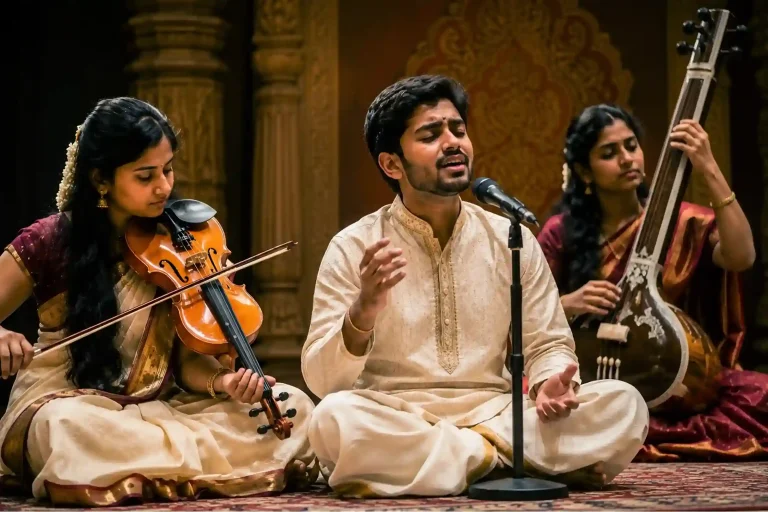
Krithis in Carnatic music form the heart of the tradition, serving as beautifully structured compositions that combine raga, tala, sahityam (lyrics), and bhava (emotion). When students begin exploring a List of Kritis in Carnatic Music, they discover that each Kriti is a unique blend of melodic grammar and devotional poetry. These compositions are not just songs they are rich musical frameworks that help learners understand raga identity, rhythmic precision and expressive ornamentation.
Kriti in Carnatic music for students who would want to understand it better, Kritis offer an ideal entry point because the notation reveals how gamakas, phrase structures and rhythmic groupings are woven together by the composer. Through regular practice, the written notes gradually transform into living music, enabling learners to internalize the nuances of Carnatic melody.
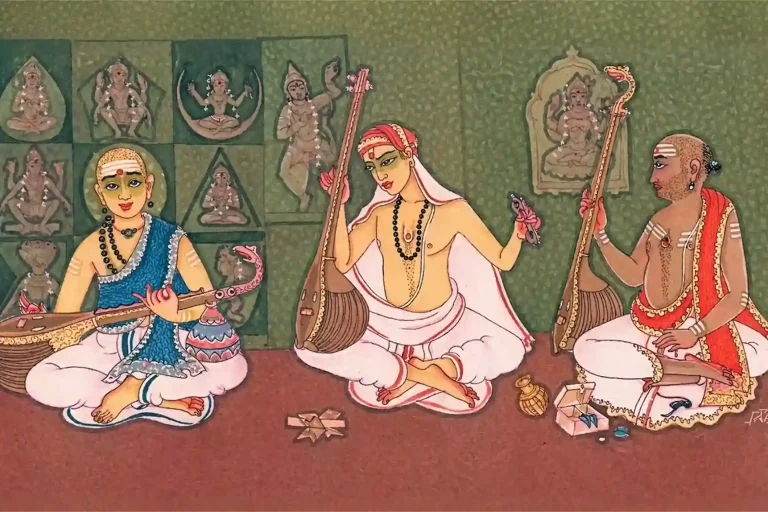
Across the centuries, certain Carnatic Music Krithis have become iconic for their lyrical depth, philosophical beauty and musical craftsmanship. Among these, the works of the Trinity – Tyagaraja, Muthuswami Dikshitar, and Syama Sastri, stand at the pinnacle. The Popular Thyagaraja Krithis, such as Endaro Mahanubhavulu, Nagumomu, Brochevarevarura and Nidhi Chala Sukhama, are celebrated for their emotional appeal, clear raga portrayal and devotional expression.
Introduction to Krithis in Carnatic Music
A Kriti is far more than a song; it is a crafted musical statement that fuses melody, rhythm and poetry into a vehicle for devotion, feeling and musical exploration. In Carnatic tradition, a Kriti is typically composed to fit a particular raga (a melodic framework) and a specific tala (rhythmic cycle).
The composer chooses the raga’s characteristic phrases and ornamentation (gamakas) and sets words often in Sanskrit, Telugu, Tamil or Kannada that carry a devotional, philosophical or descriptive message.
A Kriti in Carnatic music is not just a song it’s a beautiful combination of:
- Raga
- Rhythm
- Devotion
- Emotion
- Musical grammar
Kritis form the heart of Carnatic music, both as a learning foundation and as the highlight of concerts. They connect the artist, the audience, and the divine in a powerful musical experience. Learning and singing Kritis helps students build strong musical grounding while enjoying the rich cultural heritage of Indian classical music.
Musical Importance and Legacy of Krithis
When you listen to a Kriti, you are hearing an architecture: the opening line announces the musical idea, the middle elaborates and often climbs in intensity, and the concluding section ties together the ideas and offers a place for ornamented expression. Because Kritis are compact yet layered, they act as both repertoire for performance and a living textbook of raga grammar; students learn how a raga behaves by studying canonical Kritis written in that raga.
In contrast, the Muthuswami Dikshitar Kritis, including masterpieces like Vatapi Ganapatim, Sri Subrahmanyaya Namaste and Anandamritakarshini, are admired for their scholarly structure, complex sahityam and meditative depth. Each of these composers offered a distinct musical signature, enriching the Carnatic repertoire with compositions that continue to guide students and enchant audiences.
Thus, Krithis are both the foundation and the finest expression of Carnatic classical music. They invite learners into a world where devotion meets technical mastery, and where the beauty of each raga is revealed through the timeless genius of the composers.
The deeply expressive Syama Sastri Kritis stand out in Carnatic music for their emotional depth, rich devotional appeal and masterful rhythmic complexity. His compositions, often dedicated to Goddess Kamakshi, combine heartfelt bhava with intricate tala structures like Misra Chapu and Khanda Chapu. These Kritis challenge and inspire students with their nuanced phrasing and powerful lyrical intensity, adding a unique spiritual and musical richness to the Carnatic repertoire.
What is the Structure of Kritis in Carnatic Music?
Pallavi & Anupallavi – Foundation and Expansion
The structure of a kriti in Carnatic music is deceptively simple at first glance, yet it holds remarkable depth, musical logic and expressive potential. Each segment Pallavi, Anupallavi and Charanam plays a distinct role in shaping the emotional and melodic journey of the composition.
The Pallavi is the thematic heart or seed of the composition. Though usually short, it is crafted with precision so that it instantly conveys the raga’s essence and the emotional intention of the composer. A well-designed Pallavi becomes the anchor of the entire piece, offering a memorable melodic motif that listeners can immediately connect with.
In performance, singers often return to this opening line during improvisational passages. Because the Pallavi establishes both mood and melodic framework, it provides a stable foundation upon which the elaborate improvisational elements of kriti in Carnatic music such as neraval and swara singing are built.
Following the Pallavi, the Anupallavi deepens the musical narrative. This section often rises to a slightly higher pitch range, symbolically and musically uplifting the mood of the Kriti. It introduces fresh lyrical content, adds emotional contrast and expands the raga’s melodic territory.
By offering new phrase patterns and expanded melodic pathways, the Anupallavi prepares the singer and listener for the more elaborate developments that occur in the Charanam. It serves as a bridge, enhancing the structural flow of the composition and enriching its expressive texture.
Charanam – Culmination and Creative Expression
The Charanam is the most comprehensive and musically intricate part of the Kriti. It completes the story lyrical, emotional, musical, and often contains the composer’s mudra, subtly embedding their identity within the composition. The Charanam usually holds the longest lines, which gives singers a wide canvas for creativity.
Its structure supports sustained gamakas, longer breaths, flowing musical sentences and expressive interpretation. Additionally, the Charanam is the ideal space for neraval, where a chosen line is elaborated melodically within the bound framework of the raga and tala.
It also serves as the foundation for kalpana swaras, where performers create spontaneous yet raga-appropriate swara passages. Some Carnatic Music Krithis even include multiple Charanams, each offering varied emotional shades and musical opportunities.
In this way, the Pallavi, Anupallavi and Charanam together transform a Kriti into a complete musical journey structured yet deeply expressive, disciplined yet full of creative possibility.
How to Sing a Carnatic Kriti with Perfection?
Singing a Kriti “with perfection” goes far beyond simply hitting the correct notes or executing the rhythm accurately. It requires a sensitive blend of technical skill, emotional connection and deep cultural understanding. A Kriti in Carnatic music is a living form, rooted in centuries of tradition so performing it authentically means honoring both its musical architecture and its devotional spirit.
The first major foundation is raga knowledge. A singer must internalize the arohana and avarohana, identify the exact gamakas that define the raga, and become fluent in its characteristic sancharas (phrases). This familiarity creates a musical palette from which expressive colors can be chosen. Mastery over shruti is equally essential; every phrase, oscillation and glide must stay aligned with the pitch centre so the identity of the raga remains intact throughout the performance.
Equally important is tala discipline. Even though a singer may stretch, compress or embellish phrases for emotional effect, the tala cycle must remain unbroken. This unwavering rhythmic awareness is what allows performers the freedom to improvise within the boundaries of the composition. When the tala is internalized, the singer gains the confidence to explore the Kriti creatively while maintaining structural integrity.
The Heart of Expression in a Kriti: Sahityam and Gamakas
The sahityam (lyrics) is the emotional core of any Kriti. Pronunciation must be clean, syllables must be divided correctly and the meaning, literal and philosophical, must be understood deeply. Only then can the singer convey the true bhava intended by the composer.
Expressive singing depends on this understanding; the placement of emphasis, variation in volume and subtle changes in tone all emerge naturally when the meaning of the text is absorbed.
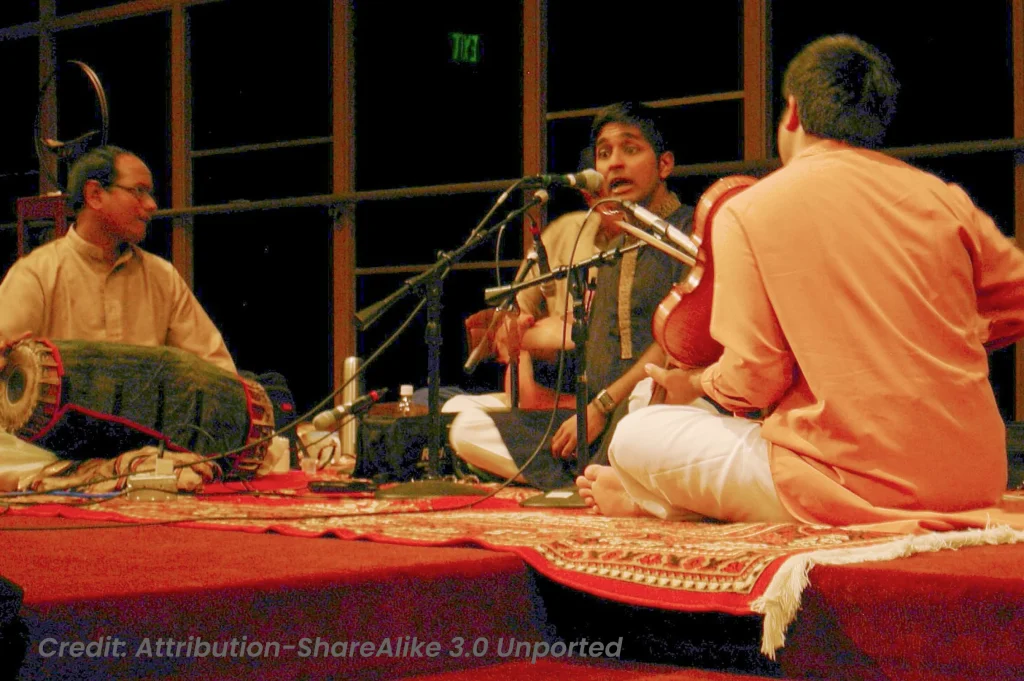
A key feature of Carnatic performance is gamakas, which are not ornamental extras but the very grammar that shapes melody. Learning the precise oscillations and movements unique to each raga transforms a simple tune into a richly expressive composition. Developing these techniques requires slow, mindful practice followed by gradual refinement. True artistic excellence emerges when technique becomes a transparent vehicle for emotion rather than the focus of the performance.
To master a Kriti, a learner should pay attention to:
- Internalizing the raga’s identity through steady shruti, characteristic phrases and correct gamakas.
- Maintaining tala fluency, ensuring rhythmic stability even during expressive expansions.
- Understanding sahityam deeply to achieve authentic emotional expression.
- Practicing with gradual progression, starting slow and increasing complexity with confidence.
When these elements harmonize, singing a Kriti becomes a profound experience, one where the performer not only presents a composition but brings its soul to life.
What is the Significance of Kritis in Carnatic Music?
Kritis hold an irreplaceable place in the world of Carnatic music because they seamlessly blend musical beauty, devotional essence and technical depth. They function not only as compositions to be sung, but also as spiritual messages, instructional guides and creative platforms for performers. Historically, the great composers, especially the Trinity of Tyagaraja, Muthuswami Dikshitar and Syama Sastri, infused each Kriti with intricate raga structures, heartfelt bhava and deep philosophical meaning.
By doing so, they created masterpieces that are musically rich and spiritually transformative. Every Kriti becomes a window into the composer’s interpretation of a raga, making it a timeless reference for generations of learners.
At the concert stage, a Kriti in Carnatic music provides a delicate balance between structure and freedom. The composed lines offer a dependable framework to which the vocalist and instrumentalists can return throughout the performance. Yet, within that framework, there is enormous scope for creativity, whether through alapana (raga elaboration), neraval (melodic development of a specific line) or kalpana swaras (improvised swara patterns).
This dynamic interaction between stability and improvisation gives Carnatic concerts their unique charm, allowing each performance of the same Kriti to feel both familiar and refreshingly new.
Cultural, Spiritual and Musical Depth of Kritis in Carnatic Music
Beyond music, Kritis carry immense cultural and emotional weight. Their lyrics reflect centuries of devotion, mythology, philosophy and regional languages. Singing them keeps ancient spiritual traditions alive, connecting modern performers and listeners to the cultural and devotional heritage of South India.

In this sense, a Kriti is not merely a musical form, it is a vessel of memory, history and spiritual expression.
To understand their significance clearly, consider how Kritis function:
- Musically: They teach raga grammar and showcase melodic identity.
- Spiritually: They express devotion, surrender and philosophical introspection.
- Culturally: They preserve language, tradition and stories of deities.
- Creatively: They serve as anchors for improvisation, allowing the artist to explore and innovate.
In essence, Kritis are a complete musical universe blending technical mastery, emotional resonance and cultural depth in a way few other musical forms can achieve.
Also Read,
Role of Gamakam and Vocal Ornamentation In Carnatic Music
How to Learn Kritis in Carnatic Music?
Learning a Kriti is a gradual and immersive process that unfolds layer by layer. The first step is absorbing the melodic framework of the composition. This begins with learning the raga’s characteristic phrases and practicing the Pallavi, Anupallavi and Charanam slowly until the notes, gamakas and transitions feel natural.
Equal focus must be given to the tala, because maintaining rhythmic integrity from the very beginning ensures smooth progression later. In this way, the foundation of a Kriti in Carnatic music becomes strong and reliable.
Understanding the sahityam (lyrics) adds emotional depth. When a student grasps both the literal meaning and the deeper sentiment behind the words, their phrasing automatically becomes more expressive. This is why teachers often encourage learners to study the translation and listen to seasoned musicians.
Effective Learning and Practice of Kritis
By hearing multiple renditions of the same Kriti, students gain insight into permissible improvisations, typical gamaka patterns and interpretive choices, while still respecting the raga’s grammar.
To learn a Kriti effectively, students should focus on:
- Internalizing raga structure through slow, steady practice.
- Maintaining tala accuracy, ensuring rhythmic discipline.
- Understanding sahityam deeply for emotional expression.
- Listening to expert renditions to absorb stylistic nuances.
- Practicing gradually, linking sections only after mastering each one.
Example: “Vatapi Ganapatim” in raga Hamsadhwani is a popular beginner-friendly Kriti that helps learners understand raga identity, tala discipline and basic gamakas precisely and clearly.
Link: Vathapi Ganapathim by MS Subbulakshmi
Effective practice is essential. Breaking the Kriti into manageable sections helps internalize each musical idea. Singing slowly, using a shruti support, and gradually increasing tempo develops confidence and precision. Once the composition becomes stable, the student can incorporate basic improvisational elements such as gentle neraval or simple kalpana swaras. Guidance from a trained guru is invaluable here, as they refine subtle details, correct gamakas and help shape the musical personality of the learner.
Cultivating bhava (emotion) is the final and most beautiful layer. Spending time contemplating the meaning of the lyrics, practicing mindfully and performing with awareness transforms the Kriti from a memorized piece into a heartfelt musical experience.
Learning Kritis in Carnatic Music Through Guided Learning
Kritis form the soul of Carnatic music, offering a perfect blend of melodic beauty, lyrical depth and devotional expression. Mastering them requires understanding raga nuances, tala discipline and expressive interpretation, all of which become easier with structured learning and expert guidance.
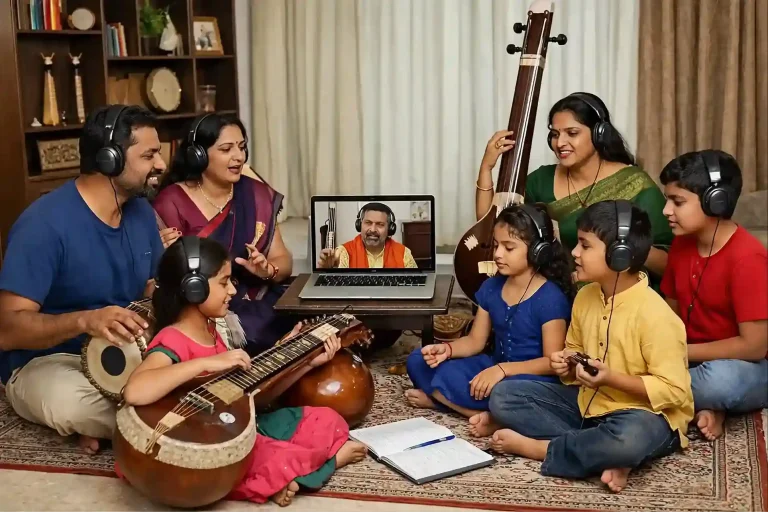
Artium Academy offers music classes for all ages where anyone can learn Carnatic music through a well-designed online curriculum that gently progresses from foundational concepts to more complex compositions. In Artium’s one-on-one classes, Kritis are taught in detail in the online carnatic music lessons at the intermediate level, where learners receive personal attention and guidance from trained Carnatic experts.
Also check,
Online Carnatic Music Tools
So don’t wait; start your journey today. Book A Free Trial and unlock the timeless beauty of Carnatic music.

FAQs
Kritis in Carnatic music are structured classical compositions that combine raga, tala and lyrical expression to convey devotion and musical depth. They are central to the Carnatic repertoire and typically consist of three parts—Pallavi, Anupallavi and Charanam. A kriti in Carnatic music showcases raga identity through melody and gamakas while expressing emotion through sahityam. Kritis also serve as the core pieces performed in concerts, enabling both composed and improvised musical expression for learners and artists.
A kriti is a classical musical composition in Carnatic music that blends melody, rhythm and devotional or philosophical lyrics. The word “kriti” means “creation” or “composition,” reflecting its structured and crafted nature. A kriti is designed to highlight the beauty of a raga while maintaining rhythmic discipline through a tala. Unlike simpler forms like Geetam, a kriti is musically richer, allowing space for expressive singing, improvisation and deeper emotional interpretation by performers.
A kriti is a structured, mature classical composition featuring Pallavi, Anupallavi and Charanam, emphasizing raga portrayal and expressive depth. A Keerthana, while similar, is usually simpler in structure and repetition, often focusing more on devotion than musical complexity. Both are foundational forms in Carnatic music, but a kriti in Carnatic music allows more improvisation and detailed raga exploration, whereas a Keerthana is typically lighter, making it suitable for beginners or devotional singing.
The Pancharatna Kritis are five masterpieces composed by Saint Tyagaraja in praise of Lord Rama. They are set in Ghana ragas and represent the highest musical and lyrical excellence in Carnatic music. The five Kritis are:
Jagadanandakaraka – Nattai
Dudukugala – Gowla
Sadhinchene – Arabhi
Kanakana Ruchira – Varali
Endaro Mahanubhavulu – Sri
These compositions are traditionally performed as a group during Tyagaraja Aradhana celebrations.
Beginners usually start with Kritis that are melodically clear, moderately paced and easy to internalize. Popular early-level choices include Vatapi Ganapatim (Hamsadhwani), Ninnukori (Mohanam), Gananayakam (Rudrapriya) and Rara Venu Gopabala (Bilahari). These pieces help learners understand basic gamakas, enhance raga awareness and gain confidence in tala. Each of these Kritis introduces foundational concepts, making them ideal stepping stones before progressing to more advanced Carnatic compositions.