
All Topics
- Alchemizing Music Concepts for Students
- Anuv Jain Songs
- Artist Spotlight
- artium gift card
- Artium Maestros
- Artium News
- Artium Tech Blog
- Best Coke Studio Songs
- Best Female Singers
- Bollywood Love Songs
- buying guide
- Carnatic Music
- Devotional Music
- Editorials by Ananth Vaidyanathan
- English Love Songs
- Festival
- Film Music
- Ghazal Music
- Guitar
- Hindustani Classical Music
- Indian Classical Music
- Indian Folk Music
- Insights
- Instagram Reels Viral Songs
- Instruments
- Karaoke
- Karaoke Singing
- Keyboard
- Kids Music
- maestros
- Music Education
- Music for Kids
- Music Games
- Music Industry
- Music Instruments
- Music Legends
- Music Press Release
- Music Technology
- Music Theory
- Music Therapy
- Piano
- piano guide
- Songs
- South Devotional Music
- Success Stories
- Tamil Film Music
- Telugu Film Music
- Time Theory
- Tools
- Uncategorized
- Uncategorized
- Uncategorized
- Uncategorized
- Vocal Singing
- Vocals
- western classical music
- western music
- Western vocal music
Ragas and the Brain: The Neuroscience of Hindustani Classical Music
Ragas and the Brain: The Neuroscience of Hindustani Classical Music
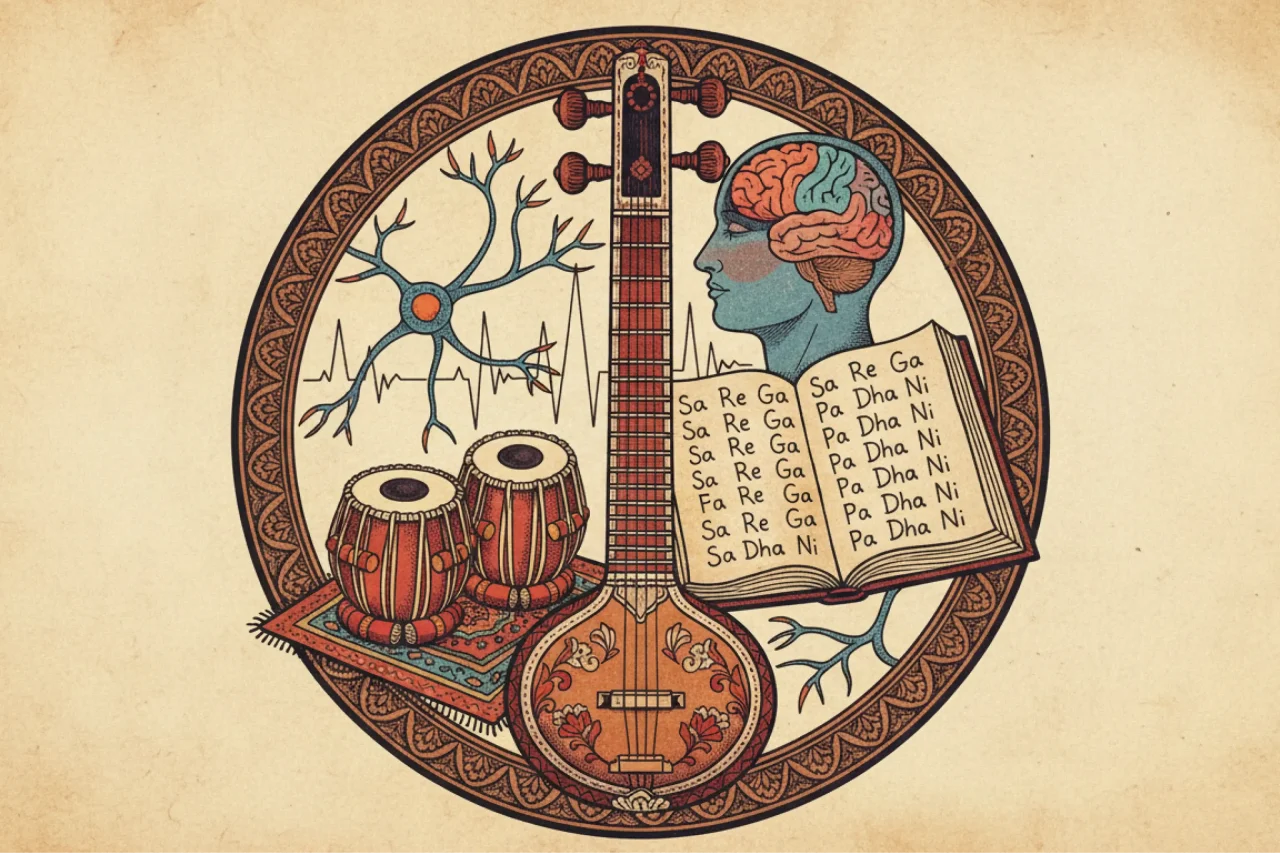
Table of Contents
“Music expresses that which cannot be said and on which it is impossible to be silent.” By Victor Hugo
Hindustani classical music is often described as an intricate conversation between the musician and the raga, a living, cyclical structure inviting deep exploration, spontaneous creativity, and emotional resonance. Rather than being confined to spiritual metaphors or centuries-old tradition, ragas also interact with the human brain in quantifiable, measurable ways. This blog delves into how ragas influence perception, emotion, attention, memory, and even physiological states, revealing why understanding these dynamics can make both listening and performing a richer, more conscious experience.
Recent scientific studies lend credibility to the idea that ragas are far more than aesthetic constructs. They are sophisticated sound patterns capable of provoking diverse neurological responses. Each raga, characterized by its unique combination of swaras (notes), time cycles, and melodic movement, can evoke and regulate a spectrum of emotions from tranquility and bliss to yearning and introspection. Researchers have found that certain ragas can lower stress hormones, enhance concentration, and even influence heart rate and breathing patterns, establishing them as potent resources for mental and emotional well-being.
This impact is not just a passive experience for listeners. Musicians themselves, especially when improvising within the framework of a raga, enter heightened states of creative flow and intense emotional engagement. These moments are mirrored by notable shifts in brainwave activity, underscoring the transformative creative process at play. With online music classes now making this ancient tradition more accessible than ever, understanding the cognitive and physiological roots of ragas allows both students and connoisseurs to discover the full, scientifically validated potential of Hindustani classical music.
What is a Raga and Why Does it Matter to the Brain?
A raga is not just a scale. It’s a framework: a specific set of pitches (swaras), characteristic phrases (pakad), permissible ornamentations (gamak, meend, kan), typical melodic movements (aroha/avaroh), and an aesthetic mood (rasa). Many ragas are also tied to times of day or seasons, which adds a ritualized temporal context.
From a neuroscience angle, these features matter because the brain doesn’t process sound as raw frequency alone. It parses patterns, expects sequences, and assigns emotional valence based on learned associations and innate processing biases. Ragas provide structured, repeated patterns that the brain can lock onto, and that structure is precisely what opens windows into attention, prediction, and emotion.
Understanding Prediction, Expectation, and Pleasure
One of the brain’s most powerful functions is prediction. The auditory system constantly anticipates what will come next based on past input. When those expectations are met, we feel comfort; when they’re artfully violated and resolved, we feel surprise, tension, and release.
Hindustani music excels at this game. A raga establishes norms, which phrases are typical, where a melodic tension might build, which microtonal inflections are familiar, and the performer uses improvisation to stretch those norms. That tension release cycle engages reward systems in the brain (dopaminergic pathways in midbrain regions, projecting to the striatum and prefrontal areas), producing pleasure and the urge to listen for more. In short, the carefully constrained unpredictability in raga improvisation is neurologically satisfying.
Microtonality and Fine-Grained Pitch Perception
Ragas often use microtonal inflections, subtle deviations from Western equal temperament. These microtones (shruti variations, delicate bends, and slides) require fine auditory discrimination. The auditory cortex, including Heschl’s gyrus and surrounding regions, adapts to these distinctions: experienced listeners and performers show heightened sensitivity to tiny pitch differences.
This isn’t just academic. Musicians who train in Hindustani tradition develop enhanced pitch discrimination, and studies in other musical traditions show that this kind of training changes the brain’s auditory maps, a form of use-dependent plasticity. For listeners, those microtonal choices carry emotion: a delicate kan (grace note) or a slow meend (glide) can turn an ordinary phrase into something that feels yearning, devotional, or mischievous.
You can check out these videos and understand the theory of Hindustani Classical Music-
Hindustani Classical Music Complete Playlist:
https://www.youtube.com/playlist?list=PLAlGxvPcB0govGElpIJzvbzxR972o0n6E

Rhythm, entrainment, and the body- The tala system in Hindustani music, cyclical rhythmic frameworks like teental or jhaptaal, does more than keep time. Rhythmic patterns entrain brain activity and bodily rhythms. Neural oscillations (brain waves) can synchronize with external beats, a phenomenon called neural entrainment, and this synchronization enhances attention and sensorimotor coordination.
Beyond the brain, heartbeat and breathing often follow the rhythm we listen to. Slow, meditative laya (tempo) can lower heart rate and induce relaxation, whereas faster rhythmic interplay increases arousal and motor readiness. This is why a soulful alap in a late-night raga can feel calming, while a brisk jhala or rhythmic tihai can leave you energized and alert. The neural circuits linking the auditory cortex, motor cortex, and basal ganglia are central to this audio-motor coupling.
Emotion, memory, and the limbic system- Ragas are strongly tied to rasa, emotional flavors like karuna (pathos), shringara (love/beauty), or vira (heroism). Neuroscience gives us a way to think about why certain ragas consistently evoke certain feelings. Emotional response to music involves the limbic system (amygdala, hippocampus), the orbitofrontal cortex, and the anterior cingulate, regions that process salience, reward, and emotional regulation.
Memory plays a role, too. If you’ve grown up hearing a raga associated with a festival, a dawn, or a family ritual, your hippocampus links that melodic pattern to episodic memories, amplifying the emotional response. Even for new listeners, contour, tempo, and timbre create emotional impressions: a descending minor-like phrase can sound “sad” or introspective across cultures because human vocal and prosodic cues commonly map onto emotional states.
Significance of Attention, Mindfulness and the Neural Default Mode
Listening closely to a raga, following its micro-phrases, bends, and subtleties, is an attention-demanding task. This focused listening suppresses activity in the brain’s default mode network (DMN), a set of regions active during mind-wandering. That suppression can produce a meditative state: sustained attention to musical detail both calms and sharpens the mind.
For performers, the phenomenon is deeper. Entering a long improvisation often means achieving a flow state where self-monitoring drops and performance becomes fluid. Neuroimaging studies of flow show increased activity in attentional networks and decreased activity in self-referential DMN regions. The cyclical and evolving nature of raga improvisation is fertile ground for these flow states.
Learning, neuroplasticity, and cognitive benefits – Long-term engagement with Hindustani music, whether as performer or attentive listener, changes the brain. Musicians display greater cortical thickness in auditory areas, enhanced connectivity between motor and auditory regions, and improved executive control. Practicing ragas involves fine motor control (for instrumentalists), auditory discrimination, memory for long melodic arcs, and real-time improvisation decisions, all of which train different cognitive functions.
Educationally, exposure to raga practice can improve children’s working memory and auditory attention. It also strengthens pattern recognition skills: when you internalize the grammar of a raga, you become better at predicting and generating musical structures, a transferable cognitive skill that supports language processing and complex sequential thinking.
Time-of-day effects and cultural entertainment- Many ragas are traditionally associated with particular times of day or seasons, Bhairav in the early morning, Yaman at dusk, Desh during the monsoon. While some of these associations are cultural, there’s an intriguing physiological angle: circadian rhythms influence hormonal states, arousal levels, and sensory thresholds. Over generations, cultural practices might have aligned certain musical moods with times when listeners are physiologically predisposed to receive them.
From a neuroscience standpoint, listening to a raga at its traditional time may prime both expectation and mood through learned associations. That doesn’t mean a raga won’t move you at an “incorrect” hour, but the layered history of association enriches the experience for community members who share that cultural clock.
Practical Listening: How To Train Your Brain To Hear Ragas?
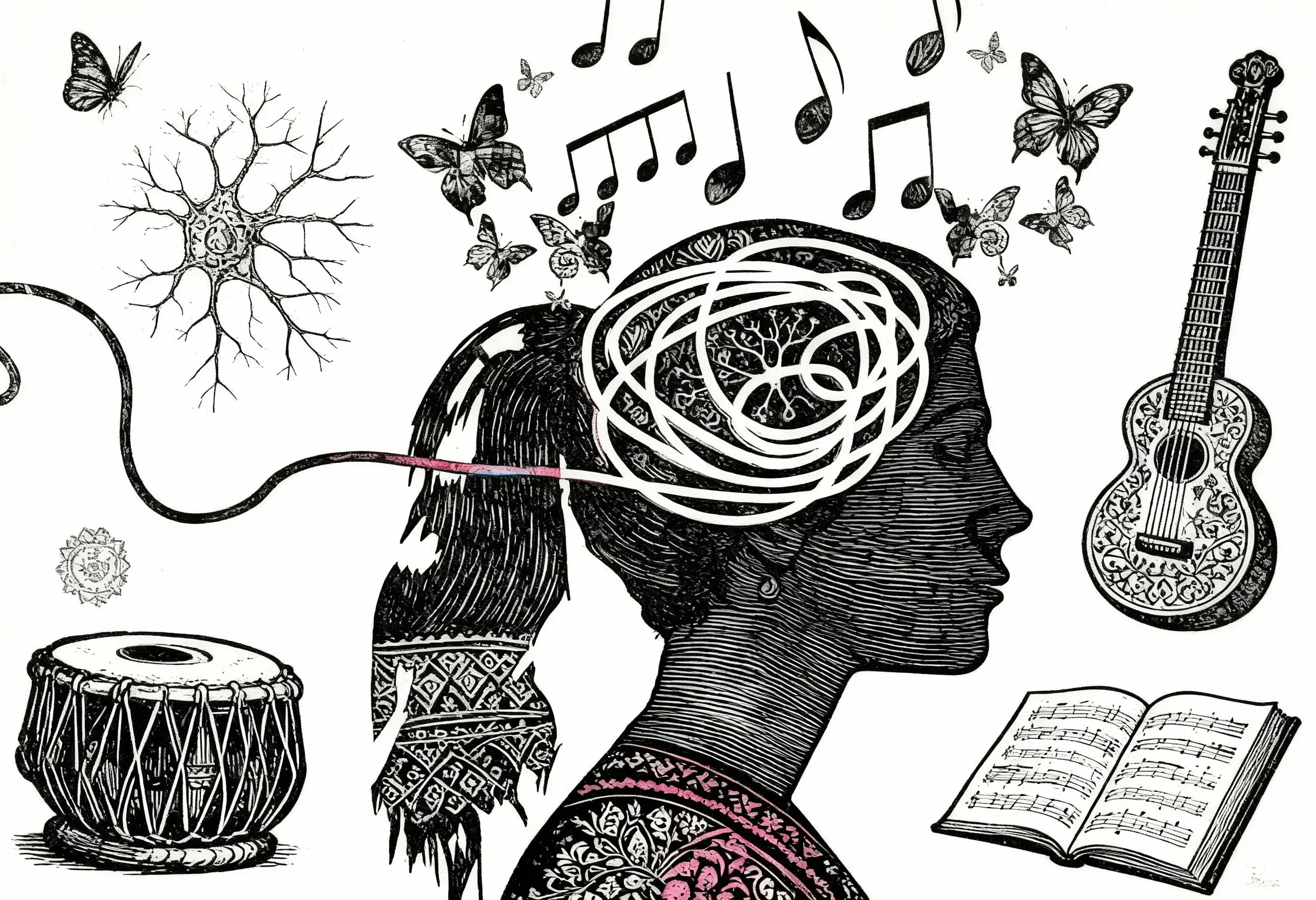
You don’t need to be a musician to deepen your neural relationship with ragas. Here are practical exercises that harness basic neuroscience principles:
1. Focused listening (10–20 minutes): Choose an alap and listen without distractions. Follow the rising and falling contours. Note moments of tension and release. This trains sustained attention and reduces mind-wandering.
2. Pitch tracking: Hum along and try to match key notes (vadi, samvadi). Micro-adjusting your pitch sharpens auditory discrimination and engages auditory-motor loops.
3. Phrase prediction: After hearing a phrase twice, pause the recording and try to sing what you expect next. This strengthens predictive processing and pattern recognition.
4. Rhythmic tapping: Tap the tala cycle while listening to a composition. This improves entrainment and sensorimotor coupling.
5. Compare renditions: Listen to several artists perform the same raga. Notice how each emphasizes different phrases or moods. This develops sensitivity to micro-variation and the tradition’s expressive palette.
Therapeutic potentials a cautious optimism- There’s growing interest in music-based interventions for stress, mood disorders, and cognitive decline. The structure and expressivity of ragas may be particularly well-suited for specific therapeutic uses: slow alap for relaxation, devotional ragas in palliative contexts, rhythmic cycles for motor rehabilitation.
However, a note of caution: rigorous clinical evidence is still emerging, and responses to music are highly individual. Neuroscience helps explain mechanisms, but therapeutic application requires careful, ethically guided research. Still, the anecdotal and preliminary clinical reports are promising enough to justify further study.
“Where words leave off, music begins.” — Heinrich Heine
For Performers: How Neuroscience Can Inform Practice?
Understanding the brain can make practice smarter, not just longer.
Chunking: The brain learns sequences more efficiently when you break long improvisational ideas into smaller chunks and practice transitions.
Interleaving: Alternate between slow, deliberate practice and faster, expressive runs. This promotes robust learning and flexible retrieval.
Sleep and consolidation: Memory consolidation for melodic material happens during sleep. A good night’s rest after practicing a complex alaap helps solidify neural traces.
Mental practice: Imagining phrases activates neural networks similar to those activated during actual play. Silent, focused visualization of improvisation strengthens the same auditory-motor circuits.
The universality and the particularity- Music neuroscientists often emphasize two truths: some musical responses are universal (e.g., faster tempo increases arousal), while others are culturally conditioned (e.g., the emotional meaning of a specific scale). Hindustani ragas sit at the intersection of these truths. Their microtonal subtleties and cultural narratives make them uniquely powerful within South Asian contexts, yet their capacity to engage prediction, attention, and reward systems is a human universal.
That’s why a carefully rendered raga can feel immediately emotionally resonant even to someone who doesn’t know its tradition. The brain recognizes pattern, tension, and resolution. The culture supplies layers of meaning that deepen the resonance for insiders.
The Raga-Mind Symphony: Eternal Wisdom Meets Neural Mag
Hindustani classical music is often described as an intricate conversation between the musician and the raga—a living, cyclical structure that inspires exploration, spontaneous creativity, and profound emotional resonance. This timeless art form, steeped in tradition, has always been more than just a collection of sound patterns or melodic motifs; it represents a dynamic landscape of feeling and imagination where every note and phrase carries the potential for deep personal transformation. Beyond poetic metaphors and centuries-old practice, recent scientific advancements are now confirming what generations of musicians and listeners have intuited: ragas uniquely interact with the human brain, producing effects that are not only perceptible but also quantifiable.
Contemporary research underscores that ragas are sophisticated frameworks capable of eliciting complex neurological responses. Each raga, with its distinctive arrangement of swaras (notes), rhythmic cycles, and melodic contours, offers a palette of emotional and psychological experiences. Some ragas are known to instill tranquility and peace, while others awaken joy, longing, or introspection. Scientists have observed that listening to or performing particular ragas can lower levels of stress hormones like cortisol, boost concentration, and even modulate physiological variables such as heart rate and breathing. These findings reinforce the traditional view of ragas as tools for meditation, healing, and self-discovery, now bolstered by modern neuroscience.
Importantly, the influence of ragas is not a one-sided affair. For musicians, the creative act of improvising within the flexible boundaries of a raga often produces what psychologists call “flow”—a highly focused, immersive mental state celebrated for its association with peak performance and creative insight. In these moments, brainwave patterns shift, indicating deeper engagement and heightened awareness. Whether experienced on stage, in the intimacy of individual practice, or through attentive listening, these states of mind contribute to Hindustani classical music’s enduring transformative power.
Thanks to the advent of digital education, this ancient wisdom is more approachable than ever. With platforms like Artium Academy making high-quality instruction widely available, aspiring musicians and curious listeners can unravel the mysteries of this art form from the comfort of their own homes. Online Hindustani music instruction in Artium Academy’s comprehensive Hindustani music course and interactive online music classes offers unique opportunities to learn Indian classical music under the expert guidance of accomplished maestros.
These carefully designed programs are structured to preserve the authenticity of tradition while using technology to foster personalized, engaging learning experiences. As a result, passionate students anywhere in the world can now participate in a vibrant, living tradition—discovering how the science and soul of Hindustani classical music continue to enrich minds, elevate spirits, and build meaningful connections in the digital age.
FAQs
A raga’s structure—its specific set of swaras, characteristic phrases, and emotional mood (rasa)—creates predictable melodic patterns that the brain learns to anticipate. When these expectations are met or skillfully stretched during improvisation, the brain’s reward circuits (including dopaminergic pathways) are activated, producing pleasure, emotional resonance, and even a sense of calm or upliftment. The limbic system (amygdala, hippocampus, orbitofrontal regions), which governs emotion and memory, plays a major role in assigning emotional meaning to these patterns. Over time, personal or cultural associations with a raga further strengthen these emotional responses.
Microtonality in Hindustani music—delicate shrutis, meends, and nuanced pitch bends—requires and develops fine-grained auditory discrimination. Training and repeated exposure strengthen the auditory cortex, making listeners and musicians more sensitive to subtle pitch differences. This “use-dependent plasticity” means the brain literally rewires itself to detect microtonal detail. Emotionally, microtones add expressive depth; a slight glide or grace note can evoke yearning, tranquility, or playful tension, enriching the listener’s experience.
Tala cycles entrain both brain waves and bodily rhythms. Neural oscillations can synchronize with the rhythmic laya of the tala, improving attention and sensorimotor coordination. Slow, meditative tempos lower heart rate and breathing, inducing relaxation, while faster rhythmic passages increase arousal and alertness. The auditory cortex, motor cortex, and basal ganglia work together to align the body’s internal rhythms with external beats. This is why tapping the tala, listening to a slow alap, or experiencing a fast jhala can create distinct physiological and psychological states.
Emotional responses arise from the interaction of melodic contour, tempo, timbre, and long-established cultural associations. For example, descending minor-like phrases often evoke introspection or melancholy across cultures because they mimic natural human vocal expressions of sadness.
The limbic system interprets these features and assigns emotional valence. Additionally, memory and cultural exposure—such as hearing Bhairav at dawn or Desh during monsoon—strengthen these associations over time, making the emotional response both universal and culturally enriched.
Neuroscience highlights several strategies that optimize learning:
- Chunking: Breaking complex improvisational ideas into smaller units improves processing and memory.
- Interleaving: Alternating between slow, deliberate practice and expressive, faster passages enhances flexible recall.
- Sleep: Practicing before sleep boosts consolidation of melodic patterns in long-term memory.
- Mental rehearsal: Imagining an alaap or taan activates similar brain networks as actual performance, strengthening auditory-motor circuits. Understanding these principles allows students to practice more efficiently, deepen their musical intuition, and enter creative flow states more easily.