
All Topics
- Alchemizing Music Concepts for Students
- Anuv Jain Songs
- Artist Spotlight
- artium gift card
- Artium Maestros
- Artium News
- Artium Tech Blog
- Best Coke Studio Songs
- Best Female Singers
- Birthday songs
- Bollywood Love Songs
- buying guide
- Carnatic Music
- Child Singers
- Devotional Music
- Editorials by Ananth Vaidyanathan
- English Love Songs
- Festival
- Film Music
- Ghazal Music
- Guitar
- Hindustani Classical Music
- Indian Classical Music
- Indian Folk Music
- Insights
- Instagram Reels Viral Songs
- Instruments
- Karaoke
- Karaoke Singing
- Keyboard
- Kids Music
- maestros
- Music Education
- Music for Kids
- Music Games
- Music Industry
- Music Instruments
- Music Legends
- Music Press Release
- Music Technology
- Music Theory
- Music Therapy
- Music Tools
- Piano
- piano guide
- Songs
- South Devotional Music
- Success Stories
- Tamil Film Music
- Telugu Film Music
- Time Theory
- Tools
- Uncategorized
- Uncategorized
- Uncategorized
- Uncategorized
- Vocal Singing
- Vocals
- western classical music
- western music
- Western vocal music
How to Read Guitar Sheet Music for Beginners?
How to Read Guitar Sheet Music for Beginners?
Table of Contents
If you are an aspiring guitarist or have learnt a few chords, then there are chances that you’d have come across mysterious sheet music. You’d have seen five horizontal lines with dots scattered across them. It is called the guitar sheet music. It is very easy to read guitar sheet music for beginners once you understand the basics.
Learning to read guitar sheet music enables a guitarist to play music written for any instrument. It’s like speaking a universal musical language. Whether you are picking up an easy guitar sheet music arrangement or moving towards more complex compositions, understanding how to read sheet music transforms you from someone who plays songs into someone who understands music itself.
In this blog, we’ll deep dive into 101s of how to read guitar sheet music for beginners. We will explore what makes sheet music different from tabs, why it matters, and most importantly, how to actually read it without feeling overwhelmed. By the end, you will have the confidence to tackle any guitar sheet music that comes your way.
Understanding the Difference: Sheet Music Vs Guitar Tabs
Now, before we delve into the topic, it is important to understand that sheet music and guitar tabs are not the same thing, and each has its own strengths and weaknesses. If guitar tabs show you which fret to play on the strings, then sheet music tells you more. It shows you more than just which notes to play; you also learn the rhythm, tempo, dynamics, and even emotional intent.
This means two musicians reading the same piece of sheet music will play it the same way, regardless of the instruments they play. A violinist and a guitarist reading the same sheet music will produce harmonious music together. The best part? The sheet music is universal. By learning to read it, you can access centuries of music compositions. This can help you play in orchestras, jazz ensembles, or collaborate with other musicians from any background.
Importance of Learning Guitar Sheet Music
Now, you may ask, “Why should I learn sheet music when I can learn guitar with tabs?” The question is relevant, but here is what you’d be missing –
- Access to Professional Arrangements
Go to any professional arrangements and you will see classical guitar pieces use sheet music. On the other hand, free guitar sheet music libraries feature tabs, while high-quality music arranged by master musicians is always in standard notation. - Understanding Music Theory
Music theory comes to life on sheet music. You will see intervals, chord progressions and harmonic relationships visually on the staff. For guitar sheet music for beginners, this knowledge transforms your improvisation and composition abilities. - Sight-Reading Skills
Learning to read guitar sheet music can enable you to pick a piece and play it on the spot. You’ll be able to play music with other musicians too; that’s the power of sight-reading. - Playing with Others
If you ever want to play in a band, orchestra or ensemble, sheet music is the common language. Tabs simply don’t convey enough information for coordinated group playing. - Better Technical Developments
Learning sheet music helps you to develop a deeper understanding of your fretboard and finger positioning, eventually making you a better guitarist.
Who Should Learn to Read Sheet Music?
The ability to read sheet music is a skill that pays dividends. And it is not necessary for you to be a classical guitar player to benefit from it; you can also be a beginner or someone who’s been playing for a while. You can be a novice and can start learning sheet music immediately, even before knowing any chords. It is recommended that you start early, so that it becomes natural to you. By the time you have learned 20 songs, reading sheet music will feel second nature.
While learning on one’s own is a skill in itself, there have been many instances of self-taught guitarists hitting a dead end when relying on tabs. Learning to read guitar sheet music for beginners breaks those ceilings and opens new possibilities. Young learners develop stronger musicality when introduced to sheet music early. If you’re considering online guitar classes, look for programs that teach sheet music alongside practical playing skills. So, if you are a serious guitarist, understanding sheet music offers numerous benefits, regardless of your musical goals.
Learning to Read Guitar Sheet Music
Now that we know the importance of guitar sheet music, let’s get to the stuff that matters. To read guitar notes on sheet music, you have to understand several layers of information. Let’s dive right into it.
Understanding the Music Staff
The five horizontal lines with four spaces between that you see on guitar sheets are called the musical staff. They are the foundation of all sheet music. Think of it as a ladder where each line and space represents a different note. The staff starts with a clef symbol. For guitars, a treble clef (also called the G clef) is used. It looks like a fancy symbol centered on the second line. This tells you where to start on the musical alphabet. And the best part is, you don’t need to memorise all the notes at once. You can learn them progressively, line by line.
The Notes on the Lines and Spaces
For the treble clef used in guitar music:
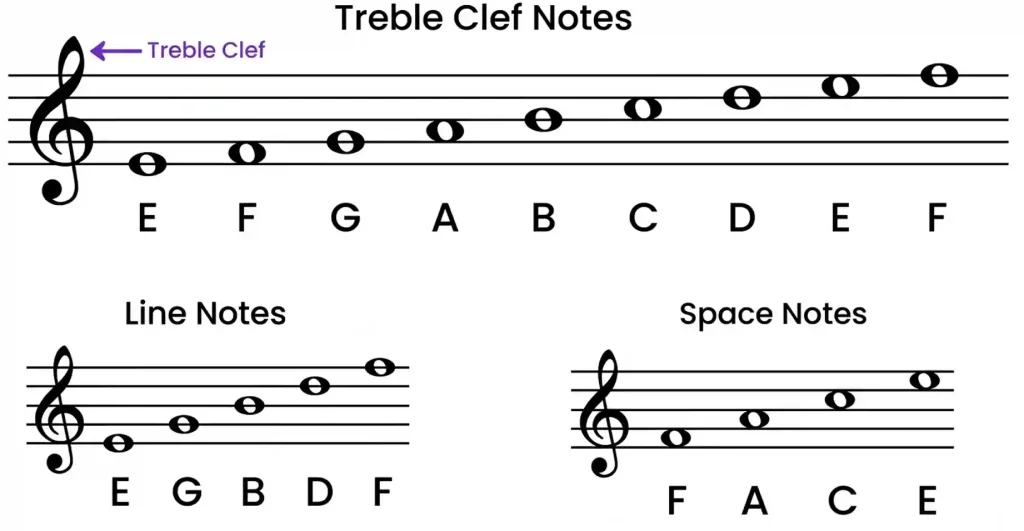
Notes on the lines (bottom to top): E, G, B, D, F
Notes in the spaces (bottom to top): F, A, C, E
The best way to memorise the lines is: “Every Good Boy Does Fine”
For the spaces, the notes spell out “FACE” naturally.
In this guide to read guitar sheet music for beginners, If you understand these basics, you can identify any notes on the staff. The higher notes sit higher on the staff and the lower notes sit lower. It is organised logically.
Connecting Sheet Music to Your Fretboard
Now, for its practical application, you have to know which note the guitar sheet tells you to play. Once you know that, you need to find it on your guitar. The beauty of the guitar is that you can play most notes in multiple positions. For example, note E can be played at the open low E string, or on the second string at the 7th fret, or on the third string at the 12th fret. Different positions offer different tonal qualities. This flexibility is very helpful because it helps you learn to choose positions that make musical sense in context.
Understanding Rhythm and Note Duration
Now, knowing how to play the note is just half the battle. You also need to know how long to play it.
Note Values Explained
Different note shapes communicate duration:
Whole note – Four beats (an empty note head with a stem)
Half note – Two beats (an empty note head with a stem)
Eighth note – Half a beat ( a filled note with a single flag)
Sixteenth note – A quarter beat (a filled note head with two flags)
Think of it like fractions. A whole note is the complete measure. Half notes are half of that. Quarter notes are quarters. The pattern continues logically while you learn to read guitar sheet music for beginners.
Time Signatures
At the start of a guitar sheet music, you will see two numbers stacked one above the other; they are the time signature. In most songs, it is 4/4, pronounced “four-four”, “four-by-four” or “common time”. The top number represents how many beats are in each measure. The bottom number tells you what type of note gets the beat
In 4/4 time: There are 4 beats/measure, the quarter note gets the beat and four quarter notes fill one complete measure. This arrangement helps you keep rhythm. Each measure is a self-contained rhythmic unit and when you complete it, you move to the next measure.
Rests: Knowing When Not to Play
Now, it’s good to know when to play, but it is equally important to know when to be silent. Rests are the sheet music equivalent of silence, and they have durations just like notes. A whole note rest and a half note rest look like an upside-down hat. Quarter note rests and smaller rests have distinctive symbols. The key point: every rest has a duration. If you see a whole rest in a 4/4 measure, you are silent for the entire measure.
Sharps, Flats, and Naturals
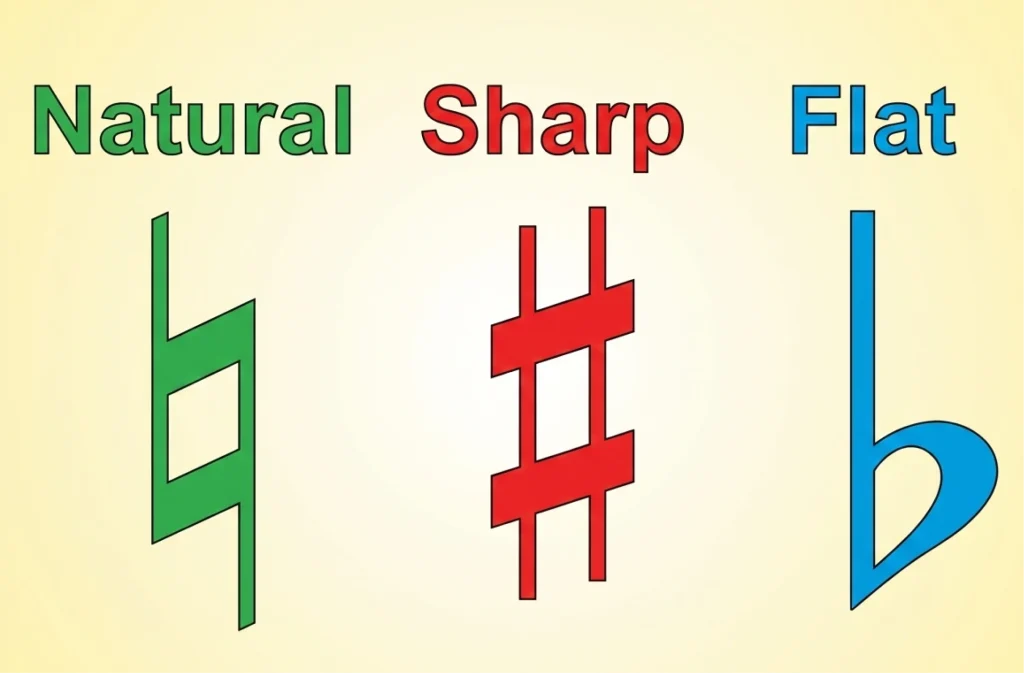
While playing music, a note may need to be slightly raised or lowered in pitch. This is where accidentals come in.
Sharp (#) – Raises a note by one half step
Flat (♭) – Lowers a note by one half step
Natural (♮) – Cancels a sharp or flat
For example, if a note is C and it has a sharp, you play C-sharp (the fret one higher than C). These symbols appear right before the note head on the staff.
As a beginner, understanding sharps and flats is especially important when you see the key signature, the series of sharps or flats that appears right after the clef at the beginning of a piece. While you read the guitar sheet music for beginners, the key signature tells you which notes are naturally sharp or flat throughout the entire piece, eliminating the need to rewrite them constantly.
Practice Tips for Reading Guitar Sheet Music
Here are some practice tips for all the beginners –
- Start with Simple Melodies
Begin with single-note melodies from easy songs you know. Don’t jump into complex pieces; playing familiar ones helps the brain connect the dots faster. - Use a Metronome
Practice reading rhythmically accurate passages. A online metronome keeps you honest and helps you internalize timing. - Combine Guitar Sheet Music with Tabs
Look at the sheet music and tab together when learning a song. This helps in understanding how the notation translates to your fretboard. - Say the Note Names Aloud
While playing, say the notes aloud. “E, F, G, A…”. This helps in reinforcing the connection between the symbol, the name and the physical location on your guitar. - Record Yourself
Listen to yourself play; you will easily find where your rhythm is shaky or where you hesitate. - Practice Regularly
10-15 mins of daily practice beats triumphs over inconsistent, longer sessions. Consistency builds fluency. - Trust your Guitar Teacher
Trust your guitar teacher to guide you with the right techniques, practice methods, and musical direction tailored to your goals.
Common Beginner Mistakes to Avoid
- Rushing the Process
As a beginner, understanding what you read is important. Don’t read faster than you can comprehend. Accuracy beats speed every single time. - Ignoring Rhythm
Don’t ignore rhythm completely in search of the right notes. The rhythm is just as important as the pitch. - Forgetting About Rests
Don’t make the mistake of ignoring rests. They are important too. A well-placed rest is crucial to musical expression. - Not using the Metonome
Your internal sense of time isn’t good enough when you are learning. The metronome is your teacher. - Trying to Memorize Everything
You don’t need to memorize the staff. It is okay to refer back to your cheat sheet while you are learning. Fluency develops with time.
Learn How To Read Guitar Sheet Music for Beginners With Artium
As a musician, learning to read guitar sheet music is one of the most important skills you can develop. It opens the door to more professional arrangements, collaborations, and deeper musical understanding.
The journey is simple: start by learning the five lines and four spaces, understanding basic rhythm, and connecting it all to your fretboard. From there, every piece of music you read makes the next one easier.
At Artium Academy, we understand how important it is to read guitar sheet music. That’s why we believe in structured guidance; it transforms the learning process. Our online guitar classes for kids and adults are designed to teach you sheet music reading alongside practical playing skills.
Our online music courses are curated by one of India’s renowned musicians, Raju Singh. He has been an integral part of curating our guitar course, which gives students globally recognised music certification.
From learning to read guitar sheet music for beginners to those looking to rekindle their passion after years, online guitar classes will help them to learn it better. With consistent practice and correct guidance, you will be reading guitar music confidently within weeks.
Start today. Pick up an easy guitar sheet music, grab your metronome, and begin. Your musical literacy and your guitar playing will never be the same.
FAQs on Guitar sheet music
No, it is not necessary. But, the upside is, learning to read guitar sheet music for beginners teaches you music itself, pitch, rhythm and expression in one language that works on any instrument. It makes your guitar playing more flexible, musical and professional, especially if you want to jam beyond simple songs with other artists.
Well, most beginners start with tabs, and there’s nothing wrong with it. But it is always advisable to learn guitar sheet music. A great way can be to pick a simple melody, look at the tab and the sheet music side-by-side and see how they match. This approach builds practical skills faster than learning them one at a time.
For most beginners, getting comfortable with basic guitar notes on sheet music and simple rhythms takes about 4-8 weeks with consistent practice. To become fluent, it takes 3-6 months of disciplined and regular practice. The key is consistency.
When you’re just starting to read guitar sheet music, focus first on the higher-pitched strings: the 1st (E) and 2nd (B) strings. These usually carry the melody and are where most beginner sheet music melodies are played. Once you’re comfortable with notes on those strings, gradually add the 3rd (G) and 4th (D) strings. The lower strings (5th and 6th) come later, when you’re ready for more complex arrangements. Start simple, stay on the higher strings, and build confidence step by step.
Rhythm is half of reading sheet music. Here’s how to practice it effectively: Use a metronome at a slow, comfortable speed. Start with simple pieces in 4/4 time using only quarter and half notes. Clap the rhythm or count aloud (1–2–3–4) before playing the notes on the guitar. Play along with the metronome, focusing on hitting each note at the right time. Gradually add eighth notes, rests, and changes in note values. Record yourself and listen back to the spot where your timing wobbles. This trains your internal clock and turns reading guitar sheet music from a guessing game into natural, musical timing.
Absolutely, yes. Reading sheet music is a game-changer for lead guitar and solos because it teaches you: Where every note lives on the fretboard, how phrases are shaped rhythmically and melodically and how to move between positions while keeping the flow. Many classic solos are written in standard notation, not just tabs. Plus, knowing how to read helps you learn solos faster, adapt them to your style, and even create your own melodic, expressive lead lines. If you dream of playing killer solos, learning to read classical guitar or acoustic guitar sheet music will level up your playing fast.
The easiest way is to combine three simple habits:
- Learn the open strings first – E, A, D, G, B, E (from 6th to 1st string).
- Use the staff as a map – Learn the notes on the staff (E, G, B, D, F and F, A, C, E) and find where those notes fall on each string.
- Practice with simple melodies – Pick a short tune, read the notes on the staff, then play them note by note on the guitar. Say the note name out loud as you play it.
Over time, your fingers will naturally start remembering “that’s a G on the 3rd string, 5th fret. And as you build this muscle memory, playing from guitar sheet music for beginners becomes smooth, confident, and musical.