
All Topics
- Alchemizing Music Concepts for Students
- Artist Spotlight
- artium gift card
- Artium Maestros
- Artium News
- buying guide
- Carnatic Music
- Devotional Music
- Editorials by Ananth Vaidyanathan
- Film Music
- Guitar
- Hindustani Classical Music
- Indian Classical Music
- Indian Folk Music
- Insights
- Instruments
- Karaoke Singing
- Keyboard
- Kids Music
- maestros
- Music Education
- Music for Kids
- Music Industry
- Music Instruments
- Music Legends
- Music Theory
- Music Therapy
- Piano
- piano guide
- Success Stories
- Tamil Film Music
- Telugu Film Music
- Time Theory
- Tools
- Uncategorized
- Vocal Singing
- Vocals
- western classical music
- western music
- Western vocal music
How to Read Treble Clef Notes on a Piano?
How to Read Treble Clef Notes on a Piano?
Table of Contents
What is that one thing that can help a pianist play music more fluently or effortlessly? No, prizes for guessing, it is the treble notes. Learning how to read rebel clef notes on the piano is your path to musical freedom. From beginner to pro, understanding the treble clef is fundamental to your musical journey. At Artium Academy, we have helped thousands of aspiring pianists master this skill, and we are excited to share this complete guide with you.
At first, how to read treble clef notes may look difficult, with their dots, lines, and symbols, but the truth is reading them is easier than you think. With the right approach, consistent practice, and the following strategies, you will never have trouble reading treble clef notes. This blog will help simplify treble clef and equip you with techniques to easily identify and play notes on treble clef piano with confidence.
What is Treble Clef?
The treble clef is a symbol that sits at the start of a musical staff. It tells you which notes you are playing. It looks like a stylish “G” and is also called the “G clef.”
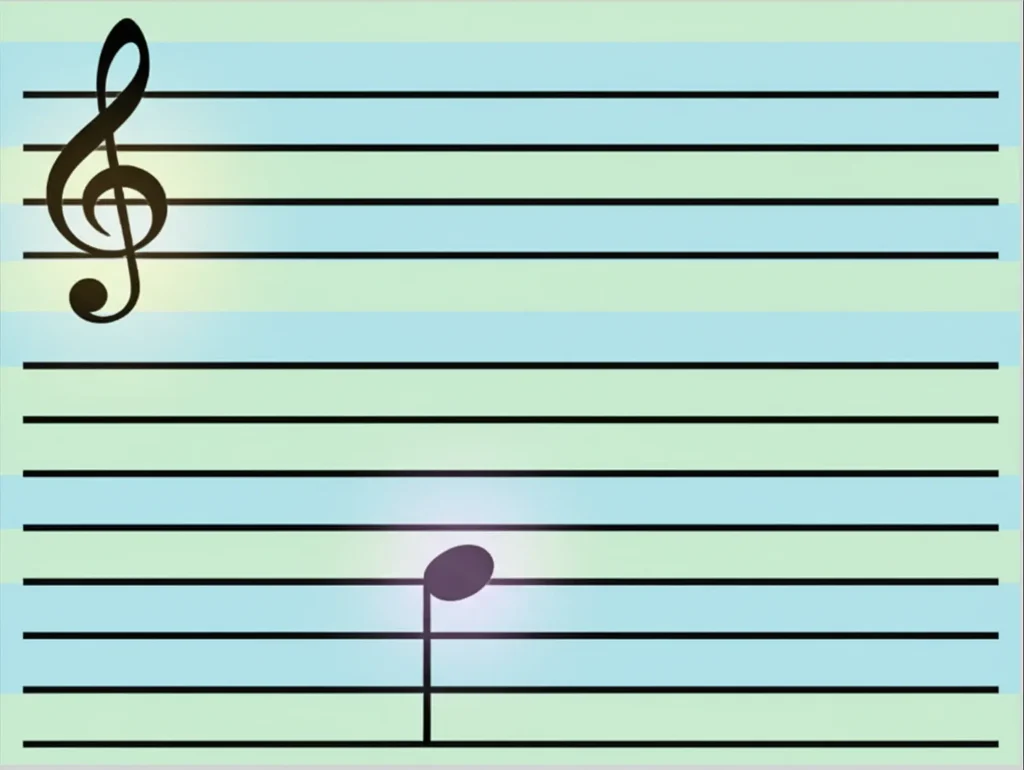
This treble clef symbol marks the location of the G on treble clef above middle C on your piano keyboard. The treble clef is mainly used for higher-pitched instruments and voices, the right hand on piano, flute, soprano singers, guitar, and many others. As a pianist, mastering the treble clef is important because it represents the melodies and higher notes you’ll most frequently play.
The treble clef note is important because it is the most commonly used clef in today’s music. From classical pieces to contemporary pop songs, the musical notation you will encounter uses the treble clef. This is why understanding how to read treble clef notes on the staff is such a valuable skill for any pianist.
Watch this to identify notes on the Piano:
How to Read Treble Clef in the Piano?
On a piano, bass clef and treble clef notes are the primary tools for reading the left-hand part and the right-hand part of a piece on the piano. This distinction is crucial because it helps you understand which hand plays which note.
Treble clef piano keys represent notes from approximately the middle of the piano keyboard upward. As an aspiring piano player, you will spend a lot of time on how to read treble clef and interpreting treble clef notation during practice sessions. Understanding this clef thoroughly means you are building a foundation that supports everything else you will learn about music notation.
The beauty of the treble clef is that it covers a wide range of notes, from the lowest to the highest notes on the piano. This versatility makes it indispensable for expressing the instrument’s full emotional and tonal range.
Understanding Staff Anatomy: Lines, Spaces & Middle C
Before diving into the notes on treble clef, let us understand the structure you are looking at. A musical staff consists of five horizontal lines and four spaces between them. These lines and spaces can hold notes, creating nine positions for notes. Each of these lines and spaces represents a specific pitch (a particular musical note, higher or lower in sound), not just a visual spot on the page.
Here’s what you need to know about the staff:
- The five lines provide one position each for notes (five distinct pitches).
- The four spaces between the lines provide another position for notes (four more distinct pitches).
- Notes can also extend above and below the staff using ledger lines, which add extra note positions and pitches beyond these nine.
The middle C in treble clef helps you steer the staff. In treble clef notation, middle C sits on a small ledger line just below the five main staff lines. Once you locate middle C, you can count up or down alphabetically (C–D–E–F–G–A–B, then repeating) to find any other note and its pitch on or around the staff. This becomes very helpful when you are learning to read sheet music.
Treble Clef Notes on Piano on a Staff – Line and Spaces
The alphabet used in music resets after G and returns to A. So the sequence is:
A, B, C, D, E, F & G, then it starts again at A. This pattern repeats across the entire keyboard, making it easy to predict once you understand the basic structure.
Method 1: The Mnemonic Shortcuts (Traditional Approach)
Mnemonic devices are among the most efficient ways to learn treble clef notes on the staff. These tricks, used for generations, have remained incredibly powerful because they blend visualization with language, making information stick in your memory.
Treble Clef Lines
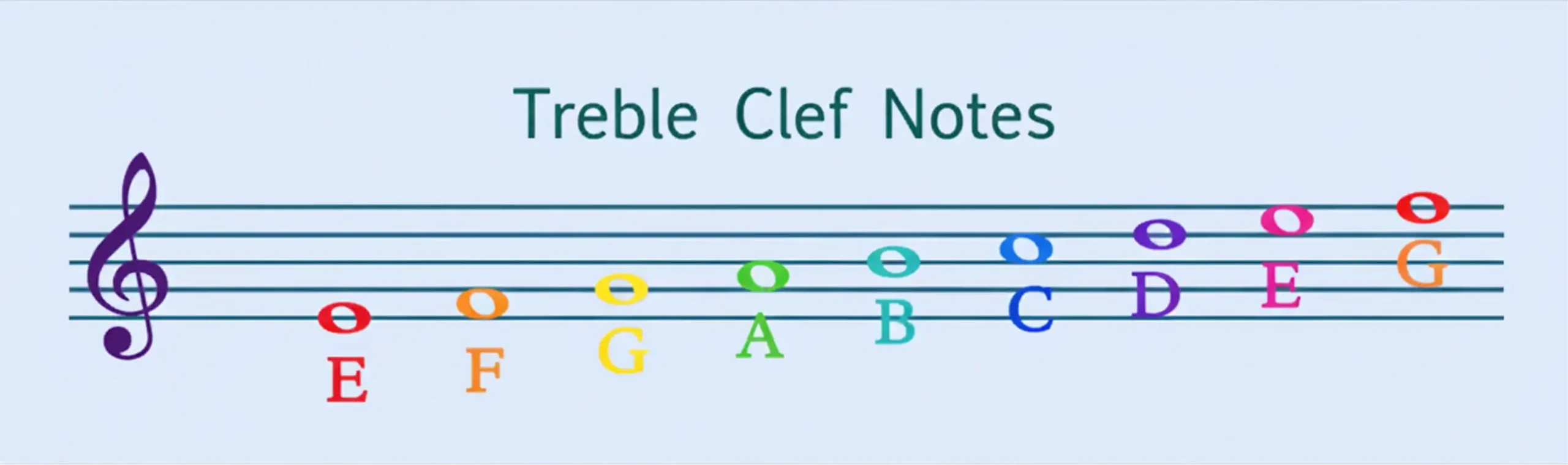
The five lines from bottom to top, spelled out are: E-G-B-D-F
An easy way to remember these can be:
- Every Good Boy Deserves Food
- Every Good Boy Does Fine
You can also create your own phrase that you find easy to remember. The idea is to find something that helps you remember the line notes instantly. The best way to remember is to repeat your phrase while looking at the staff.
Understanding Treble Clef Spaces on a Piano

The spaces from bottom to top spell out: F-A-C-E
It is easy to remember and is one of the most used memory tools in music education. That’s the beauty of these mnemonic devices; they work instantly. Instead of counting from one note to the next, you will glance at the staff and immediately identify whether you are looking at a line or a space note. This speed is what separates confident sight-readers from those who struggle with sheet music.
Method 2: The “Guide Note” Strategy (Advanced Approach)
The guide note strategy involves identifying one reference note on the staff, often middle C, and then counting up and down from that note.
Let’s see how it works:
Step 1: Find the guide note you know well. Middle C is an excellent option since it stands out visually on the staff.
Step 2: Count alphabetically. From your guide note, count up or down the musical alphabet to reach your target note. Remember that the alphabet sequence is A, B, C, D, E, F & G, then repeats.
Step 3: Track the position. As you count, keep track of whether each note falls on a line or in a space
You can use this method when your notes are far from your reference point or when you are ready for unfamiliar pieces. Although slower than the mnemonic method, this is reliable and helps you develop a deeper understanding of how treble clef notes relate to each other.
Mapping Treble Clef Notes to Piano Keys
Understanding and connecting the staff to your piano keyboard is very important. This practical application is where theory becomes reality, and on how to read treble clef transforms into music.
Note E represents the bottom line of the treble clef staff. It’s just above middle ,C and if you find it, you have found your starting reference point. From there, each line and space on the staff corresponds directly to the white keys moving upward on your keyboard.
Here’s the mapping:
- Bottom line (E): The E above middle C
- First space (F): The F above that E
- Second line (G): The G
- Middle line (B): The B
- Third space ©: The C
- Fourth line (D): The D
- Fourth space (E): The E
- Top line (F): The F
Sight-reading becomes easier if you understand this correlation between the staff and your keyboard. You are no longer memorizing abstract symbols; you are connecting visual notation directly to physical keys under your fingers.
Decoding Ledger Lines
As you advance deeper into your piano learning journey, you will find that these notes extend beyond five main staff lines.
The ledger line notes have the same sequence as the staff. Above the top line (F), the first ledger line represents G, followed by a space with A, then another line with B, and so on.
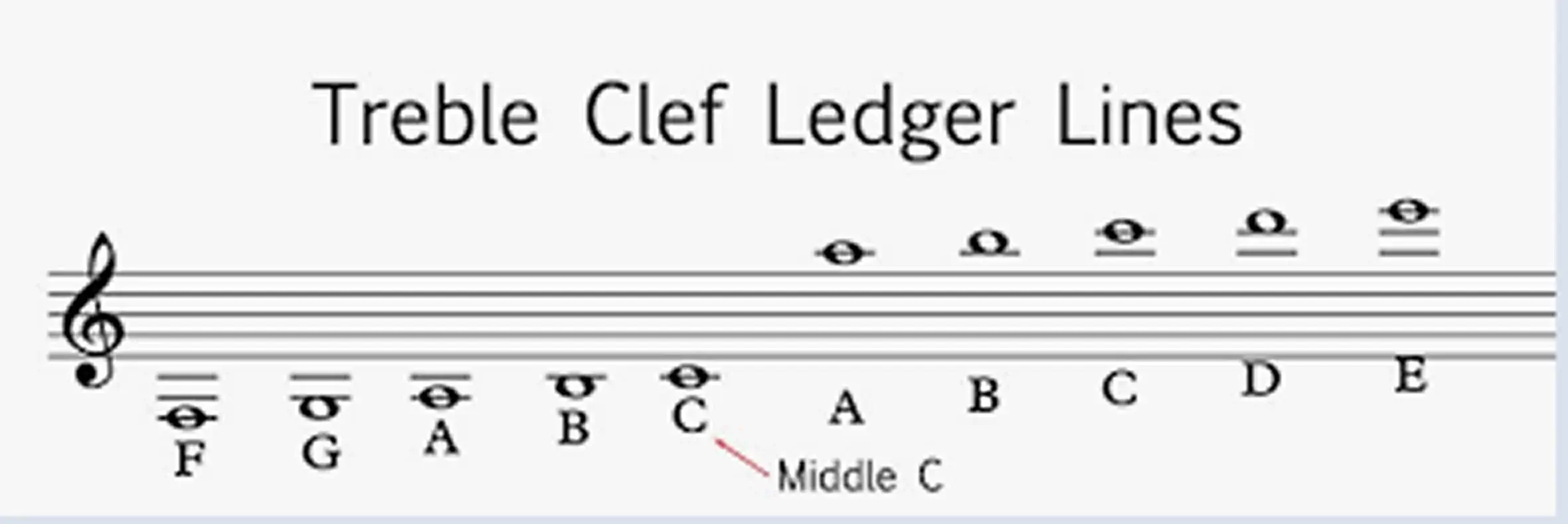
Below the bottom line (E), the next space is D, then the first ledger line is middle C, followed by B, A, and so on as you add more ledger lines. It is significant for you to learn what ledger lines are because they expand the range of notes you can read. Without ledger lines, the treble clef would be limited to nine notes (if we don’t consider sharps and flats), or else it is twelve notes, but with them, you can read notes across multiple octaves.
Here are some tips for mastering ledger lines while understanding how to read a treble clef :
- Memorise the first ledger line above and below the staff as reference points.
- Use the guide note strategy to count from staff to ledger line notes.
- Practice writing ledger line notes to reinforce your understanding.
- Ledger lines need more practice, so do not rush.
Step-by-Step Method to Read a Treble Clef Melody
Now, let us put together a practical, step-by-step approach to reading an actual melody:
Step 1: Locate and see the first note on the staff. Use your mnemonics (FACE for spaces, or your line phrase) to identify it quickly.
Step 2: Note the rhythm and duration. Look at the note head’s shape and any stems or flags. These tell you how long the note should ring.
Step 3: Find the pitch. It is not about playing; it is about discovering where it sits.
Step 4: Play the note. Press the key and listen to the sound. Connect the visual symbol to the actual music.
Step 5: Repeat for each note. Move through the melody one note at a time, gradually building the speed.
Step 6: Increase the speed. Be identifying each note and try reading faster each time without playing each one. Eventually, you will recognise note patterns without identifying each one. This will enable you to build confidence and ensure your foundation is rock-solid before you attempt faster sight-reading.
How to Practice Reading Treble Clef Notes Effectively?
If you want to transform your skills, practice is key. Here are some proven strategies to speed up your progress:
- Daily & Consistent Practice
Give yourself 10-15 minutes daily to read treble clef notes. Being consistent will go a long way toward achieving results than lengthy, occasional sessions. - Use flashcards
Create flashcards with treble clef notes on one side and answers on the other. Quiz yourself regularly. - Sight-read simple melodies
Take a beginner-level sheet of music and read through pieces without worrying about perfect technique. The goal is reading fluency and not perfection. - Play and sing
Once you identify a note, play it on your piano and sing it out loud. This multi-sensory approach strengthens memory. - Write your own staff
Practice drawing treble clefs and writing notes to reinforce recognition. - Use interactive tools
Apps and websites offer interactive practice where you identify notes under timed conditions.
Our piano courses at Artium Academy integrate all these practice methodologies on how to read treble clef notes into structured lessons designed to accelerate your learning piano and keep you motivated.
Common Mistakes and How to Fix Them
Mistakes are part of the learning process, and every learner sometimes stumbles. Here are some common mistakes and how to overcome them:
Mistake 1: Confusing line and space notes
Solution: Remember that lines have note names (E, G, B, D, F), while spaces spell FACE. Picture this feature clearly until it becomes spontaneous.
Mistake 2: Forgetting middle C’s position
Solution: Practice locating middle C on the staff and keyboard regularly. This landmark note is essential for orientation.
Mistake 3: Struggling with ledger lines
Solution: Go slow with ledger lines. Master the five-line staff first, then gradually introduce the ledger lines one at a time.
Mistake 4: Not connecting staff to the keyboard
Solution: Always play what you read. The physical action of playing reinforces the connection between notation and sound.
Mistake 5: Memorizing all at once
Solution: Always break your learning into sizable chunks. Master the lines, then the spaces, then the ledger lines. This approach is far more effective than trying to absorb everything simultaneously.
Begin Your Musical Journey with Artium Academy
The ability to know the basics of how to read treble clef notes is a skill. It opens doors to an extensive world of music. It is the foundation upon which all your future musical growth will be built. Whether you are enrolled in piano classes for adults or are enrolled in online piano lessons for kids, understanding notes on treble clef piano and types of clef is non-negotiable for serious musicianship.
By combining mnemonic devices, guide note strategies, and a consistent practice routine, you can create a powerful learning system. Yes, it requires time and effort, but the payoff? It is the ability to read any piece of sheet music fluently. Now that is something absolutely worth learning.
At Artium Academy, we have seen students transform from aspirants to confident musicians. Our piano courses, curated by Grammy nominee Louiz Banks, are designed to ensure you progress in the right direction. We understand the challenges you face, and we have developed teaching methods that work. Your musical future starts with mastering the basics. The treble clef is one of those foundational skills that, once learned, becomes second nature. With dedication, the right mindset, and consistent practice, you will be amazed at how quickly you progress.
So, grab your sheet music, find the best spot at your piano and start reading. From every note identified to every melody you successfully sight-read, you are a step closer to becoming the musician you have always wanted to be. The treble clef is simply a language, and like any language, learning it takes practice and patience, but the rewards are immeasurable.
Also check,
Online Music Tools
FAQs on How to Read Treble Clef Notes
The five lines from bottom to top are: E, G, B, D, F. The four spaces from bottom to top are: F, A, C, E. These notes repeat alphabetically across the keyboard: A, B, C, D, E, F, G, then repeat.
Use mnemonic devices:
- Lines (E-G-B-D-F): “Every Good Boy Deserves Food” or “Every Good Boy Does Fine”
- Spaces (F-A-C-E): Spells the word “FACE” naturally
Alternatively, use the guide note strategy: identify middle C as a reference point and count alphabetically up or down from there.
The treble clef is also called the “G clef” because it marks the location of the note G (specifically, the G above middle C on the second line of the staff). The symbol itself originated as a stylized letter “G”, you can still see the curve at the bottom of the treble clef symbol as a fancy “G.” Historically, it was used to mark treble (pre-pubescent) voice parts.
The four most commonly used clefs in modern music are:
- Treble clef (G clef) – for higher-pitched instruments and voices
- Bass clef (F clef) – for lower-pitched instruments
- Alto clef (C clef) – primarily used by violas
- Tenor clef (C clef) – used for cello, euphonium, and bassoon
Of these, treble and bass clefs are by far the most common.
The flat symbol (♭) lowers the pitch of a note by one semitone (half step). For example, B♭ is one semitone lower than B natural. On a piano, B♭ is the black key immediately to the left of B. Flats are used in key signatures and as accidentals within a measure to alter the pitch of notes.
Ledger lines are short lines placed above or below the main five-line staff that extend the range of notes you can read. They allow you to write notes beyond the staff’s boundaries. Above the staff, ledger lines continue the note sequence upward (G, A, B, etc.). Below the staff, they continue downward (D, B, A, etc.), leading to middle C on the first ledger line below.
The first step is to enroll in a music course. Many online music learning platforms offer globally recognised music programmes, such as Artium Academy. We provide online piano courses, including lessons on reading treble clef. Things you need consider include:
- Using interactive apps and websites that let you identify notes under timed conditions
- Daily 10–15 minute practice sessions (consistency matters more than long sessions)
- Using digital flashcards to quiz yourself
- Finding beginner-level sheet music and practicing sight-reading
- Playing each note on a keyboard and singing it to reinforce multi-sensory memory
A simple 3-step method:
Step 1: Start at the second line from the bottom. Draw a circular motion to the right, touching the middle line, then the bottom line, returning to the second line.
Step 2: Draw a diagonal line (bottom-left to top-right) that goes beyond the top of the staff.
Step 3: Draw a straight line downward through the semicircle from Step 1, extending beyond the bottom line, and finish with a small curl to the left.
Alternatively, think of the treble clef as made up of simple shapes: a “J” (curved part going through the staff) plus a “P” and “d” combined to create the full symbol.