
All Topics
- Alchemizing Music Concepts for Students
- Artist Spotlight
- artium gift card
- Artium Maestros
- Artium News
- buying guide
- Carnatic Music
- Devotional Music
- Editorials by Ananth Vaidyanathan
- Film Music
- Guitar
- Hindustani Classical Music
- Indian Classical Music
- Indian Folk Music
- Insights
- Instruments
- Karaoke Singing
- Keyboard
- Kids Music
- maestros
- Music Education
- Music for Kids
- Music Industry
- Music Instruments
- Music Legends
- Music Theory
- Music Therapy
- Piano
- piano guide
- Success Stories
- Tamil Film Music
- Telugu Film Music
- Time Theory
- Tools
- Uncategorized
- Uncategorized
- Uncategorized
- Uncategorized
- Vocal Singing
- Vocals
- western classical music
- western music
- Western vocal music
How to Remember Guitar String Names and Numbers
How to Remember Guitar String Names and Numbers
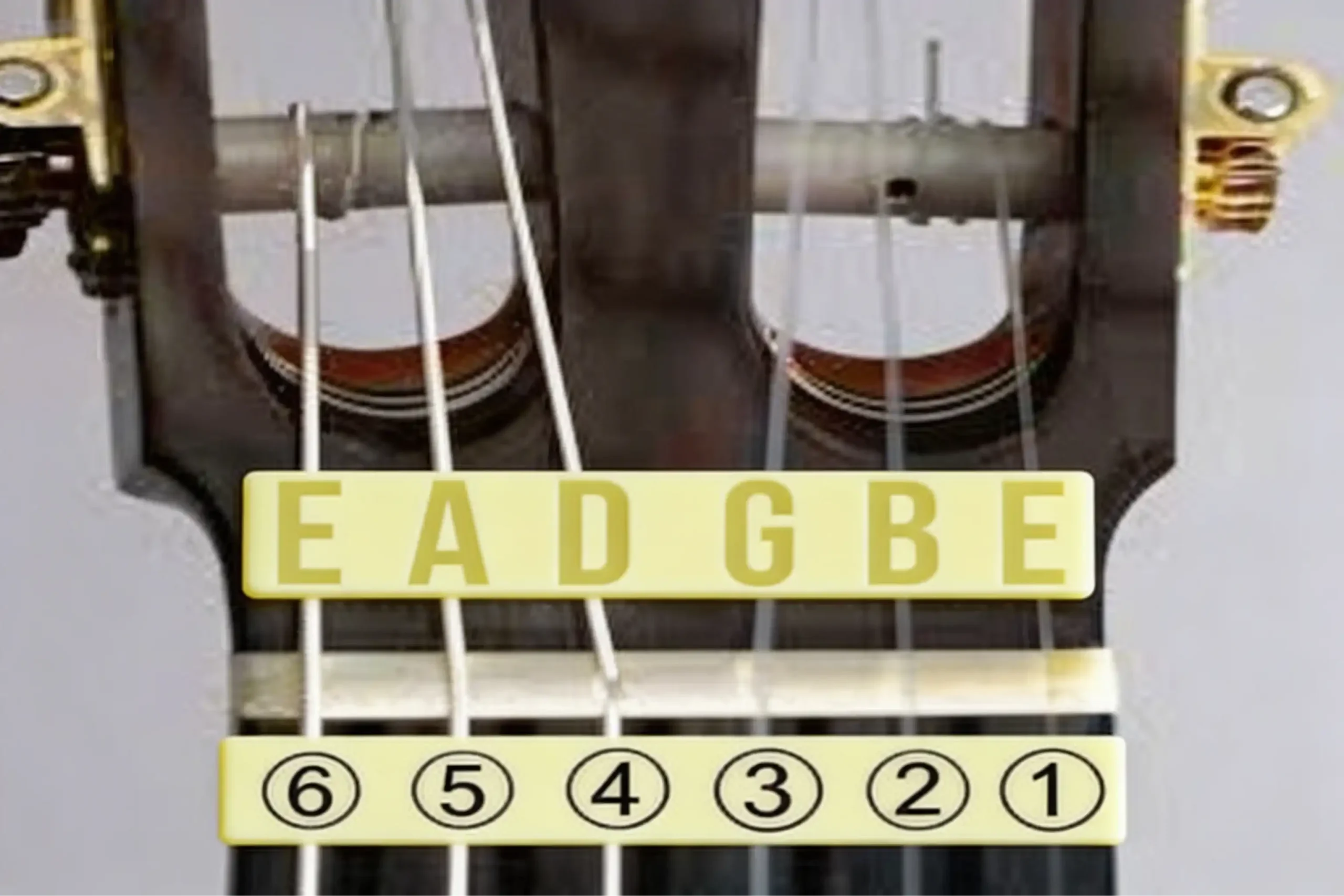
Table of Contents
Are you new to the guitar, or just picked one up? That feeling would have been exciting, right?
You strum a few strings, some notes get played, and for a split second, you feel like a rockstar or at least envision yourself as one. But then, when someone says, “Play the A string”, and all of a sudden you are staring at six identical-looking wires, wondering which one they mean. Now, if you have been in this situation, don’t worry, it’s one of the most common scenarios you can face as a guitarist.
Those strings are not just random wires; they have names (based on the note it plays) and numbers (based on their position). Together, they form the language every guitarist uses to communicate, read tabs, learn chords, and follow lessons. Understanding how to remember guitar string names and numbers is genuinely one of the very first and most useful things you will learn. And the best part? It is far easier than it looks.
In this guide, you will learn guitar string names and guitar string numbers, the order they follow, and a few fun tricks to make sure you never forget them making it easier to progress faster in your online guitar lessons.

How Many Strings Does a Guitar Have?
A standard guitar, be it acoustic or electric, has 6 strings. This has been the norm since the mid-1800s. The tuning for modern 6-string classical guitar is E, A, D, G, B, E. Now, you may have come across 7, 8, or even 10 strings, but these are specialty instruments. As a guitar learning beginner, it is almost certain that you will be learning on a 6-string, and that is exactly what this guide covers.
Guitar String Names Explained (EADGBE)
Each of the 6-strings produces a specific note when played “open”, meaning you pluck it without pressing any fret. These open notes give each string its name.
The following are the guitar string names, from the thickest to the thinnest:
- E (Low E) – the thickest, lowest-sounding string
- A
- D
- G
- B
- E (High E) – the thinnest, highest-sounding string
As you see, both the thickest and the thinnest strings are named E. To differentiate them, guitarists call them “Low E (thick, deep) and “High E” (thin, bright). The Low E string sounds two octaves lower than the High E. So, when someone talks about the names of strings on the guitar, this is exactly what they mean, E, A, D, G, B, E. Easy, ain’t it? Remembering this sequence is the most basic thing you’ll do on the guitar.
Guitar String Numbers Explained (String 1 – 6)
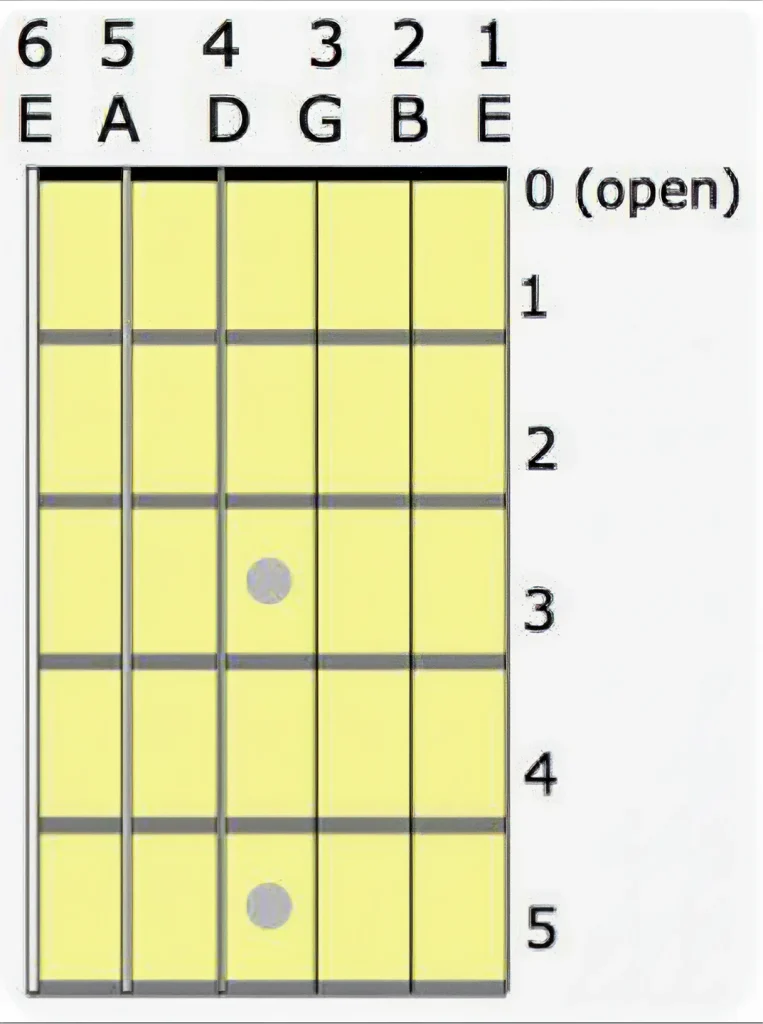
Now, along with the names, these strings also have numbers. This is where beginners sometimes get tripped up because the numbering feels a bit backwards. So, here’s how the guitar string numbers work: the thinnest string (high E) is number 1, and count upwards to the thickest string (Low E), which is string 6. To make it easier to understand, when you hold the guitar in the playing position and look down, the string closest to the floor is string 1, and the one nearest to your face is string 6.
Historically, this has been the way to count. The thinnest string was considered the “first” because melodies are often played on it. Plus, when your fretting hand reaches for the strings, the thinnest one is naturally the first your fingers touch. Understanding numbers on guitar strings is crucial for reading tabs, following chord diagrams and understanding your teacher’s instructions during online guitar lessons.
Guitar String Names, Numbers, and Order
Here is a quick guitar string names and numbers chart you can bookmark or screenshot for handy reference:
| String Number | String Name | Thickness |
| 6th string | E (Low E) | Thickest |
| 5th string | A | ↓ |
| 4th string | D | ↓ |
| 3rd string | G | ↓ |
| 2nd string | B | ↓ |
| 1st string | E (High E) | Thinnest |
This is the most useful guitar string chart for beginners. Print it, stick it on your wall, or save it on your phone. You will be referring to it more often than you think.
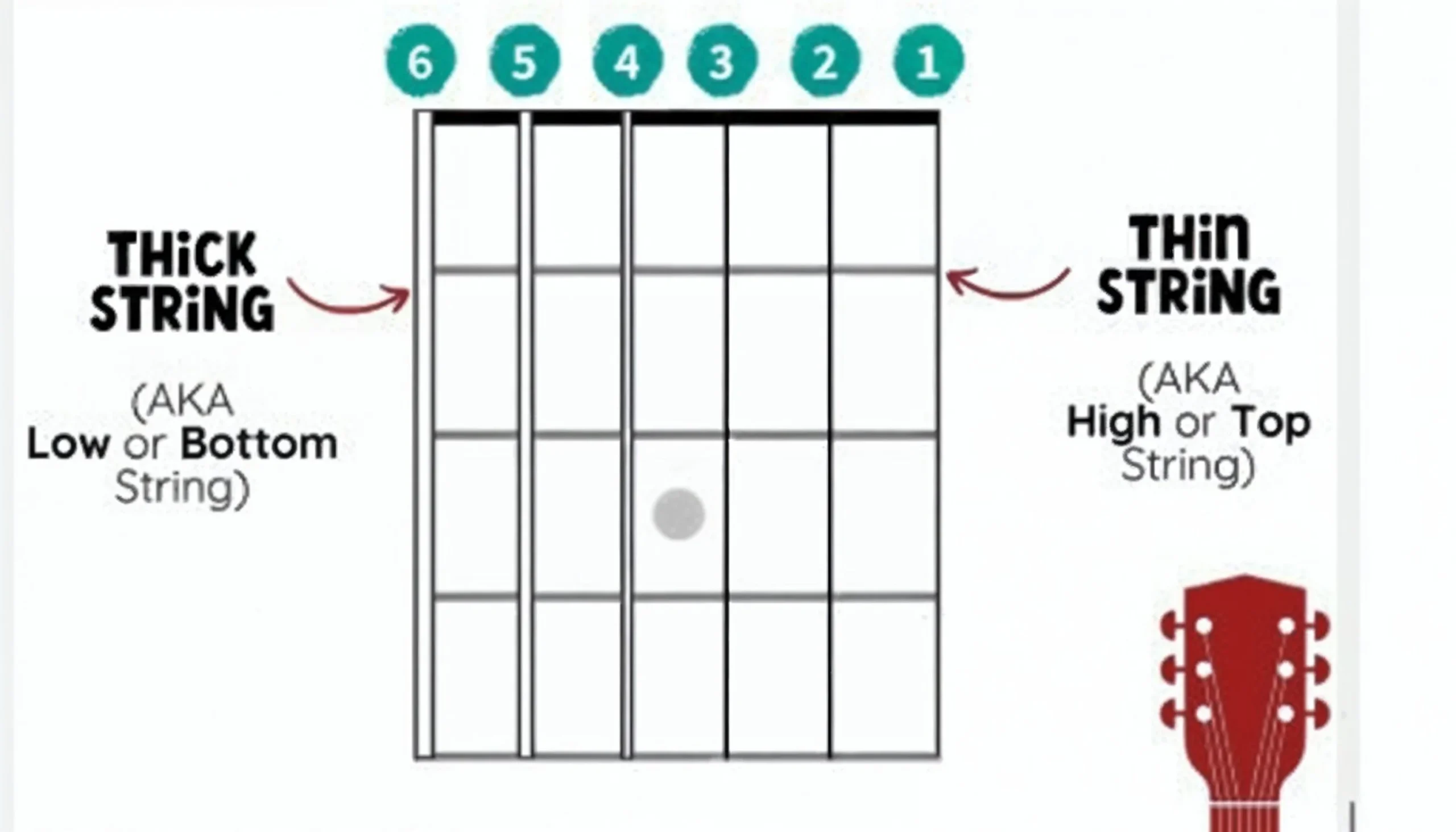
Now, you will notice that guitar string names can be read in two directions, and different contexts use different orders.
Thick to Thin (6th > 1st): E-A-D-G-B-E
The most common order used in tuning the guitar, string packaging and when reciting string names aloud.
Thin to Thick (1st > 6th): E-B-G-D-A-E
This order appears on tabs (where the 1st string sits at the top) and in some chord charts.
Both these sequences represent the same strings; it is all about which end you start from. As a beginner, get comfortable with the thick-to-thin order first (E A D G B E), since that is how most lessons and tutors present it.
Ways to Remember Guitar String Names and Numbers
The easiest way to remember these random 6-letter words is with mnemonics. A mnemonic gives you a fun phrase where the first letter of each word matches a string name. Here are some tried and tested favorites for remembering E-A-D-G-B-E (thick to thin):
- Eddie Ate Dynamite, Good Bye Eddie
- Every Amateur Does Get Better Eventually
- Eat a Darn Good Breakfast Every Day
- Elephants and Donkeys Grow Big Ears
Now, if you want from thin to thick (E-B-G-D-A-E)
- Every Beginner Gets Dinner At Eight
You can always create your own mnemonic that you are comfortable with. The sillier or more personal it is, the better it sticks. Try making one that uses names from your favorite movie, your pet’s habits, or your daily routine. If it makes you laugh, you will never forget it.
Here are some of the reasons why memorizing the guitar string names and guitar string numbers matters in practice:
- Reading tabs and chord charts. Tabs use string numbers to tell you exactly where to place your fingers. Without knowing which string is which, tabs are just confusing grids of numbers.
- Tuning your guitar. Whether you use an app or tune by ear, you need to know which string should produce which note. A tuner will display letters like E, A, D. You ought to know which string it is referring to.
- Following lessons and tutorials. Every teacher, whether in person or online, will refer to strings by name or number. “Place your finger on the 2nd fret of the A string.” This only makes sense if you know where that is.
- Communicating with other musicians. While jamming or discussing music, string names and numbers offer shared vocabulary.
Common Beginner Mistakes with Guitar Strings
The following are some of the mistakes made by beginners. Knowing them in advance can save you from frustration:
- Mixing the numbering direction – String 1 is the thinnest (high E), not the thickest. Many beginners mistake string 1 as the top, but it is actually the bottom.
- Confusing “top” and “bottom” – In guitar terminology, “bottom strings” refers to the lowest-pitched string (Low E/6th), even though it is physically closest to your face when playing. The “top string” is actually the highest-pitched one (High E/1st) near the floor. This is a common mistake made by almost everyone.
- Not learning string names properly is a rookie mistake: beginners skip this step and jump straight to chords. While it works initially, it eventually slows progress when they can’t keep up with tabs or instructions.
- Putting strings in the wrong order when restringing: beginners sometimes mix up the gauges. Always go thickest to thinnest, top to bottom.
Your Strings, Your Starting Point
So, that’s about it, everything you need to know to confidently identify, name and number every string on your guitar. It might seem like a small step, but knowing your guitar string names and numbers is the foundation that makes chords, scales, songs and every future lesson click into place. Having the right guidance makes all the difference if you are serious about building a strong musical foundation.
At Artium Academy, our online guitar lessons are designed for learners of all ages and levels, from beginners to advanced players. Our curriculum is curated by legendary Bollywood music composer and guitarist, Raju Singh, who brings decades of experience in composing for films, TV shows and albums.
Whether it is guitar lessons for kids just starting out or guitar classes for adults rediscovering their passion, Artium Academy offers expert-led, 1:1 live online music classes that meet you exactly where you are. So, pick up your guitar, name those strings and let’s make some music.
FAQs
The 6 strings of a standard guitar, from the thickest to the thinnest, are E (Low E), A, D, G, B, and E (High E). Each string is named after the note it produces when played open, i.e., without pressing any fret. The thickest string (Low E) produces the deepest sound, while the thinnest string (High E) produces the brightest, highest-pitched sound.
The 1st string on a guitar is the thinnest string, also known as the High E string. When you hold the guitar in the playing position, the string closest to the floor is the one you play. It produces the highest pitch among all six strings. Beginners often confuse this, assuming the thickest string is the 1st but in guitar numbering, it’s the opposite: the thinnest string is String 1, and the thickest (Low E) is String 6.
C2–G2–D3–A3–E4–G4 is not a standard guitar tuning. However, it closely resembles All-Fifths Tuning (C2–G2–D3–A3–E4–B4), in which the guitar is tuned to perfect fifths, as a violin or mandolin is. The standard tuning for a 6-string guitar is E2–A2–D3–G3–B3–E4, where the number beside each note indicates the octave it belongs to. If you have come across C2, G2, D3, A3, E4, G4, it is likely an alternate tuning used for extended-range or experimental playing.
The terms 1/2 and 3/4 typically refer to time signatures in music. In 3/4 time, there are 3 beats per measure, with each beat being a quarter note. This creates a waltz-like rhythm: 1-2-3, 1-2-3. You strum or pick on beat 1 (strong), beat 2 (weak), and beat 3 (medium), giving the music a flowing, dance-like feel. In 2/4 time (often written as 2/4, not 1/2), there are 2 beats per measure, creating a march-like rhythm: 1-2, 1-2. To practise these, tap your foot to the beat and strum along, emphasising beat 1 in each measure to feel the groove naturally.
Yes! While 6 strings are the standard, guitars can have 7, 8, 10, 12, and even 18 strings. Seven-string guitars add a low B string below the standard Low E and are popular in heavy metal and progressive rock. Eight-string guitars add both a low B and F# for even greater range. Twelve-string guitars double each of the six strings to produce a rich, shimmery, chorus-like sound and are widely used in folk and rock music. Double-neck guitars, like the ones famously used by Led Zeppelin, combine a 6-string and a 12-string neck in one instrument. However, for beginners, the standard 6-string guitar is the ideal starting point.