
All Topics
- Alchemizing Music Concepts for Students
- Artist Spotlight
- artium gift card
- Artium Maestros
- Artium News
- buying guide
- Carnatic Music
- Devotional Music
- Editorials by Ananth Vaidyanathan
- Film Music
- Guitar
- Hindustani Classical Music
- Indian Classical Music
- Indian Folk Music
- Insights
- Instruments
- Karaoke Singing
- Keyboard
- Kids Music
- maestros
- Music Education
- Music for Kids
- Music Industry
- Music Instruments
- Music Legends
- Music Theory
- Music Therapy
- Piano
- piano guide
- Success Stories
- Tamil Film Music
- Telugu Film Music
- Time Theory
- Tools
- Uncategorized
- Uncategorized
- Uncategorized
- Uncategorized
- Vocal Singing
- Vocals
- western classical music
- western music
- Western vocal music
The Role of Raag Yaman In Hindustani Music: A Beginner’s Guide
The Role of Raag Yaman In Hindustani Music: A Beginner’s Guide
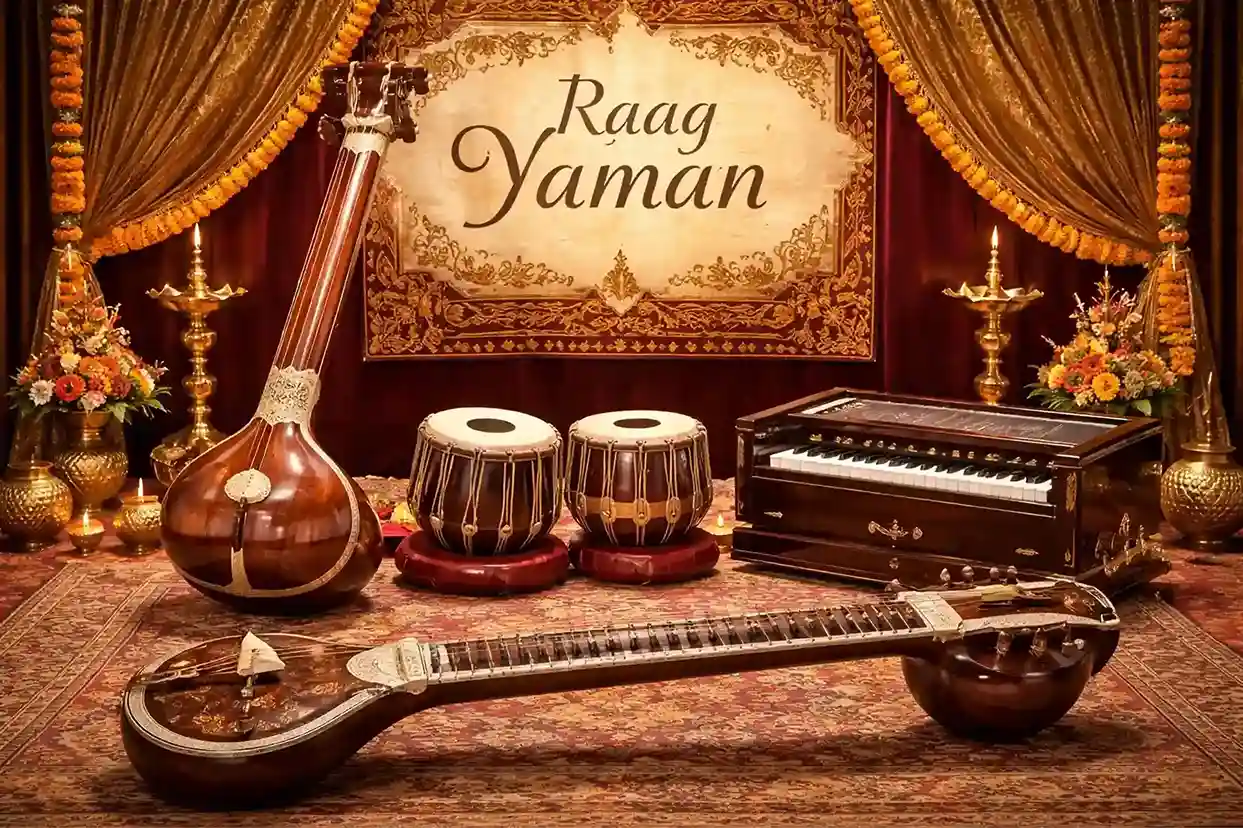
Table of Contents
On a quiet evening, as the sky turns deep blue and the first stars begin to shimmer, a gentle melody rises. This is Raag Yaman, the magical doorway to Hindustani classical music. For generations, Yaman has been the very first raga that welcomes beginners into the vast and beautiful world of swaras. With its glowing Tivra Madhyam and flowing movement, it feels like a lamp being lit in the darkness, calm, graceful, and full of hope.
Yaman Raga plays a powerful role in shaping a student’s musical foundation. It teaches balance, emotion, voice control, and the beauty of expression. Whether learned traditionally or through online Hindustani music classes, information about Raag Yaman becomes a student’s first true musical companion. In many Hindustani music classes, this raag is not just taught; it is experienced, felt, and cherished. It is where the journey begins, and where passion for music truly awakens.
Introduction to Kalyan: Aadi Swaroop of Raag Yaman
Raga Yaman is one of the most fundamental and widely performed ragas in Hindustani Classical Music. Its Aadi Swaroop (original form) is known as Kalyan, from which Yaman has evolved into a refined, stylized presentation. The term Kalyan means “auspicious” or “blessed,” reflecting the serene and devotional nature associated with this melodic framework.
About Raag Yaman
The origins of Raag Yaman trace back to the Kalyan Thaat, one of the ten parent scales (Thaats) classified by Pandit Vishnu Narayan Bhatkhande in the early 20th century. Raag Yaman Kalyan is a graceful evening raga of the Kalyan thaat, blending the luminous Teevra Madhyam of Yaman with subtle Shuddha Madhyam touches, creating a rich and expansive melodic expression.
Kalyan Thaat is characterized by the presence of Tivra Madhyam (Ma#) along with all other shuddha swaras:
Sa, Re, Ga, Ma (Tivra), Pa, Dha, Ni
Raag Yaman uses all seven swaras in both ascent and descent (Sampoorna–Sampoorna Jati) and prominently features Tivra Madhyam, which gives the raga its luminous and expansive character.
The name “Kalyan” appears in ancient texts and traditional raga classifications. In earlier times, the melodic form we now call Yaman was referred to simply as Kalyan. Over centuries, stylistic developments and regional influences shaped its presentation.
Historical Context and Evolution of the Name “Yaman”
The name “Yaman” is believed to have evolved during the medieval period, possibly influenced by Persian or Middle Eastern cultural interactions during the Mughal era. Some scholars suggest that the term may be derived from “Yemen” (Yaman in Persian/Arabic pronunciation), reflecting Indo-Persian musical exchanges. However, musically, the structure remained rooted in the traditional Kalyan framework.
In classical texts such as Sangeet Ratnakar by Sharngadeva (13th century), the direct mention of Yaman is not found, but the melodic principles associated with Kalyan were well established. Later musicological works and oral traditions solidified Yaman’s identity as distinct yet derived from Kalyan.

In modern Hindustani music, a subtle distinction is sometimes made:
- Kalyan may occasionally include Shuddha Ma as a grace note
- Yaman strictly emphasizes Tivra Ma and follows a more defined chalan (movement)
Today, Raag Yaman stands as one of the foundational ragas taught to beginners, symbolizing purity, balance, and devotion. Its deep connection to Kalyan Thaat makes it an essential starting point for understanding the grammar and aesthetics of Hindustani Classical Music.
Understanding The Raag Yaman Notes Structure
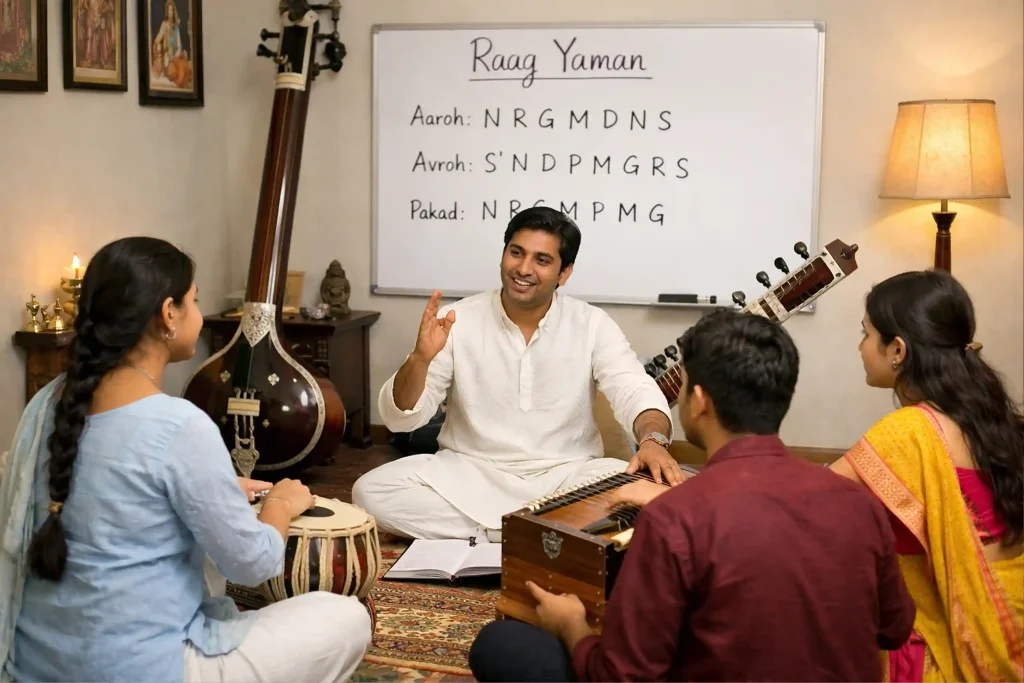
Raag Yaman belongs to the Kalyan Thaat and is known for its bright and expansive character. Raag Yaman notes use all seven swaras with Teevra Madhyam and shuddha (natural) Sa, Re, Ga, Pa, Dha, Ni, forming its characteristic Sampurna–Sampurna scale framework.
Aroh (Ascending): Ni Re Ga Ma (Tivra) Pa Dha Ni Sa
Avroh (Descending): Sa Ni Dha Pa Ma (Tivra) Ga Re Sa
Raag Yaman is a Sampoorna–Sampoorna Jati raga, meaning it uses all seven notes in both ascent and descent.
- Vadi (most important swara): Ga (Gandhar)
- Samvadi (second most important swara): Ni (Nishad)
- Pakad (signature phrase): Pa Re, Ga Re, Ni Re Sa
The raga is performed during the first prahar of the night and expresses peace, devotion, and gentle romance. The emphasis on Tivra Ma gives it a luminous, graceful quality.
Explanation of How Raag Yaman Was Named
Originally, this raga was known as Kalyan, meaning “auspicious” or “blessed.” Over time, the name Yaman became more popular in performance traditions. It is believed that the term “Yaman” may have Persian or Middle Eastern origins, possibly derived from the word “Yemen” (pronounced “Yaman” in Persian).
During the Mughal period, cultural exchanges between Indian and Persian traditions influenced musical terminology. Though the melodic structure remained rooted in the ancient Kalyan framework, the name Yaman became widely accepted in North Indian classical music.
Key Historical References
Ancient texts such as Sangeet Ratnakar by Sharngadeva (13th century) mention the concept of Kalyan, though the name Yaman appears later in musical history.
In the modern era, Pandit Vishnu Narayan Bhatkhande classified Yaman under the Kalyan Thaat in his systematic arrangement of ragas. His work helped standardize its structure and notation.
Thus, Raag Yaman stands as a beautiful blend of ancient tradition and historical evolution, holding a central place in Hindustani Classical Music.
Raagas Close to Yaman
Raag Yaman, belonging to the Kalyan Thaat, has inspired several closely related ragas that share similar swaras or emotional colour. Because Yaman uses all seven notes with a prominent Tivra Madhyam (Ma#), many ragas derived from or connected to Kalyan Thaat naturally resemble it in structure or mood.
Similar Raagas
Some ragas closely related to Yaman include:
- Yaman Kalyan- This is almost identical to Yaman but may occasionally use Shuddha Ma as a grace note along with Tivra Ma
- Shuddha Kalyan- This is Bhupali with tivra Ma and suddha Ni in descending and with a typical use of Meend
- Puriya Kalyan- This combines features of Puriya and Yaman, with strong emphasis on Ni and Ga, creating a slightly more serious mood
- Bhoopali (in thaat relation)- Raag Bhoopali is generally classified under Kalyan Thaat in modern theory, as its swara framework aligns with the Kalyan parent scale
Similarities and Differences
The main similarity among these ragas is the use of Tivra Madhyam, which gives them a bright, devotional quality. However, their chalan (movement), vadi-samvadi, and emotional mood create distinct identities.
For example:
- In Yaman, Ga is the Vadi and Ni is the Samvadi, and the Pakad is Pa Re, Ga Re, Ni Re Sa.
- In Puriya Kalyan, the movement is more curved and serious, and the emphasis on Re and Ni changes the mood.
Thus, even if the swaras appear similar, the personality of each raga differs.
Categorization of Bhoopali and Yaman
Although Raag Bhoopali and Raag Yaman are both melodious and often taught to beginners, they differ structurally.
Raag Yaman
- Jati: Sampoorna–Sampoorna (7 notes)
- Uses: Tivra Ma
- Thaat: Kalyan
Raag Bhoopali
- Jati: Audav–Audav (5 notes)
- Swaras: Sa Re Ga Pa Dha Sa
- No Ma and No Ni used
- Traditionally placed under Kalyan Thaat by some musicologists because of its swara arrangement possibilities, though it does not use Tivra Ma in performance.
The Thaat Classification
In the Bhatkhande Thaat system, ragas are grouped under parent scales called Thaats.
- Raag Yaman clearly belongs to Kalyan Thaat because it includes Tivra Madhyam along with all other shuddha swaras.
Raag Bhoopali is also often categorized under Kalyan Thaat in modern classification, as its theoretical parent scale aligns with Kalyan when arranged in full form, even though Bhoopali omits Ma and Ni in practice.
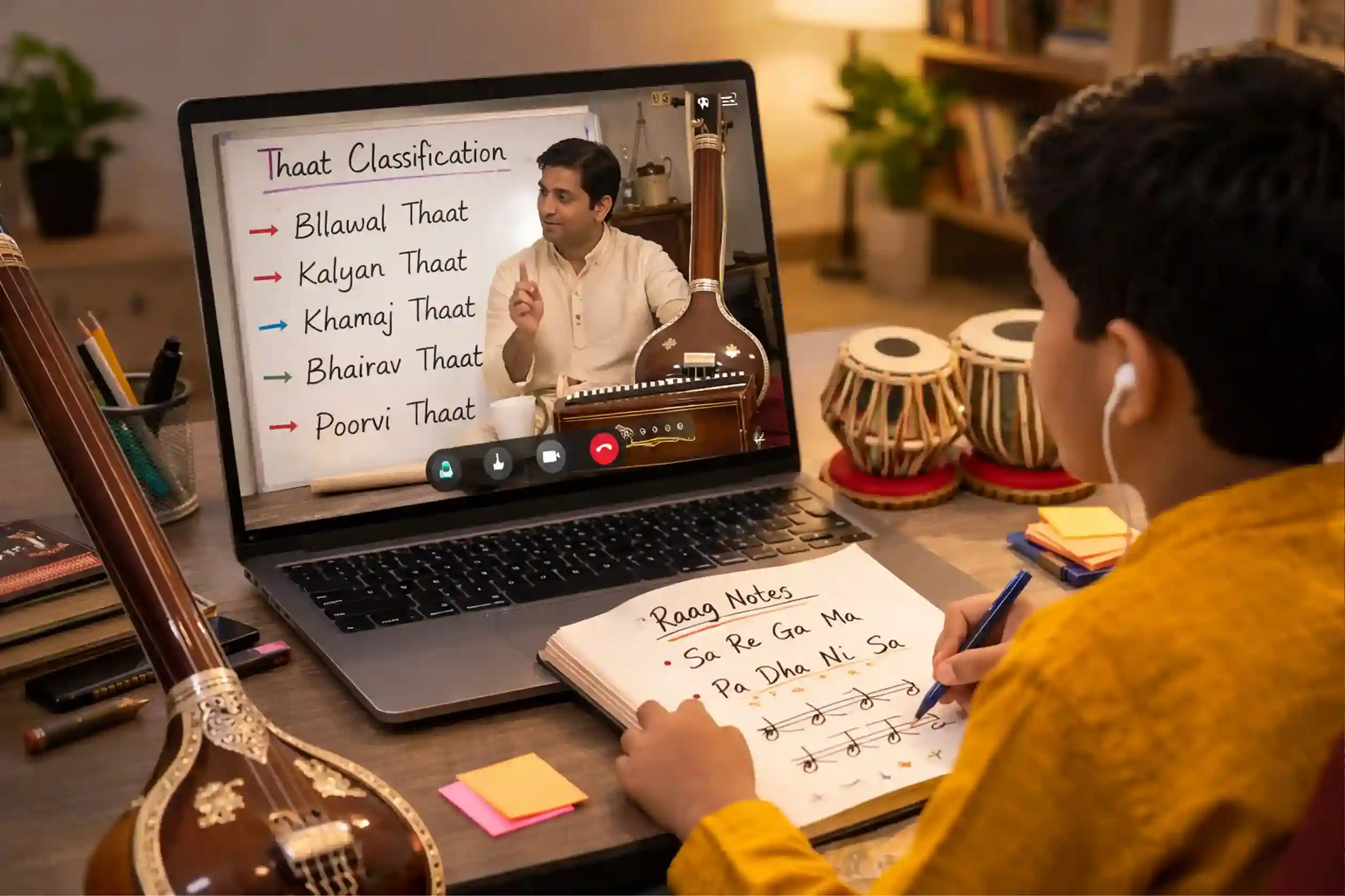
This classification helps students understand the structural relationships between ragas and their melodic families in Hindustani Classical Music.
Bilawal Scale Vs. Yaman Scale
In Hindustani Classical Music, both Bilawal and Yaman are foundational scales that help students understand the structure of ragas. While they may appear similar at first glance because both use seven swaras, their emotional character and musical identity are quite different.
Scale Structure Comparison
Bilawal Scale (Bilawal Thaat):
Sa Re Ga Ma Pa Dha Ni Sa
(All swaras are Shuddha or natural)
Yaman Scale (Kalyan Thaat):
Sa Re Ga Ma# Pa Dha Ni Sa
(Uses Tivra Madhyam (Ma#) instead of Shuddha Ma)
The key structural difference lies in the fourth note:
- Bilawal uses Shuddha Ma
- Yaman uses Tivra Ma (raised Ma)
This single change creates a completely different tonal colour.
Aroh–Avroh
Raag Bilawal
Aroh: Sa Re Ga Ma Pa Dha Ni Sa
Avroh: Sa Ni Dha Pa Ma Ga Re Sa
Raag Yaman
Aroh: Ni Re Ga Ma# Pa Dha Ni Sa
Avroh: Sa Ni Dha Pa Ma# Ga Re Sa
In Yaman, the ascent often begins from Ni, giving it a graceful, flowing entry, whereas in Bilawal it generally begins from Sa, making it straightforward and balanced.
Emotional and Aesthetic Contrast
Bilawal has a pure, bright, and cheerful nature. It represents simplicity and stability. Because all notes are natural, it closely resembles the Western Major Scale (Ionian mode). Its mood is joyful and often associated with morning time.
Yaman, on the other hand, has a romantic, devotional, and serene mood. The use of Tivra Ma gives it a luminous, slightly dreamy quality. It is performed during the first prahar of the night, and its melodic movement feels more expansive and graceful compared to Bilawal.
Musical Identity and Usage
Bilawal is considered the basis for understanding pure swaras and is important in music theory. It is often used to introduce students to shuddha swaras.
Yaman is one of the first ragas taught practically because it beautifully demonstrates how a single altered swara (Tivra Ma) can transform the entire emotional landscape of a scale.
Key Contrast Summary
| Feature | Bilawal | Yaman |
| Thaat | Bilawal | Kalyan |
| Madhyam | Shuddha Ma | Tivra Ma |
| Mood | Bright, Joyful | Devotional, Romantic |
| Time | Morning | Early Night |
Thus, while both scales contain seven notes, the shift from Shuddha Ma to Tivra Ma makes Yaman far more expressive and emotionally nuanced compared to the straightforward purity of Bilawal. Traditional bandishes like “Piya ki najariya jaadu bhari” and “Eri aali piya bin” are foundational compositions in Yaman Raag Bandish that help students internalize its melodic structure and phrasing.
Academic Overview and Practice Framework of Raag Yaman
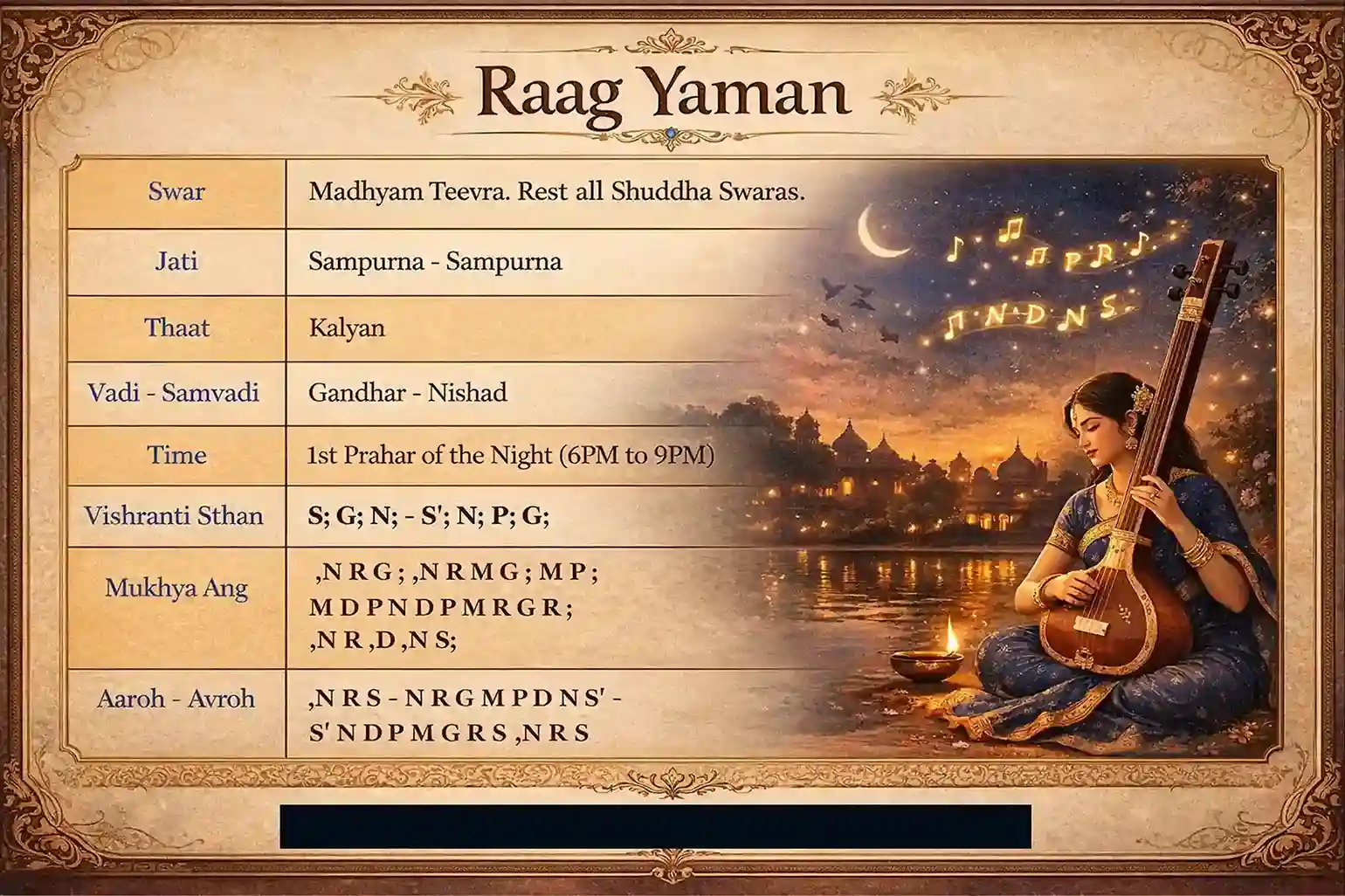
Raag Yaman is a prominent evening raga in Hindustani classical music, belonging to the Kalyan thaat. Its defining feature is the use of Teevra Madhyam (Ma♯), while all other swaras, Sa, Re, Ga, Pa, Dha, and Ni, are shuddha (natural). Structurally, it is a Sampurna–Sampurna raga, employing all seven notes in both ascent and descent. The vadi (primary note) is Gandhar (Ga), and the samvadi (secondary note) is Nishad (Ni), establishing a melodic axis between these two swaras.
Performed during the first prahar of the night (approximately 6 PM to 9 PM), Raag Yaman evokes a mood of serenity, devotion, and gentle romanticism. Its aesthetic character is luminous and expansive, often associated with tranquility and spiritual elevation. A distinctive feature is the graceful treatment of Teevra Ma, which must be rendered with clarity and emotional sensitivity. The raga avoids abrupt or forceful transitions, favoring smooth meend (glides) and sustained notes, especially around Ni–Re and Ga–Ma. The frequent use of lower Ni leading into Re enhances its introspective quality.
Raag Yaman PDF – A PDF of sitar notation and basic structure for Raag Yaman Kalyan (Aaroh, Avroh, Pakad, sthāi & antara) is available here: SITAR – Raga Yaman Kalyan (PDF).
Chalan Description
The chalan of Raag Yaman reflects its characteristic movement and grammar. It emphasizes the phrase Ni Re Ga and the oscillation between Ga and Teevra Ma. A typical progression includes: Ni Re Ga, Re Ga Ma (Teevra), Pa, Ma Dha Pa, Ni Dha Pa, Ma Ga Re. The descent often highlights the glide from upper Sa to Ni and Dha, resolving gently toward Ga or Sa.
A distinctive aspect of Yaman’s chalan is the importance of starting phrases from Ni in the lower octave, such as Ni Re Ga or Ni Re Sa. The most important descending Meend for Yaman or Kalyan Thaat is Pa to Re. The chalan avoids direct, linear scalar runs without expressive ornamentation; instead, it unfolds through curved, lyrical movements that preserve its contemplative mood.
Aroh-Avroh and Pakad
The canonical Aroh (ascent) of Raag Yaman is:
Ni Re Ga Ma (Teevra) Pa Dha Ni Sa’
The Avroh (descent) is:
Sa’ Ni Dha Pa Ma (Teevra) Ga Re Sa
In some interpretations, Sa is approached through Ni Re Sa in ascent, reinforcing the raga’s signature entry from lower Ni.
The Pakad (signature phrase) encapsulates the raga’s essence:
Ni Re Ga, Re Ga Ma (Teevra), Pa; Ma Ga Re; Ni Re Sa
This phrase demonstrates the prominence of Ni Re Ga and the graceful handling of Teevra Ma. Accurate rendering of the pakad is essential for establishing the raga’s identity, especially in improvisational contexts.
Swar Phrases for Aalap, Vistaar, and Taan
In Aalap, swar phrases are developed slowly and meditatively. Phrases such as Ni Re Ga, Ga Ma (Teevra) Pa, and Ma Dha Ni Sa’ are elaborated with sustained notes and meend. Emphasis is placed on Ga and Ni as nyas (resting) swaras.
For Vistaar, the expansion includes broader movements across octaves:
Ni Re Ga Ma Pa; Ma Dha Ni Sa’; Sa’ Ni Dha Pa; Ma Ga Re Sa.
The elaboration must maintain clarity of Teevra Ma and avoid overuse of Pa as a resting point.
In Taan practice, patterns may include:
Ni Re Ga Ma Pa Dha Ni Sa’; Sa’ Ni Dha Pa Ma Ga Re Sa.
Taans should be fluid and maintain the raga’s grammar, avoiding phrases alien to Kalyan ang.
Swar Vistaar Practice
A session on Swar Vistaar begins with systematic note expansion. Students sing elongated phrases such as Ni Re Ga—Ga Ma (Teevra) Pa—Pa Dha Ni Sa’, focusing on tonal purity and breath control. The objective is to expand the chalan while preserving the raga’s emotional essence.
Reinforcing previously learned swar phrases ensures technical accuracy and fluency. Repetition with attention to intonation, especially of Teevra Ma, refines the melodic contour. Through consistent practice of structured phrases and gradual improvisation, learners internalize Raag Yaman’s grammar and expressive depth.
Influence of Raag Yaman in Hindi Film Songs
Raag Yaman has had a deep influence on Hindi film music due to its melodic richness and emotional versatility. Rooted in the Kalyan thaat and characterized by the use of Teevra Madhyam, Yaman creates a serene, romantic, and devotional atmosphere. Many Hindustani classical and semi-classical pieces are Raag Yaman songs, including instrumental recordings like Raag Yaman by Budhaditya Mukherjee and bandish renderings in Teen Taal & Rupak.
Film composers have frequently adapted its structure to craft songs that are melodious yet accessible to a wide audience. While cinematic interpretations may simplify classical grammar, the essential phrases such as Ni Re Ga and the luminous touch of Teevra Ma remain identifiable.
Raag Yaman Hindustani is a central evening raga in Hindustani classical music, celebrated for its serene mood, elegant ascents and descents, and its role as an early pedagogical raga for learners.
Romantic Expression in Cinema
One of the most celebrated examples is “Chaudhvin Ka Chand Ho” (film: Chaudhvin Ka Chand, music by Ravi). The song reflects Yaman’s graceful ascent and soothing tonal quality, especially in its treatment of Ga and Ni. Similarly, “Jab Deep Jale Aana” (film: Chitchor, music by Ravindra Jain) beautifully captures the devotional-romantic mood of the raga. The melodic flow mirrors Yaman’s smooth chalan and balanced movement between middle and upper octaves.

Classical Influence and Semi-Classical Adaptations
The song “Man Re Tu Kahe Na Dheer Dhare” (film: Chitralekha, music by Roshan) strongly reflects classical Yaman in its structure and contemplative mood. Its slow tempo allows space for note expansion resembling aalap and vistaar. Another notable composition is “Dil Jo Na Keh Saka” (film: Bheegi Raat, music by Roshan), where the melodic lines prominently feature Yaman’s characteristic phrases and emotional depth.
https://youtu.be/N5UipW8J0js?si=xHIAoqOmtZZGB6RB
Modern Adaptations
In later cinema, “Tum Dil Ki Dhadkan Mein” (film: Dhadkan, music by Nadeem-Shravan) demonstrates how Yaman continues to inspire romantic melodies. Though harmonized with contemporary orchestration, its foundational swar patterns align closely with the raga’s aroh–avroh framework.
Hindustani Music Classes: Learn Raag Yaman at Artium Academy
Raag Yaman stands as one of the most essential and foundational ragas in Hindustani classical music, offering students a deep understanding of melody, expression, and raga grammar. Its structured aroh–avroh, distinctive pakad, and the nuanced use of Teevra Madhyam make it an ideal raga for building strong technical and aesthetic foundations.
For those beginning their journey, Raag Yaman for beginners provides clarity in swara placement, voice culture, and raga development, while advanced learners explore aalap, vistaar, and taan with greater depth.Indian classical music for kids introduces young learners to swaras, rhythm, and melody in a fun and structured way, helping build creativity, focus, and strong musical foundations.
At Artium Academy, students experience a structured and progressive approach to learning Hindustani music online, guided by expert music teachers. The academy teaches Learning Raag Yaman at the Proficient level, ensuring that learners understand not only the theoretical framework but also practical application through swar vistaar, chalan development, and performance techniques. From foundational concepts to advanced improvisation, Artium’s Hindustani music classes provide comprehensive training, helping students internalize the essence, discipline, and expressive beauty of Raag Yaman in a systematic and accessible way.
The blog is validated by Hindustani Classical, PFM Hindi Teacher Pranamita Roy .
FAQs on Raag Yaman
Raag Yaman is one of the most important and popular ragas in Hindustani Classical Music. It belongs to the Kalyan That and is known for its peaceful, devotional, and romantic mood. The speciality of this raga is the use of Tivra Madhyam (Ma#), while all other notes are Shuddha. It is a Sampoorna raga, meaning all seven notes are used in both Aroh and Avroh. Yaman creates a calm and soothing atmosphere and is often one of the first ragas taught to beginners.
In Raag Yaman, all seven notes are used, but one note makes it special Tivra Madhyam (Ma#). The other notes Sa, Re, Ga, Pa, Dha, and Ni, are Shuddha (natural). The Vadi (most important note) of Yaman is Gandhar (Ga), and the Samvadi (second most important note) is Nishad (Ni). These two notes are strongly emphasized during performance. The Pakad (important phrase) of Yaman is: Pa Re, Ga Re, Ni Re Sa, which helps identify the raga clearly.
Raag Yaman is sung during the first phase of the night, usually between 6:00 PM to 9:00 PM. In Hindustani Classical Music, ragas are assigned specific times to enhance their emotional effect. Yaman’s soothing and serene mood suits the calmness of early night. Singing it at the proper time helps bring out its full beauty and emotional depth. The peaceful atmosphere of evening perfectly matches the devotional and romantic nature of this raga.
Raag Yaman is often associated with the Anahata Chakra (Heart Chakra) in music therapy and spiritual practices. The Anahata Chakra represents love, compassion, peace, and emotional balance. Since Yaman creates a calm, devotional, and uplifting mood, it is believed to activate and balance this heart center. The soothing effect of Tivra Madhyam and the emphasis on Ga and Ni enhance feelings of inner harmony. Though chakra associations are spiritual interpretations, many believe Yaman promotes emotional healing and positivity.
Raag Yaman uses all seven notes and belongs to the Kalyan That. The most important note (Vadi) is Gandhar (Ga), and the second most important note (Samvadi) is Nishad (Ni). The unique feature of this raga is the use of Tivra Madhyam (Ma#) instead of Shuddha Ma. All other notes are natural. These key notes shape the identity and emotional expression of Yaman. Proper emphasis on Ga and Ni while using Tivra Ma gives the raga its graceful and majestic character.
Raag Yaman is traditionally performed in the early night, during the first prahar of the night (around 6 PM to 9 PM). In Hindustani Classical Music, each raga has a specific time based on its mood and tonal structure. Yaman’s bright and serene nature blends beautifully with the quiet and peaceful evening atmosphere. Performing it at the correct time enhances its emotional depth and devotional feel, making the experience more powerful for both the singer and the listener.