
All Topics
- Alchemizing Music Concepts for Students
- Artist Spotlight
- artium gift card
- Artium Maestros
- Artium News
- buying guide
- Carnatic Music
- Devotional Music
- Editorials by Ananth Vaidyanathan
- Film Music
- Guitar
- Hindustani Classical Music
- Indian Classical Music
- Indian Folk Music
- Insights
- Instruments
- Karaoke Singing
- Keyboard
- Kids Music
- maestros
- Music Education
- Music for Kids
- Music Industry
- Music Instruments
- Music Legends
- Music Theory
- Music Therapy
- Piano
- piano guide
- Success Stories
- Tamil Film Music
- Telugu Film Music
- Time Theory
- Tools
- Uncategorized
- Uncategorized
- Uncategorized
- Uncategorized
- Vocal Singing
- Vocals
- western classical music
- western music
- Western vocal music
Carnatic Music, Indian Classical Music
The Trinity of Carnatic Music: Tyagaraja, Muthuswami Dikshitar & Syama Sastri
The Trinity of Carnatic Music: Tyagaraja, Muthuswami Dikshitar & Syama Sastri
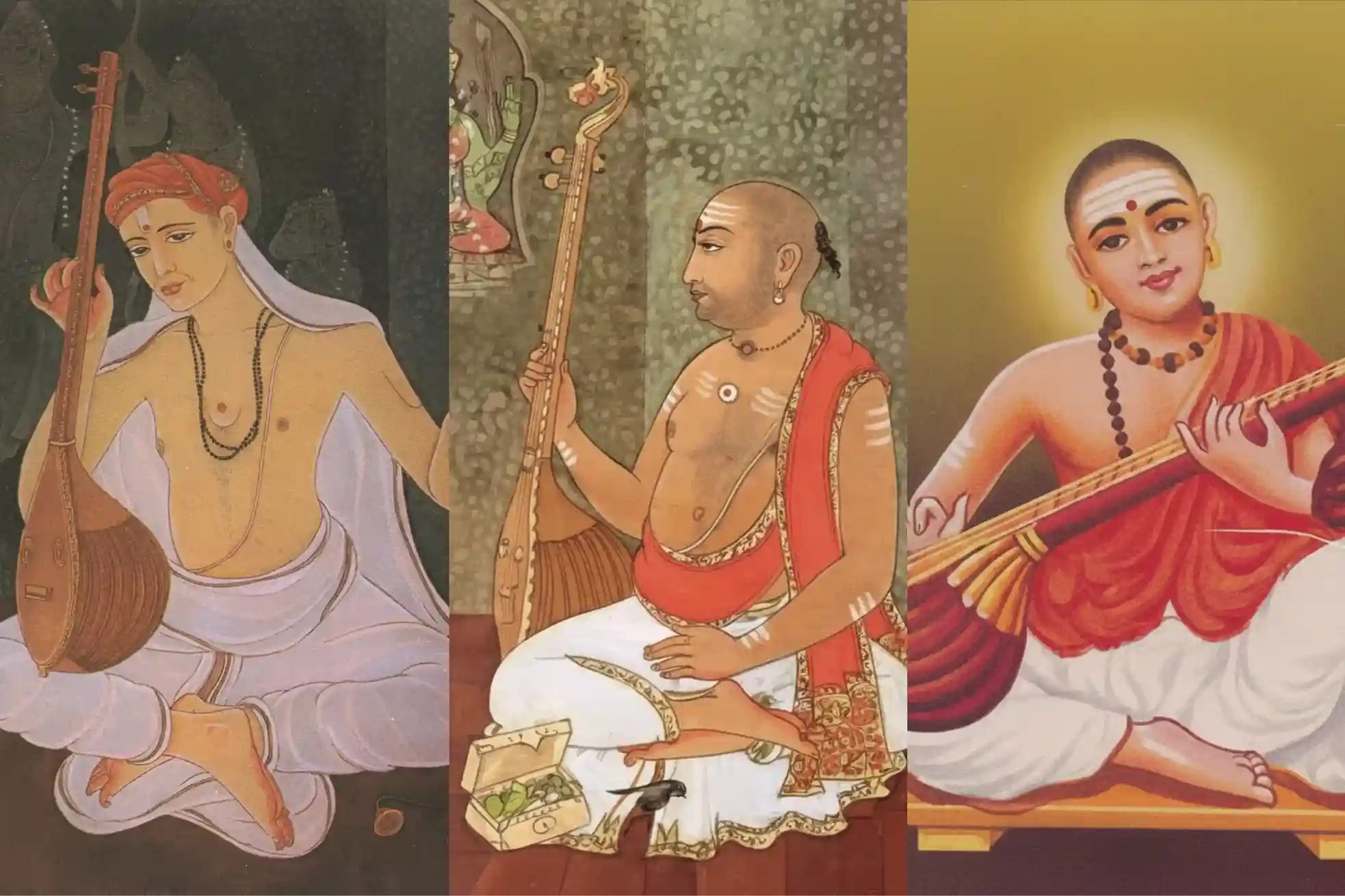
Table of Contents
Carnatic classical music, which flourished in South India, reached its greatest artistic and spiritual heights during the 18th and early 19th centuries through the contributions of three extraordinary composer -saints. These legendary musicians, such as Tyagaraja, Muthuswami Dikshitar, and Syama Sastri, are collectively known as the three jewels of Carnatic music. The trinity of Carnatic music holds a sacred and central place in the history of Indian classical arts.
Their compositions not only enriched the musical tradition but also laid a strong foundation for structured learning, performance, and devotion through music. Even today, their works dominate concert platforms, music syllabi, and Carnatic music instruction worldwide. Understanding who the Trinity is, their philosophy, and their musical genius helps students and rasikas appreciate why Carnatic music continues to thrive as a living tradition rooted in bhakti, discipline, and creativity.
What is Carnatic Classical Music?
Carnatic classical music is a rich and highly structured musical tradition that developed in South India, with a strong focus on devotion, discipline, and creativity. It is primarily taught through composition-based learning, where students first master songs before exploring improvisation. The heart of this system lies in its three core pillars.
- Ragas define the melodic identity of a composition. For example, raga Mohanam creates a bright and joyful mood, while Kalyani conveys grandeur and devotion.
- Talas provide rhythmic structure. Adi Tala (8 beats) and Rupaka Tala (3 or 6 beats) are commonly used in beginner and intermediate lessons.
- Kritis bring everything together by combining raga, tala, and meaningful lyrics, such as Tyagaraja’s devotional compositions or Muthuswami Dikshitar’s scholarly kritis.
Over centuries of evolution, these elements were refined and standardized by the Trinity, making Carnatic music ideal for systematic learning in both traditional and modern Carnatic vocal lessons.

In addition to these fundamentals of the trinity of Carnatic music, Carnatic classical music strongly emphasizes manodharma, or creative expression, in which musicians explore ragas through improvisational forms such as alapana, neraval, and swarakalpana. This balance between strict structure and creativity helps students develop both discipline and musical imagination.
Learning is traditionally oral, with close guidance from a teacher, ensuring clarity in pronunciation, raga purity, and rhythm. Today, this method has beautifully adapted to modern formats, allowing learners to experience authentic training through guided practice. As a result, Carnatic music continues to thrive across generations, remaining both deeply traditional and dynamically evolving in Carnatic vocal lessons.
Why Are They Called the Trinity of Carnatic Music?
Tyagaraja, Muthuswami Dikshitar, and Syama Sastri lived around the same time and worked independently, yet their collective contributions transformed Carnatic music permanently. They are called the Trinity because:
- Each had a distinct musical style
- Each composed kritis of exceptional depth and beauty
- Together, they covered a vast range of ragas, talas, and devotional themes
- Their works form the backbone of modern Carnatic concerts
Though they never collaborated as a group, their combined legacy is unmatched, making them the three jewels of Carnatic music.
Beyond their individual brilliance, the Trinity played a vital role in standardizing the musical grammar of Carnatic classical music. Their compositions established clear models for how ragas should be handled, how talas should be balanced, and how devotion could be expressed through music with both emotion and intellect.
Each composer focused on a different aspect, Tyagaraja on heartfelt bhakti, Muthuswami Dikshitar on scholarly depth, and Syama Sastri on rhythmic sophistication—creating a complete and balanced musical framework. Because of this, their kritis are not only performed on stage but are also essential study material in Carnatic vocal lessons at Artium Academy.
Tyagaraja: The Saint of Devotion and Simplicity
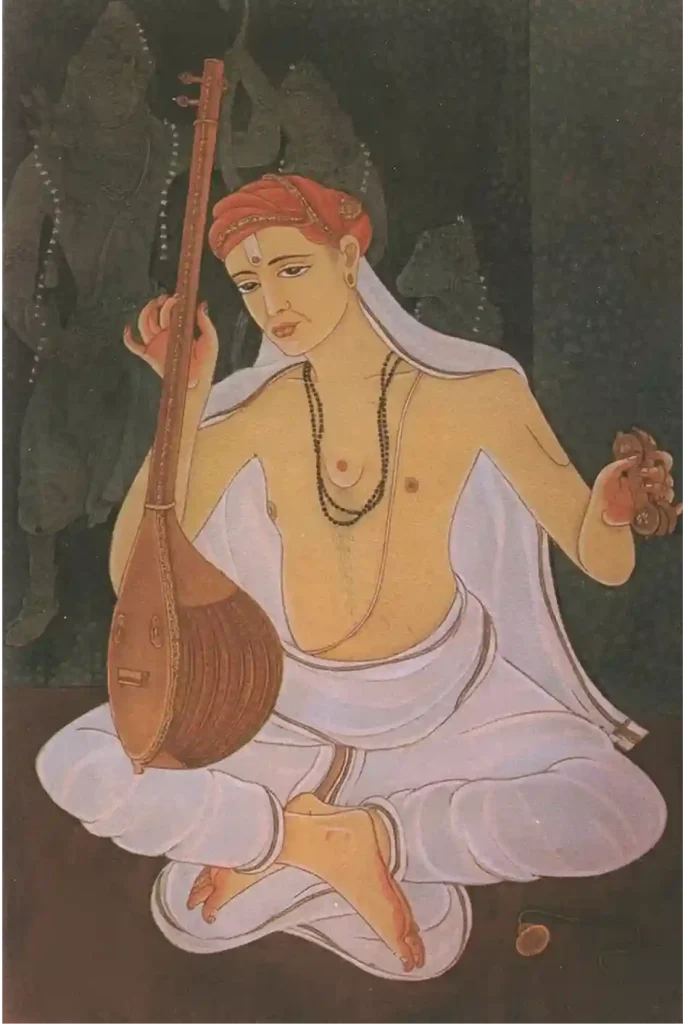
Tyagaraja (1767–1847) was born in Thiruvaiyaru, Tamil Nadu. A great devotee of Lord Rama, Tyagaraja viewed music as a direct path to spiritual liberation. He rejected royal patronage and lived a simple life dedicated to devotion and music.
Musical Contributions
- Composed over 600 kritis, mainly in Telugu
- Focused on bhakti (devotion) rather than technical display
- Popularized many ragas through accessible and emotional compositions
Tyagaraja’s kritis are often the first major compositions taught to students. Their clear structure makes them ideal for understanding raga bhava and lyrical meaning. His Pancharatna Kritis are still sung collectively by musicians worldwide.
Beyond his musical genius, Tyagaraja Swami played a crucial role in shaping the spiritual identity of Carnatic classical music. His compositions reflect deep philosophical ideas expressed in simple, heartfelt language, making them relatable to both scholars and common listeners. Many of his kritis explore themes of surrender, humility, and the relationship between the devotee and the divine.
Watch this
Tyagaraja, being one of the trinity of Carnatic music, also set a strong example for musicians by showing that music was not meant for fame or wealth, but for inner growth and devotion. Because of this approach, his works remain central to concerts, practice sessions, and structured Carnatic music learning, inspiring students even today.
Muthuswami Dikshitar: The Scholar and Musical Architect
Muthuswami Dikshitar (1775–1835) was a highly learned composer proficient in Sanskrit, philosophy, astrology, and music. He traveled extensively across India, absorbing musical influences and temple traditions.
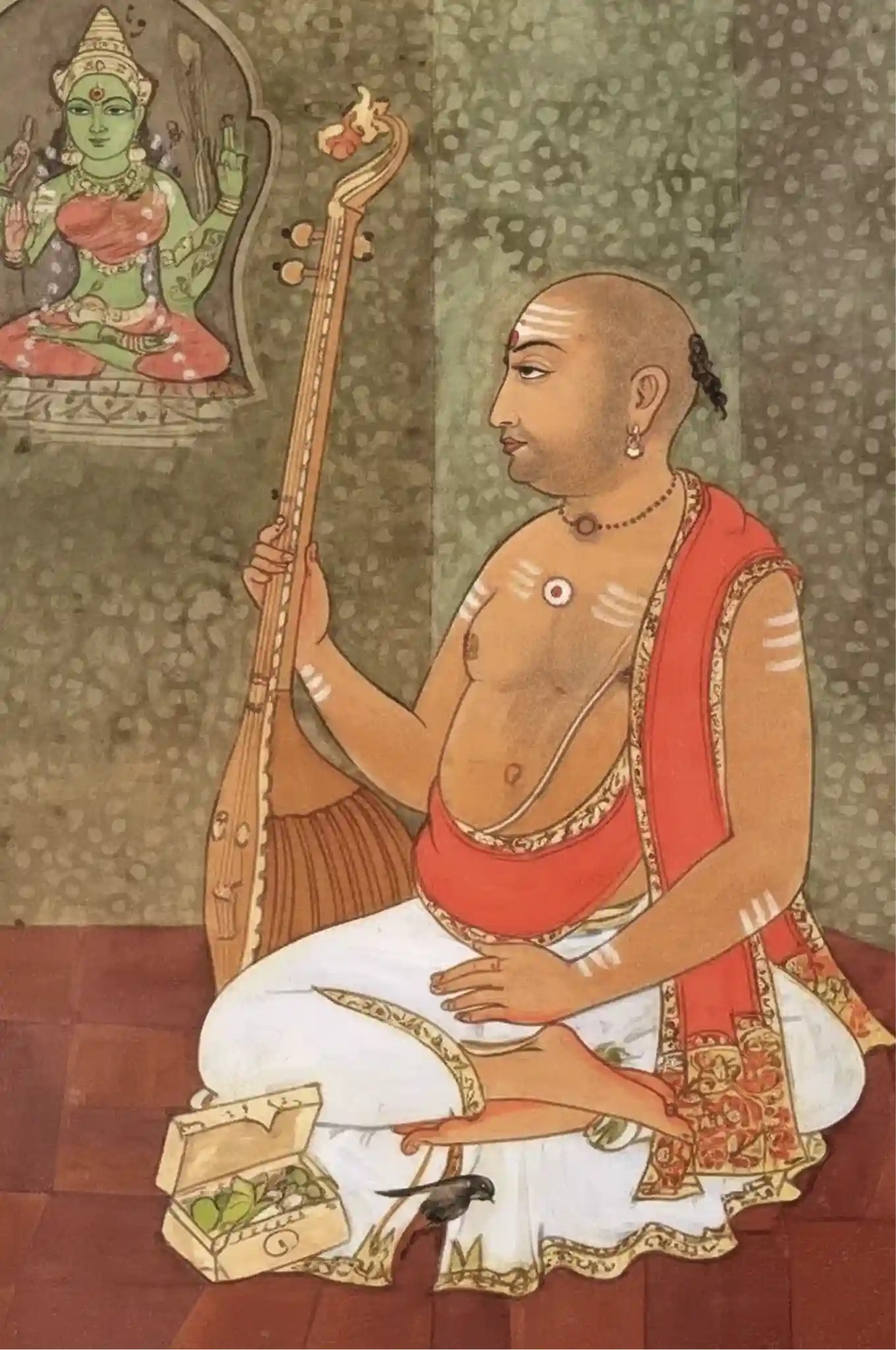
- Composed primarily in Sanskrit
- Known for complex melodies and majestic tempo
- Introduced rare and ancient ragas into mainstream Carnatic music
- His compositions follow the Dikshitar school, known for precision and grandeur
Muthuswami Dikshitar’s kritis are rich in lyrical meaning and musical sophistication. They are considered advanced pieces and are essential for higher-level Carnatic music learning.
In addition to his scholarly brilliance, Muthuswami Dikshitar brought a deeply meditative and temple-centric approach to Carnatic classical music. Many of his compositions are dedicated to specific deities and sacred temples, often describing their location, mythology, and iconography in exquisite detail.
Watch this- Muthuswamy Dikshitar Kriti- Sri Ramacandro- Sriranjani- Misra Chapu-ML Vasanthakumari
His kritis follow a slow, dignified pace that allows the raga to unfold gradually, demanding great control and precision from the performer. Dikshitar also made extensive use of vakra prayogas and traditional raga phrases, preserving ancient melodic forms. Because of their depth and complexity, his works play a vital role in Carnatic learning, helping students achieve musical maturity and refinement.
Syama Sastri: The Master of Rhythm and Emotion
Syama Sastri (1762–1827) was the eldest of the Trinity and lived in Thanjavur. He was a devoted worshipper of Goddess Kamakshi and expressed deep emotion through his music.
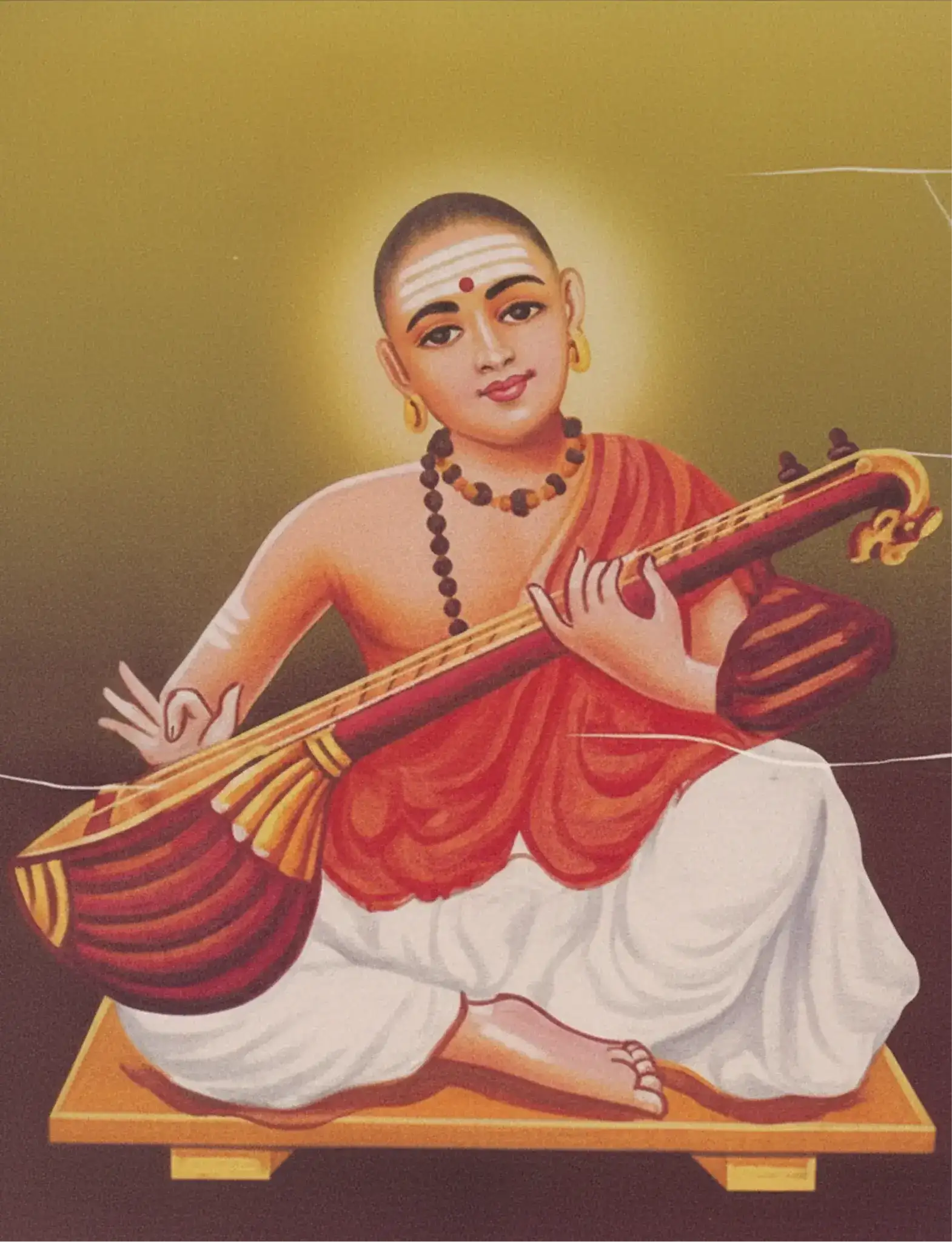
- Composed fewer kritis compared to the others
- Most compositions are in Telugu and Sanskrit
- Specialized in complex talas and rhythmic patterns
Syama Sastri’s works are known for their emotional intensity and rhythmic intricacy. His compositions challenge musicians to master laya (rhythm), making them invaluable in advanced training.
Watch this- Shyama Sastri Popular Krithis By M. S. Subbulakshmi | Ninnu Vina | Durusuga | Carnatic Music
Beyond these defining features, Syama Sastri brought a rare emotional depth and rhythmic sophistication to Carnatic classical music. His intense devotion to Goddess Kamakshi is evident in almost all his compositions, where music becomes a direct expression of surrender and longing. Unlike Tyagaraja and Muthuswami Dikshitar, Syama Sastri paid exceptional attention to laya, often using uncommon and intricate talas that demand advanced rhythmic understanding.
This makes his kritis especially valuable for serious students seeking mastery over rhythm and tempo. Though fewer in number, his compositions are powerful and enduring, forming an essential bridge between emotional expression and technical excellence.
Trinity Compositions (Kritis): The Heart of Carnatic Music
The Trinity Compositions (Kritis) form the core repertoire of Carnatic classical music. These kritis:
- Cover a wide variety of ragas and talas
- Combine devotion, philosophy, and musical excellence
- They are performed in almost every Carnatic concert
- Serve as primary teaching material in online Carnatic singing classes
Each composer brought a unique flavor, ensuring balance between devotion, intellect, melody, and rhythm. These timeless works are not merely songs but complete musical lessons that teach raga purity, tala discipline, and expressive singing.
Each kriti serves as a framework for both learning and performance, allowing musicians to explore improvisational elements such as alapana, neraval, and swarakalpana while staying rooted in tradition.
Because they span a vast range of ragas and talas, Trinity kritis help students gradually progress from basic understanding to advanced musical maturity. Their lyrical content blends devotion and philosophy, making music a spiritual experience rather than a mere performance.
As a result, these compositions are indispensable in modern pedagogy and andragogy are widely used as core material in music classes and Carnatic vocal lessons. Through these kritis, the Trinity continues to guide generations of learners and performers, keeping the tradition vibrant and alive.
Role of the Trinity in Modern Carnatic Music
Even today, the influence of the Trinity is unmistakable:
- Over 70% of concert items are Trinity kritis
- Music examinations and syllabi rely heavily on their works
- Students learn improvisation (alapana, neraval, swaras) using these compositions
Their music has become the standard framework through which Carnatic music is taught and performed globally.
The role of the Trinity extends far beyond preservation; they actively shape how Carnatic classical music is practiced and taught today. Their compositions act as benchmark models for raga development, rhythmic balance, and expressive singing, helping musicians maintain authenticity while exploring creativity. Concert musicians rely on Trinity kritis as dependable anchors around which elaborate improvisation can be built.
In academic settings, these works form the backbone of graded examinations, ensuring that students develop a strong foundation before progressing to advanced concepts. In modern learning formats, including Trinity compositions, continue to be the primary tools for teaching manodharma, voice culture, and stage performance skills.
Because of their universal appeal and structured design, the music of Tyagaraja, Muthuswami Dikshitar, and Syama Sastri transcends regional boundaries, uniting learners and performers worldwide under a shared musical language that defines Carnatic music today.
For beginners and advanced learners alike, the Trinity’s compositions are essential:
- Tyagaraja builds an emotional connection
- Muthuswami Dikshitar develops discipline and depth
- Syama Sastri strengthens rhythmic control in your voice
This balanced approach makes their works ideal for structured Carnatic vocal lessons, whether learned traditionally or through modern platforms.
Today, students across the world access online Carnatic singing classes to learn the compositions of the Trinity. Digital learning has made it possible to:
- Learn authentic kritis from expert teachers
- Understand raga structure and lyrical meaning
- Practice at one’s own pace with guidance
At Artium Academy, Carnatic music learning is designed to blend tradition with technology, helping students explore the Trinity’s compositions in a systematic and engaging way.
Why Does Carnatic Music Trinity Still Matter Today?
The Trinity of Carnatic Music is not just a historical concept—they are living influences. Their music continues to:
- Inspire musicians and composers
- Preserve the spiritual essence of Carnatic music
- Connect generations through devotion and discipline
Understanding the Trinity helps learners appreciate why Carnatic classical music remains timeless, relevant, and deeply transformative.
The trinity of Carnatic music, Tyagaraja, Muthuswami Dikshitar, and Syama Sastri, represents the highest artistic and spiritual achievement in Carnatic classical music. As the three jewels of Carnatic music, their kritis, ragas, and talas form the foundation of performance and pedagogy even today.
Whether you are a beginner starting your Carnatic journey or an advanced learner refining your art, studying the Trinity opens the door to accurate musical understanding through its theory and devotion.
The Enduring Legacy of the Trinity of Carnatic Music
The trinity of Carnatic music, Tyagaraja, Muthuswami Dikshitar, and Syama Sastri has given the world a timeless musical legacy rooted in devotion, discipline, and artistic excellence. Their compositions continue to shape how Carnatic music is understood, practiced, and performed across generations.
In today’s digital age, their teachings are reaching learners globally through online Carnatic music learning, making tradition more accessible than ever. At Artium Academy, students experience this rich heritage through structured guidance and personalized attention in 1:1 Carnatic music classes, ensuring that the Trinity’s wisdom lives on in every learner’s musical journey.
Also check,
Online Carnatic Music Tools
FAQs on Trinity of Carnatic Music
The Trinity of Carnatic Music refers to the three legendary composer-saints Tyagaraja, Muthuswami Dikshitar, and Syama Sastri, who lived between the 18th and early 19th centuries. They are revered for shaping Carnatic classical music into a structured and spiritually rich art form. Each composer had a unique style—Tyagaraja emphasized devotion, Dikshitar focused on scholarship, and Syama Sastri specialized in rhythm. Together, they created a balanced musical system that continues to define Carnatic music today.
Purandara Dasa is widely regarded as the Father of Carnatic Music. He systematized the teaching methodology by introducing graded lessons such as sarali varisai, janta varisai, and geetams, which are still used today. His structured approach made Carnatic music accessible to learners at all levels. Though he lived much earlier than the Trinity, his educational framework laid the foundation upon which later composers, including the Trinity, built and refined the Carnatic tradition.
The term female trimurtis of Carnatic music commonly refers to M.S. Subbulakshmi, D.K. Pattammal, and M.L. Vasanthakumari. These iconic vocalists played a major role in popularizing Carnatic music in the 20th century. Through their powerful performances, strict adherence to tradition, and global outreach, they brought the compositions of the Trinity to wider audiences. Their contribution lies not in composition, but in performance excellence, preservation, and inspiring generations of women musicians.
The Trinity profoundly influenced Carnatic music by standardizing composition formats, refining raga usage, and elevating devotional expression through music. Their kritis became ideal models for learning melody, rhythm, and expression. They expanded the raga repertoire, introduced lyrical depth, and balanced structure with creativity. Today’s concert format, teaching methods, and improvisational practices are all rooted in their works. Their influence ensures that Carnatic music remains disciplined, expressive, and spiritually meaningful across generations.
The three core pillars of Carnatic classical music are ragas, talas, and kritis. Ragas provide melodic identity and emotional color, while talas create rhythmic structure and balance. Kritis combine both raga and tala with meaningful lyrics, forming complete musical compositions. In a kriti, the raga expresses mood, the tala maintains rhythm, and the lyrics convey devotion or philosophy. Together, these elements create a cohesive and expressive musical experience.
The Trinity’s kritis continue to dominate because they perfectly balance musical structure, emotional depth, and devotional content. These compositions serve as ideal teaching tools for understanding raga purity, tala discipline, and improvisation techniques like alapana and swaras. They are adaptable for both beginners and advanced learners, making them central to syllabi and concerts. Their timeless appeal, spiritual relevance, and technical completeness ensure their continued importance in Carnatic music education and performance.
Artium Academy helps students experience the Trinity of Carnatic Music through structured, personalized learning guided by expert faculty. Students learn Trinity compositions step by step, focusing on raga clarity, tala accuracy, and expressive singing. The academy blends traditional teaching values with modern tools, making learning engaging and accessible for all ages. By emphasizing foundational compositions and guided practice, Artium, school of music ensures students gain a deep, authentic understanding of the Trinity’s musical legacy.