
All Topics
- Alchemizing Music Concepts for Students
- Artist Spotlight
- artium gift card
- Artium Maestros
- Artium News
- buying guide
- Carnatic Music
- Devotional Music
- Editorials by Ananth Vaidyanathan
- Film Music
- Guitar
- Hindustani Classical Music
- Indian Classical Music
- Indian Folk Music
- Insights
- Instruments
- Karaoke Singing
- Keyboard
- Kids Music
- maestros
- Music Education
- Music for Kids
- Music Industry
- Music Instruments
- Music Legends
- Music Theory
- Music Therapy
- Piano
- piano guide
- Success Stories
- Tamil Film Music
- Telugu Film Music
- Time Theory
- Tools
- Uncategorized
- Uncategorized
- Uncategorized
- Uncategorized
- Vocal Singing
- Vocals
- western classical music
- western music
- Western vocal music
What Is a Time Signature in Music? A Beginner’s Guide to Rhythm and Meter
What Is a Time Signature in Music? A Beginner’s Guide to Rhythm and Meter
Table of Contents
Every piece of music has a beat and a rhythm, which is called a time signature.
A time signature in music is one of those little symbols at the start of a piece that tells the way a rhythm is organised. It shows how many beats are in each bar and which note gets one beat. Consider it the rhythm roadmap that gives every song its groove, from a Bollywood ballad to a classical piano sonata to a rock anthem.
So, if you ever find yourself thinking about why a pop song feels different than a rock anthem, or why some songs feel like lilting and others marching, then the answer lies in the time signature. In this blog, we’ll explore, in simple, practical terms, what a time signature is, how to read it, why it matters, and how it shapes the feel of music.
What is a Time Signature in Music?
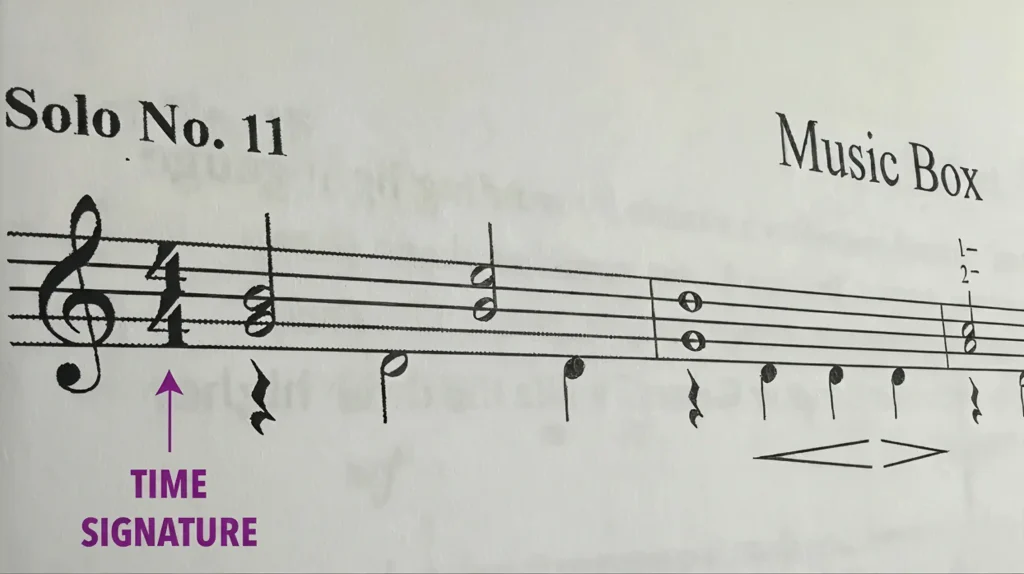
Think of a time signature as something that keeps the rhythm in a piece of music in check. It is that pair of numbers like 4/4 or ¾, that you will see after the clef and key signature at the beginning of a staff.
In easy terms, you get to know two things from time signatures:
- How many beats are in each measure (bar)
- Which type of note gets one beat (the “pulse”)
So, if you ever find someone asking, “What’s a time signature in music?”, your answer should be: it is the written code that tells musicians how to count and group the beats in a piece.
Why Do Time Signatures Matter?
Just think of it this way: time signatures add calm and structure to the music notes. Without it, the music you listen to would be chaotic with no clear pulse or structure. Time signatures in music make it possible for a pianist, a guitarist and a vocalist to stay perfectly in sync, even if they are reading from different parts of the score. Here’s what makes time signatures so important:
- They define the meter (the repeating pattern of strong and weak beats).
- They help musicians count and phrase the music correctly.
- They give each piece the “feel”: be it steady and marching, flowing and dreamy or driving and energetic.
For instance, 4/4 is the most common time signature, which is steady and grounded, while ¾ gives that lifting, waltz-like sway. Once you understand what time signatures in music, you will start to notice and hear these patterns in every song you listen to.
Here’s why time signatures are so important:
- They define the meter (the repeating pattern of strong and weak beats).
- They help musicians count and phrase the music correctly.
- They give each piece its characteristic “feel”, whether it’s steady and marching, flowing and dreamy, or driving and energetic.
For example, a 4/4 time signature feels steady and grounded (like a heartbeat), while 3/4 gives that lilting, waltz-like sway. Once you understand time signatures, you start to hear these patterns in every song you listen to.
How to Read a Time Signature?
A time signature looks like a fraction, but it’s not a real mathematical fraction. It’s just two numbers stacked on top of each other, like this: 4/4, ¾ or 6/8.
Let us break it down for you:
- The top number represents the number of beats in each measure (bar)
- The bottom number tells you which note value gets one beat.
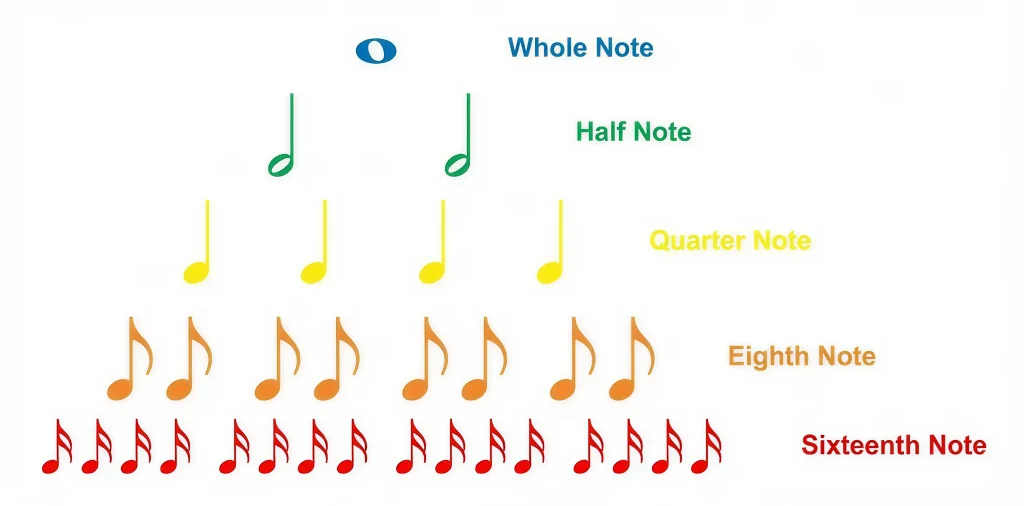
So, for a 4/4 time, there are 4 beats/measure, and a quarter note (crotchet) gets one beat. In ¾ time, there are 3 beats/measure, a quarter note gets one beat, and in 6/8 time, there are 6 beats/measure, and an eighth note (quaver) gets one beat. Understanding this makes reading music time signatures easier.
What do the Two Numbers Mean?
Let us dive deeper into what these numbers actually mean. The top number is all about the quantity: the number of beats in each bar. The most common top numbers include – 2 beats/bar, 3 beats/bar, 4 beats/bar, and 6,9,12 compound meters, where beats are grouped in threes. So, if the top number is 4, you will count “1, 2, 3, 4” in each bar.
The bottom number tells you which note value equals one beat. In Western music, the most common bottom numbers are:
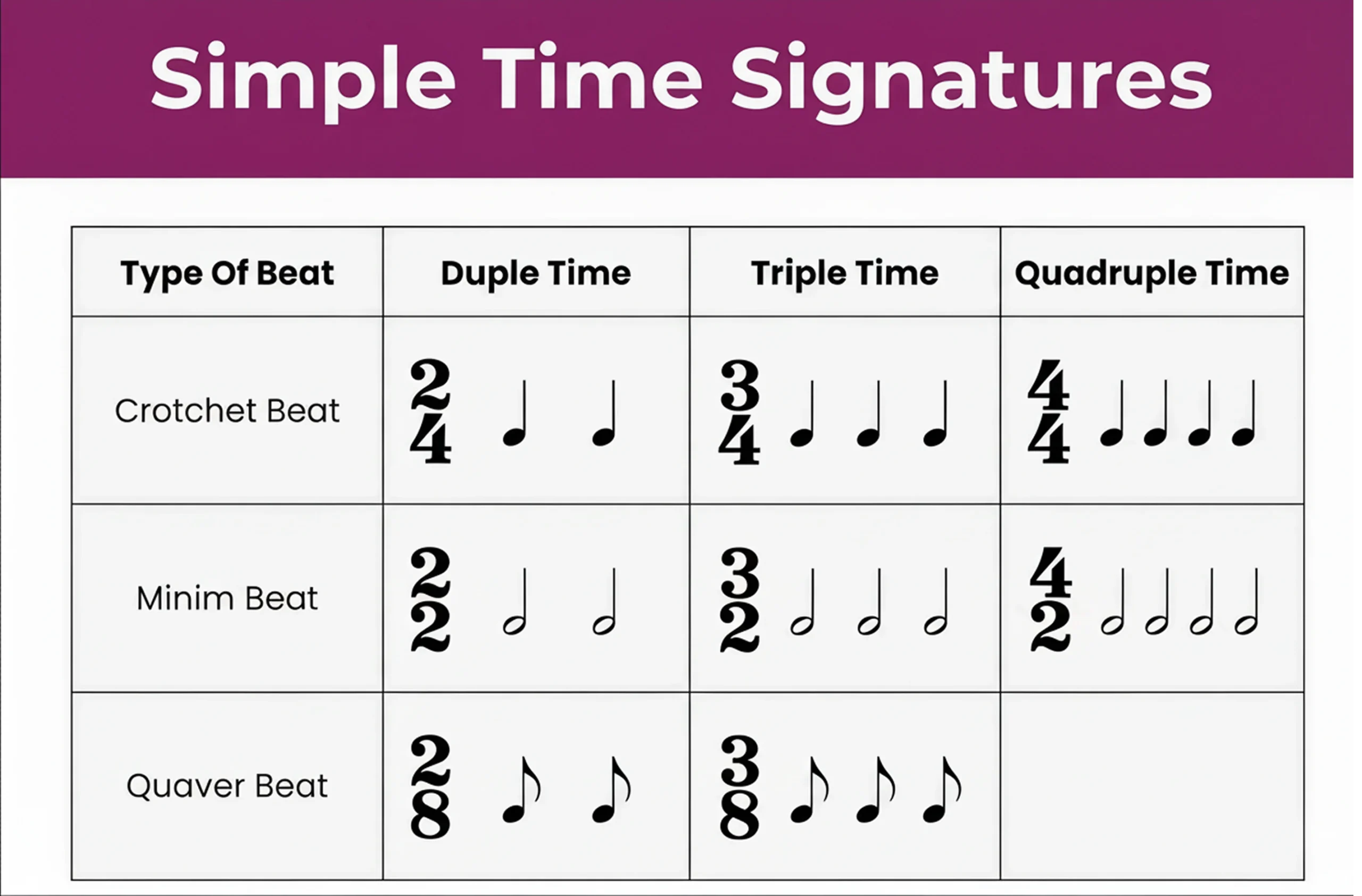
- 2= half note (minim) gets one beat
- 4= quarter note (crotchet) gets one beat
- 8= eighth note (quaver) gets one beat
So:
- In 2/2, a half note gets one beat, and there are two beats per bar (often called “cut time”).
- In ¾, a quarter note gets one beat, and there are three beats per bar (the classic waltz time).
- In 6/8, an eighth note gets one beat, and there are six beats per bar (often felt in two groups of three).
Four Main Categories of Time Signatures
The following are the four main categories in which time signatures are grouped. It is based on how the beats are organised.
- Simple Time Signatures
In this time signature, every beat is divided naturally into two parts. These are the most common time signatures in Western music.
Example:
– 2/4: 2 beats/bar, quarter note gets the beat
– ¾: 3 beats/bar, quarter note gets the beat
– 4/4: 4 beats/bar, quarter note gets the beat
4/4 is also often called “common time” and noted with a “C” instead of 4/4.
- Compound Time Signatures
In compound time signatures, every beat is divided into three parts. You may find these time signatures flowing or lilting.
Examples:
– 6/8: 6/8th notes/bar, but usually felt as two groups of three
– 9/8: 9/8th notes/bar, felt as three groups of three
– 12/8: 12/8th notes/bar, fet as four groups of three
This time signature is common in ballads, folk songs and Indian film music, where it gives that gentle, swaying feel.
- Duple, Triple, and Quadruple Meters
Time signatures are also described by how many main beats they have per bar:
– Duple meter: Two main beats/bar (e.g 2/4, 2/2)
– Triple meter: Three main beats/bar (e.g ¾, 3/8)
– Quadruple meter: Four main beats/bar (e.g 4/4, 4/2)
This time signature helps you understand the “feel” of the music, whether it is marching, waltzing, or something in between.
- Irregular (Odd) Time Signatures
These are more complex time signatures. They have “odd” numbers like 5/4, ⅞ or ⅝. They are responsible for creating intricate, off-kilter grooves.
Examples:
– 5/4: 5 beats/bar (Used in famous songs like “Take Five” by Dave Brubeck)
– ⅞: 7/8th notes/bar, often clubbed as 2+2+3 or 3+2+2
Odd time signatures are very common in jazz, progressive rock and some Indian classical and fusion music.
How Time Signatures Affect Musical Interpretation?
The time signature plays an important role in how you count. Not just that, it also shapes the way you feel the music and how you should play it.
Example:
- The first beat of each bar in 4/4 sounds the strongest, giving a steady, grounded feel.
- In ¾, the first beat is strong and the second and third are weaker, creating that waltz “oom-pah-pah” feel.
- In 6/8, the first and fourth eighth notes are often emphasized, giving a lilting, two-beat feel within the six beats.
As a musician, understanding this helps you play with the right accent and phrasing. You can shape their dynamics (louds and softs) to match the meter. You can also feel the natural “pulse” of the music, even when the rhythm is complex.
Common Time Signatures You Will See
Here are some of the most common time signatures you will encounter, along with how they feel:
- 4/4 (common time)
– Four beats per bar
– Quarter note gets the beat
– Feels steady and marching; used in most pop, rock and classical music
- ¾ (Waltz time)
– Three beats per bar
– Quarter note gets the beat
– Feels lilting and graceful; used in waltzes, ballads and many film songs
- 2/4
– Two beats per bar
– Quarter note gets the beat
– Feels quick and bouncy; common in marches and folk tunes
- 6/8
– Six eighth notes per bar
– The eighth note gets the beat
– Feels flowing and swaying; common in ballads, lullabies and Indian film music
- 2/2 (Cut Time / Alla Breve)
– Two beats per bar
– Half note gets the beat
– Feels fast and driving; often used in fast marches and energetic pieces
Tips for Beginners to Learn About Time Signatures
As a beginner, here are some easy and proven tips to help you understand and feel time signatures:
- Clap, count along with songs in different time signatures.
– For 4/4: clap “1, 2, 3, 4” in a steady pulse
– For ¾: clap “1, 2, 3” with a strong first beat
– For 6/8: clap “1,2,3,4,5,6” but feel it in two big beats(1-2-3, 4-5-6)
- Listen to the “feel” of the music
– Does it feel like it is marching (4/4)?
– Does it feel like a waltz (¾)?
– Does it feel like it is swaying or flowing (6/8)?
- Practice with a metronome
– Start with a slow tempo and count each beat out loud
– Try playing simple rhythms in 4/4, then switch to ¾ and feel the difference.
- Read simple sheet music
– Look at the time signature at the start of the piece
– Count how many beats are in each bar and which note gets the beat
- Relate it to real songs
– Most Bollywood and Western pop songs are in 4/4
– Many romantic ballads and waltzes are in ¾
– Many lullabies and flowing melodies are in 6/8
Why Understanding Time Signatures Matters for Musicians?
Knowing and understanding what time signatures are and how it works is an important part of music theory. It makes a significant difference in how you play the music. By understanding time signatures, you can:
- Read sheet music more confidently and accurately
- Learn to play in time with other musicians, from a band, an orchestra or an online ensemble
- Improvise and compose with a clear sense of rhythm and structure
- Feel the natural “pulse of a piece, which makes your playing more expressive and musical.
For aspiring musicians enrolled in online Western music classes, piano lessons online or music classes for kids, understanding time signatures is very crucial. It will help in building a strong foundation for what is to come, from reading music to performing confidently.
Make Time Signatures Your Friend: Start Your Music Journey
A time signature in music is one of the most powerful tools a musician can have in their toolkit. It can turn a random collection of notes into a living, breathing piece of music with a clear pulse and feel.
It does not matter if you are learning any instrument, vocals or just exploring music theory; understanding time signatures in music will pay off in every aspect of your musical journey.
That’s why, at Artium Academy, our music classes, including online Western music classes, piano lessons online, and music classes for kids, are designed to help learners understand time signatures. In these classes, we make complex topics like time signatures easy to understand and fun to learn.
So, if you ever found yourself looking at a time signature and thinking, “What does this even mean?”, know that you are not alone, and you are at the right place. With a little practice and the right guidance, you will soon be reading and feeling time signatures like a pro.
So, what are you waiting for? Learn more about time signatures and begin your musical journey today.
Book a free 1:1 trial class today.
FAQs on Time Signature in Music
Time signatures are symbols written at the beginning of a piece of music that show how the beats are grouped in each bar. They tell you how many beats are in a measure and which note value gets one beat, helping musicians stay in time together.
A time signature looks like two numbers stacked vertically, like a fraction: 4/4, 3/4, or 6/8. You’ll usually find it right after the clef and key signature at the start of the staff.
In music theory, a time signature is the notation that defines the meter of a piece. The top number shows how many beats are in each bar, and the bottom number shows which note value (for example, a quarter note or eighth note) counts as one beat.
Both 3/4 and 6/8 have a “triple” feel, but they are felt differently:
- In 3/4, you feel three main beats: 1–2–3 (like a waltz).
- In 6/8, you feel two main beats, each split into three: 1‑2‑3, 4‑5‑6.
If the music feels like “ONE‑two‑three, ONE‑two‑three,” it’s likely 3/4. If it feels like “ONE‑two‑three‑FOUR‑five‑six” with only two big pulses, it’s probably 6/8.
To read a time signature:
- Look at the top number: this tells you how many beats are in each bar.
- Look at the bottom number: this tells you which note value gets one beat (2 = half note, 4 = quarter note, 8 = eighth note, etc.).
- Then, count the beats in each measure according to that pattern. For example, in 4/4, you count “1‑2‑3‑4” with the quarter note as one beat.
The “C” symbol on a staff stands for common time, which is another way of writing the 4/4 time signature. When you see a “C” instead of numbers, it means there are four quarter‑note beats in each bar. If the “C” has a vertical line through it, that indicates cut time (2/2), where there are two half‑note beats per bar and the music feels faster and more driving.