
All Topics
- Alchemizing Music Concepts for Students
- Anuv Jain Songs
- Artist Spotlight
- artium gift card
- Artium Maestros
- Artium News
- Artium Tech Blog
- Best Coke Studio Songs
- Best Female Singers
- Birthday songs
- Bollywood Love Songs
- buying guide
- Carnatic Music
- Child Singers
- Devotional Music
- Editorials by Ananth Vaidyanathan
- English Love Songs
- Festival
- Film Music
- Ghazal Music
- Guitar
- Hindustani Classical Music
- Indian Classical Music
- Indian Folk Music
- Insights
- Instagram Reels Viral Songs
- Instruments
- Karaoke
- Karaoke Singing
- Keyboard
- Kids Music
- maestros
- Music Education
- Music for Kids
- Music Games
- Music Industry
- Music Instruments
- Music Legends
- Music Press Release
- Music Technology
- Music Theory
- Music Therapy
- Music Tools
- Piano
- piano guide
- Songs
- South Devotional Music
- Success Stories
- Tamil Film Music
- Telugu Film Music
- Time Theory
- Tools
- Uncategorized
- Uncategorized
- Uncategorized
- Uncategorized
- Vocal Singing
- Vocals
- western classical music
- western music
- Western vocal music
Learning Guitar For Indian Classical Music: A Complete Beginner’s Guide
Learning Guitar For Indian Classical Music: A Complete Beginner’s Guide
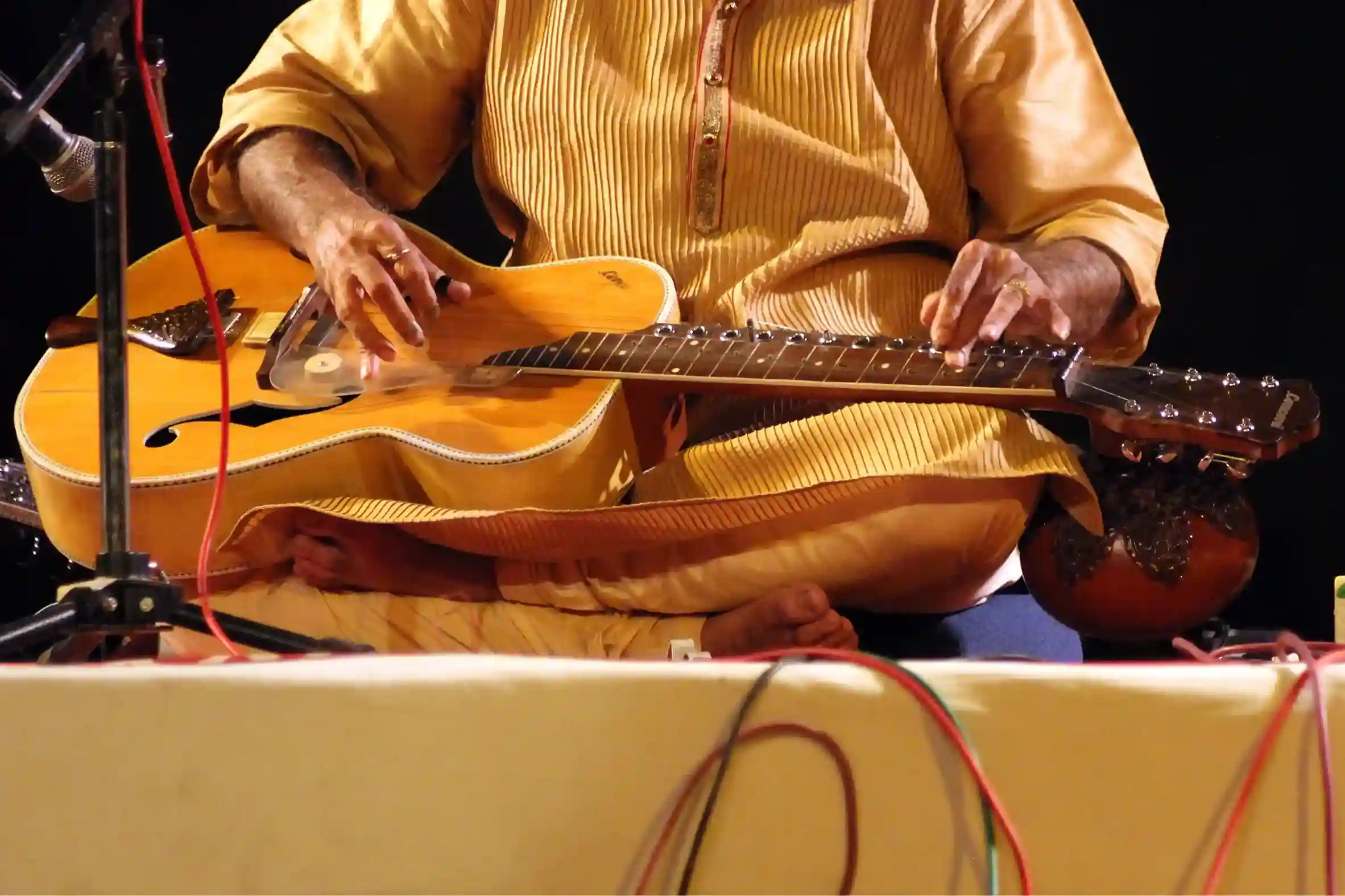
Table of Contents
What are the first things that come to your mind when you think of Indian classical music? Probably, ragas, sarod, tabla, or a deep hum of a tanpura? Well, there’s more.
The humble guitar. Yes, really. Even the guitar can sing a raga just as beautifully as other Indian classical instruments. From Pandit Brij Bhushan Kabra’s pioneering slide guitar work to Pandit Vishwa Mohan Bhatt’s Grammy-winning Mohan Veena and Pandit Debashish Bhattacharya’s Chaturangui, Indian classical guitar has grown into its own respected tradition.
And today, with the growing popularity of online guitar classes, anyone, from a curious 10-year-old, a college student, or a working professional, can step into this world. This blog is a beginner’s guide for those exploring guitar learning for Indian classical music, whether on their own or for their child. We will walk you through the basics, core techniques and beginner ragas that can help you turn your guitar into a raga-ready instrument.
Can Indian Classical Music Really Be Played on a Guitar?
A short and encouraging answer would be: absolutely yes.
That’s because, for over five decades, the guitar has been adapted for Hindustani classical music. It started with Pandit Brij Bhushan Kabra, who introduced the slide guitar to Indian classical audiences in the 1960s.
He is famously known as the father of the Indian classical guitar tradition. Through his famous album, Call of the Valley (1967), he brought the guitar into the heart of raga music. Post that, the tradition never stopped:
- Pandit Vishwa Mohan Bhatt invented the Mohan Veena, a modified slide guitar, and won a Grammy for A Meeting by the River with Ry Cooder.
- Pandit Debashish Bhattacharya developed the Chaturangui, a 23-string slide guitar blending guitar, sitar, sarod, violin and rudra veena.
- Kamala Shankar shaped the Shankar Slide Guitar style, bringing a distinct voice to Hindustani classical guitar.
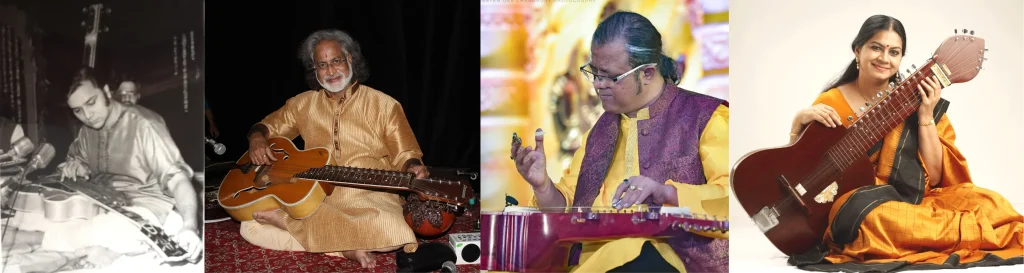
So, this is what we mean when we say, guitar learning for Indian classical music is real. It is a beautiful path with an already existing legacy. All you need is the right guidance to walk into it.
Understanding the Basics Before You Start
Before jumping into ragas, it helps to know what Indian classical music is and what it asks of a guitarist. It is a slightly different mindset from strumming chords to Hindi film songs. Here are some of the core concepts you will meet early on –
- Raga – the melodic framework or “mood” of a piece.
- Tala – the rhythmic cycle (like Teental, which has 16 beats)
- Sur – pure musical notes (Sa, Re, Ga, Ma, Pa, Dha, Ni).
- Shruti – micortones, the tiny notes between notes.
- Gamak, Meend, Andolan – ornamentations that give the raga its emotion.
What Guitar Works Best?
For guitar lessons for Indian music, most beginners start with one of these:
- A standard acoustic or classical guitar with nylon strings for softer tonality.
- A lap-style slide guitar for dedicated Hindustani playing.
- An electric guitar, for students who later want to explore fusion.
For beginners joining guitar classes for kids, a standard acoustic is a gentle, practical place to begin. Slide guitar can come later as the child matures.
Core Techniques for Indian Classical Guitar
This is where the guitar stops simply playing notes and starts singing them. Since Indian classical music is deeply vocal in nature, every technique you learn on the guitar is basically an attempt to imitate the human voice. This is what gives the Hindustani guitar its soul.
Here are some basic techniques every student explores in guitar learning for Indian classical music, along with a little more of what they actually involve:
- Meend
A meend is a glide that brings a raga to life. It is the smooth, seamless slide between two notes, imitating the way a vocalist glides across pitches. On a guitar, this is done either by bending the string on a standard guitar or by using a slide bar on a lap-style slide guitar. By mastering the meend, you can transform a straight Sa-Re-Ga into an expressive musical phrase.
- Gamak
A gamak is the emotional weight of a raga. It is a firm oscillating ornament, a powerful shake of a note that adds intensity and gravity. Just think of it like a musical equivalent of emphasizing a word while speaking. On guitars, a gamak is produced through controlled bends, hammer-ons, and pull-offs. It takes patience to develop the right pressure and timing.
- Andolan
An Andolan is a gentle, meditative sway. If the gamaka is considered bold, then an andolan is its soft sibling, a slow, subtle oscillation around a single note. Usually, it is used on notes like Re, Ga, or Dha to create a sense of longing or calm. For guitarists, Andolan is practiced through delicate slides or vibrato that never feels rushed.
- Alap
An Alap is the soul of the raga. It is the slow, unmetered opening of a performance where a guitarist explores the raga one note at a time, without rhythm or hurry. It’s just the guitar and the tanpura drone; no tabla has come in yet. This is where the guitarists plays the raga, letting each note breathe. As a beginner, alap is the best way to understand a raga’s personality, even before learning compositions.
- Jor and Jhala
A jor comes after alap, where the steady rhythmic pulse begins to emerge from the melody itself, even without percussion. Jhala is a couple of steps above. It is a rapid, energetic section full of strummed patterns and fast plucks that build excitement. These stages teach a guitarist timing, stamina and control, all while staying true to the raga.
- Drone Awareness
In Hindustani music, the tanpura drone is the silent teacher that guides every note. Playing along with a tanpura (or a good tanpura app) helps your ears stay locked to Sa and makes every other note sound more accurate and expressive. For serious students, the drone is a reference point, the “home” their fingers and ears return to.
Through practice, you’ll notice these techniques are more than just separate exercises, and they start blending into one another. A meend might lead into a gamak, which softens into andolan, all while the drone holds you steady. That’s the beauty of Indian classical guitar: every small technique contributes to one flowing, emotional expression. The best part is, with good online guitar classes, you can break these techniques into small, manageable steps, so you grow into them naturally rather than feeling overwhelmed on day one.
Best Ragas to Learn First on Guitar
Here are a few ragas you can learn; just a few well-practised ones will help you build strong foundations:
- Raga Yaman
This raga is also known as a sampurna raga (because it uses all 7 notes). It is famous for its calming, romantic evening mood. Quite often, Raga Yaman is the first raga taught in Hindustani classical training. It is beautifully suited to the guitar because its phrases lie naturally across the strings. - Raga Bhupali (Bhoop)
A pentatonic raga (5 notes), which feels very close to the Western major pentatonic scale. This makes it a dream starting point for guitarists already comfortable with pentatonic soloing. - Raga Bhairav
This is a morning raga, which is solemn and deeply emotional. This raga is great for building sensitivity and learning meend (glides). - Raga Durga
Simple, graceful and pentatonic, this raga is ideal for developing clean, expressive phrasing. - Raga Desh/ Raga Kafi
These ragas may feel very familiar to you since they’re used in semi-classical, folk and film music. You may have heard them in countless bhajans and Bollywood classics.
Guitar Classes for Kids: Is Indian Classical Music a Good Starting Point?
Now, this is one of the most common questions we hear from parents: “Is Indian classical too advanced for my child’s first guitar class?”
The honest answer is, not at all. Properly structured guitar classes for kids that incorporate elements of Indian classical music can give your child a strong musical foundation. Here’s what your child can gain:
- Strong pitch perception from the very beginning
- A naturally trained ear through raga and drone listening
- Discipline and patience built through slow, mindful practise
- A deeper connection to Indian cultural roots
- Flexibility to later branch into Western, film, fusion or rock styles.
In the majority of cases, children start with basic Western-style lessons and gradually step into learning guitar for Indian classical music as their fingers and focus grow. Indian classical music has always been rooted in the guru-shishya parampara – one teacher, one student, deep attention. This is where online guitar classes work well. Good online guitar classes replicate this beautifully, often better than crowded, in-person classes. Here’s why online learning works so well for this genre:
- 1:1 attention that upholds the personal, meditative nature of learning a raga.
- Drone and tanpura apps make it easy to practice pitch at any time.
- Screen sharing lets teachers display notation and fretboard positions in real time.
- Flexibility fits working adults and school-going kids alike.
- Learn from expert teachers from around India, no matter where you live.
For those of you exploring online guitar lessons for adults or enrolling your children in structured weekly sessions, the online learning format removes most traditional barriers like distance, time and access.
The Path – Beginner to Indian Classical Guitarist
Every learner has to start somewhere and usually, the path is a long and slow one. But that being said, here’s a simple, honest roadmap:
- Stage 1 – Get familiar with the guitar. Learn the correct posture, tuning and how to play basic notes on the guitar.
- Stage 2 – Meet Sargam: Practice Sa Re Ga Ma Pa Dha Ni Sa correctly with the help of a tanpura drone.
- Stage 3 – Start by learning one raga at a time. Begin with Raga Yaman or Bhupali. Explore slow alap.
- Stage 4 – Learn a bandish: Try a short composition and basic tala alignment.
- Stage 5 – Perform and experiment: Play for family, record yourself and explore fusion pieces.
Understand that, when it comes to Indian classical guitar, it is not always about speed; it is more about depth. Each raga you learn truly becomes part of you.
Structured Guitar Lesson by Artium Academy
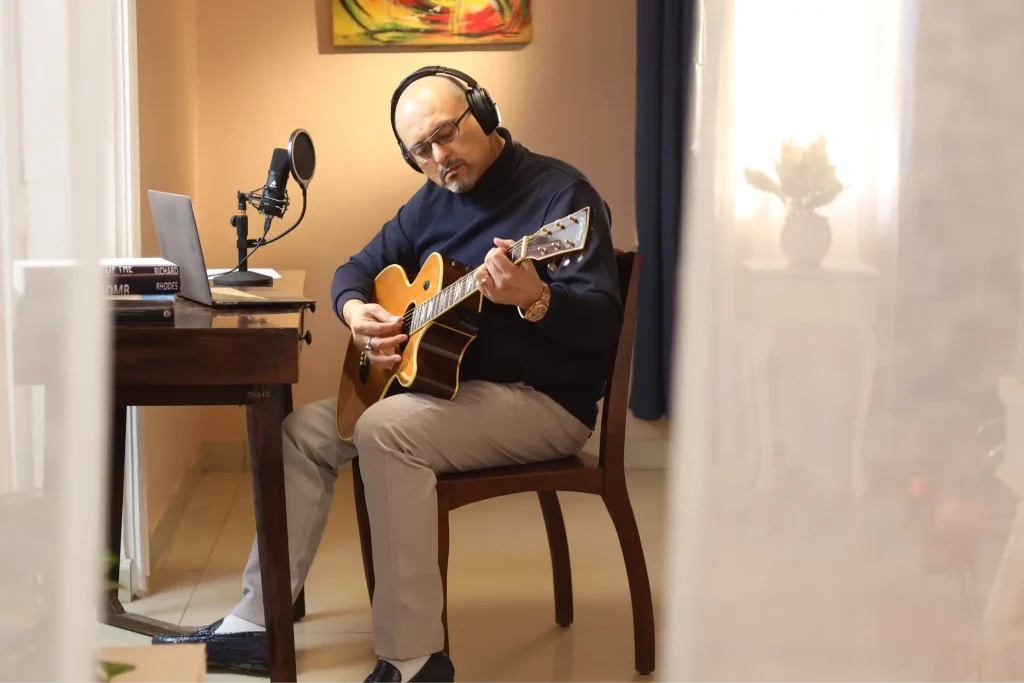
As a beginner, it is difficult to begin the guitar journey on your own. That’s why at Artium Academy, we have designed our online music classes to help aspiring guitar players with a strong, structured and joyful path. Here’s what makes Artium Academy’s approach stand out:
- Curated by Maestro – Our guitar curriculum is curated by an award-winning music director and renowned guitarist, Mr. Raju Singh. Under his guidance, expert teachers teach guitar to help aspirants achieve their musical dreams.
- Worldwide Certification – Our music course is part of a Globally Recognized Music Programme (GRMP). Under this program, you will also receive a certificate accepted worldwide.
- 1:1 Classes – To ensure each and every student gets personal attention, we offer regular, Live 1:1 online guitar classes that respect every learner’s pace. You’ll also have the opportunity to perform and practice on dedicated tracks for Western and Indian classical styles.
- Music for all – Our online music classes are age-appropriate programs. It means from online guitar classes for kids to online guitar lessons for adults, you can find everything you need under one roof.
- Structured Progression – From basic chords and scales to raga exploration, bandish and performance training, our music programs offer the best learning overall.
Being one of the most trusted platforms for guitar classes in India, we bring together experienced mentors, flexible timings and a curriculum benchmarked against the best guitar lessons in the world. With the help of our broader catalog of online music classes, you can explore vocals, piano or other instruments alongside guitars, without leaving the platform.
Start Your Raga Journey with a Single String
To be a good guitar player, you don’t have to be a born prodigy. You don’t even need an expensive instrument. You don’t even need to know a single raga today.
All you need to have is a guitar, a little curiosity and a teacher who truly understands your need for guitar learning for Indian classical music. With daily, consistent practice and structured guidance from an experienced teacher, your guitar can become the voice of a raga: expressive, soulful and unmistakably yours.
So, if you or your child is ready to begin, we at Artium Academy are here to help you take that first step. With our expertly designed and certified programs, you can learn guitar online from experienced teachers who make the guru-shishya bond feel just as real over a screen as it does in person.
So, stop waiting. Pick up a guitar and learn how to play. Your raga is waiting for you.
Book a free trial today!
FAQs
No. At Artium Academy, we do not offer guitar lessons for Indian classical music. However, we offer structured guitar lessons as part of our broader online music classes. Our guitar curriculum is curated by award-winning music director and renowned guitarist Raju Singh. We offer 1:1 online guitar classes for kids and online guitar lessons for adults, with broader applicability to both Western and Indian styles. Students can start with the basics and gradually move into advanced guitar learning. By the end of the course, you can put your skills to use for Indian classical music including raga practice, alap, bandish and performance skills. If you’d like, you can book a free trial and experience how our teachers make Indian classical guitar both accessible and inspiring.
Western guitar playing (especially in rock, pop and Western classical music) often focuses on chords, scales, harmony and fixed forms such as songs or pieces. Guitar learning for Indian classical music focuses more on:
- Single-line melodic exploration (raga) instead of a chord progression
- Techniques like meend, gamak and andolan to imitate vocal nuances
- Playing with a tanpura drone and aligning notes to Sa, rather than thinking in terms of key signatures alone.Both approaches are valuable and many modern players blend them to create fusion.
Time taken to learn a raga on guitar depends on your practice, consistency and prior experience. But to put things into perspective, with a few weeks of focused practice, you can usually learn the basic aroha-avaroha (ascending/descending) and simple phrases of a beginner-friendly raga like Yaman or Bhoopali. In a few months, you can start playing alap, simple bandish-based phrases, and basic improvisation within that raga. The journey of Indian classical music is a lifelong one; the goal is not to finish a raga but to go deeper into it over time.
For beginners, a standard acoustic or classical guitar is more than enough to start learning ragas and building technique. For those serious about traditional Hindustani slide guitar, lap-style slide instruments (in the lineage of Mohan Veena, Chaturangui, etc.) are ideal, though not mandatory at the beginner stage. Many students learn alap, basic meend and raga phrases on a regular acoustic before moving to specialised slide setups later.
Yes, good online guitar classes, like those at Artium Academy, can be very effective for Indian classical music. The 1:1 format mirrors the guru-shishya tradition and tools like tanpura apps, screen sharing and high-quality audio make it easy to work on pitch, meend and raga structure. Online guitar lessons are especially helpful if you do not have access to specialised Indian classical teachers in your city.
Most children can comfortably start structured guitar classes for kids around the ages of 7-8, when their fingers are a bit stronger and they can focus for 20-30 minutes. Younger children (5-6) can still begin with very basic exercises and simple tunes if they are keen, but Indian classical elements are usually introduced gradually as their coordination and attention span grow. Adults can start at any age; it is never “too late” to learn guitar online or explore ragas.
Yes, the guitar can absolutely be used for Indian classical music. For over five decades, artists like Pandit Brij Bhushan Kabra, Pandit Vishwa Mohan Bhatt, Pandit Debashish Bhattacharya and Kamala Shankar have shown that the guitar, especially in slide form can beautifully express ragas with meend, gamak and all the nuances usually associated with instruments like sitar or sarod.