
All Topics
- Alchemizing Music Concepts for Students
- Artist Spotlight
- artium gift card
- Artium Maestros
- Artium News
- buying guide
- Carnatic Music
- Devotional Music
- Editorials by Ananth Vaidyanathan
- Film Music
- Guitar
- Hindustani Classical Music
- Indian Classical Music
- Indian Folk Music
- Insights
- Instruments
- Karaoke Singing
- Keyboard
- Kids Music
- maestros
- Music Education
- Music for Kids
- Music Industry
- Music Instruments
- Music Legends
- Music Theory
- Music Therapy
- Piano
- piano guide
- Success Stories
- Tamil Film Music
- Telugu Film Music
- Time Theory
- Tools
- Uncategorized
- Uncategorized
- Uncategorized
- Uncategorized
- Vocal Singing
- Vocals
- western classical music
- western music
- Western vocal music
Hindustani Classical Music, Indian Classical Music
Bhendi Bazaar Gharana: Where Rhythm Thinks and Melody Speaks
Bhendi Bazaar Gharana: Where Rhythm Thinks and Melody Speaks
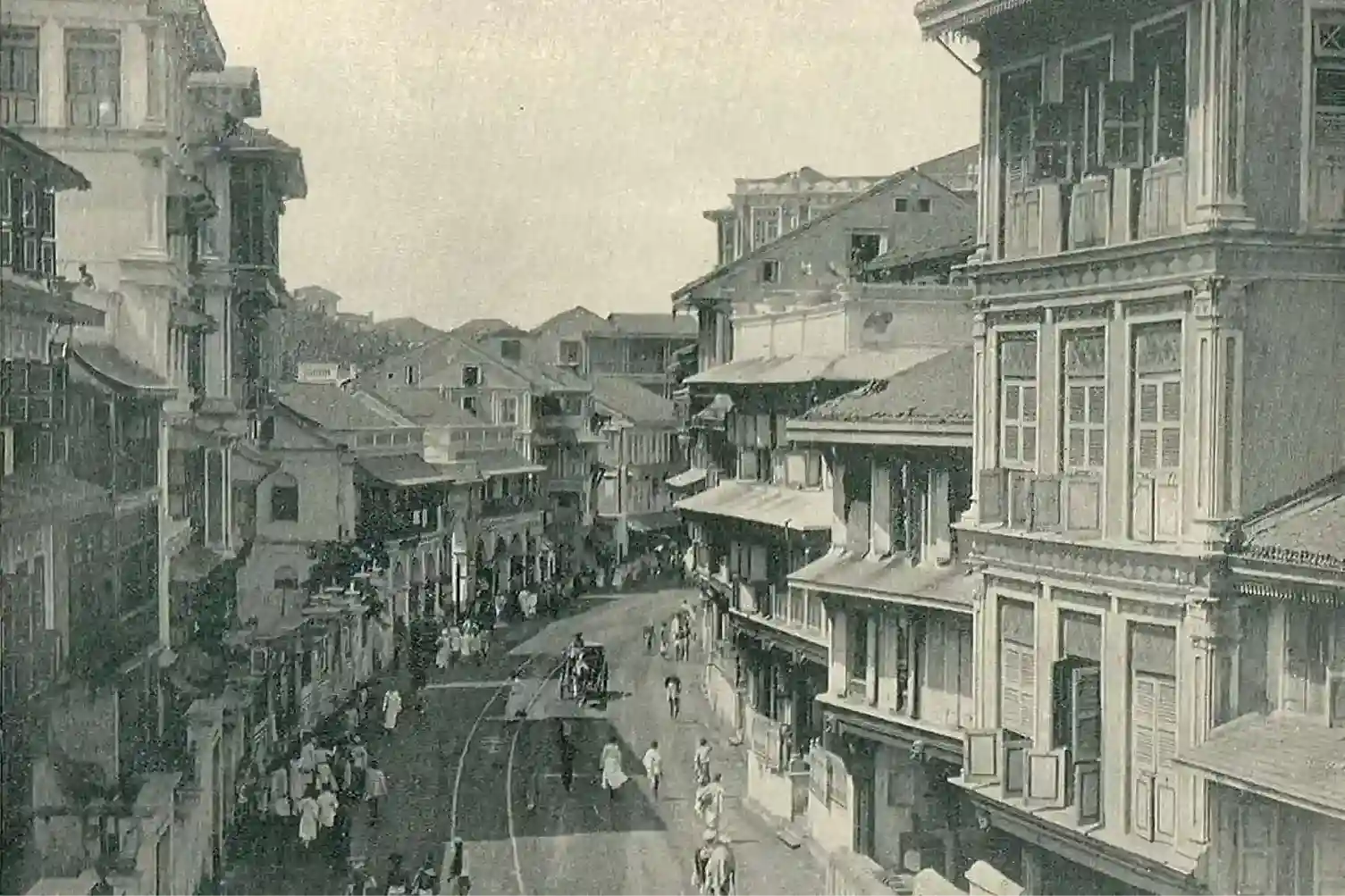
Table of Contents
On a humid evening in early 20th-century Bombay, the narrow lanes of Bhendi Bazaar echoed with sounds far removed from the chaos of the street. Amid vendors calling out their wares and horse-drawn carriages clattering past, a voice rose, measured, confident, and deeply aware of time itself. This was not just singing; it was architecture built in sound. That voice belonged to a lineage that would come to be known as the Bhendi Bazaar Gharana.
Unlike many gharanas that trace their roots to royal courts or secluded cultural centers of North India, the Bhendi Bazaar Gharana was born in the heart of a city, urban, intellectually charged, and constantly evolving. It was located behind the Crawford market area of Mumbai and was referred to as ‘Behind the Bazaar’, which was then corrupted to Bhendi Bazaar. Its music reflects that environment: structured yet daring, rooted yet experimental, emotional yet analytical.
This gharana stands today as a symbol of intellectual Hindustani classical music, where rhythm (laya) is not subordinate to melody but an equal partner in expression.
The Birth of a Gharana in a City of Flux
Most gharanas arose under royal patronage, Gwalior in princely courts, Jaipur under Rajput rulers, Kirana in contemplative North Indian settings. Bhendi Bazaar was different.
Mumbai at the turn of the century was a city in transformation. Colonial influence, emerging public concert culture, and exposure to multiple art forms shaped its musicians. In this environment, Ustad Chajju Khan (1855–1920) emerged as a visionary.
Trained in the Kirana Gharana, Chajju Khan respected the meditative purity of swaras but felt constrained by an excessive focus on slow alap. He believed that a raga must breathe within time, not float outside it. His experiments with rhythmic complexity, mathematically structured taans, and dynamic raga exposition laid the foundation for a new musical ideology.
What began as a personal exploration slowly solidified into a distinct gharana named not after a dynasty or court, but after a neighborhood. This itself was revolutionary.
The Philosophical Backbone: Music as Thought
At the core of the Bhendi Bazaar Gharana lies a belief that music is both emotional and intellectual.
Where some gharanas prioritize ‘Bhava’ above all else, Bhendi Bazaar insists that emotion must be organized through logic. The raga is treated not as a mood to drift into, but as a structure to explore, test, and expand without violating its grammar.
Key philosophical principles include:
- Raga as a system, not just a feeling
- Rhythm as an expressive force, not a constraint
- Improvisation guided by intellect
- Respect for tala is equal to swara
This approach makes the gharana deeply satisfying for listeners who enjoy unraveling musical ideas layer by layer.
1. Layakari as Language
If Kirana speaks in long, meditative sentences, Bhendi Bazaar speaks in complex paragraphs with punctuation.
Layakari is known to play with rhythm, is central. Artists frequently employ:
- Syncopation
- Cross-rhythms
- Sudden tempo shifts
- Rhythmic patterns that converse directly with the tabla
This rhythmic sophistication gives performances a sense of dialogue rather than monologue.
2. Taans with Intelligence
Taans in Bhendi Bazaar are not merely fast; they are designed. Each taan has a beginning, logic, and resolution. Mathematical symmetry often governs their construction, yet they never feel mechanical.
This is why tabla players often admire the vocalists of Bhendi Bazaar; they speak the language of rhythm fluently.
3. Balanced Alap
Unlike Kirana, which may dwell extensively in slow alap, Bhendi Bazaar treats alap as a foundation, not the destination. The raga often finds its fullest expression within bandish and improvisation in tala.
4. Vocal–Instrumental Bridge
The gharana’s clarity of phrasing, precision, and rhythmic emphasis often mirrors instrumental music. This has influenced instrumentalists and made Bhendi Bazaar aesthetics compatible with sitar, sarod, and tabla traditions.
Great Masters Who Defined the Bhendi Bazaar Gharana
Ustad Chajju Khan
The visionary founder reimagined what vocal music could be, structured yet free. His ideas seeded a lineage that valued musical reasoning as much as emotion.
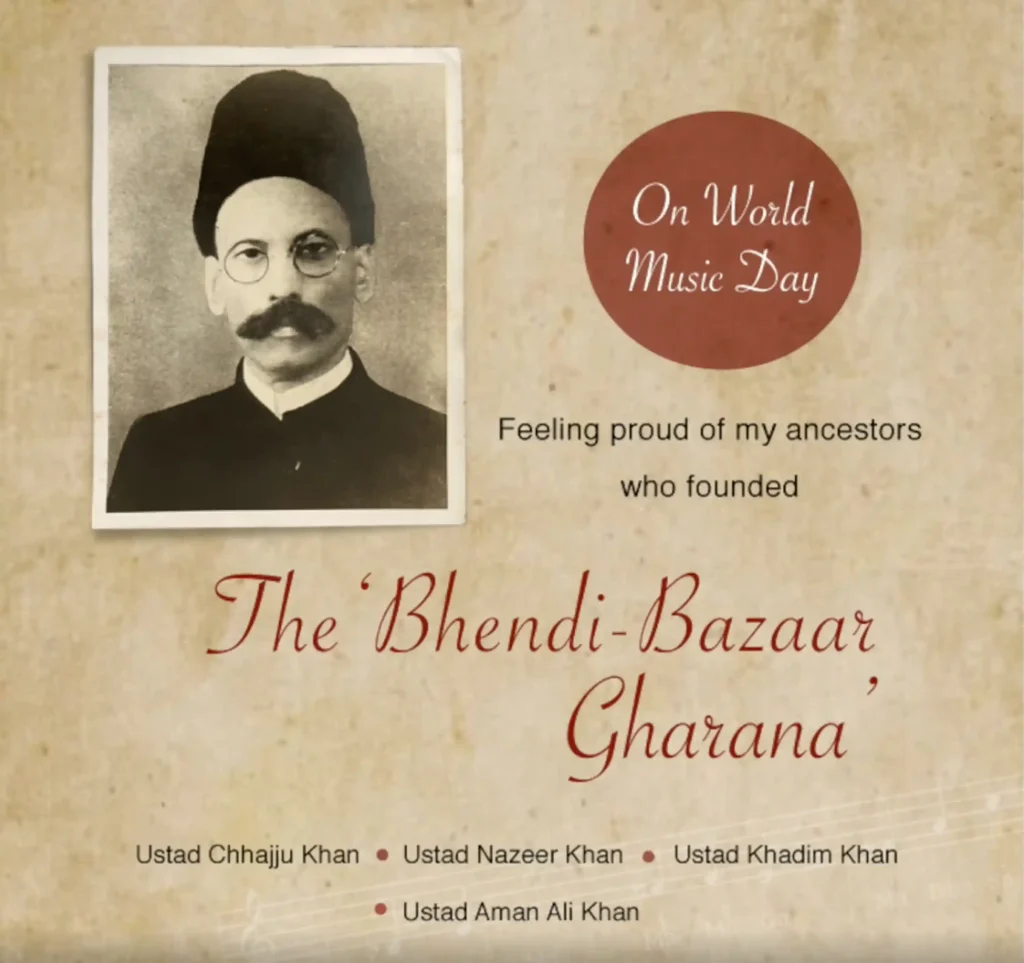
Ustad Chhajju Khan was a key architect of the Bhendi Bazaar Gharana, co-founding it in Bombay with his brothers Ustad Nazir Khan and Ustad Khadim Hussain Khan after the family migrated from Bijnor (near Moradabad) and settled in the Bhendi Bazaar neighborhood that gave the style its name. Trained first by his father, Ustad Dilawar Hussain Khan, and later in dhrupad through the Dagar parampara and Rampur-Sahaswan influences, he brought a disciplined, dhrupad-grounded imagination structured, yet free.
He composed khyals and dhrupads under the pen name “Amar,” and was remembered for spiritual seriousness and respected disciples (including Ustad Chand Khan). The pedagogy he helped seed emphasizes open-voice aakaar, strong breath control, medium tempos, and merukhand/khandmeru-based improvisation, musical reasoning in service of emotion. Its hallmark is the ability to unfold long, clear phrases in one breath and develop taans through systematic note permutations with precision.
Ustad Aman Ali Khan(1888–11 Feb 1953)
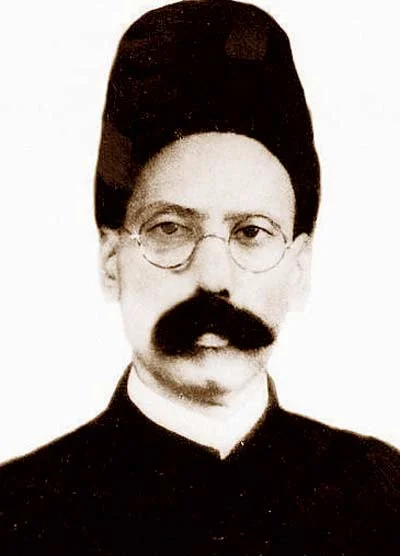
A pivotal figure in shaping the gharana’s identity, he refined its pedagogy and performance style.
Ustad Aman Ali Khan “Amar” is credited with sharpening the Bhendi Bazaar Gharana’s identity, refining both performance style and teaching in Bombay’s vibrant musical milieu. Son of Chhajju Khan (founding family shaped with Nazeer Khan and Khadim Hussain Khan), he was known for crisp, rhythm-forward sargam and imaginative layakari, reflecting an openness to Carnatic ideas.
Pedagogically, he systematized training through composition and documentation: he is said to have created ~400 bandishes (often signed “Amar”), broadened repertoire by adapting Carnatic ragas, and authored an Urdu volume on vocal nuance, raga forms, and notated compositions—an unusually explicit curriculum for an oral tradition.
His influence spread beyond the gharana via students such as Lata Mangeshkar and Manna Dey, and he is cited as an influence on Ustad Amir Khan. He died in Delhi after pneumonia contracted while on a concert visit.
Anjanibai Malpekar: The Voice of Authority
Few figures loom as large as Ustad Anjanibai Malpekar. In an era when female classical vocalists faced societal barriers, her powerful voice and commanding presence shattered expectations.
Her singing was uncompromising—strong layakari, bold taans, and total command over raga. She brought the Bhendi Bazaar Gharana into the national spotlight and influenced generations of musicians across gharanas.
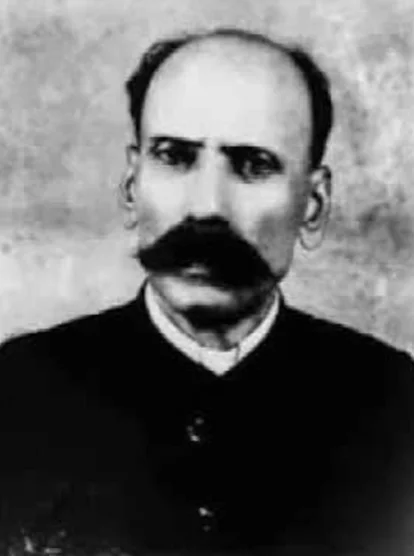
Ustad Nazir Khan
A revered teacher, he carried the gharana’s philosophy forward through rigorous training and intellectual depth.
Ustadji helped shape a style prized for clarity of swara, open-throated aakaar, and long, seamless phrases supported by disciplined breath control. Alongside his brothers, Ustad Chhajju Khan and Ustad Khadim Hussain Khan, he emphasized bandish-led learning, where compositions anchor raga grammar and improvisation grows from musical logic rather than display.
The gharana’s hallmark systematic thinking, often expressed through merukhand (khandmeru) note-permutation practice, reflects this pedagogy: structured taans, clean layakari, and measured madhyalaya development that still feels expressive and unforced.
Remembered as a founder-teacher, Nazir Khan’s influence endures through generations of singers who carry the gharana’s blend of rigor and sweetness to contemporary audiences. His legacy is less about biography than about method: sing intelligently, and let rasa/bhava follow.
Pandit Jitendra Abhisheki
Perhaps the most scholarly exponent, Pandit Jitendra Abhisheki (1932–1998) was a major 20th‑century Hindustani vocalist known for blending rigorous classical craft with powerful expressiveness. He is widely associated with the Bhendi Bazaar Gharana, while also drawing on training and repertoire from other traditions—most notably a deep Jaipur-Atrauli influence through his study with Pandit C. R. Vyas.
On stage, Abhisheki was admired for “bandish-first” raga development, crisp enunciation, and an assured command of laya (rhythm), moving from expansive vilambit (slow) elaboration to energizing taans without losing raga focus. Beyond khayal, he made an enduring impact on Marathi natyasangeet and devotional music, bringing classical weight and nuance to semi-classical and theatrical forms.
As a guru, he emphasized disciplined riyaaz and stylistic integrity, and his students helped carry his distinctive aesthetic into the present generation.
Comparison with Other Major Gharanas
Bhendi Bazaar Vs Kirana Gharana
Similarities:
- Emphasis on swara purity
- Serious, contemplative approach to raga
Differences:
- Kirana prioritizes slow, introspective alap
- Bhendi Bazaar prioritizes rhythmic engagement and structured improvisation
If Kirana is meditation, Bhendi Bazaar is thoughtful conversation.
Bhendi Bazaar vs Jaipur-Atrauli Gharana
Similarities:
- Intellectual approach
- Respect for raga grammar
- Complexity in presentation
Differences:
- Jaipur focuses on rare ragas and angular phrases
- Bhendi Bazaar focuses on rhythmic sophistication and clarity
Jaipur challenges the mind through raga complexity; Bhendi Bazaar does so through laya.
Bhendi Bazaar vs Gwalior Gharana
Similarities:
- Importance of bandish
- Clear raga presentation
Differences:
- Gwalior emphasizes straightforward exposition
- Bhendi Bazaar adds layers of rhythmic and mathematical exploration
Gwalior is foundational; Bhendi Bazaar is an analytical expansion.
A Gharana That Embraced Change
One of the most remarkable aspects of the Bhendi Bazaar Gharana is its openness to modernity.
While many gharanas resisted the shift from court to concert hall, Bhendi Bazaar adapted effortlessly. Radio, recordings, public performances, and later digital platforms became vehicles for propagation rather than threats to purity.
This adaptability ensured the gharana remained relevant, not frozen in time, but alive.
Significance of Bhendi Bazaar Gharana in Artium Academy
In the contemporary landscape, Artium Academy has emerged as a vital institution that bridges traditional classical music with modern learning systems. The Bhendi Bazaar Gharana’s philosophy aligns naturally with Artium’s pedagogy and andragogy.
Why Bhendi Bazaar Works in a Modern Music Learning Academy?
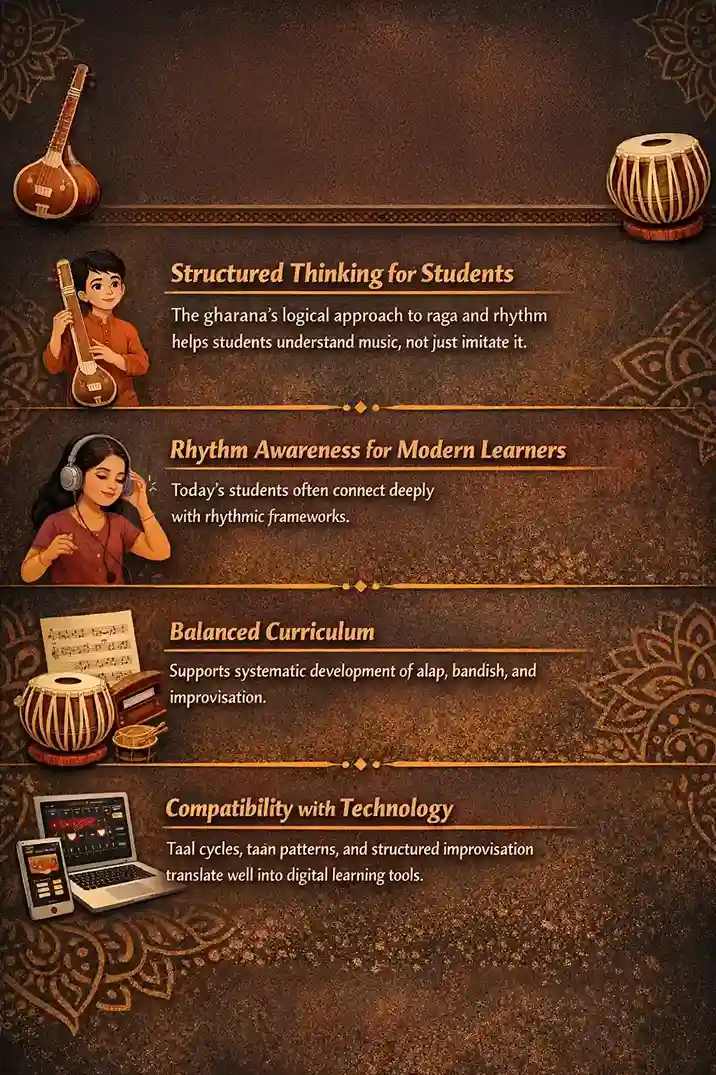
Preserving Tradition, Empowering the Future
Through platforms like Artium Academy, the Bhendi Bazaar Gharana is no longer confined to geography or lineage. Its principles reach students across the globe—democratizing access while preserving depth.
The Living Legacy
The Bhendi Bazaar Gharana is not a relic of the past. It is a living method of thinking about music.
It reminds us that:
- Emotion gains strength through structure
- Rhythm can think
- Discipline can liberate creativity
In a world of instant gratification, this gharana calls us back to deep listening and thoughtful creation.
The Intelligence of Emotion
The Bhendi Bazaar Gharana stands at a rare intersection, where heart and mind meet. Born in the lanes of Mumbai, shaped by urban dynamism, and sustained by towering intellects, it represents a uniquely modern classical tradition.
As institutions like Artium Academy carry their teachings forward in their Hindustani music classes, the gharana continues to evolve, proving that tradition is not about preservation alone, but purposeful progression.
To listen to Bhendi Bazaar music is to witness melody thinking aloud, rhythm questioning time, and raga revealing its inner logic, one phrase at a time.
Also Check,
FAQs on Bhendi Bazaar Gharana
It was founded in Mumbai (Bombay), roughly late 19th century (c. 1870–1890), by three brothers: Ustad Chhajju Khan, Ustad Nazir (Nazeer) Khan, and Ustad Khadim Hussain Khan, originally from Moradabad (Uttar Pradesh).
A Hindustani (North Indian) classical vocal gharana—a school/lineage—best known for khayal singing and a recognizable style of raga development and virtuosity.
The four main Kathak dance gharanas are: Lucknow, Jaipur, Banaras, and Raigarh.
Bhendi Bazaar Gharana bandishes influenced modern-day Kathak by supplying clear, bandish-first compositions with strong laya/layakari, crisp bol articulation, and fast tarana-friendly phrasing that choreographers could map onto tatkar, tihais, and chakkar builds.
The impact spread through shared Mumbai performance circuits, accompanists, and widely taught/recorded repertoire rather than a direct Kathak lineage link.
The Gwalior Gharana is widely cited as the oldest khayal gharana (often traced back to the 16th century).
It is primarily known for Hindustani classical vocal music (especially khayal), but its influence extends through training, bandishes (compositions), and stylistic ideas that sometimes show up in semi-classical or film-adjacent learning paths via disciples—still, its identity is fundamentally classical.
Commonly cited figures include:
- Ustad Aman Ali Khan (major 20th-century exponent; prolific composer, pen name “Amar”)
- Anjanibai Malpekar
- Also often mentioned as having trained under Aman Ali Khan: Lata Mangeshkar and Manna Dey
Frequently noted traits include:
- Open-voice aakaar and clear intonation in khayal
- Exceptional breath control, enabling long phrases in one breath
- Preference for madhyalaya / madhyadrut tempos
- Merukhand (Khandmeru) based note-pattern improvisation
- Smooth meend plus strong taan varieties (including gamak/sapat/satta)
- Emphasis on well-crafted bandish presentation (shabda–sur–laya blend)
- Noted Carnatic raga inclusions (e.g., Hamsadhwani, Nagaswarawali, Pratapwarali) and an emphasis on layakari and sargam associated with Aman Ali Khan’s innovations
A gharana is a recognized stylistic lineage in Indian music—typically passed via guru–shishya (teacher–disciple) tradition—where students inherit characteristic approaches to raga development, voice/instrument technique, ornamentation, rhythm, repertoire (bandishes/gats), and aesthetics. Bhendi Bazaar is one such lineage within Hindustani vocal music.