
All Topics
- Alchemizing Music Concepts for Students
- Artist Spotlight
- artium gift card
- Artium Maestros
- Artium News
- buying guide
- Carnatic Music
- Devotional Music
- Editorials by Ananth Vaidyanathan
- Film Music
- Guitar
- Hindustani Classical Music
- Indian Classical Music
- Indian Folk Music
- Insights
- Instruments
- Karaoke Singing
- Keyboard
- Kids Music
- maestros
- Music Education
- Music for Kids
- Music Industry
- Music Instruments
- Music Legends
- Music Theory
- Music Therapy
- Piano
- piano guide
- Success Stories
- Tamil Film Music
- Telugu Film Music
- Time Theory
- Tools
- Uncategorized
- Uncategorized
- Uncategorized
- Uncategorized
- Vocal Singing
- Vocals
- western classical music
- western music
- Western vocal music
Carnatic Music, Indian Classical Music
Sarali Varisai In Carnatic Music: A Beginner’s Guide
Sarali Varisai In Carnatic Music: A Beginner’s Guide
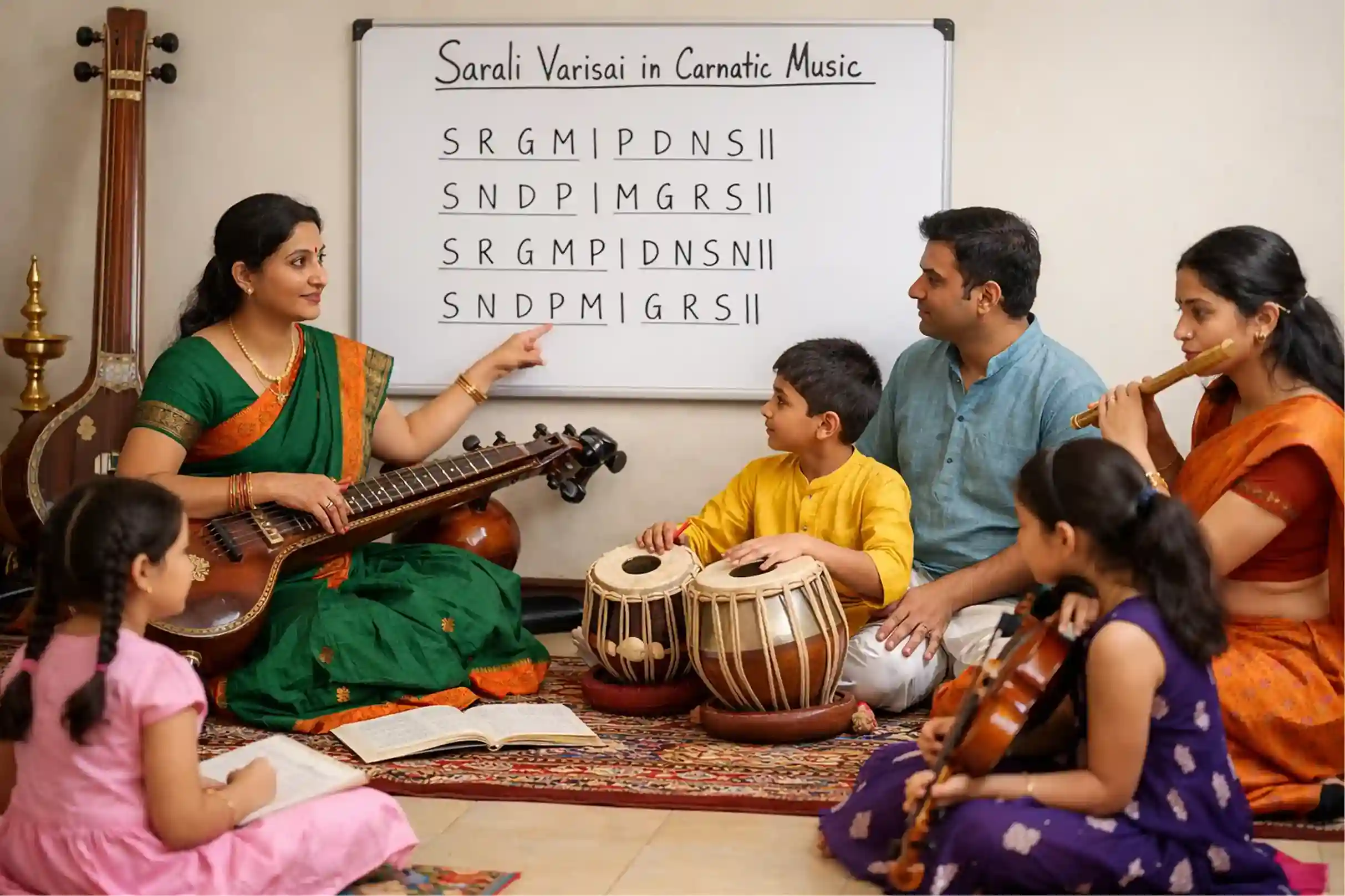
Table of Contents
Learning Carnatic music begins with building a strong and disciplined foundation, and this is where Sarali Varisai plays a crucial role. These fundamental exercises are designed to introduce beginners to the basic structure of swaras, voice control, and rhythmic discipline. For every student stepping into the world of Carnatic music, these early lessons act as the first bridge between musical theory and practical singing.
With patience and consistency, learners can be prepared for more advanced forms such as janta varisai, alankaras, and eventually compositions. This guide explores their purpose, structure, benefits, and how modern learners can master them effectively.
In addition to providing the technical foundation, Sarali Varisai helps cultivate essential musical habits, such as attentive listening, pitch awareness, and steady breath support. These exercises train the voice to move smoothly between notes without strain, encouraging natural voice development from the very beginning.
Regular practice also builds mental focus and discipline, which are vital qualities for long-term musical growth. Over time, learners begin to internalize swara patterns and tala flow, making future lessons easier to grasp. This gradual, methodical approach ensures that students progress with confidence, clarity, and a strong sense of musical direction.
What Are Sarali Varisai?
Sarali Varisai in Carnatic music refers to the very first set of vocal exercises taught to beginners. These exercises consist of simple, sequential patterns of swaras sung in a fixed raga, usually Mayamalavagowla. The goal is not speed or complexity, but clarity, accuracy, and steadiness. By repeatedly singing these patterns, students become familiar with pitch alignment, note transitions, and basic tala adherence.
Unlike songs, these exercises do not have lyrics. Instead, they focus purely on musical notes, allowing learners to concentrate fully on intonation and rhythm without distraction.
Watch Sarali Varisai in Carnatic singing – Sarali Varasai in Carnatic Singing | The Key To Carnatic Mastery | Carnatic Music Fundamentals
Why Is Sarali Varisai Important for Beginners?
For a beginner, Carnatic music can feel vast and intricate. Sarali Varisai simplifies this journey by breaking music down into manageable steps. These exercises help learners:
- Understand the concept of swaras and their placement
- Develop a steady voice and breath control
- Improve concentration and listening skills
- Build confidence before moving to compositions
Please refer to this pdf for better understanding of the basics of Sarali Varisai- https://www.scribd.com/document/936565079/Sarali-Varisai-PDF
Just as alphabets are essential before forming words, these exercises are essential before learning songs. Beyond these core benefits, Sarali Varisai also helps beginners develop musical discipline and consistency from the very start of their learning journey. Repeated practice trains the ear to recognize pitch accurately and naturally correct deviations.
These exercises encourage students to sing in a uniform tempo, strengthening their sense of rhythm and coordination. Over time, learners gain better control over voice modulation and smooth note transitions, which are essential for expressive singing.
By focusing on fundamentals without the complexity of lyrics, Sarali Varisai allows students to internalize musical concepts deeply, creating a strong and reliable foundation for all future Carnatic music learning.
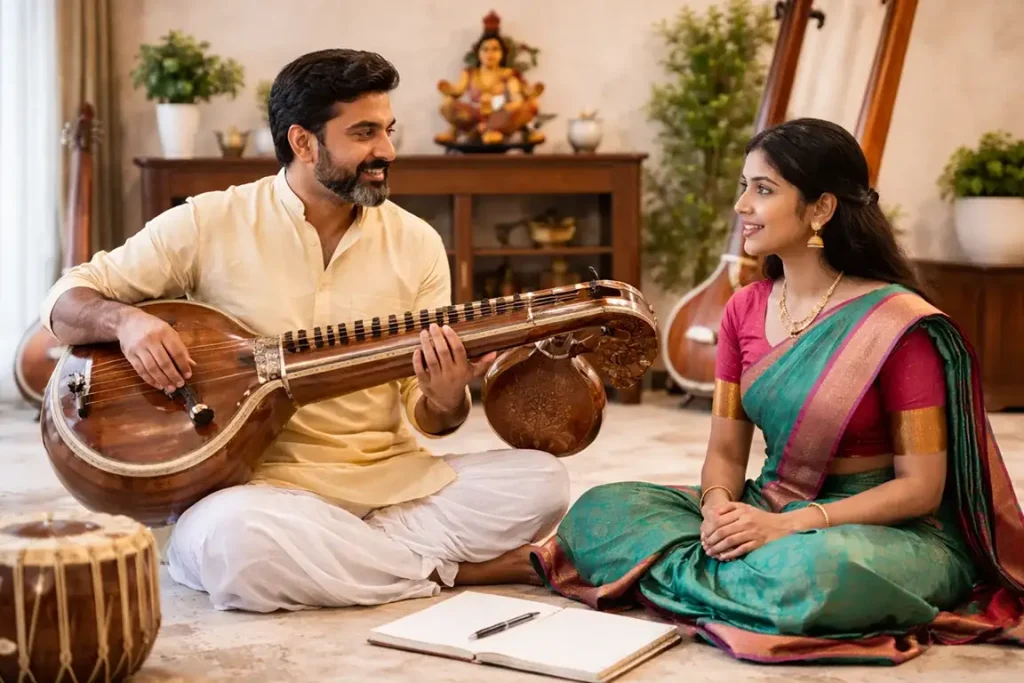
Understanding sarali varisai notes is essential for effective practice. Beginners are encouraged to learn the swara names clearly and sing them with proper pronunciation. Practicing with a shruti box helps maintain pitch accuracy, while a slow tempo ensures clarity. Teachers often guide students to avoid rushing and focus instead on uniformity and tone quality.
The Role of Raga Mayamalavagowla
Most Sarali Varisai lessons are taught in the raga Mayamalavagowla because of its symmetrical scale and clarity. The raga contains all seven swaras in both ascent and descent, making it ideal for beginners.
Singing exercises in this raga help students clearly hear pitch differences and develop strong swara recognition. Once mastery is achieved, the same exercises may later be practiced in other ragas for versatility.
In Mayamalavagowla, the swara sequence Sa Ri₁ Ga₃ Ma₁ Pa Da₁ Ni₃ Sa and its descent are evenly spaced, making pitch relationships easy to understand for beginners.
For example, when a student sings a simple Sarali Varisai pattern like Sa Ri Ga Ma | Pa Da Ni Sa, the clear progression helps the ear distinguish each note without confusion.
This clarity builds confidence and accuracy in early practice. Because of this balanced structure, Mayamalavagowla acts as a training raga, strengthening voice alignment and ear training. Once students gain control here, adapting the same exercises to other ragas becomes much smoother.
Understanding Sarali Swaras
The exercises are built using sarali swaras, which are sung in ascending and descending sequences. These patterns introduce learners to smooth transitions between notes and correct voice placement. Practicing them slowly ensures accuracy, while gradual tempo increases help improve agility. Teachers often emphasize maintaining a steady pitch throughout, making these swaras a powerful tool for developing voice culture.
Sarali swaras form the basic building blocks of early Carnatic music training and are designed to help beginners internalize swara movement with clarity and control. These exercises use simple, linear patterns sung in both ascending and descending order, allowing the voice to move naturally across notes.
Watch this to identify Sarali Varisai
For example, a basic pattern like Sa Ri Ga Ma | Ga Ri Sa trains the student to transition smoothly without jerks or strain. Singing these patterns slowly helps correct pitch alignment and voice placement, while repeating them at higher speeds improves flexibility and breath support. By insisting on steady shruti and even tone, teachers use sarali swaras to establish a strong voice culture and musical discipline from the start.
Structure of Sarali Varisai Lessons
Sarali Varisai Lessons typically begin with simple linear patterns and gradually introduce variations. Each exercise follows a clear structure:
- A fixed raga framework
- A steady tala, usually Adi Tala
- Repetition across multiple speeds
This structured approach trains the student’s ear and voice simultaneously, ensuring balanced musical growth.
In addition to this core structure, these lessons are designed to build gradual progression and consistency in learning. Beginners start with slower tempos to ensure swara clarity and correct pitch alignment before moving to medium and faster speeds.

This repetition across speeds strengthens muscle memory and improves breath control. Practicing within a fixed raga and tala helps students internalize both melody and rhythm together, rather than treating them separately. Over time, this method develops coordination between the ear, voice, and mind, preparing learners to handle more complex exercises and compositions with confidence and musical stability.
Practice Tips for Better Results
- Practice daily, even if it is for a short duration, to build consistency
- Start at a slow tempo to ensure clear swara pronunciation and pitch accuracy
- Sing each exercise in multiple speeds to improve voice control and flexibility
- Use a shruti box or tanpura to maintain correct pitch throughout practice
- Pay close attention to tala alignment, especially Adi Tala
- Listen carefully to your own voice and self-correct gently
- Avoid rushing through exercises; focus on clarity over speed
- Maintain a relaxed posture and steady breathing while singing
With the growth of digital education, learners can now access online Carnatic music lessons that provide structured guidance and flexibility. Video demonstrations, practice recordings, and real-time feedback help students maintain discipline even when learning remotely. Many learners also refer to a sarali varisai pdf for revision and daily practice, making learning more accessible and organized.
Important Extensions of Sarali Varisai
Heechu Sthayi Varisai and Taggu Sthayi Varisai are extensions of Sarali Varisai in Carnatic music learning, designed to expand a student’s vocal range and control. Heechu Sthayi Varisai focuses on singing exercises in the higher octave (upper sthayi).
These patterns help students gradually and safely develop strength, clarity, and confidence while singing higher notes without strain. Regular practice improves voice projection and stability in the upper register.
On the other hand, Taggu Sthayi Varisai concentrates on the lower octave (mandra sthayi). These exercises train the voice to remain steady and resonant in lower pitches, improving depth and tonal balance. Together, both forms ensure overall voice development, smooth octave transitions, and prepare learners for advanced compositions that span multiple octaves.
How Sarali Varisai Prepares You for Advanced Learning?
Once mastered, these exercises pave the way for janta varisai, alankaras, and geetams. They strengthen muscle memory, pitch stability, and rhythmic awareness. Students who practice diligently find it easier to grasp compositions and improvisation later in their musical journey.
Watch to learn singing Alankaras- https://www.youtube.com/shorts/2A2dIv-v8T4
Even today, both traditional and modern teachers consider these exercises indispensable. Whether learned in traditional gurukul systems or contemporary Carnatic music classes, they remain unchanged in purpose and importance. Their timeless design proves they are well-suited for nurturing musical fundamentals.
You can watch to know more about singing Janta Varisai- Janta Varasai Explained | 3 Speeds Demonstration with Aakarams | Carnatic Vocal Exercise |
Watch this to learn Carnatic Vocal exercises- Carnatic Vocal Exercise: Janta Varasai with Akaram, Syllables & Tips | Artium Carnatic
Building a Strong Foundation with Artium Academy
Mastering Sarali Varisai is the first meaningful step in a Carnatic music journey. These exercises shape a learner’s voice, discipline, and musical understanding for years to come. At Artium Academy, beginners receive structured guidance, personalized feedback, and a supportive learning environment that ensures strong foundations from day one.
Through thoughtfully designed lessons and expert mentorship, students gain the confidence and clarity needed to progress smoothly in Carnatic music while honoring tradition in a modern learning format.
In addition, Artium Academy ensures that students develop sound practice habits from the very beginning, helping them avoid common mistakes in pitch, rhythm, and vocal use. Regular assessments and guided practice sessions keep learners motivated and consistent. With flexible schedules and individual attention, students are encouraged to progress at their own pace while staying rooted in strong fundamentals.
This balanced approach allows learners to build a lasting connection with Carnatic music and confidently move toward advanced exercises and compositions.
FAQs on Sarali Varisai In Carnatic Music
Heechu Sthayi Varisai and Taggu Sthayi Varisai are foundational voice exercises in Carnatic music. Heechu means ‘ascending,’ so Heechu Sthayi Varisai focuses on gradually moving from lower to higher notes, helping develop vocal strength and pitch control in the upper range. Taggu means descending, so Taggu Sthayi Varisai trains the voice to move smoothly from higher notes to lower notes. Practicing both ensures balanced voice development, smooth transitions, and better control across all pitch ranges.
While practicing Sarali Varisai, the tanpura provides a steady shruti (tonic note), helping you stay in correct pitch throughout the exercise. The metronome helps maintain a consistent tempo, which is essential for developing rhythm and timing. Start Sarali Varisai at a slow metronome speed and gradually increase it as you gain confidence. Always align your swaras with the metronome beats while listening carefully to the tanpura drone.
Breath control is very important when singing Sarali Varisai in three speeds (slow, medium, and fast). In the first speed, take a deep, relaxed breath and sing steadily without strain. At the second speed, use shorter phrases and control airflow evenly. In the third speed, avoid gasping for breath; instead, plan breaths between avartanams. Always breathe from the diaphragm, keep your posture straight, and avoid tightening the throat. Proper breath control ensures clarity, stability, and stamina during practice.
Sarali Varisai is the first set of structured exercises taught to beginners in Carnatic music. It introduces basic swara patterns using the notes of the raga Mayamalavagowla. These exercises help students understand swara placement, develop voice control, improve rhythm, and maintain pitch accuracy. Sarali Varisai is practiced at multiple speeds, helping build a strong foundation for advanced lessons like Janta Varisai and Alankaram. Regular practice of Sarali Varisai prepares students for disciplined and confident Carnatic singing.
To memorize Sarali Varisai, practice regularly in a fixed order and repeat each pattern multiple times. Sing slowly at first while clearly pronouncing each swara. Use hand gestures or tala to reinforce rhythm memory. Listening carefully to your own voice with the shruti helps correct mistakes. Break the varisai into small sections and master one before moving to the next. Daily repetition with focus builds muscle memory, making Sarali Varisai easy to recall without written notation.