
All Topics
- Alchemizing Music Concepts for Students
- Artist Spotlight
- artium gift card
- Artium Maestros
- Artium News
- Artium Tech Blog
- buying guide
- Carnatic Music
- Devotional Music
- Editorials by Ananth Vaidyanathan
- English Love Songs
- Festival
- Film Music
- Ghazal Music
- Guitar
- Hindustani Classical Music
- Indian Classical Music
- Indian Folk Music
- Insights
- Instagram Reels Viral Songs
- Instruments
- Karaoke Singing
- Keyboard
- Kids Music
- maestros
- Music Education
- Music for Kids
- Music Industry
- Music Instruments
- Music Legends
- Music Technology
- Music Theory
- Music Therapy
- Piano
- piano guide
- Songs
- South Devotional Music
- Success Stories
- Tamil Film Music
- Telugu Film Music
- Time Theory
- Tools
- Uncategorized
- Uncategorized
- Uncategorized
- Uncategorized
- Vocal Singing
- Vocals
- western classical music
- western music
- Western vocal music
Melakarta Ragas: Understanding the 72 Parent Ragas in Carnatic Music
Melakarta Ragas: Understanding the 72 Parent Ragas in Carnatic Music
Table of Contents
Carnatic classical music has been around for centuries now. It is an integral part of Indian classical music and is very popular in southern India. There’s a notion that Carnatic music is difficult to learn because of the sheer number of ragas a student has to master. We are here to clear the air around it. Carnatic music students often feel overwhelmed by the sheer number of ragas. Melakarta ragas offer a structured pathway through this complexity. A Melakarta raga is the main scale including 7 swaras (notes) in ascending and descending order. This means every Melakarta is a full 7-note scale (sampurna) without any zig-zags, serving as a “genetic code” for many derivative ragas.
It is the backbone of Carnatic music melody, much like the periodic table that organizes the chemical elements. When you master these 72 foundational scales, you will build a good base for improvisation and composition in Carnatic music. At Artium Academy, in our online singing classes, we emphasize this foundational principle to ensure that students understand the Melakarta system early on.
What Is A Melakarta Raga In Carnatic Music?
A Melakarta raga is essentially a parent or fundamental scale in Carnatic music. Each one uses all seven basic notes (Sa, Ri, Ga, Ma, Pa, Dha, Ni) in direct order for ascent (arohanam) and descent (avarohanam). There’s no repetition or omission of notes here, and the ascending and descending sequences mirror each other (to put in perspective, Bhairavi is a sampurna raga, but not a Melakarta, because its ascent and descent differ). There are precisely 72 such parent scales in the Melakarta schemes. Each Melakarta has a unique name (like Shankarabharnam, Mayamalavagowla, etc.) and a corresponding number (1-72) that encodes its swara makeup.
Key Features:
- All Melakarta ragas are sampurna, containing all seven swaras.
- Their sequences are the same in arohanam & avarohanam and each swara appears once.
- They are divided into: Melakarta 1-36 use the lower Ma (madhyama) & 37-72 use the higher Ma, doubling the chances.
- Each Melakarta raga is a parent (janaka) raga from which various derived (janya) ragas can be created.
To sum it up, learning Melakarta ragas is very important in Carnatic music. Every Janya ragas (1000s of them) can be tracked back to one Melakarta parent. For example, Mohanam (5-note scale) is derived from Harikambhoji (28th Melakarta) and Hindolam is usually linked to Natabhairavi (20th Melakarta). When you understand Melakarta ragas, you gain insights into the entire melody of Carnatic music.
History and Origin of the Melakarta System
The raga framework in South India dates back centuries. In the 17th century, the musicologist Venkatamakhin classified the full set of 72 parent scales in his monograph Chaturdandi Prakasika. He built on older ideas and named each scale with Sanskrit syllables. (Centuries earlier, Ramamatya’s Svaramelakalanidhi had fewer Melas, but Venkatamakhin’s contribution expanded it significantly). Roughly 10 decades after Venkatamakhin, the Katapayadi sankhya system was applied to the names of the ragas so that the first two syllables encode the Melakarta number.
Timeline:
Ramamatya (16th C.): Introduced the early mela system
Venkatamakhin (17th C): Compiled the Chaturdandi Prakasika, listing 72 Melakarta ragas.
Govinda Dikshitra/Govindacharya (18th C): Streamlined Venkatamakhin’s list into the standard 72-scheme used today
The Chaturdandi Prakasika by Venkatamakhin was the game changer. He set the rules for it: every Melakarta must include all 7 notes, and Rishabha (Ri) must precede Gandhara (Ga), Dhaivata must precede Nishada, etc. This results in the scheme generating exactly 72 possibilities. For example, he identified Harikhamboji and published it as the 28th Melakarta. His framework also established the 12 Chakra grouping. To sum this up, he gave Carnatic music a scientific classification system, ensuring that no 7-note scale was left uncatalogued.
Organising the 72 Melakarta Ragas
Swarasthana, or note positions, are at the center of any raga. Carnatic music uses 7-basic swaras – Sa, Ri, Ga, Ma, Pa, Da, Ni, corresponding to specific frequencies. These seven are drawn from the 12 possible semitones (equivalent to the Western 12-tone system). Each Melakarta raga fixes exactly one variant of each swara (except Sa & Pa, as they’re fixed). For example, there are three options each for Ri/Ga(R1/G1, R2=G1, R3=G2, etc.) and Dha/Ni and two options for Ma (M1 or M2). So, by selecting one each of R, G, M, D, N (with Sa & Pa fixed), we get a scale. The number of combinations is therefore 2*3*3*2*2=72
In practice this means:
- Sa & Pa are present in all Melakartas (no variants)
- Ma has two forms: Shuddha Ma(M1) and Prati Ma (M2). Melakarta ragas 1-36 use M1 and 37-72 use M2, thus doubling the system.
- Ri/Ga and Da/Ni eac have three gradations. A Melakarta picks one Ri and one Ga (with Ri lower than Ga) and one Dha and one Ni.
This arrangement makes a sampurna ascent/descent with no gaps. As a result, all 72 possible seven-note linear scales are captured (this is why Melakarta ragas are often called the “complete set” of scales, as they use every swara once in order).
Structure Behind the 72 Melakarta Ragas
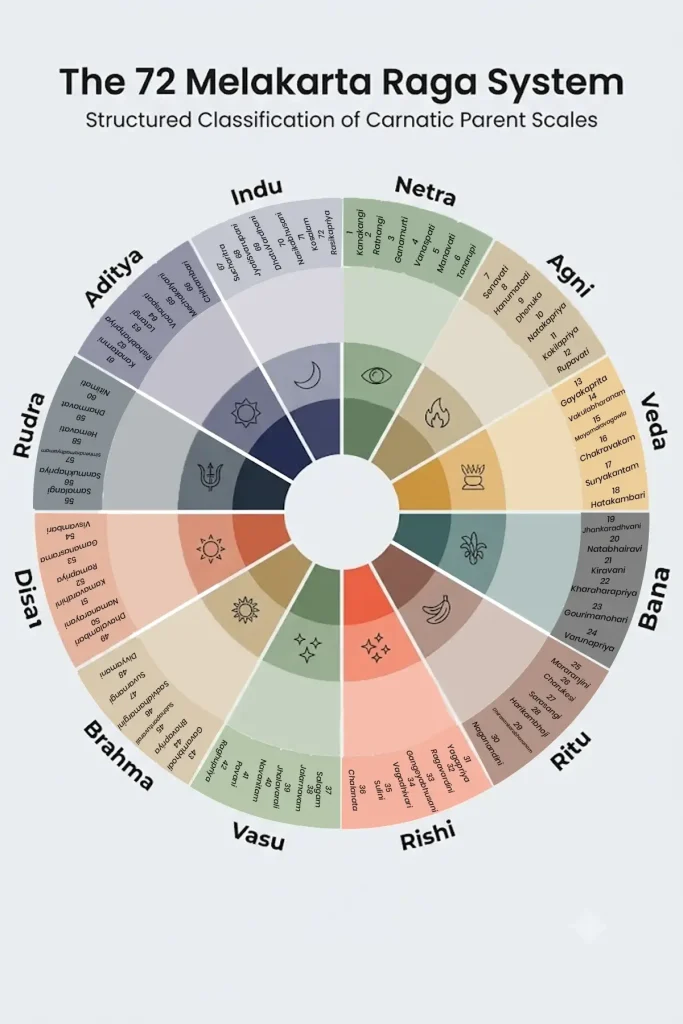
The 72 Melakarta ragas are divided into two sets of 26 based on Ma. The first 36 (Chakras 1-6) use Shuddha Madhyama (M1) and the next 36 (Chakras 7-12) mirror them with Prati Madhyama (M2). Each raga in the first half has a partner in the second with the same Ri, Ga, Da, Ni but opposite Ma, for example, Harikambhoji (28, M1) and Vachaspati (64, M2).
Katapayadi Sankhya further encodes the Melakarta number in the raga’s name. The first two consonants map to digits: in “Ha-ri-kam-bo-ji”, Ha = 8 and ri = 2, yielding 82 > 28, thus confirming Harikambhoji as Melakarta 28. These ragas are further grouped into 12 chakras (wheels or groups), each including 6 ragas. Each of these chakra’s names hints at its number, making them easy to recall:
- Indu (moon) – Chakra 1 (1-6). Indu means one (we have one moon).
- Netra (eyes) – Chakra 2 (7-12). Two eyes.
- Agni (fire) – Chakra 3 (13-18). 3 types of fire (Dakshina, Ahavaniyam, Garhapatyam).
- Veda (Vedas) – Chakra 4 (19-24). Four Vedas.
- Bana (Arrows) – Chakra 5 (25-30). Five arrows of Kama (Manmatha).
- Rutu (Seasons) – Chakra 6 (31-36). Six seasons of the Hindu calendar.
- Rishi (Sages) – Chakra 7 (37-42). Seven great sages
- Vasu (Vasus) – Chakra 8 (43-48). Eight Vasus (elemental gods).
- Brahma (Brahmas) – Chakra 9 (49-54). Nine forms of Brahma.
- Disi (Directions) – Chakra 10 (55-60). Ten directions (eight compass + up/down).
- Rudra (Rudras) – Chakra 11 (61-66). Eleven Rudras (forms of Shiva).
- Aditya (Suns) – Chakra 12 (67-72). Twelve Adityas (suns).
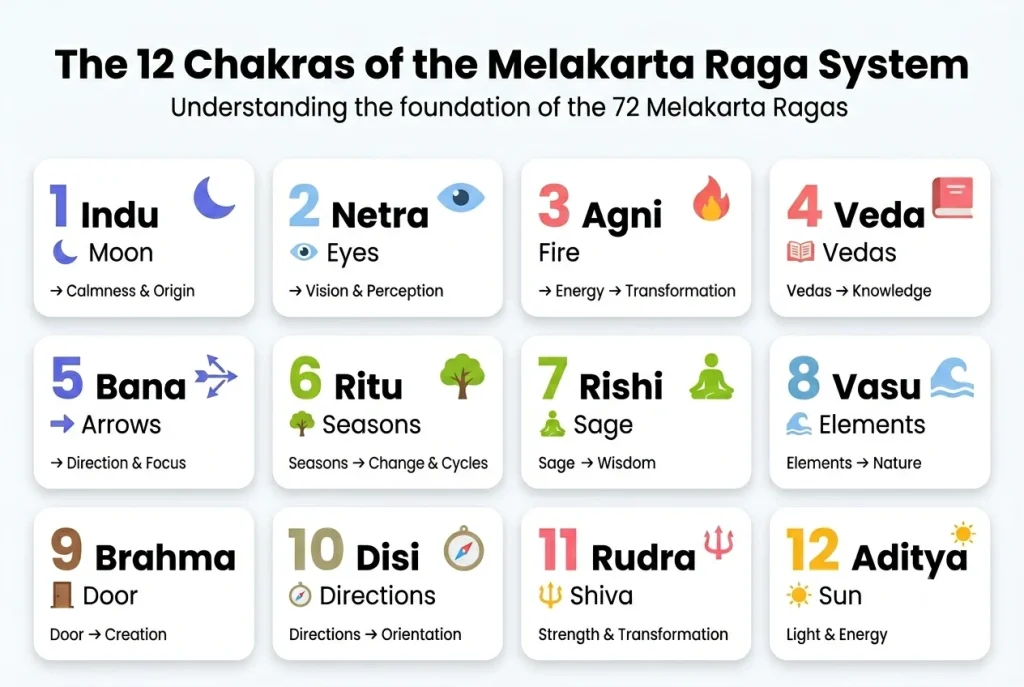
By remembering these key Sanskrit terms, you can instantly guess a raga’s number range. For example, knowing Kokilapriya is in Netra Chakra means it’s between 7 and 12. This mnemonic system, combined with Katapayadi, makes it much easier to recall all 72.
Below is the list of 72 Melakarta ragas divided into two halves (1-36 with Shuddha Ma, 37-72 with Prati Ma). Consider this list as the authoritative “master chart” of Carnatic scales:
| Melakarta | Raga Name | Melakarta | Raga Name |
| 1 | Kanakangi | 37 | Salagam |
| 2 | Ratnangi | 38 | Jalarnavam |
| 3 | Ganamurti | 39 | Jhalavarali |
| 4 | Vanaspati | 40 | Navanitam |
| 5 | Manavati | 41 | Pavani |
| 6 | Tanarupi | 42 | Raghupriya |
| 7 | Senavati | 43 | Gavambhodi |
| 8 | Hanumatodi | 44 | Bhavapriya |
| 9 | Dhenuka | 45 | Subhapantuvarali |
| 10 | Natakapriya | 46 | Sadvidhamargini |
| 11 | Kokilapriya | 47 | Suvarnangi |
| 12 | Rupavati | 48 | Divyamani |
| 13 | Gayakaprita | 49 | Dhavalambari |
| 14 | Vakulabharanam | 50 | Namanarayani |
| 15 | Mayamalavagowla | 51 | Kamavardhini |
| 16 | Chakravakam | 52 | Ramapriya |
| 17 | Suryakantam | 53 | Gamanasrama |
| 18 | Hatakambari | 54 | Visvambari |
| 19 | Jhankaradhvani | 55 | Samalangi |
| 20 | Natabhairavi | 56 | Sanmukhapriya |
| 21 | Kiravani | 57 | Simhendramadhyamam |
| 22 | Kharaharapriya | 58 | Hemavati |
| 23 | Gourimanohari | 59 | Dharmavat |
| 24 | Varunapriya | 60 | Nitimati |
| 25 | Mararanjini | 61 | Kanatamni |
| 26 | Charukesi | 62 | Rishabhahpriya |
| 27 | Sarasangi | 63 | Latangi |
| 28 | Harikambhoji | 64 | Vachaspati |
| 29 | Dhirasankarabharanam | 65 | Mechakalyani |
| 30 | Naganandini | 66 | Chitrambari |
| 31 | Yagapriya | 67 | Sucharitra |
| 32 | Ragavardini | 68 | JyotiSvarupani |
| 33 | Gangeyabhusani | 69 | DhatuVardhani |
| 34 | Vagadhivari | 70 | Nasikabhusani |
| 35 | Sulini | 71 | Kosalam |
| 36 | Chalanata | 72 | Rasikapriya |
The names of each of the above Melakarta are unique and universally recognized. Note: the spelling may vary slightly in English.
Why Are Melakarta Ragas Important?
While all these 72 ragas are important, some stand out in practice. As a student of Carnatic music, out of these 72, you need to be aware of Mayamalavagowla, Shankarabharnam, Kharaharapriya, Kalyani and Hanumatodi. By mastering these few Melakarta ragas, you will be able to sing with a rich vocabulary of notes and emotions. Here are a few reasons why understanding Melakarta ragas is crucial for any Carnatic music aspirant:
- Complete Framework: They include all seven notes, ensuring you learn every swarasthana. This helps you with your knowledge of notes and scales.
- Parentage: Every derived (janya) raga comes from a Melakarta raga. Knowing this, you can analyze, learn and even improvise janya ragas easily. For example, the bright Mohanam comes from Harikambhoji.
- Pedagogy: They serve as a pedagogical backbone, exactly like children learning major/minor scales before jazz. Carnatic students learn Melakarta scales to train their ears and voice.
- Analytical insight: The Melakarta system reveals the “math” behind Carnatic music. Its logical structure (chakras, katapayadi) trains students in pattern recognition.
- Continuity: These ragas have been taught for centuries. Learning them connects students with traditional teaching methods, while also preparing them to explore contemporary uses.
Melakarta ragas are very important in Carnatic music. As a student, if you know all 72, you’ll be well-equipped to tackle any style or composition. The Melakarta chart functions as a periodic table of musical emotions, a foundation on which creativity blossoms.
How to Remember the 72 Melakarta Ragas
Although it may sound impossible to remember the names and scales of all 72, there are mnemonics to make it easy:
- Katapayadi System: As mentioned above, the raga’s first two syllables encode its number. For instance, “Kha-ra” for Kharaharapriya yields digits 2 and 2. (Melakarta 22).
- Chakra Mnemonics: Each chakra name suggests its number (Indu=1, Netra=2). E.g., knowing bhavapriya is in Vasu chakra means its number is between 43-48; then katapayadi pinpoints the exact number (44).
- Mnemonic Phrases: Traditional mnemonics (such as sa ra gi ma pa dha ni) exist for each chakra to help recall the Ri/Ga and Da/Ni of all 6 ragas in that group.
- Progressive Learning: Follow a learning path rather than cramming all 72 together. Start with Melakartas 1-6, then 7-12 and so on.
Melakarta ragas are central to contemporary Carnatic music. Some composers still create new kritis and varnams in these scales and teachers rely on them to train their students. Film and fusion music also draw heavily on Melakarta themes, so knowing them helps listeners identify ragas in popular songs. At Artium Academy, our music courses use interactive Melakarta charts, audio demos and structured curriculum to make these scales accessible in digital classrooms. Thus, the Melakarta system bridges the gap between past and present: understanding them gives you a portable toolkit for recognising, learning and creating music that has stayed relevant for centuries.
Beginners Approach to Learning Melakarta Ragas
Here are a few steps a beginner must take when learning Melakarta ragas:
- Start with Key Scales: Start with Mayamalavagowla and Shankarabharanam. These are often taught first to set fingering and vocal patterns.
- Understand basic patterns: Practice sa-ri-ga-ma-pa sequences and common exercises in these ragas. Build familiarity with the 7-note scale concept.
- Use the Chakra system: Learn the names and characteristic phrases of each chakra (sa, ri, ga, ma, pa, dha, ni for Netra chakra) to remember Ri/Ga and Dha/Ni patterns.
- Apply Katapayadi: As soon as possible, use the name-to-number trick to confirm raga numbers. This empowers you to learn new Melakarta names on your own.
- Progress gradually: Move through chakras in order (Indu 1-6, Netra 7-12 etc). This builds logical progression.
- Leverage songs: Try identifying simple film or bhajan songs in these scales. Hearing familiar tunes helps cement the sound.
With the help of modern tools, this journey can become much easier. At our online Carnatic classes, we use interactive tutorials and practice track for each Melakarta, so students can sing along, see positions and receive guided feedback from home. The visuals and exercises turn a seemingly daunting system into an engaging, step-by-step exploration. Of course, no one memorises 72 scales overnight. A bite-sized approach works the best. Learn a few scales each month, keep revising older ones and let familiarity build gradually. Over time, the entire Melakarta chart becomes second nature, sharpening mental faculties and connecting learners to a rich musical heritage.
Exploring the World of Melakarta Ragas
Although they sound like theory, Melakarta ragas come alive in practice. The more you learn about them, it is like opening a musical treasure chest. Each scale offers new shades of emotion and countless improvisation possibilities. At Artium Academy, our Carnatic music program (certified by Padma Shri Aruna Sairam) guides students from these fundamentals to full expression. Whether you are a parent looking for Carnatic music classes for kids, an enthusiast taking online Carnatic music lessons or an adult joining online singing classes, Melakarta ragas will be your roadmap.
Ready to start? Dive in with a structured course: Learn Carnatic music online at Artium Academy. Our expert carnatic music teachers will walk you through each chakra, each raga and each swara step-by-step. In Artium Academy’s Carnatic music classes, the 72 Melakarta ragas become not just theory, but a practical toolkit.
Take the next step, empower your singing with a proven Carnatic curriculum. Join our Carnatic vocal courses, explore how each Melakarta opens up a world of melodies and discover the joy of Indian classical music.
FAQs on Melakarta Ragas
The 72 Melakarta ragas are the complete set of parent ragas in Carnatic music. They are systematically classified into 12 chakras with each chakra containing six ragas. Some renowned Melakarta ragas include Mayamalavagowla, Kharaharapriya, Harikambhoji, Shankarabharanam, Mechakalyani, Charukesi, Keervani and Todi. Together, these 72 ragas form the foundation from which hundreds of thousands of Janya (derived) ragas originate.
A Melakarta raga is a parent raga in Carnatic music that contains all seven swaras in both ascending (arohanam) and descending (avarohanam) scales. Every Melakarta raga follows a complete and sequential arrangement of notes, making it the basis for Carnatic music raga classification. These parent scales serve as the source of numerous Janya ragas.
The 7th Melakarta raga is Senavati. Its scale is Arohanam: S R1 G2 M1 P D1 N1 S and Avarohanam: S N1 D1 P M G2 R1 S. Senavati belongs to the Netra Chakra, the second chakra in the Melakarta system. Like all Melakarta ragas, it contains all seven swaras in ascending and descending order.
Learning all 72 Melakarta Ragas becomes easier when approached systematically:
- Learn the ragas chakra-wise rather than memorizing all 72 at once.
- Understand the 12 Chakras of Melakarta Ragas and their grouping patterns.
- Use the Katapayadi system to identify a raga’s number from its name.
- Practice singing Melakarta scales regularly.
- Listen to compositions based on major Melakarta ragas.
- Create a Melakarta Ragas Chart or flashcards for quick revision.
Consistent listening, singing, and pattern recognition are far more effective than rote memorization.
Contemporary Carnatic music recognizes 72 Melakarta Ragas. This classification remains the accepted and authoritative framework for organizing parent ragas in Carnatic music. While not all 72 are frequently performed in concerts, the entire Melakarta system continues to play an important role in music education, composition, and raga analysis.
The Melakarta system was developed and formalized by the 17th-century musicologist Venkatamakhin through his landmark treatise, Chaturdandi Prakasika. His work laid the foundation for the systematic classification of ragas in Carnatic music. Later scholars refined the framework into the 72 Melakarta scheme that is followed today.