
All Topics
- Alchemizing Music Concepts for Students
- Anuv Jain Songs
- Artist Spotlight
- artium gift card
- Artium Maestros
- Artium News
- Artium Practice Studio
- Artium Tech Blog
- Best Coke Studio Songs
- Best Female Singers
- Birthday songs
- Bollywood Love Songs
- buying guide
- Carnatic Music
- Child Singers
- Devotional Music
- Editorials by Ananth Vaidyanathan
- English Love Songs
- Festival
- Film Music
- Ghazal Music
- Guitar
- Hindustani Classical Music
- Indian Classical Music
- Indian Folk Music
- Insights
- Instagram Reels Viral Songs
- Instruments
- Karaoke
- Karaoke Singing
- Keyboard
- Kids Music
- maestros
- Music Education
- Music for Kids
- Music Games
- Music Industry
- Music Instruments
- Music Legends
- Music Press Release
- Music Technology
- Music Theory
- Music Therapy
- Music Tools
- Piano
- piano guide
- Songs
- South Devotional Music
- Success Stories
- Tamil Film Music
- Telugu Film Music
- Time Theory
- Tools
- Uncategorized
- Uncategorized
- Uncategorized
- Uncategorized
- Vocal Range
- Vocal Singing
- Vocals
- western classical music
- western music
- Western vocal music
10 Hardest Musical Instruments to Learn
10 Hardest Musical Instruments to Learn
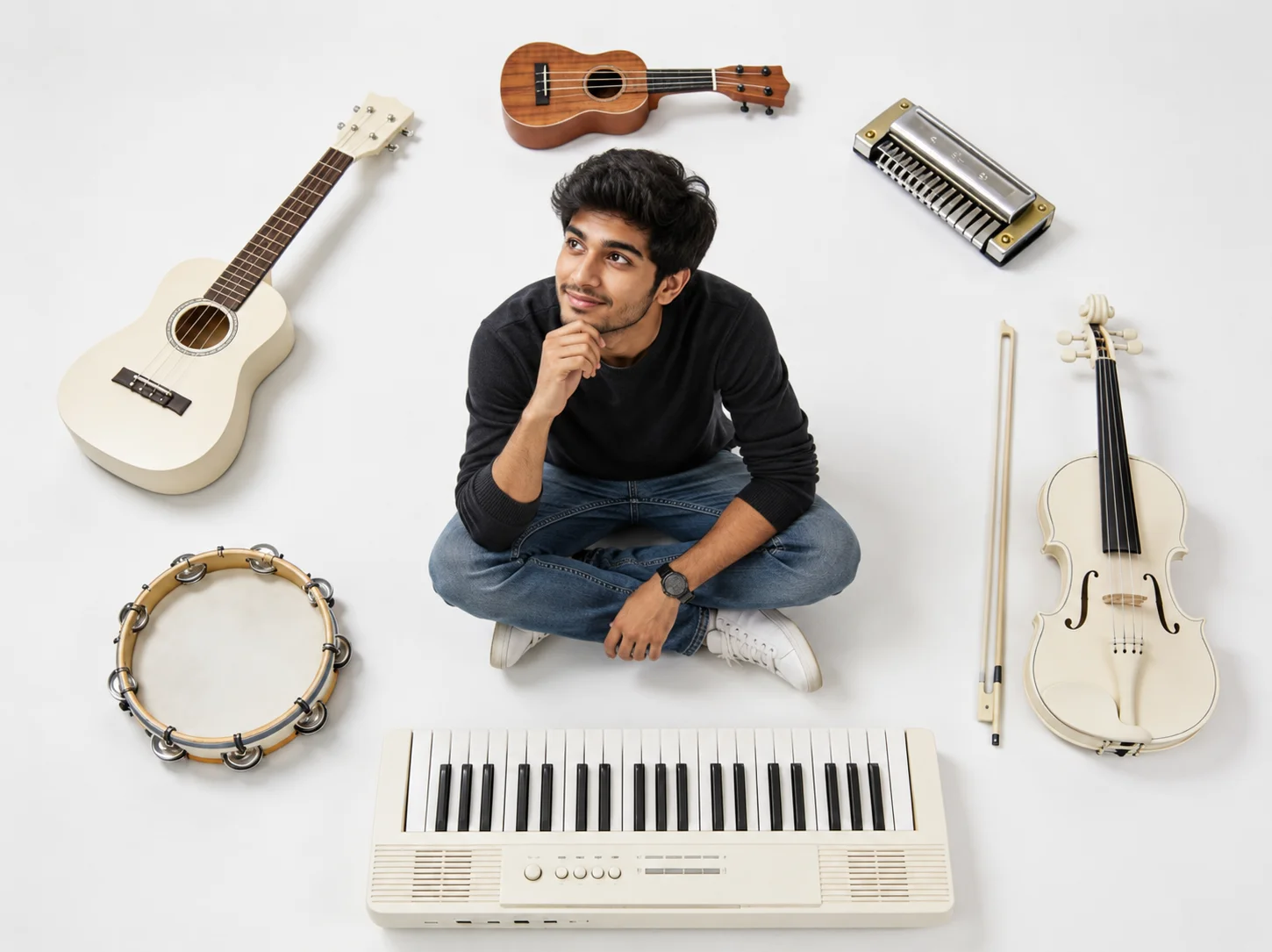
Table of Contents
Playing an instrument has to be one of the most impressive things a musician can do. While singers and vocalists are integral to music, instrumentalists are impressive in their own right.
If you have ever watched a violinist glide across the strings or an organist manage three keyboards and pedals at once, you have probably wondered: “How do they even do that?”, or questions like, “what is the hardest instrument to play in a band?” or, “which are the hardest musical instruments to learn?’ pop up all the time among curious learners.
At Artium Academy, we encounter thousands of students drawn to complex instruments because they seem impossible at first glance. They often want to challenge and play something that helps them grow. And they want to know where instruments like piano, guitar, drums, violin or saxophone fit within the top 10 hardest instruments to play.
We’ll answer this question, and explain what makes an instrument hard and show the list of 10 hardest instruments to play and show how structured online music lessons can make complex instruments feel achievable.
What Makes A Musical Instrument Difficult To Learn?
Before we get into naming the Top 10 hardest instruments to play, it is important to define what “difficult” actually means. There’s no instrument in this world that is difficult to learn & play; it’s only that some demand more from you in certain areas:
- Physical Difficulty
Some instruments require intense breath control (saxophone, trumpet), precise finger stretch (guitar, violin) or complex coordination across hands, feet and body (drums, organ).
- Technical Complexity
Fretless instruments like the violin require good intonation by ear. Others, like the piano and organ, often require reading two staves at once and managing independent hand patterns.
- Coordination and Multitasking
Drummers are ambidextrous. They can coordinate all four limbs. Organists coordinate hands on multiple keyboards plus feet on pedals. Accordion players juggle buttons, bellows and melody at the same time.
- Learning Curve and Time To Master
Some instruments let you make a nice sound quickly (e.g., basic chords on guitar), but take years to truly control tone and expression. Others are tricky even just to get a clean note from the beginning (double-reed woodwinds, brass).
So, when we talk about the hardest instrument to learn, we’re usually looking at some combination of all these factors.
Top 10 Hardest Musical Instruments To Learn
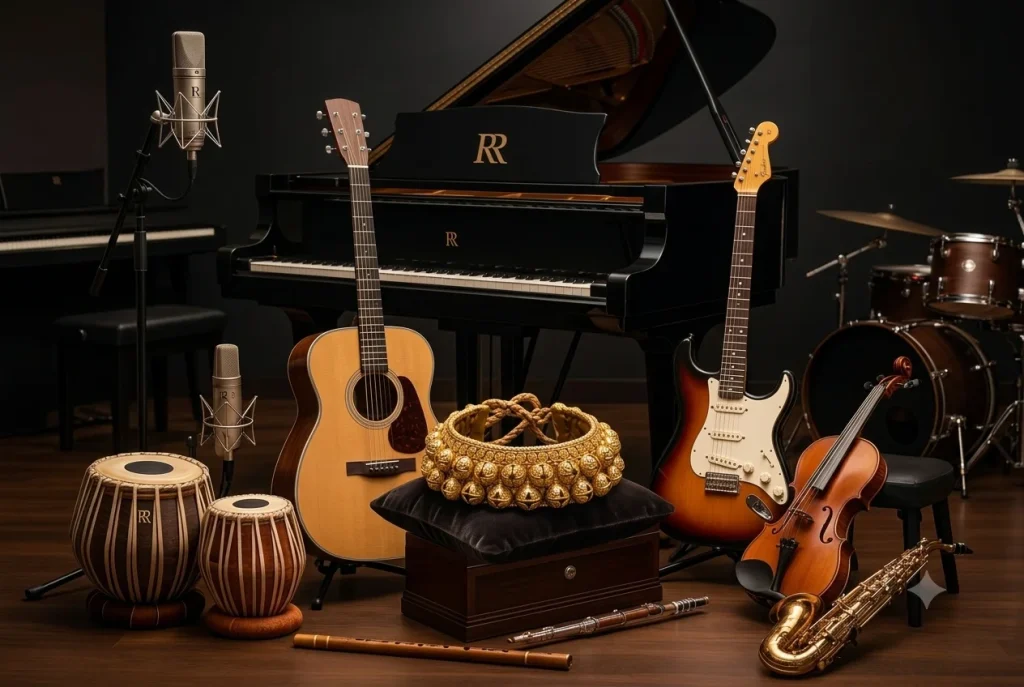
So, let’s get to what we are here for. Here’s a list of the hardest musical instruments to learn that are well-known and admired by music aspirants around the world. The order is random, but each of them appears in the discussion as the “hardest”.
- Violin
With no frets and fingers required to land on the right spots for every note, guided by ear, the violin is one of the hardest instruments. Bow control, posture and subtle left-hand techniques (vibrato, shifting, double stops) make it a lifetime journey of learning.
- Piano
Although you may not have expected it, the piano is equally difficult. To play well, you need to be ambidextrous, read two staves at once, have a wide dynamic range & finger control. Advanced piano repertoire is one of the most demanding in Western music.
- Guitar
You may not feel the guitar is the hardest instrument, probably because at the start, you can play simple chords and songs easily. But as you progress, it becomes more detailed: barre chords, complex finger picking, fast solos, bending, muting, alternate tuning and more. The gap between strumming a few chords and mastering the guitar is huge. Hence, we have ranked this even though it is the most popular instrument.
- Drums
Drums don’t involve melody, but they rate highly on physical and coordination difficulty. A drummer must: be ambidextrous, maintain solid timing & groove for long stretches and manage dynamics and stamina. With advanced styles and complex time signatures, drums are on this list.
- Saxophone
Although the saxophone looks cool and sounds expressive, it’s not as easy as it seems. You need to be patient with your breath control, embouchure (how you shape your mouth), fingerings across registers and intonation. It takes years to play in tune and with a rich tone across the full range.
- Trumpet/French Horn
For those asking, “What is the hardest instrument to play in a band?”, brass instruments, especially the French Horn, will be the most common answer. Producing clean notes in the right partial, maintaining embouchure strength and controlling pitch are all challenging. Trumpet demands strong, precise airflow and endurance. Since the French Horn has a narrow “target” for each note, it is easy to crack or miss pitches.
- Flute
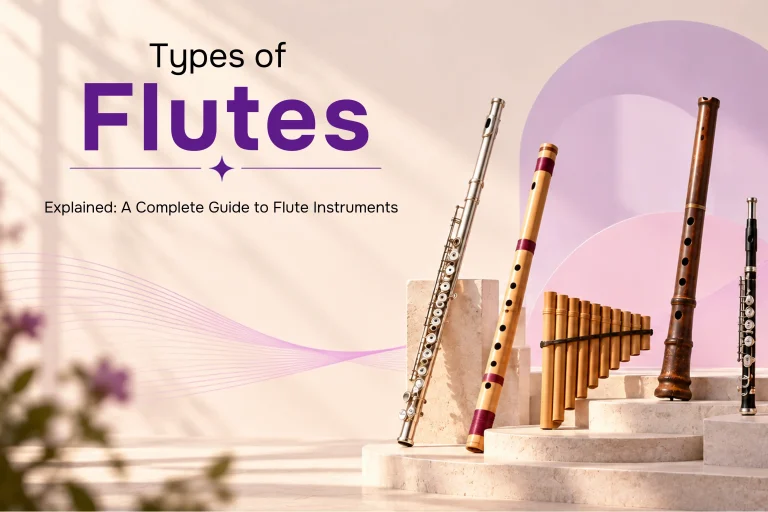
Although it may look simple, achieving a clear, consistent tone on the flute is a real test. Breath support, embouchure, finger coordination and tuning across registers all play a part. Adding vibrato, articulation and fast passages pushes the difficulty higher.
- Harp
Although the harp is visually stunning and technically complex, a harp player must be ambidextrous to control multiple strings. Use pedals to change pitch & key and coordinate glissandi, arpeggios and advanced techniques. The harp is often listed among the hardest musical instruments to learn because of size, cost and the combination of technique and theory involved.
- Organ
Think of an organ as a piano, but twice as complex and with extra layers. Multiple keyboards (manuals), a full pedalboard for the feet and managing registration (sound combinations) turn it into a serious multitasking challenge. Think of it like playing piano and bass at the same time, while conducting your own mini orchestra.
- Oboe/Accordion/Bagpipes (honorable tough contenders)
Although less common, these are famous for their difficulty:
Oboe – Double-reed, air control, tuning and endurance make it a specialist instrument.
Accordion – Both hands are doing different things plus managing bellows and buttons for chords and bass.
Bagpipes – Constant air pressure, steady drones and fingerings while marching or moving.
Any of these could easily sit in a “top 10 hardest instruments to play” list, depending on who you ask.
Hardest Indian Classical Instruments to Learn
Now, let us see a few Indian classical instruments that stand out for their depth and complexity:
Indian Violin (Carnatic or Hindustani) – Think of this as all the complexities of the Western violin, plus microtones, gamakas (ornaments) and long, seated performance postures.
Sitar or Veena – It includes complex left-hand techniques, sympathetic strings, intricate right-hand plucking and deep raga knowledge.
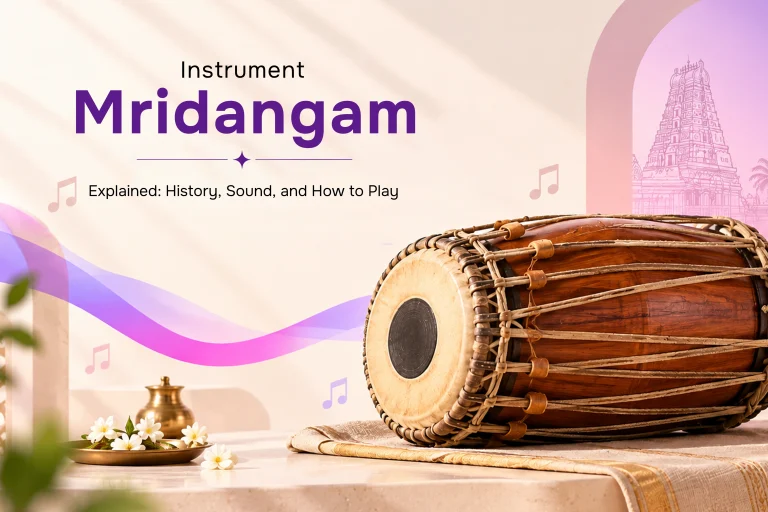
Tabla & Mridangam – It includes extremely detailed rhythmic systems, hand techniques and coordination. Students spend years internalising patterns and talas.
Bansuri (Indian bamboo flute) – For expressive playing of this instrument, breath control, pitch bending and microtonal inflections are required.
Centuries of tradition are attached to these musical instruments. They demand not only physical skills but also immersion in raga, tala and stylistic intricacies passed down through gurus.
Comparing Instruments Difficulty Level
Here’s a comparison table for your reference. Note that it is not a strict ranking but a way to understand how difficulty can vary –
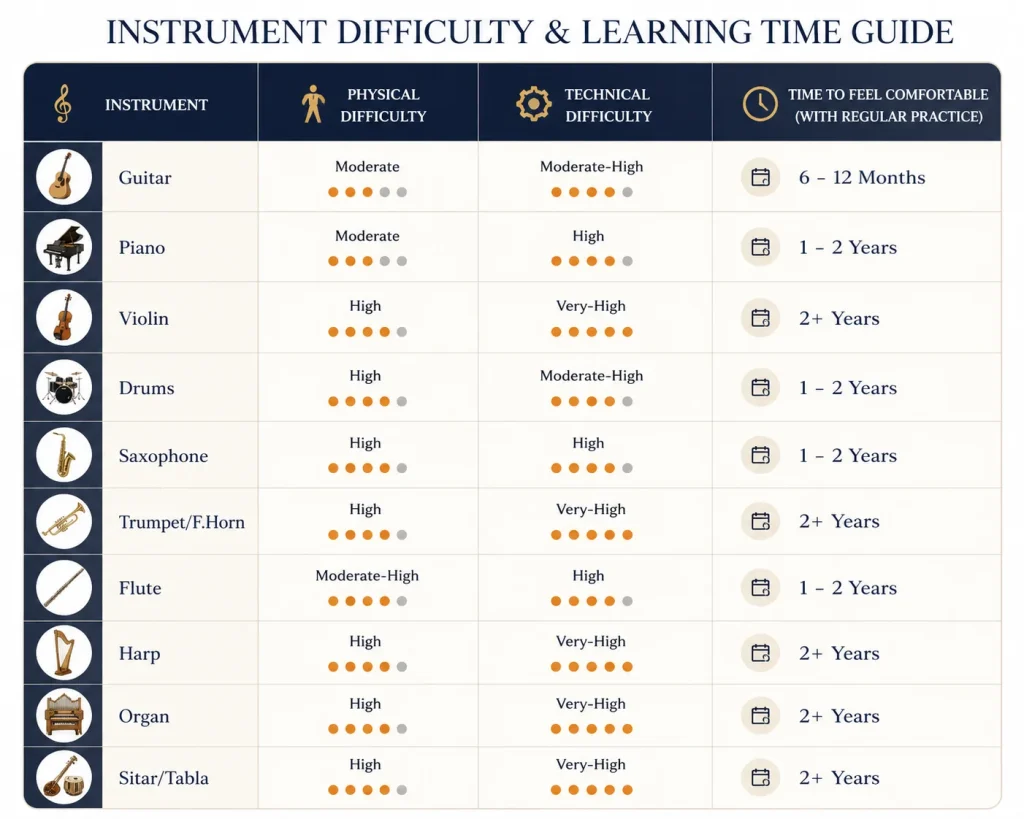
It is important to understand that these are approximate ranges for you to reach a comfortable intermediate level, not to master the instrument itself. Learning music and becoming a master musician is a lifetime journey.
Can Beginners Learn Difficult Musical Instruments?
Of course, yes. Beginners can absolutely start learning from the names in the above list of the hardest musical instruments to learn. The key here is to start learning with the right mindset:
- Understand that learning is a slow process. So, expect a slower start and celebrate every small win.
- Guessing is the biggest hurdle to learning. Instead, learn from a music teacher or a structured course.
- As mentioned earlier, learning is a slow, lifelong process. Give yourself time; months & years, not days and weeks.
No matter what you are drawn to, it is important to choose the sound that inspires or moves you, because only passion and discipline will carry you through the difficult days.
Tips For Learning The Hardest Musical Instruments
Here are some practical tips to learn one of the hardest musical instruments to play and to make your journey smoother:
- Right Guidance
Learn via online musical instrument classes or in-person lessons to develop the right technique from day one. This is important for instruments involving posture, breath and fine motor skills.
- Break Skills Into Small Goals
If your goal is to “master the violin”, then aim for clean open strings, then basic scales, then simple pieces. Tiny targets build confidence.
- Build A Realistic Practice Plan
20-30 minutes a day, 4-5 days a week, is far more effective than one long session once in a while. - Use Technology Wisely
When you learn music online, you can use metronomes, slow-down tools, practice apps and recordings to support your practice between classes.
Are Hard Instruments Worth Learning?
Picking a “hard” instrument to learn is like choosing a steep but beautiful hiking trail. It may take longer and may demand more energy, but the views along the way are unforgettable. By learning a hard instrument, you can:
- Improve your overall understanding of music
- Sharpen your concentration, ear and coordination
- Build resilience and patience that carry into other areas of your life
If you ever find yourself asking, “What is the hardest instrument to play in band?” or googling lists of the top 10 hardest instruments to play, chances are that you do not shy away from a challenge. That mindset alone will serve you well, no matter which instrument you choose.
How Artium Can Help in Learning Piano and More
The piano often appears in guides to the hardest musical instruments to learn. At the same time, it’s one of the best instruments for building a strong musical foundation. It lets you see melody and harmony laid out clearly in front of you, making theory easier to understand.
At Artium Academy, our online piano classes are designed to help aspiring musicians approach this powerful instrument step by step. You don’t need prior experience. Through our live online music classes, structured modules and guided practice, we help you:
- Develop proper technique and posture
- Read notation confidently
- Play chords, songs and pieces that connect with your musical taste
Not just piano, we also offer guitar lessons online and other musical courses to support learners who are curious about guitar, vocals and more. All our music courses are curated by legendary musicians, so you learn from a curriculum shaped by real performers and industry experts. So, no matter if it’s piano or guitar, these instruments give you a strong base to explore some of the top 10 hardest instruments to play in Western or Indian classical traditions.
Choosing Your Instrument: Where to Begin
So, now that you have come this far, the question is which instrument should you pick up? Instead of asking, “Which is the hardest instrument to learn?”, try asking:
What’s the sound that I love so much that I’m willing to work for it?
Which instrument best fits my physical comfort and environment?
Do I want to play solo, in a band or in an ensemble?
The “correct” answer can be deeply personal. At Artium Academy, we suggest picking an instrument that excites you enough to show up consistently for your classes. Then give yourself good guidance, a realistic timeline and a supportive learning space, whether through offline lessons or when you learn music online. Think of hard instruments as instruments to help you grow. And if piano or guitar on this list calls out to you, we’d be happy to help you take the next step.
FAQs
Hardest is subjective to each person, and there’s no universally agreed “hardest instrument”. But some do appear consistently on top of experts’ and educators’ lists, like violin, French horn, organ, harp, oboe and bagpipes. These instruments are a few of the hardest as they demand precise control of pitch, complex coordination and years of focused practice. In the end, “hardest” depends on the player’s body, mindset and the quality of guidance they receive.
A violin has a steeper learning curve at the beginning than a piano. On the piano, pressing a key produces a clear, in-tune sound immediately, so early progress is smoother. On the violin, you must learn exact finger placement on a fretless fingerboard, bow control, posture and intonation before even simple notes sound pleasant. At advanced levels, both violin and piano are very demanding, but for beginners, violin is generally considered harder to start with than piano.
Indian classical instruments like violin, sitar, veena, tabla, mridangam and bansuri are all difficult in different ways. Many musicians consider the Indian violin and the major melody instruments (sitar, veena) among the most difficult to master because they combine microtonal precision, intricate ornamentation (gamakas), complex raga vocabulary and decades of guru-shishya training. Advanced percussion instruments like the tabla and the mridangam are equally rhythmically demanding, often requiring years of dedicated practice to reach a professional level.
Becoming “good” at a difficult instrument usually requires years of consistent, structured practice. With 30-60 minutes of focused practice most days and regular guidance, many players reach a comfortable intermediate level.
Yes. Adults can absolutely learn hard instruments successfully. In fact, adult learners often bring discipline, clearer goals, and greater self-awareness to their practice. While starting later may mean you progress differently than someone who began as a child, adults can reach strong intermediate and even advanced levels on instruments like piano, violin, guitar or Indian classical instruments by following a realistic plan, practising regularly and getting expert guidance.
Good online music classes can be highly effective for complex instruments when structured and interactive. Live or well-designed online musical instrument classes allow teachers to correct posture, technique and timing, provide practice plans and answer questions, all of which are crucial for instruments with steep learning curves. Many modern platforms also combine live sessions with videos, backing tracks and assignments so you can learn music online systematically. For instruments like piano and guitar, online piano classes and guitar lessons online are now a proven way for serious learners to progress from beginner to advanced levels.