
All Topics
- Alchemizing Music Concepts for Students
- Anuv Jain Songs
- Artist Spotlight
- artium gift card
- Artium Maestros
- Artium News
- Artium Tech Blog
- Best Coke Studio Songs
- Best Female Singers
- Birthday songs
- Bollywood Love Songs
- buying guide
- Carnatic Music
- Child Singers
- Devotional Music
- Editorials by Ananth Vaidyanathan
- English Love Songs
- Festival
- Film Music
- Ghazal Music
- Guitar
- Hindustani Classical Music
- Indian Classical Music
- Indian Folk Music
- Insights
- Instagram Reels Viral Songs
- Instruments
- Karaoke
- Karaoke Singing
- Keyboard
- Kids Music
- maestros
- Music Education
- Music for Kids
- Music Games
- Music Industry
- Music Instruments
- Music Legends
- Music Press Release
- Music Technology
- Music Theory
- Music Therapy
- Music Tools
- Piano
- piano guide
- Songs
- South Devotional Music
- Success Stories
- Tamil Film Music
- Telugu Film Music
- Time Theory
- Tools
- Uncategorized
- Uncategorized
- Uncategorized
- Uncategorized
- Vocal Range
- Vocal Singing
- Vocals
- western classical music
- western music
- Western vocal music
Major vs Minor Scale: What’s the Difference? A Beginner’s Guide
Major vs Minor Scale: What’s the Difference? A Beginner’s Guide
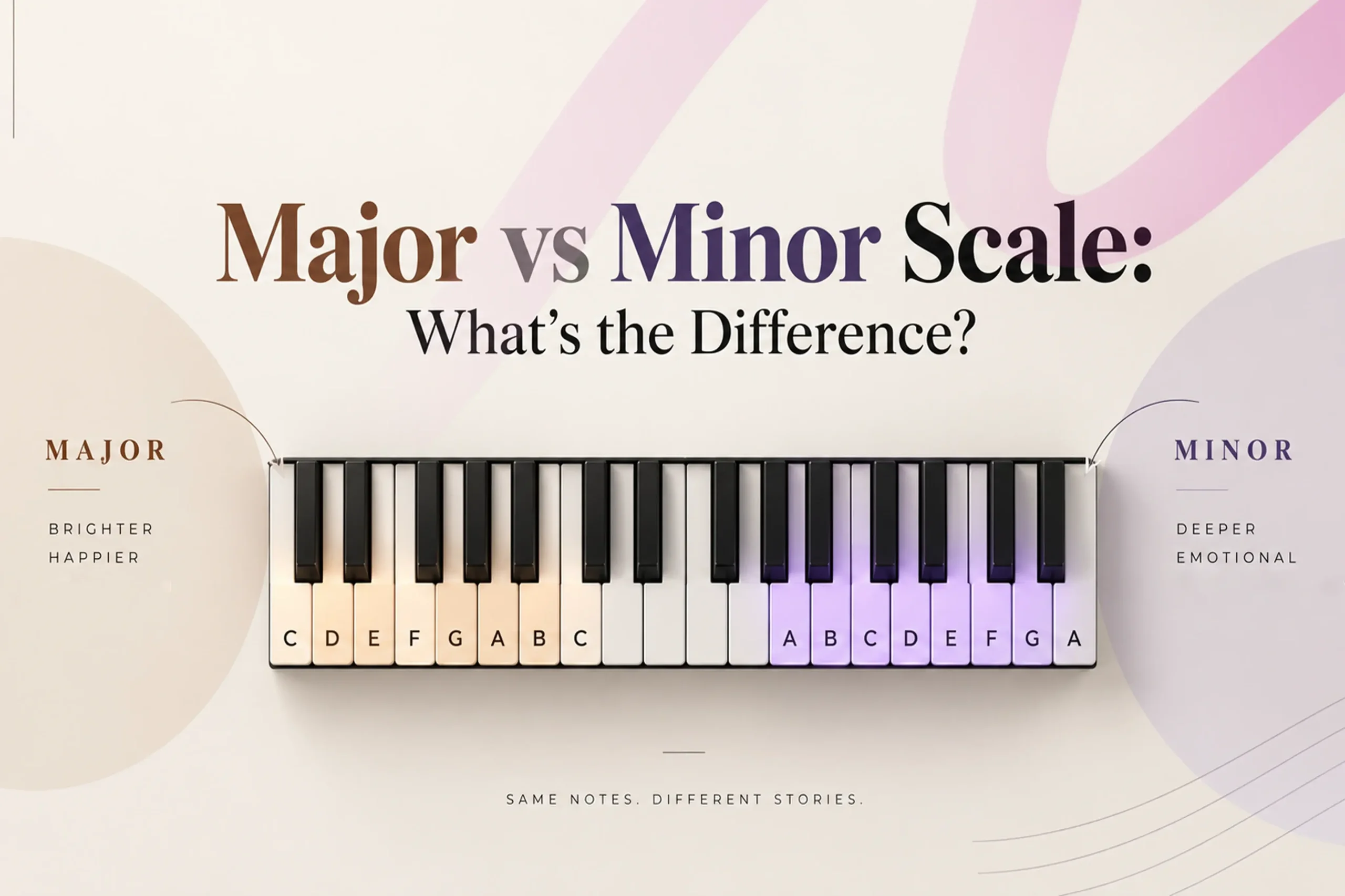
Table of Contents
Quick Summary
| The comparison between Major Scale and Minor Scale shows how two common seven-note patterns differ in sound, mood, intervals and musical use. Major Scale often sounds bright and stable while Minor Scale can sound deeper or more reflective. These differences help learners understand C Major Scale versus A Minor Scale, scales, ear training and practical exercises. |
What Is a Major Scale?
A Major Scale is a sequence of seven notes arranged in a pattern of whole steps and half steps. A Major Scale is one of the building blocks of music and is used in melodies, chords, songs and exercises.
A whole step means moving two semitones. On a piano a whole step usually means moving from one key to the key with one key in between. A half step means moving one semitone, such as from E to F or B to C.
The pattern of a major scale is:
Whole step – Whole step – Half step – Whole step – Whole step – Whole step – Half step
You can also write this as:
W – W – H – W – W – W – H
Example: C Major Scale
The C major scale contains:
C – D – E – F – G – A – B – C
On the piano, this scale uses only the white keys. Its intervals follow this pattern:
- C to D: Whole step.
- D to E: Whole step.
- E to F: Half step.
- F to G: Whole step.
- G to A: Whole step.
- A to B: Whole step.
- B to C: Half step.
C Major Scale is often the first scale beginners learn because it has no sharps or flats in its form.
How Major Scales Sound
Major scales are commonly associated with:
- Brightness.
- Openness.
- Stability.
- Celebration.
- Confidence.
- Energy.
However, a major scale does not automatically make every song cheerful. Tempo, rhythm, lyrics, melody, instrumentation, and performance style also affect the mood.
Major Scales in Music
Major scales appear in many forms of music, including:
- Bollywood songs.
- Indian film background scores.
- Western pop.
- Rock.
- Jazz.
- Gospel.
- Folk music.
- Children’s songs.
- Classical and contemporary compositions.
When you learn major scales, you begin to understand how melodies are constructed and how chords relate to a song’s key.
What Is a Minor Scale?
A minor scale is another seven-note scale pattern. Compared with a major scale, its third note is lower by one semitone. This lowered third gives the minor scale much of its characteristic sound.
The most commonly introduced minor scale is the natural minor scale.
The natural minor scale pattern is:
Whole step – Half step – Whole step – Whole step – Half step – Whole step – Whole step
You can also write it as:
W – H – W – W – H – W – W
Example: A Natural Minor Scale
The A natural minor scale contains:
A – B – C – D – E – F – G – A
Like C major, A natural minor uses only the white keys on the piano. However, the notes begin and resolve around A rather than C.
How Minor Scales Sound
Minor scales are often linked with:
- Reflection.
- Seriousness.
- Mystery.
- Tenderness.
- Sadness.
- Intensity.
- Emotional depth.
These descriptions are useful for beginners, but they are not strict rules. Minor music can sound exciting, dramatic, powerful, playful, or hopeful. For example, a fast minor-key song may feel energetic and intense rather than sad.
Types of Minor Scales
There are three commonly taught types of minor scales:
1. Natural Minor Scale
The natural minor scale uses the notes of the minor key without changing the sixth or seventh notes.
For example:
A natural minor: A – B – C – D – E – F – G – A
2. Harmonic Minor Scale
In a harmonic minor scale, the seventh note is raised by one semitone.
A harmonic minor becomes:
A – B – C – D – E – F – G♯ – A
The raised seventh creates a stronger pull towards the final A. It is especially useful when building dominant chords and creating a dramatic sound.
3. Melodic Minor Scale
In the traditional ascending form of the melodic minor scale, the sixth and seventh notes are raised. When descending, the scale often returns to the natural minor notes.
A melodic minor ascending becomes:
A – B – C – D – E – F♯ – G♯ – A
In modern genres such as jazz, the ascending melodic minor pattern may be used in both directions.
Major vs Minor Scale: Key Differences Explained
The major vs minor scale distinction is not only about whether a scale sounds happy or sad. These two scale types differ in their interval patterns, tonal centres, chord qualities, and emotional colour.
| Point of difference | Major scale | Minor scale |
| Sound and mood | A major scale often sounds bright, open, stable, or uplifting. However, tempo, lyrics, rhythm, and performance style can also influence its mood. | A minor scale often sounds reflective, deep, serious, or emotional. It can also sound dramatic, powerful, romantic, or energetic. |
| Third note | The third note is a major third above the first note. In C major, C to E is four semitones. | The third note is a minor third above the first note. In A natural minor, A to C is three semitones. |
| Example of notes | C major: C – D – E – F – G – A – B – C | A natural minor: A – B – C – D – E – F – G – A |
| Scale pattern | W – W – H – W – W – W – H | W – H – W – W – H – W – W |
| First three notes | 1 – 2 – 3 | 1 – 2 – ♭3 |
| Meaning of ♭3 | Not applicable. | The third note is lowered by one semitone compared with the major scale. |
| Tonal centre | The first note, or tonic, feels like the musical “home”. In C major, C feels like the point of rest. | The first note, or tonic, feels like the musical “home”. In A minor, A feels like the point of rest. |
| Chord quality | A major chord contains a major third. For example, C major is C – E – G. | A minor chord contains a minor third. For example, A minor is A – C – E. |
| Emotional colour | Often sounds clear, warm, confident, or cheerful. It can also express nostalgia, longing, or sadness. | Often sounds intimate, thoughtful, dramatic, or intense. It can also express strength, suspense, romance, or determination. |
| Musical resolution | Melodies and chords often resolve towards the major tonic, creating a stable or open feeling. | Melodies and chords often resolve towards the minor tonic, creating a deeper or more reflective feeling. |
Difference in Sound and Mood
| Aspect | Explanation |
| Major and minor third | The one-semitone difference between the major and minor third plays an important role in how these scales sound. |
| C major chord | C – E – G forms a C major chord, which usually sounds open or bright. |
| A minor chord | A – C – E forms an A minor chord, which often sounds more reflective or subdued. |
| Major-key music | A major-key song can sound emotional or melancholic, depending on its tempo, lyrics, rhythm, and performance style. |
| Minor-key music | A minor-key song can sound energetic or powerful rather than sad. |
| General guideline | Major and minor scales often create different moods, but these are general tendencies rather than strict rules. |
Difference in Tonal Centre
| Aspect | Major scale | Minor scale |
| Meaning | The tonal centre is the note that feels like “home”. It is also called the tonic. | The tonal centre is the note that feels like “home”. It is also called the tonic. |
| Example | C major uses the notes C, D, E, F, G, A, and B, with C feeling like the point of rest. | A minor uses the same seven notes, but A feels like the point of rest. |
| Role of the tonic | The melody and chords often feel settled when they resolve to C. | The melody and chords often feel settled when they resolve to A. |
| Important point | Simply listing the notes does not always tell you whether a piece is in a major key. | Simply listing the notes does not always tell you whether a piece is in a minor key. |
| What to listen for | Listen for the note and chord that feel most settled. | Listen for the note and chord that feel most settled. |
Difference in Chords
| Aspect | Major chord | Minor chord |
| Example | C major chord: C – E – G | A minor chord: A – C – E |
| Third note | Contains a major third. In C major, C to E is four semitones. | Contains a minor third. In A minor, A to C is three semitones. |
| Sound | Often sounds bright, open, or stable. | Often sounds deeper, softer, or more reflective. |
| Relationship with scales | Major and minor scales produce different chord qualities because their notes are organised around different tonal centres. | Major and minor scales produce different chord qualities because their notes are organised around different tonal centres. |
| Role in a song | The overall key depends on the tonal centre and how the chords resolve. | The overall key depends on the tonal centre and how the chords resolve. |
| Harmonic variety | A song in a major key may also include minor chords. | A song in a minor key may also include major chords. |
C Major vs A Minor Scale: A Closer Look
The relationship between C major and A minor is a simple way to understand how relative major and minor scales work. Both scales use the same seven notes, but they begin and resolve on different notes.
| Feature | C Major Scale | A Natural Minor Scale |
| Scale notes | C – D – E – F – G – A – B – C | A – B – C – D – E – F – G – A |
| Starting note | C | A |
| Resting note | C feels like the musical “home” or point of rest. | A feels like the musical “home” or point of rest. |
| Notes used | A, B, C, D, E, F, and G | A, B, C, D, E, F, and G |
| Number of different notes | Seven | Seven |
| Relationship | C major is the relative major of A minor. | A minor is the relative minor of C major. |
| Key signature | No sharps or flats | No sharps or flats |
| Common sound | Often sounds bright, open, or stable. | Often sounds reflective, deep, or emotional. |
| Main difference | The scale is organised around C. | The scale is organised around A. |
Although C major and A minor contain the same notes, they do not sound identical. The note that feels like “home” changes the musical character of the scale. In C major, melodies often resolve to C, while in A minor, they often resolve to A.
Why They Share the Same Notes
A minor is the relative minor of C major. C major is the relative major of A minor.
A major scale’s relative minor begins on its sixth note. The sixth note of C major is A:
C – D – E – F – G – A
Therefore, A is the relative minor of C major.
You can also find the relative minor by moving three semitones down from the major tonic:
- C to B: One semitone.
- B to B♭: Two semitones.
- B♭ to A: Three semitones.
This relationship means that C major and A minor have the same key signature, with no sharps or flats. However, they do not necessarily sound the same because their tonal centres are different. This is the central idea behind the C major vs A minor relationship.
Same Notes, Different Feeling
Imagine using the same set of letters to create two different sentences. The letters are the same, but the order and emphasis change the meaning.
C major may emphasise:
C – E – G – C
A minor may emphasise:
A – C – E – A
The notes overlap, but the musical “home” changes.
A melody that repeatedly settles on C may sound as if it belongs to C major. A melody that settles on A, especially alongside an A minor chord, may sound as if it belongs to A minor.
How to Identify Major and Minor Scales by Ear
Learning to hear the difference between major and minor is useful for singers, pianists, guitarists, and music learners in general. You do not need perfect pitch. Regular comparison and focused listening can help you develop this skill.
1. Listen for the Feeling of Home
Ask yourself:
- Which note sounds most settled?
- Where does the melody seem to want to stop?
- Does the ending feel complete on C, A, or another note?
- Which chord feels like the final resting point?
The note that feels most stable is often the tonic.
2. Compare Major and Minor Chords
Play or sing these pairs:
- C major: C – E – G.
- C minor: C – E♭ – G.
- A major: A – C♯ – E.
- A minor: A – C – E.
Keep the root and fifth the same while changing the third. This makes the difference easier to notice.
3. Listen for the Third
The third is one of the most important clues.
- A major third sounds wider and brighter.
- A minor third sounds closer and more subdued.
Sing or play:
- C to E.
- C to E♭.
Then compare how each interval feels.
4. Use Familiar Songs Carefully
Some songs are commonly described as major or minor, but learners should avoid deciding only from the lyrics. A sad lyric can appear over a major harmony, and an energetic song can use a minor key.
Instead, listen to:
- The final chord.
- The opening harmony.
- Repeated bass notes.
- The note where phrases come to rest.
- The relationship between the melody and accompaniment.
5. Hum the Tonic
After listening to a song, pause it and hum the note that feels like home. Then test that note on a piano or virtual keyboard.
If the song resolves naturally to that note with a major third above it, it may be major. If it resolves with a minor third above it, it may be minor. This is not foolproof, but it is a useful beginner exercise.
6. Practise With Short Examples
Choose two short patterns:
- Major: C – D – E – F – G – F – E – D – C.
- Minor: A – B – C – D – E – D – C – B – A.
Play each slowly, then sing it using a neutral syllable such as “ah”. Repeat the exercise in different keys once the sound becomes familiar.
How to Practise Major and Minor Scales on an Instrument
Scales become useful when you practise them with accuracy, listening, and musical purpose. Simply playing up and down quickly may improve finger movement, but it does not automatically improve your understanding.
Start With One Major and One Minor Scale
For beginners, begin with:
- C major.
- A natural minor.
These scales are closely related and use the same white keys on the piano. Learning them together makes the major vs minor scale contrast easier to observe.
If you play guitar, use one comfortable position first. If you sing, play the scale on a keyboard and match each note with your voice.
Practise Slowly
Use a comfortable tempo. Your priorities should be:
- Correct notes.
- Even rhythm.
- Relaxed hands.
- Clear tone.
- Steady breathing.
- Accurate return to the tonic.
For singers, avoid pushing the upper notes. Use a light, comfortable volume and repeat the scale in a range that suits your voice.
Say the Note Names
Say or sing the note names while practising:
C – D – E – F – G – A – B – C
Then try scale numbers:
1 – 2 – 3 – 4 – 5 – 6 – 7 – 1
Scale numbers help you recognise patterns when you move to a new key.
Practise in Small Groups
Instead of always playing the entire scale, divide it into groups:
- 1–2–3.
- 2–3–4.
- 3–4–5.
- 4–5–6.
- 5–6–7.
- 6–7–1.
This develops control and makes it easier to notice where the half steps occur.
Compare Parallel Scales
Parallel scales begin on the same tonic but use different scale types.
For example:
- C major: C – D – E – F – G – A – B – C.
- C natural minor: C – D – E♭ – F – G – A♭ – B♭ – C.
This is different from the C major vs A minor relationship. C major and A minor share the same notes, while C major and C minor share the same starting note but have different notes.
Playing parallel scales helps you hear the effect of lowered third, sixth, and seventh notes.
Play Scale-Based Chords
After playing a scale, build simple triads using alternate notes.
In C major:
- C – E – G gives C major.
- D – F – A gives D minor.
- E – G – B gives E minor.
In A minor:
- A – C – E gives A minor.
- C – E – G gives C major.
- E – G – B gives E minor.
This shows how scales and chords are connected.
Use a Keyboard Practice Tool
If you do not own a piano, you can use a virtual piano as a free online practice tool. It can help you locate notes, hear scale patterns, and compare major and minor examples from home.
For learners who want a structured path, learn piano online with guided lessons that connect scales to rhythm, chords, reading, and songs.
Add Learning Resources Gradually
A beginner-friendly resource can support your weekly practice, but avoid collecting too many materials at once. piano books for beginners may be useful when you want written exercises and simple repertoire.
You can also explore our Artium Academy’s best piano learning app to understand which digital features may support independent practice. An app or online tool can supplement learning, but feedback from a teacher can help you correct posture, fingering, rhythm, and musical interpretation.
Artium Academy also offers a collection of music games (interactive practice games, not courses) to make theory and note-reading practice more engaging. You can browse the full library which includes Note Ninja – Free Piano Note Game under the Western Music section.
Common Mistakes Beginners Make
1. Thinking Major Always Means Happy
Major scales often sound bright, but tempo, lyrics, and arrangement can change the mood.
2. Thinking Minor Always Means Sad
Minor scales can also sound powerful, dramatic, romantic, mysterious, or energetic.
3. Confusing Relative and Parallel Scales
C Major and A Minor are relative scales because they share the same notes. C Major and C Minor are parallel scales because they start on the same tonic.
4. Always Starting with C
C Major is a good starting point, but practise scales in other keys like G, D, and F too.
5. Memorising Shapes Without Listening
Learn the finger patterns, but also listen to the notes, half steps, and tonal centre.
6. Playing Too Fast
Start slowly and increase your speed only when your notes and rhythm are accurate.
7. Confusing Scale and Key
A scale is a group of notes, while a key describes the tonal centre and relationships within a piece.
8. Practising Without Feedback
A teacher can help identify pitch, rhythm, fingering, and technique issues that you may miss yourself.
Build Confidence Through Guided Practice
Practice, listen, and compare major and minor scales regularly. Start with C Major and A Minor, then explore other keys.
If you would like personal guidance, Artium Academy offers 1:1 live online music classes with certified teachers. Its GRMP-recognised curriculum is designed to provide structured learning for students at different ages and skill levels, while masterclasses by renowned artists can add broader musical perspective.
Ready to start? Book your free 1:1 trial class with Artium Academy and learn from certified teachers at your own pace.
FAQs
The main difference is the arrangement of intervals and the sound of the third note. A major scale has a major third, while a natural minor scale has a minor third. This difference contributes to the brighter sound commonly associated with major and the deeper sound often associated with minor.
The patterns are also different:
Major: W – W – H – W – W – W – H.
Natural minor: W – H – W – W – H – W – W.
C major and A natural minor share the same notes because A is the sixth note of the C major scale. A minor is therefore the relative minor of C major, and both scales have no sharps or flats in their key signatures.
They still sound different because C and A act as different tonal centres.
Listen for the note or chord that feels like home. Then notice whether the third above that note sounds major or minor.
You can also listen to the ending. Many songs finish on their tonic chord, although exceptions are common. Use the melody, bass line, chord progression, and overall resolution together rather than relying only on the lyrics.
Major often sounds brighter or more cheerful, while minor often sounds more serious or reflective. These are general tendencies, not fixed rules.
Tempo, rhythm, lyrics, instrumentation, dynamics, and singing style can change the mood significantly. A minor song can feel exciting, and a major song can feel emotional.
The three commonly taught types are:
Natural minor.
Harmonic minor.
Melodic minor.
Natural minor follows the basic minor pattern. The harmonic minor raises the seventh note. Melodic minor traditionally raises the sixth and seventh notes while ascending.
Practise slowly, use a steady beat, say the note names, and listen carefully to the half-step locations. Start with C major and A natural minor, then compare parallel scales such as C major and C minor.
For singers, use a comfortable vocal range. For instrumentalists, focus on relaxed technique and even tone rather than speed. Short daily sessions are usually easier to sustain than occasional long sessions.
Major and minor sounds appear across many genres, including Indian film music, Western pop, rock, jazz, folk, gospel, classical music, and independent music.
Different genres may use additional modes, ragas, blues notes, chromatic notes, or modal mixtures.
A relative minor scale is the minor scale that shares the same notes and key signature as a particular major scale.
To find it, begin on the sixth note of the major scale. For example:
C major: C – D – E – F – G – A – B
The sixth note is A, so A minor is its relative minor.
Not always. Some related scales may use similar or identical notes on a piano, but their practical fingerings can differ depending on the instrument, starting note, and direction.
For example, C major and A natural minor use the white keys on a piano, but you may begin with a different finger to make the pattern comfortable. Guitar fingerings also depend on the position and string pattern.
Major and minor scales help you:
Recognise musical patterns.
Understand melodies.
Build chords.
Improve pitch accuracy.
Develop finger coordination.
Identify the key of a song.
Improvise simple musical ideas.
Understand why songs create different moods.