
All Topics
- Alchemizing Music Concepts for Students
- Anuv Jain Songs
- Artist Spotlight
- artium gift card
- Artium Maestros
- Artium News
- Artium Practice Studio
- Artium Tech Blog
- Best Coke Studio Songs
- Best Female Singers
- Birthday songs
- Bollywood Love Songs
- buying guide
- Carnatic Music
- Child Singers
- Devotional Music
- Editorials by Ananth Vaidyanathan
- English Love Songs
- Festival
- Film Music
- Ghazal Music
- Guitar
- Hindustani Classical Music
- Indian Classical Music
- Indian Folk Music
- Insights
- Instagram Reels Viral Songs
- Instruments
- Karaoke
- Karaoke Singing
- Keyboard
- Kids Music
- maestros
- Music Education
- Music for Kids
- Music Games
- Music Industry
- Music Instruments
- Music Legends
- Music Press Release
- Music Technology
- Music Theory
- Music Therapy
- Music Tools
- Piano
- piano guide
- Songs
- South Devotional Music
- Success Stories
- Tamil Film Music
- Telugu Film Music
- Time Theory
- Tools
- Uncategorized
- Uncategorized
- Uncategorized
- Uncategorized
- Vocal Range
- Vocal Singing
- Vocals
- western classical music
- western music
- Western vocal music
Music Education in India: Growth, Trends & Opportunities
Music Education in India: Growth, Trends & Opportunities
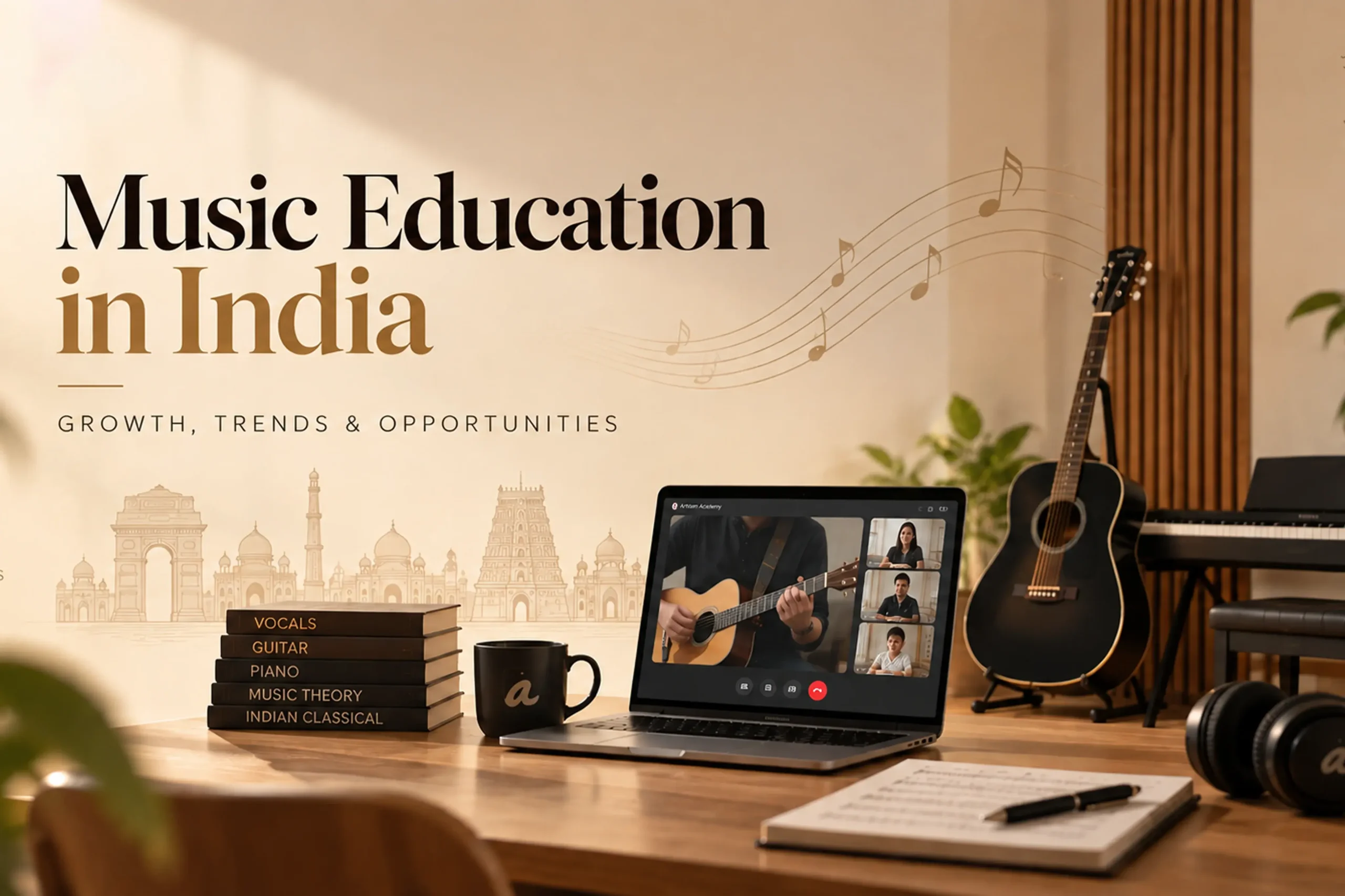
Table of Contents
Quick Summary
| Music education in India is evolving through online classes, structured curricula, and personalised teacher guidance. Learners of all ages can explore Hindustani and Carnatic vocals, film music, guitar, piano, and other disciplines from home. This growth is making music learning more flexible, accessible, and suitable for beginners, hobbyists, children, and aspiring professionals. |
Introduction
Music has always been part of Indian life. It is present in festivals, films, homes, temples, schools, and community celebrations. Yet, for many years, formal music learning was available mainly through private tutors, traditional guru-shishya settings, music schools, or higher education institutions.
Today, music education in India is changing. Learners can study Indian classical music, film singing, Western vocals, guitar, piano, and other disciplines through structured online and offline programmes. Technology has made it possible for a student in a small town, a busy adult in Mumbai, or an Indian learner living abroad to connect with trained teachers from home.
This shift is also supported by broader changes in education. The National Education Policy (NEP) 2020 promotes holistic learning, experiential education, flexibility between academic and creative subjects, and greater use of technology. It also highlights the importance of Indian knowledge systems, traditional learning, arts, and cultural education.
However, music learning is not only about becoming a professional singer or instrumentalist. It can help you build discipline, confidence, listening skills, creativity, and a deeper connection with culture. The right learning format can make music a meaningful part of your everyday life.
The Roots of Music Education in India
Learning through the guru-shishya tradition
Indian music education has deep roots in the guru-shishya parampara. In this tradition, a student learns directly from a teacher through regular practice, observation, repetition, and personal guidance.
This approach has shaped both Hindustani and Carnatic music. Students traditionally spent years developing:
- Voice or instrumental control.
- Knowledge of ragas and talas.
- Improvisation skills.
- Listening and memory.
- Respect for musical tradition.
- Discipline through regular riyaaz.
The relationship between teacher and student was central. Learning was not limited to a textbook or a fixed number of lessons. The teacher observed the learner closely and adjusted the training according to their abilities.
Oral learning and cultural transmission
Much of Indian music was passed from one generation to another through listening and imitation. Students learned compositions, devotional songs, folk music, and performance styles by hearing them repeatedly.
This helped preserve regional and cultural traditions, including:
- Hindustani classical music.
- Carnatic classical music.
- Folk and devotional music.
- Ghazal singing.
- Regional film music.
- Traditional percussion and instrumental styles.
This oral tradition remains valuable. At the same time, modern learners often need additional structure, such as lesson plans, practice targets, progress tracking, and flexible schedules.
The move towards structured music learning
Over time, music education expanded through schools, colleges, music academies, examinations, cultural organisations, and private teachers. Learners began to follow graded systems and formal programmes alongside traditional training.
The current opportunity is to combine the strengths of both approaches: the personal guidance of a teacher and the clarity of a structured curriculum.
The Present State of Music Education in India
Music education today exists across several settings. Each option serves a different type of learner.
Schools and colleges
Many schools introduce music through:
- Choirs and group singing.
- Patriotic and regional songs.
- Basic rhythm activities.
- School events and performances.
- Optional vocal or instrumental lessons.
- Arts and cultural projects.
At the higher education level, students can study music through undergraduate, postgraduate, diploma, and certificate programmes. These may focus on performance, theory, composition, music history, education, or research.
NEP 2020 supports fewer rigid divisions between academic, vocational, extracurricular, and creative learning. It also encourages experiential learning and greater flexibility in subject choices.
Private teachers and music academies
Private lessons remain popular because they offer personal attention. A teacher may help a learner work on pitch, rhythm, pronunciation, posture, technique, or performance.
However, learners should check whether the programme includes:
- A clear curriculum.
- Regular feedback.
- Suitable practice guidance.
- Age-appropriate teaching.
- A reliable class schedule.
- Opportunities to perform or apply what they learn.
A friendly teacher is important, but a consistent learning plan makes progress easier to understand.
Online music education
Online music education has made lessons more accessible to learners in India and abroad. Students can attend live classes from home without travelling long distances. One of the key benefits of online music classes is that learners can develop their skills with guidance from teachers while managing their daily schedules.
For online learning to work well, it should include more than recorded videos. Beginners generally benefit from:
- Live interaction with a teacher.
- Real-time correction.
- Personalised exercises.
- A stable class schedule.
- Practice between lessons.
- A way to review progress.
- A learning path suited to their level.
At Artium Academy, learners can choose 1:1 live classes with certified teachers across selected vocal and instrumental disciplines. Its GRMP is described as a structured, internationally accredited five-year curriculum with graded and non-graded learning paths.
Music learning for the Indian diaspora
Online classes are particularly useful for Indian families living outside India. Learners can study Indian vocal styles, film music, devotional music, guitar, or piano while maintaining a connection with Indian languages and cultural traditions.
For families in different time zones, practical considerations include:
- Flexible lesson timings.
- Teachers familiar with the learner’s musical goals.
- Age-appropriate instruction for children.
- A curriculum that respects Indian and global musical contexts.
- Clear communication with parents or guardians.
Key Trends Shaping Music Education in India
1. Growth of online music education
Online music education is no longer limited to recorded tutorials. Live video lessons, digital practice resources, virtual performances, and online feedback have created more complete learning experiences. For a beginner, this means you can start without owning a professional setup. A suitable instrument, a quiet space, a stable internet connection, and regular practice may be enough for initial lessons. Online learning can also reduce geographical barriers. A student does not need to live in a major city to access a teacher who understands a particular genre or learning goal.
2. Personalised 1:1 learning
Group classes can be fun and social but music often needs individual attention. Two learners might sing the phrase differently or face very different problems.
A 1:1 class allows a teacher to focus on:
- Your current level.
- Your vocal or instrumental habits.
- Your preferred songs and genres.
- Your pace of learning.
- Your technical challenges.
- Your practice routine.
For example, one beginner may need help matching pitch, while another may already sing in tune but need support with breath control and expression.
3. Flexible graded and non-graded paths
Not every student wants exams or certificates. Some want a progression path. Others simply want to enjoy singing or playing without pressure.
A flexible programme can support both goals:
- Graded learning can provide milestones, assessments, and a structured sense of progress.
- Non-graded learning can reduce examination pressure and focus on enjoyment, skills, and performance.
This distinction is important when choosing music education. Ask whether the programme allows you to learn for personal development as well as formal achievement.
4. Greater respect for Indian musical traditions
Music learning is increasingly mixing global teaching methods with Indian traditions. Learners might study notation, rhythm ear training and performance while also learning ragas, regional languages, film songs, devotional music or ghazals.
The NEP 2020 also highlights traditional ways of learning, Indian knowledge systems, cultural content and translations of educational materials into Indian languages. This creates chances for students to learn music in a way that is both organised and rooted in culture.
5. Technology-assisted practice
Technology can support practice, but it does not replace a good teacher. Digital tools may help learners:
- Maintain a steady beat.
- Practise with a tanpura or metronome.
- Listen back to a recording.
- Track consistency.
- Understand basic theory.
- Repeat difficult sections.
Artium Academy also provides free online music tools, learning resources, and interactive practice games. These should be viewed as practice support rather than substitutes for structured courses or live instruction.
6. Music learning across age groups
Music education is no longer seen as for kids. Children may begin with songs and simple exercises. Teenagers may explore performance, songwriting or film music. Adults may pick up an interest or start learning an instrument for the first time.
This wider participation is important because learning music does not have a fixed age limit. The right pace, repertoire, and teacher can make the experience suitable for different life stages.
Why Music Education Matters: Benefits for Learners
Music education goes beyond performing. It builds skills that help in academics, personal life and social growth.
For a detailed discussion of these outcomes, explore Artium Academy’s Benefits of Music Education resource.
- Confidence and self-expression: Singing or playing an instrument helps learners express emotions and become more confident over time.
- Focus and discipline: Regular practice teaches patience, concentration, and the value of working towards long-term goals.
- Listening and memory: Music improves the ability to recognise pitch, rhythm, tempo, lyrics, melodies, and musical patterns.
- Creativity: Learners can explore creativity by changing a song’s mood, creating rhythms, writing lyrics, or improvising.
- Cultural connection: Indian music connects learners with languages, traditions, festivals, poetry, and regional culture.
- Social and emotional growth: Group singing and performances encourage teamwork, cooperation, emotional expression, and calmness. Progress can also appear as better participation, careful listening, or independent practice.
Parents should remember that the benefits are not always measured through marks. A child may show progress by becoming more willing to participate, listening carefully or practising independently.
Career Opportunities in Music Education and the Music Industry
Music education can lead to professional opportunities but a formal music career is not the only outcome. Learners may develop a portfolio of skills that connects music with education, technology, media and performance.
Performance
Possible performance paths include:
- Playback and film singing.
- Live stage performance.
- Concert singing.
- Session work.
- Choir and ensemble performance.
- Wedding and event music.
- Religious and devotional performance.
- Independent music releases.
Building a performance career usually requires fundamentals, regular practice, recording experience, networking and the ability to adapt to different styles.
Teaching
Skilled musicians may become:
- Vocal teachers.
- Instrument instructors.
- School music educators.
- Private tutors.
- Online music teachers.
- Workshop facilitators.
- Curriculum developers.
Good teaching requires more than ability. Teachers must explain clearly, listen patiently, identify learning challenges and adapt exercises for students.
Composition and songwriting
Composers and songwriters create music for:
- Films and web series.
- Advertising.
- Independent artists.
- Games and digital content.
- Theatre and dance productions.
- Devotional and cultural projects.
Basic knowledge of melody, harmony, rhythm, lyrics, recording and arrangement can support this path.
Music production and technology
The music industry also needs professionals who understand recording and digital production. Career possibilities include:
- Music production.
- Audio engineering.
- Vocal editing.
- Sound design.
- Arrangement.
- Mixing and mastering.
- Music programming.
- Content production.
Technology skills can be developed alongside singing or instrumental training.
Content and music education
Musicians can also work in:
- Music journalism.
- Educational content creation.
- YouTube and social media.
- Music curriculum writing.
- Artist management.
- Community music programmes.
- Music marketing and communications.
This is especially relevant as learners increasingly discover music through digital platforms.
The Role of Institutions in Advancing Music Education in India
Schools and universities
Educational institutions can make music more accessible by offering lessons, trained teachers, suitable spaces, instruments and performance opportunities.
Music should not be treated as an event activity. Consistent exposure helps learners build skills and discover whether they want to continue seriously.
Teachers and curriculum designers
Teachers are responsible for turning a syllabus into a meaningful learning experience. A useful curriculum should balance:
- Technique.
- Listening.
- Theory.
- Repertoire.
- Creativity.
- Performance.
- Cultural understanding.
Beginners need clear explanations and achievable milestones. Advanced learners need detailed feedback and opportunities to apply their skills.
Online platforms
Online platforms can support access but quality depends on how the programme is designed. Parents and learners should look for information about teachers, curriculum, class format practice support and progress evaluation.
Artium Academy positions its learning model around teachers 1:1 live instruction, structured learning and a curriculum supported by music professionals. The academy has also reported serving learners across countries and offering courses in vocals, guitar and piano.
Advocacy and community support
Music education grows when parents, teachers, institutions, artists, and learners recognise it as a meaningful part of lifelong learning. Conversations around Music Education Advocacy in India can help address common concerns about access, teacher training, curriculum quality, and the place of music in mainstream education.
Final Thoughts
Music education in India is becoming more accessible, flexible and structured. Traditional learning, classroom teaching and digital tools now work together to help learners develop their skills. One of the key benefits of online music classes is that learners can practise from home, learn from experienced teachers and follow a schedule that suits their needs. Beginners can start with simple exercises, familiar songs and regular guidance without needing years of experience. Whether you are a parent supporting your child, an adult exploring a new interest or a learner living outside India, music education can help you grow musically and personally.
Ready to begin your musical journey?
Book a free 1:1 trial class with Artium Academy and explore learning with certified teachers at a pace that suits you. You can begin with curiosity, build a regular practice habit, and decide your next step after experiencing the class.
FAQ's
Music education in India refers to the structured learning of singing, instruments, music theory, performance, listening, and musical traditions. It is important because it supports creativity, discipline, cultural connection, confidence, and lifelong learning. It also helps learners explore both personal and professional opportunities in music.
Music education can help children develop listening skills, memory, concentration, coordination, confidence and self-expression. It also introduces them to teamwork and cultural traditions. Children do not need to aim for a music career to benefit from regular music learning.
Music in education gives students a way to learn, communicate and participate. It can support development alongside academic subjects. Music also helps children engage with languages, regional traditions, rhythm, poetry and cultural heritage. NEP 2020 encourages holistic and experiential learning, including the arts.
Career opportunities include singing, instrumental performance, teaching, composition, songwriting, music production, audio engineering, sound design, artist management, content creation and music research. Some learners combine music with education, media, technology, business or communications.
Yes online music education can be effective when it includes live teacher interaction, personalised feedback, a structured curriculum and regular practice. Beginners should avoid relying on passive video watching. A live 1:1 class can help correct pitch, rhythm, posture, technique and musical expression.
Online music education has reduced barriers and made it easier for learners to access teachers from home. It also supports schedules, international learning, digital practice, virtual performances and structured programmes. This has made music learning more practical for children, adults and Indian families living abroad.
Adults can begin music education at any age. A teacher can adapt the pace, song choices, exercises and practice expectations to suit an adult learner’s schedule and goals. You may learn for relaxation, confidence, performance, cultural connection or personal fulfilment.
Structured online courses may include Hindustani vocals, Carnatic vocals, Hindi film music, Tamil film music, Telugu film music, Kannada film music, Malayalam film music, ghazal, devotional music, karaoke, Western vocals, guitar, and piano.
Free online music tools, music theory resources and interactive music games should be treated as practice and learning resources not as paid courses.
Parents should consider the child’s interest, age, schedule, preferred musical style, teacher’s experience, class format, curriculum, practice expectations and opportunities for feedback. A trial class can help parents observe whether the teacher communicates patiently and whether the child feels comfortable participating.
No. Music education is also useful for hobbyists, children, adults, families and learners who want to build confidence or enjoy an activity. Professional training is one path but music can also remain a rewarding lifelong skill.