
All Topics
- Alchemizing Music Concepts for Students
- Artist Spotlight
- artium gift card
- Artium Maestros
- Artium News
- buying guide
- Carnatic Music
- Devotional Music
- Editorials by Ananth Vaidyanathan
- Film Music
- Guitar
- Hindustani Classical Music
- Indian Classical Music
- Indian Folk Music
- Insights
- Instruments
- Karaoke Singing
- Keyboard
- Kids Music
- maestros
- Music Education
- Music for Kids
- Music Industry
- Music Instruments
- Music Legends
- Music Theory
- Music Therapy
- Piano
- piano guide
- Success Stories
- Tamil Film Music
- Telugu Film Music
- Time Theory
- Tools
- Uncategorized
- Uncategorized
- Uncategorized
- Uncategorized
- Vocal Singing
- Vocals
- western classical music
- western music
- Western vocal music
Purandaradasa’s Life and Legacy: The Saint Composer Who Shaped Carnatic Music
Purandaradasa’s Life and Legacy: The Saint Composer Who Shaped Carnatic Music
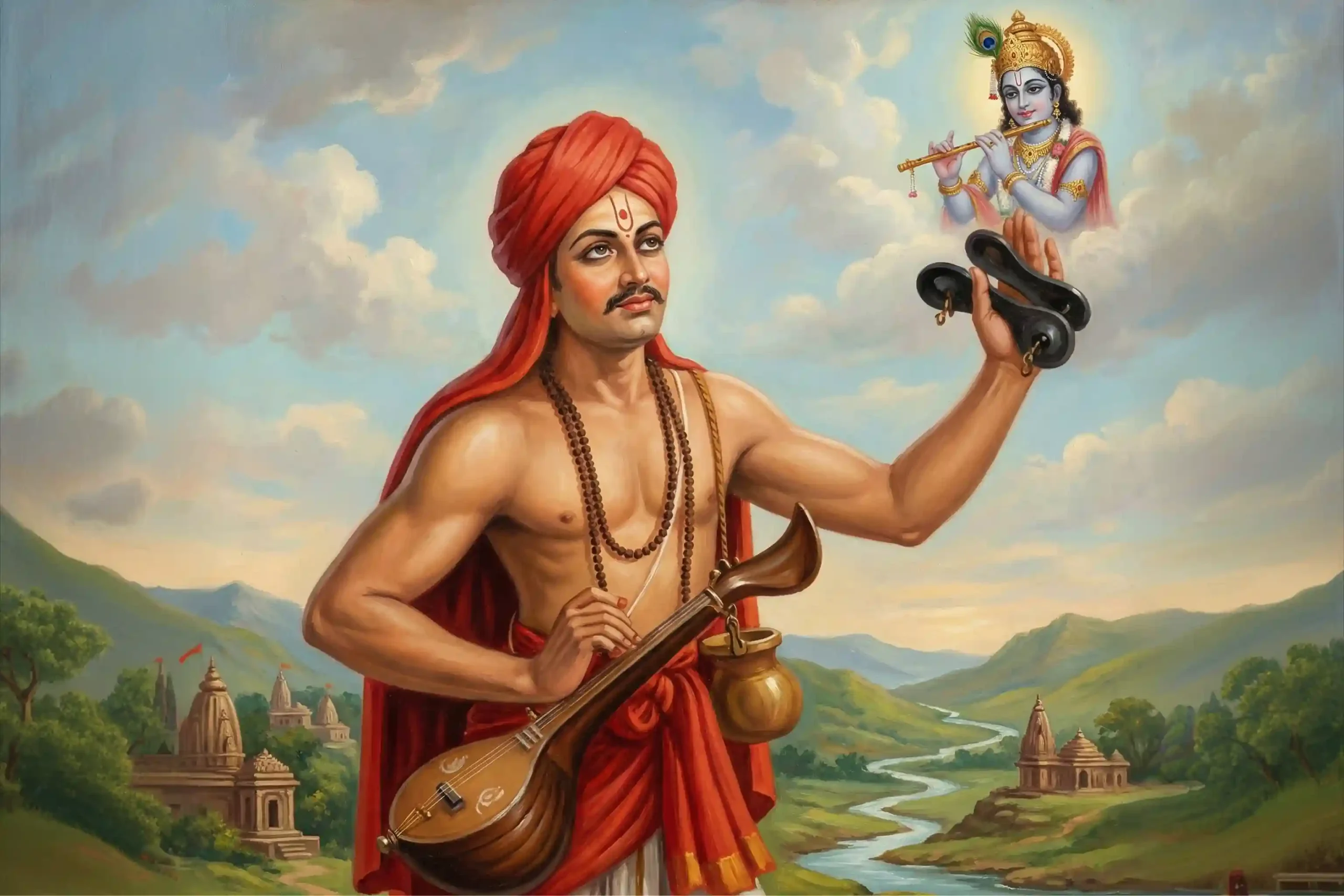
Table of Contents
Carnatic music is known for its depth, discipline, and spiritual richness. Every student who enters this world begins with basic exercises, careful listening, and patient practice. This structured and thoughtful approach to learning did not develop is the result of the vision and dedication of one composer and teacher: Purandaradasa.
Purandara Dasa is remembered not only as a great saint and poet but also as the architect of Carnatic music education. He transformed music from a loosely transmitted oral tradition into a well-organized system of learning. Even today, whether students learn in traditional classrooms or through online Indian classical music classes, the foundation of their training reflects his philosophy.
Purandaradasa: Early Life and Spiritual Transformation
Purandara Dasa was born in the 15th century in Karnataka as Srinivasa Nayaka. He belonged to a wealthy merchant family and became financially successful at a young age. In his early life, he was deeply focused on business and material wealth. Historical accounts describe him as intelligent and hardworking, but also strongly attached to money.
A powerful spiritual experience completely changed his outlook. Realizing that wealth and status were temporary, he began to question the purpose of his life. This inner awakening led him to renounce his riches and dedicate himself to devotion and service.
He became a devoted follower of Lord Vittala and immersed himself in spiritual practice. From this point onward, music became his main form of expression. His compositions were no longer meant for personal fame or comfort. They became offerings of devotion and instruments of teaching.
This transformation gave his music emotional depth and moral strength, making it meaningful for generations to come.
Music as Worship and Education
For Purandara Dasa, music was never meant to be mere entertainment. He believed that music should elevate the mind, purify emotions, and bring people closer to truth. In his view, every song was a form of prayer and every lesson was a form of service.
He used music as a tool to educate society. Through his compositions, he spoke about humility, honesty, compassion, and self-discipline. He addressed everyday human struggles and spiritual questions in simple language that ordinary people could understand.
Because of this approach, his music appealed to scholars and common people alike. Farmers, traders, children, and saints could all relate to his songs. This inclusive vision played a major role in spreading Carnatic music beyond elite circles.
Purandara Dasa – Father of Carnatic Music
Purandara Dasa is honored with the title “Pitamaha of Carnatic Music,” which means the Father or Grandfather of the tradition. This title was not given lightly. It reflects his unmatched contribution to music education and organization.
Before his time, Carnatic music was mainly passed from teacher to student through personal instruction. While this tradition was rich, it lacked a common structure. Different music teachers followed different methods, and there was no standardized syllabus.
Purandara Dasa changed this situation by creating a uniform and systematic approach to learning. He designed exercises and compositions in a graded manner, ensuring that students progressed step by step. This brought consistency and clarity to music education.
Because of this, students across regions and generations could follow the same learning path. This is why he is regarded as the true founder of organized Carnatic Pedagogy and Andragogy.
Purandaradasa’s Structured Teaching System
One of Purandara Dasa’s greatest achievements was the creation of a complete learning framework for beginners. He understood that the human voice needs careful training and gradual strengthening. His system respects this natural process.
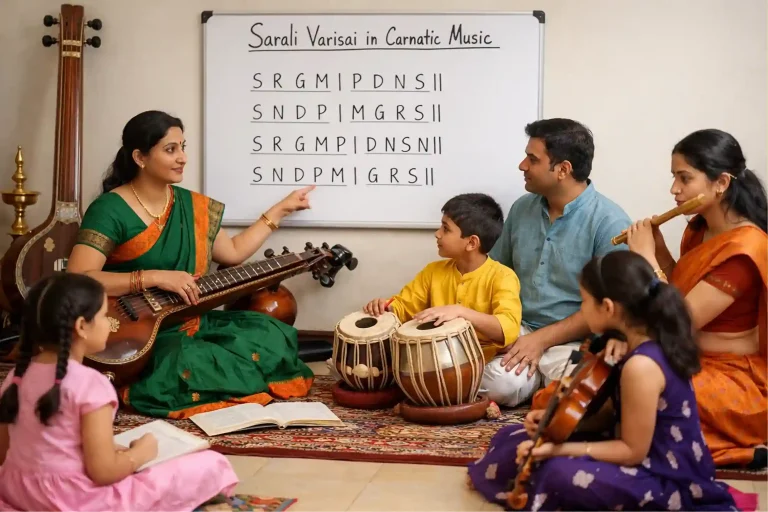
Students begin with Sarali Varisai, which introduces basic swara patterns and helps develop pitch stability. These exercises train the voice to move smoothly across notes and improve breath control. Through repeated practice, students learn to maintain Shruthi and clarity.
They then move to Janta Varisai, which involves double-note patterns. These exercises strengthen the voice and improve precision. They help students gain confidence and control over their singing.
Next come Alankarams, which combine melody with rhythm. Through these, students learn to sing within tala cycles and develop rhythmic awareness. This stage builds coordination between voice and timing.
Geethams follow, introducing simple compositions. These songs teach students how to blend lyrics, melody, and expression. They also introduce basic raga identity in a gentle manner.
Finally, students progress to Swarajatis and Kritis. At this level, they develop deeper musical understanding, emotional expression, and performance skills. This gradual system ensures that learners are well-prepared at every stage.
Even today, this structure forms the backbone of Indian music lessons worldwide.
Compositional Legacy Of Purana
Purandara Dasa composed more than 4,000 devotional songs, known as Devaranamas. Although only a portion of these are available today, they form a vast and valuable musical treasure.
His compositions explore devotion, philosophy, social values, and human emotions. He wrote about faith, doubt, surrender, gratitude, and moral responsibility. These themes make his songs timeless and relatable.
Musically, his compositions are clear and balanced. They follow well-defined swara patterns and moderate tempos, making them suitable for learners. Many teachers still use his songs to introduce students to classical composition.
His ability to combine simplicity with depth makes his work unique in Indian classical music.
Foundation for the Carnatic Trinity
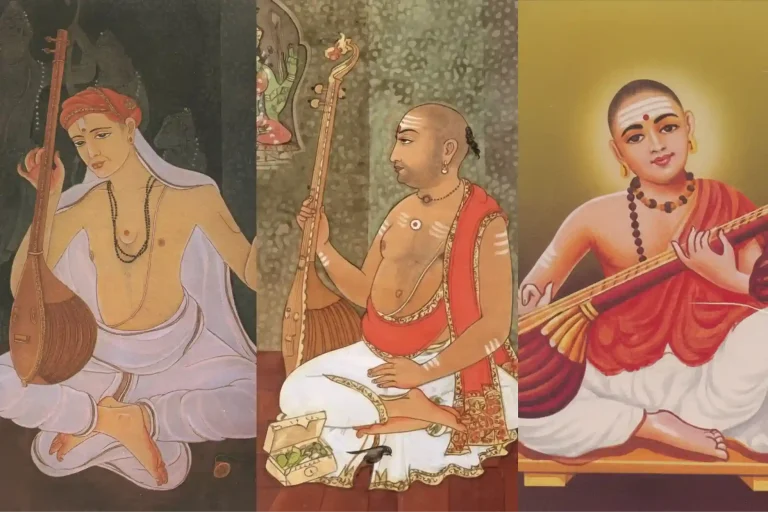
The great composers of the later period:
- Tyagaraja
- Muthuswami Dikshitar
- Syama Sastri
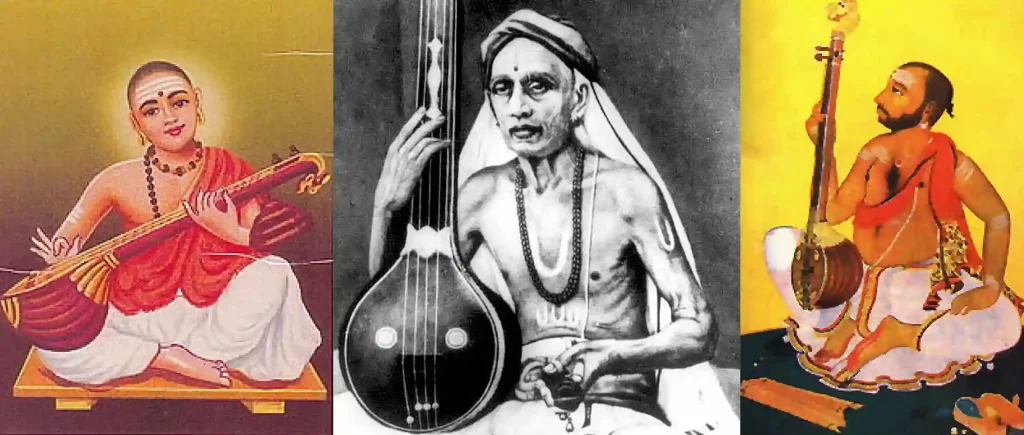
These great people are collectively known as the Carnatic Trinity. Their masterpieces form the heart of today’s concert repertoire.
These composers were trained within the educational structure established by Purandara Dasa. His graded system prepared students to understand complex ragas and compositions. Without this foundation, the flowering of their genius might not have been possible.
He laid the groundwork for the musical monuments they built.
Purandara Dasa in Modern Online Learning
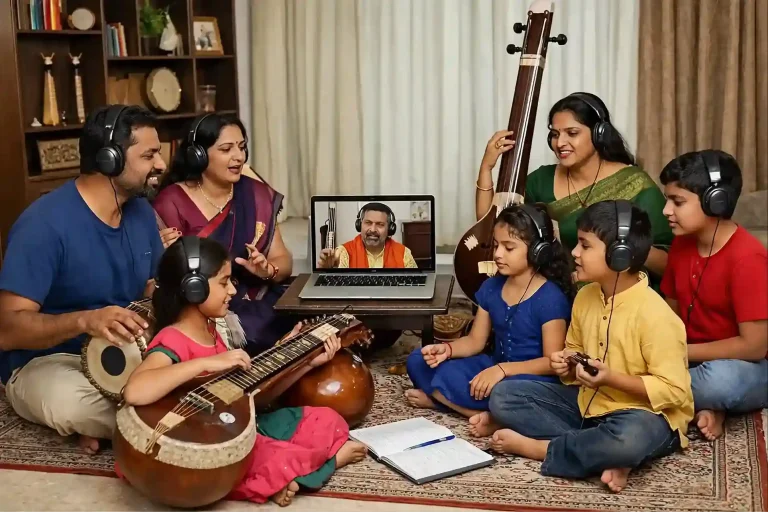
With the growth of digital education, Carnatic music is now taught worldwide through online platforms. Despite this change in medium, Purandara Dasa’s system remains central.
Good online Indian classical music classes follow his graded syllabus, focus on Shruthi training, and emphasize voice culture. Teachers continue to guide students patiently through foundational exercises before moving ahead.
Thus, even in virtual classrooms, his presence is strongly felt.
Purandara Dasa Aradhana
Just as the annual Aradhana of Tyagaraja brings together musicians at Tiruvaiyaru in collective devotion and song, the Purandara Dasa Aradhana is celebrated each year in Andhra Pradesh and Karnataka, with the main observance held at Hampi, where Purandaradasa lived and attained samadhi.
Observed on Pushya Bahula Amavasya, the day he entered samadhi, the festival gathers musicians, students, and devotees for the collective singing of his Devaranamas, devotional offerings, and classical performances.
At the Purandara Mantapa near the Vittala Temple, artists render his compositions in unison, creating a spiritually charged musical tribute that honors the Father of Carnatic Music through shared reverence and melody
Carry Forward the Legacy of Purandara Dasa – The Right Way to Learn Carnatic Music Today
Purandara Dasa did far more than compose devotional songs. He created a complete educational philosophy for Carnatic music. He gave the tradition structure, discipline, and spiritual depth.
Through his teaching system, Shruthi discipline, and meaningful compositions, he ensured that Carnatic music could be preserved and transmitted with integrity.
Every time a student begins with Sarali Varisai, practices patiently, and learns to respect musical foundations, his legacy continues to grow.
That is why he is remembered not only as a saint or composer, but also as the Father of Carnatic Music.
Today, at Artium Academy, this timeless foundation lives on through structured online Carnatic music classes designed for modern learners. Whether it is music for kids, beginners taking their first steps in classical music, or adults rediscovering their passion, Artium’s online music classes carry forward the same discipline, clarity, and respect for tradition that Purandara Dasa envisioned.
By blending authentic Pedagogy and Andragogy with accessible online learning, Artium Academy ensures that Carnatic music for all ages continues to thrive — just as the Father of Carnatic Music intended. To explore more about Carnatic music and take your first step into learning, book a free trial class. We look forward to guiding you on your musical journey!
FAQs on Purandaradasa
Purandaradasa is also known as the Pitamaha of Carnatic Music, which means the Father or Grandfather of Carnatic music.
Purandara Dasa composed thousands of devotional songs called Devaranamas or keerthanas in praise of Lord Vittala.
Some of his most well-known compositions include:
- Jagadoddharana
- Krishna Nee Begane Baaro
- Venkatachala Nilayam
- Bhagyada Lakshmi Baramma
- Narayanathe Namo Namo
These pieces are widely sung in concerts and music classrooms.
Purandara Dasa is known as the Father of Carnatic Music because he created the structured learning system that is still followed in Carnatic training today.
He is believed to have composed over 4,000 songs.
Devarnamas are the keerthanas of Purandara Dasa. His keerthanas are devotional compositions mainly dedicated to Lord Vittala.
Purandara Dasa is believed to have composed around 4,75,000 kirtans (devaranamas) during his lifetime. However, only about 1,000 to 2,000 compositions are available and sung today. His songs are mainly in Kannada and focus on devotion, moral values, and spiritual wisdom. These kirtans are simple in language yet rich in musical depth, making them suitable for both beginners and advanced learners. His vast contributions are among the main reasons he is honored as the Father of Carnatic Music.
Some of the most popular Kritis in Carnatic music are composed by the Trinity—Tyagaraja, Muthuswami Dikshitar, and Syama Sastri. Well-known examples include “Endaro Mahanubhavulu” (Sri ragam), “Nagumomu” (Abheri), “Vatapi Ganapatim” (Hamsadhwani), “Meenakshi Me Mudam” (Gamakakriya), and “Brochevarevarura” (Khamas). These Kritis are admired for their devotional depth, beautiful ragas, and intricate musical structure. They are frequently performed in concerts and form an essential part of Carnatic music learning and repertoire.
Yes. At Artium Academy, students are introduced to Purandara Dasa’s contributions, compositions, and foundational teaching methods as part of structured Carnatic music learning.