
All Topics
- Alchemizing Music Concepts for Students
- Anuv Jain Songs
- Artist Spotlight
- artium gift card
- Artium Maestros
- Artium News
- Artium Tech Blog
- Best Coke Studio Songs
- Best Female Singers
- Birthday songs
- Bollywood Love Songs
- buying guide
- Carnatic Music
- Child Singers
- Devotional Music
- Editorials by Ananth Vaidyanathan
- English Love Songs
- Festival
- Film Music
- Ghazal Music
- Guitar
- Hindustani Classical Music
- Indian Classical Music
- Indian Folk Music
- Insights
- Instagram Reels Viral Songs
- Instruments
- Karaoke
- Karaoke Singing
- Keyboard
- Kids Music
- maestros
- Music Education
- Music for Kids
- Music Games
- Music Industry
- Music Instruments
- Music Legends
- Music Press Release
- Music Technology
- Music Theory
- Music Therapy
- Music Tools
- Piano
- piano guide
- Songs
- South Devotional Music
- Success Stories
- Tamil Film Music
- Telugu Film Music
- Time Theory
- Tools
- Uncategorized
- Uncategorized
- Uncategorized
- Uncategorized
- Vocal Range
- Vocal Singing
- Vocals
- western classical music
- western music
- Western vocal music
What Is Karaoke? History, Meaning & How It Works
What Is Karaoke? History, Meaning & How It Works
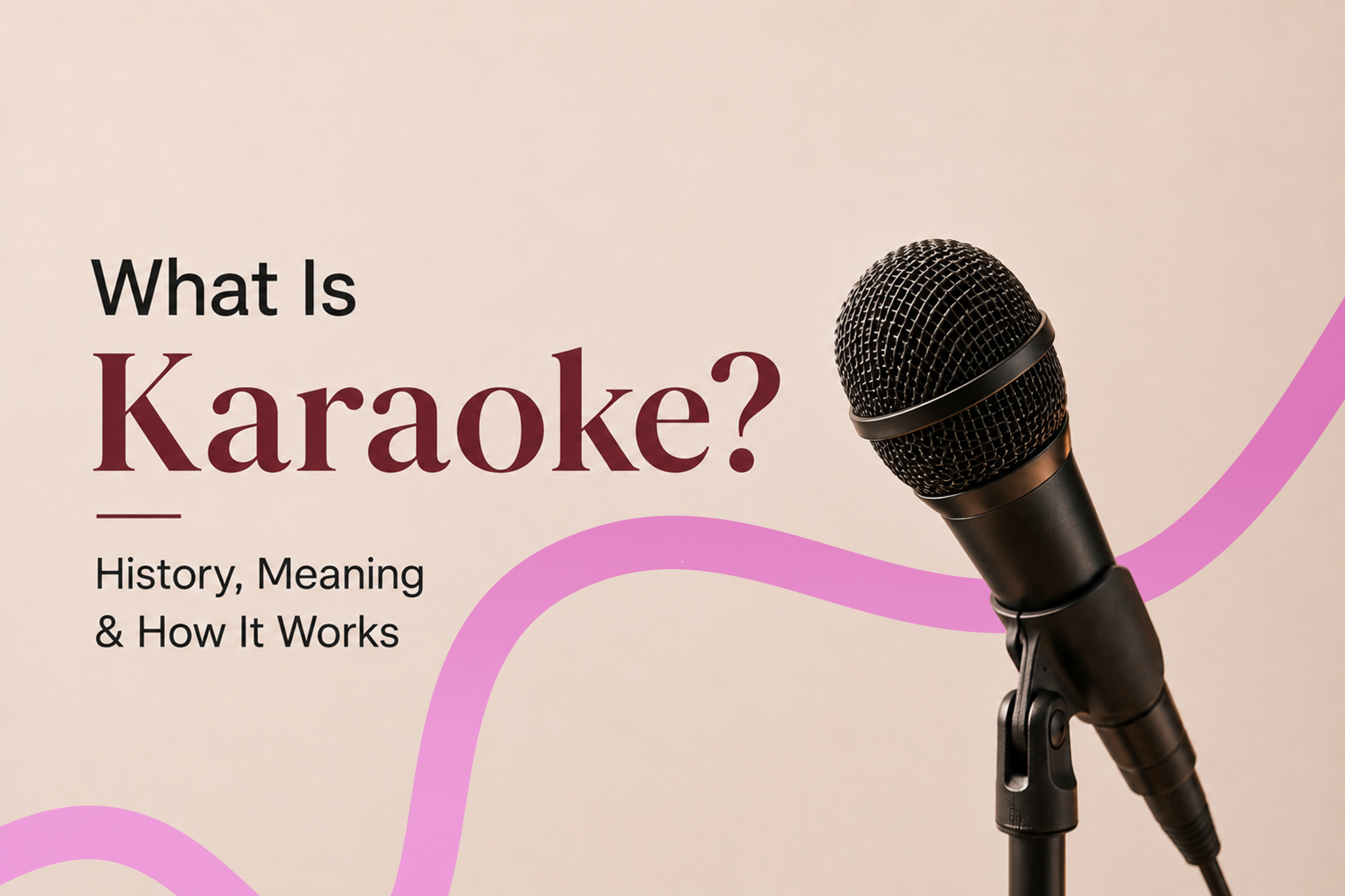
Table of Contents
Quick Summary
Karaoke is a fun musical activity where people sing along to recorded tracks without the original vocals. This blog explains what karaoke means, explores its history and evolution, describes how karaoke systems work, highlights popular karaoke songs, and shares why karaoke parties remain popular worldwide.
The word comes from two Japanese terms: kara, which is a short form of karappo (meaning empty or void), and oke, taken from ōkesutora (orchestra). So, what is karaoke? It is exactly an “empty orchestra,” a notion developed so that singers can take the spotlight without having a live orchestra present.
What Is Karaoke?
Even before it became a worldwide social phenomenon, the term was being used in Japan’s entertainment industry to refer to instrumental background tracks in cases where it wasn’t practical to hire a live band.
Gradually, various inventors in Japan created special singing machines, thus laying the foundation for the popular interactive musical experience that we now enjoy.
In this article, Artium will give you the background and culture of karaoke, including how it started, where it is heading, and why it is simply so darn fun.
Karaoke Meaning
A karaoke is an interactive device that plays instrumental versions of a wide range of songs while showing the lyrics on a screen. It lets users perform their preferred tracks by singing along to the music, and many modern machines even record the singer’s performance as it plays over the instrumental track. Hence, what is the meaning of karaoke if not a fun and accessible means for anyone to take to the spotlight and experience the excitement of singing live?
This performance style uses pre-recorded instrumental music without lead vocals, allowing ordinary people to come forward and sing the lyrics shown on the screen.
Instead of emphasizing professional singing ability, a karaoke party focuses on laughter, shared enthusiasm, and non-judgmental fun as people sing along to timeless hits or current chart successes.
The History of Karaoke
Karaoke was invented in 1967 by Shigeichi Negishi in Japan; at first it was a modified version of the 8-track player, and this simple invention led to a global cultural and technological phenomenon. It has since developed from bars in Tokyo through to living rooms all over the world, evolving hand-in-hand with digital technology and becoming a popular social activity in various cultures.
The IEEE has given recognition to the invention of karaoke by designating it an IEEE Milestone, an award that highlights important technological achievements in all fields related to it. The following is a account of how it all started and where it is going.
How Does Karaoke Work?
Before becoming one of Japan’s most famous cultural exports, the initial prototype was built as a modified car stereo using an 8-track system, developed by a firm that specialized in crafting portable radios for other businesses.
If you have ever wondered what is karaoke, the story begins with Shigeichi Negishi, who ran the electronics firm. He made a habit of singing along to a popular radio broadcast titled “Pop Songs Without Lyrics” every day on his way to work. During one of his usual morning sing-alongs, his head engineer overheard him and made a lighthearted comment about his vocal performance.
Karaoke Machines and Equipment
Understanding what is karaoke requires looking at how technology evolved to bring backing tracks to the masses. The concept became much more popular as advances in media storage and data transfer made it easier to offer expanding song libraries. Laserdiscs enabled the projection of visuals and text onto a display, leading to the launch of dedicated laserdisc systems in 1982.
As high-speed internet and broadband grew widespread, systems capable of downloading and live-streaming tracks took over. Some experts even credit this entertainment boom with accelerating consumer broadband adoption across Japan.
Contemporary setups come loaded with pitch-shifting software, keychangers, and vocal processors designed to adjust tracks to match any singer’s natural range. Yet, defining what is karaoke from an engineering standpoint goes beyond hardware.
“The biggest bottleneck karaoke faced was the willingness to invest the labor to prepare the content, package the content, distribute it, and acquire the rights to play the content in public,” Lipoff noted.
When karaoke first appeared, the machines were often seen as jukeboxes, letting bar and restaurant customers play their preferred songs even if they didn’t want to sing.
Karaoke Apps and Online Platforms
- Smule
- StarMaker & Yokee
- KaraFun & Singa
- AI & Web Tools (YouTube / Moises / StemSplit)
What Are Karaoke Songs?
Karaoke songs are popular musical tracks with the original lead vocals removed or lowered so that a singer or an amateur singer can sing the words using a microphone while reading lyrics on a screen.
These hits that work brilliantly for karaoke nights:
| Track # | Song Title | Artist / Movie | Language / Origin | Vocal Style & Energy | Why It’s Great for Karaoke |
| 1 | Chhammak Chhallo | Akon, Hamsika Iyer (Ra.One) | Hindi & English | High Energy / Dance | Perfect cross-over track with easy-to-sing English-Hindi lyrics and infectious rhythm. |
| 2 | I Want It That Way | Backstreet Boys | Hollywood (English) | Mid-Tempo Pop | Classic group song with simple melodies that everyone in the room knows by heart. |
| 3 | Badtameez Dil | Benny Dayal (Yeh Jawaani Hai Deewani) | Hindi (Bollywood) | Fast Pace / High Energy | Ultimate party anthem with repetitive, catchy hooks that keep crowd energy high. |
| 4 | Shallow | Lady Gaga & Bradley Cooper (A Star Is Born) | Hollywood (English) | Power Duet / Ballad | A dramatic duet option for pairs wanting to flex vocal range and emotional delivery. |
| 5 | Gulabi Aankhen | Sanam (Original: Kishore Kumar, The Train) | Hindi (Bollywood Classic) | Upbeat / Moderate | Timeless melody with simple note transitions; suitable for both beginner and seasoned singers. |
| 6 | Sweet Caroline | Neil Diamond | Hollywood (English) | Classic Sing-Along | Low-pressure vocal range with an iconic call-and-response chorus (“Ba, Ba, Ba!”). |
Benefits of Singing Karaoke
In Japan, loud singing is still a popular hobby, just as it was back in Negishi’s time, with people believing that it helps to relieve stress. In recent years, Japanese manufacturers have been producing machines for use in elderly people’s homes, and many have tried to link karaoke to benefits for those suffering from dementia and Alzheimer’s disease.
You can learn to sing by joining the online karaoke singing classes offered by Artium Academy and thus amaze all the people around you.
Tips for Hosting or Enjoying a Karaoke Night
- Choose a venue
- Rent or buy equipment
- Choose a theme
- Prepare a playlist
- Invite participants
- Set up equipment
- Arrange for food and drinks
- Set up a rotation system
- Plan breaks
- Encourage interaction