
All Topics
- Alchemizing Music Concepts for Students
- Anuv Jain Songs
- Artist Spotlight
- artium gift card
- Artium Maestros
- Artium News
- Artium Tech Blog
- Best Coke Studio Songs
- Best Female Singers
- Birthday songs
- Bollywood Love Songs
- buying guide
- Carnatic Music
- Child Singers
- Devotional Music
- Editorials by Ananth Vaidyanathan
- English Love Songs
- Festival
- Film Music
- Ghazal Music
- Guitar
- Hindustani Classical Music
- Indian Classical Music
- Indian Folk Music
- Insights
- Instagram Reels Viral Songs
- Instruments
- Karaoke
- Karaoke Singing
- Keyboard
- Kids Music
- maestros
- Music Education
- Music for Kids
- Music Games
- Music Industry
- Music Instruments
- Music Legends
- Music Press Release
- Music Technology
- Music Theory
- Music Therapy
- Music Tools
- Piano
- piano guide
- Songs
- South Devotional Music
- Success Stories
- Tamil Film Music
- Telugu Film Music
- Time Theory
- Tools
- Uncategorized
- Uncategorized
- Uncategorized
- Uncategorized
- Vocal Range
- Vocal Singing
- Vocals
- western classical music
- western music
- Western vocal music
How Does Evelyn Glennie Hear Music? The Science of Feeling Sound
How Does Evelyn Glennie Hear Music? The Science of Feeling Sound
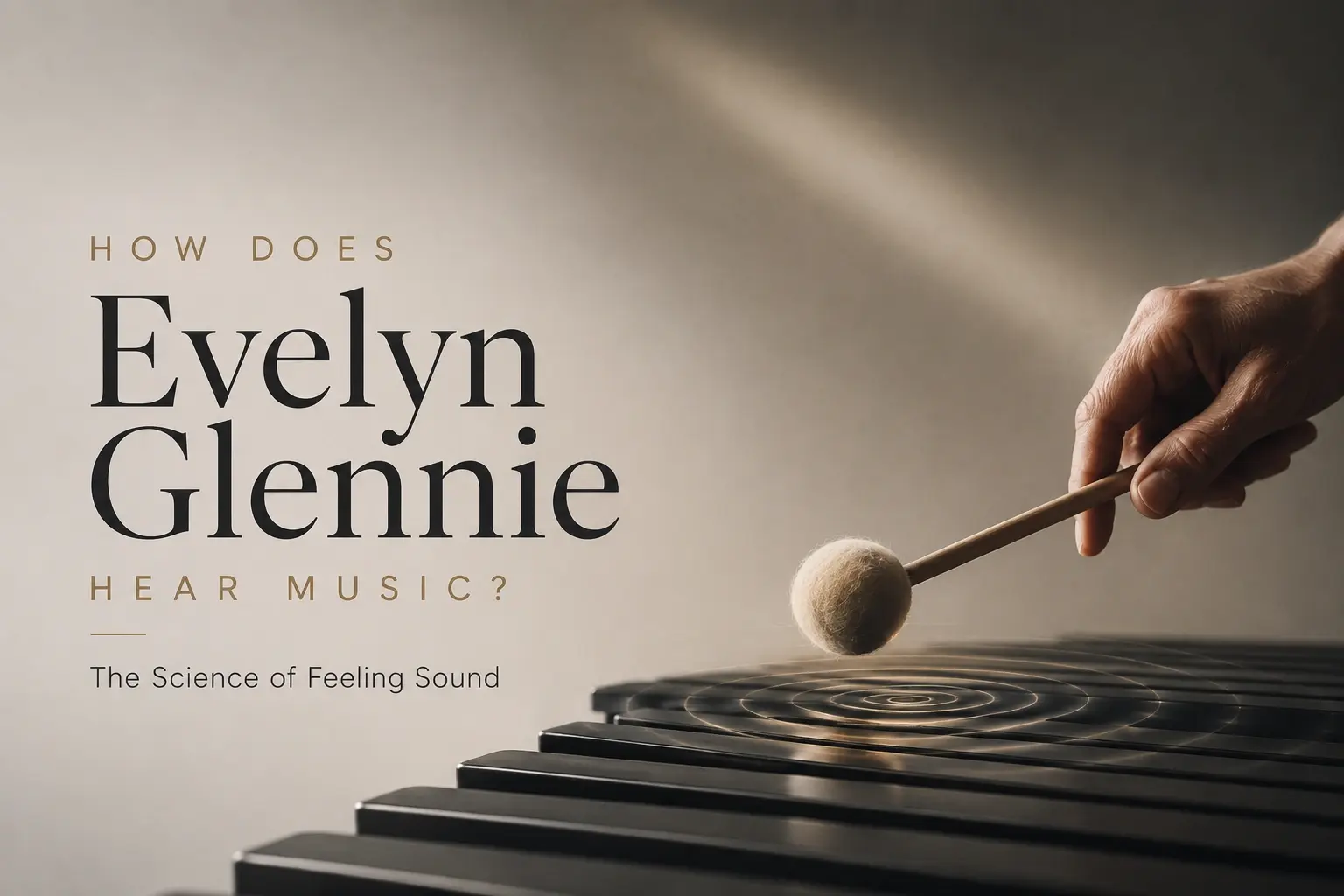
Table of Contents
What happens when the world goes silent, but your soul demands rhythm? Evelyn Glennie started to lose her hearing at age eight and became profoundly deaf by age twelve. Though profoundly deaf, her unique connection to sound proves that deafness does not limit true musicianship.
How does Evelyn hear music? Instead of relying on her ears, Evelyn hears music by feeling vibrations through her body. Encouraged by percussionist Ron Forbes, who helped Evelyn to continue with her music by teaching her to feel resonance instead of relying on her ears. She senses higher pitches above her waist and lower tones below it. Sound passes into her fingertips through xylophone sticks and resonates inside her chest when leaning against drums. To maximize these sensations, she performs barefoot on wooden stages, allowing sound waves to travel up through her feet.
Who Is Evelyn Glennie?
Dame Evelyn Glennie is a world-renowned Scottish virtuoso percussionist who redefined global classical music by becoming the world’s first full-time solo percussionist. Born in 1965 in Aberdeenshire, Scotland, she displayed an immense natural talent for music from an early age. What was wrong with Evelyn? Despite losing her hearing progressively between the ages of eight and twelve, Glennie refused to let profound deafness limit her artistic ambition.
Understanding how does Evelyn hear music requires looking beyond traditional auditory perception. Rather than listening through her ears, she experiences acoustic waves as physical vibrations felt directly through her skin, feet, and torso. Higher frequencies resonate in her upper chest, while deeper tones pulse through her lower body and legs.
As a master of over 2,000 instruments, Glennie commands an extraordinary range of percussion tools from around the globe.
Her expansive collection of instruments includes:
- Tuned Percussion: Marimba, xylophone, vibraphone, and tubular bells.
- Drums & Membrane Instruments: Snare drum, timpani, bodhrán, and various orchestral bass drums.
- World & Auxiliary Percussion: Steel pans, gongs, tam-tams, cymbals, and unique custom-built sound sculptures.
Through her groundbreaking career, including multiple Grammy Awards and a performance at the 2012 London Olympics Opening Ceremony, she has commissioned thousands of new works, reshaping modern percussion repertoire. Ultimately, exploring how did Evelyn hear music reveals that listening is not merely an auditory act, but a profound, physical dialogue where human emotion fuses directly with the pulse of sound.
How Does Evelyn Glennie Hear Music Despite Being Deaf?
Exploring how does Evelyn hear music proves that listening is a visceral, full-body experience. By opening her skin, hair, and cheekbones to physical resonance, she communicates emotion with incredible precision. Musicians learn from her that listening requires complete sensory immersion, deep awareness of subtle vibrations, and an unyielding commitment to authentic artistic connection. Ultimately, her revolutionary approach redefines human perception, demonstrating that deafness does not limit true musicianship.
Evelyn Glennie views sound as an all-encompassing, living force that belongs to everyone. What does Evelyn say about music? She emphasizes that it flows through her whole body, into her hair, skin, and cheeks, rather than entering solely through her ears. To her, music is not just something to hear, but a deep, visceral sensation that pours through her entire being, proving that true listening requires opening every sense to physical vibration.
Through her artistry, what did Evelyn want to spread through her music was a message of inclusion, proving that music belongs to everyone and boundaries can be shattered through passion. Evelyn Glennie overcame profound deafness through relentless practice and body-resonance techniques to become the world’s first full-time renowned percussionist.
Feeling Vibrations Through the Body
Understanding how does Evelyn hear music begins with tactile perception rather than auditory sound. She transforms her skin, limbs, and torso into natural resonance chambers that register acoustic frequencies. Higher pitches echo in her upper chest and neck, while lower, bass-heavy frequencies resonate in her stomach and legs, turning her whole physical frame into a sound receiver.
Using Sight as a Listening Tool
To fully grasp how does Evelyn hear music during live performances, visual awareness acts as an essential extension of her physical sensation. She carefully tracks the subtle bodily movements of fellow orchestra musicians, conductors, and the striking angles of percussion mallets, seamlessly fusing visual timing with acoustic impact to maintain perfect tempo.
The Science Behind Hearing Through Vibration
Sound is fundamentally mechanical energy, a series of physical pressure waves. Hearing through vibration relies on two primary biological systems: somatosensory perception and bone conduction.
Mechanoreceptors beneath the skin (such as Pacinian corpuscles) detect mechanical vibrations and send tactile signals to the brain. Simultaneously, structural vibrations bypass the outer eardrum, traveling directly through physical tissue and skull bones to stimulate the fluid-filled cochlea. This converts acoustic kinetic energy into neural signals, allowing the body to process rhythm, pitch, and resonance as physical touch.
In her celebrated TED Talk, “How to Truly Listen,” percussionist Evelyn Glennie challenges traditional notions of sound perception. Explaining how does Evelyn hear music, she demonstrates that listening is an active, whole-body experience rather than a passive auditory function. By removing her shoes, she illustrates how physical resonance connects directly with tactile senses. She urges audiences to slow down, open their awareness, and experience sound as physical energy that vibrates through the human body.
Evelyn Glennie’s Awards and Achievements
- Grammy Awards: Two-time winner, including Best Chamber Music Performance (1989) and Best Classical Instrumental Solo (2014).
- Polar Music Prize (2015)
- Léonie Sonning Music Prize (2023)
- Royal Philharmonic Society Awards: Best Soloist of the Year (1991) and Honorary Membership.
- Percussive Arts Society: Hall of Fame inductee (2008)
- Sabian Lifetime Achievement Award (2006)
- BAFTA Nominee for her film and television composition work
What Evelyn Glennie Teaches Us About Listening to Music?
Evelyn Glennie teaches us that listening goes far beyond passive hearing; it is an intentional, whole-body act of presence. Rather than perceiving sound solely through ears, understanding how does Evelyn hear music shows that listening requires engaging all our senses to experience acoustic resonance directly through physical touch, sight, and tactile vibration.
She shows that true listening demands patience, curiosity, and openness, and how to connect deeply with sound, ourselves, and others.
FAQs
Q1. How does Evelyn Glennie hear music if she’s deaf?
Evelyn understands music through the vibrations in her body, especially in her feet and on her skin. She also experiences music through her ears and eyes
Q2. When did Evelyn Glennie lose her hearing?
Evelyn began losing her hearing when she was young, and by the age of 12, she had very little hearing left. Even so, she continued to learn and perform music.
Q3. Is Evelyn Glennie completely deaf?
Evelyn has very little hearing. She wears hearing aids, but she mostly experiences music through vibrations, touch, movement, and listening carefully.
Q4. Why does Evelyn Glennie perform barefoot?
Evelyn performs barefoot because it helps her feel the vibrations through her feet and the floor. This helps her feel more connected to the music.
Q5. What instruments does Evelyn Glennie play?
Evelyn Glennie plays different percussion instruments like drums, marimba, timpani, and xylophone. She also uses unusual objects to make interesting sounds.
Q6. Has Evelyn Glennie won any major awards?
Yes, Evelyn Glennie has won many important awards, including a Grammy. She was also made a Dame for her contribution to music.
Q7. What is Evelyn Glennie’s TED Talk about?
In her TED Talk, “How to Truly Listen,” Evelyn explains that listening is not just about hearing. She shows that we can feel and experience sound with our whole body.
Q8. Can deaf people really experience music through vibration?
Yes, deaf people can experience music through vibrations. They can feel the rhythm and sound through their body, feet, skin, or even the surfaces around them.
Q9. What is Evelyn Glennie’s philosophy on listening?
Evelyn believes listening is not just about using your ears. She encourages people to pay attention to sounds, vibrations, movement, and everything around them.
Q10. What can musicians learn from Evelyn Glennie’s approach to sound?
Musicians can learn to listen carefully and feel music in different ways. Evelyn’s journey also teaches us to be patient, creative, and determined.