
All Topics
- Alchemizing Music Concepts for Students
- Anuv Jain Songs
- Artist Spotlight
- artium gift card
- Artium Maestros
- Artium News
- Artium Tech Blog
- Best Coke Studio Songs
- Best Female Singers
- Birthday songs
- Bollywood Love Songs
- buying guide
- Carnatic Music
- Child Singers
- Devotional Music
- Editorials by Ananth Vaidyanathan
- English Love Songs
- Festival
- Film Music
- Ghazal Music
- Guitar
- Hindustani Classical Music
- Indian Classical Music
- Indian Folk Music
- Insights
- Instagram Reels Viral Songs
- Instruments
- Karaoke
- Karaoke Singing
- Keyboard
- Kids Music
- maestros
- Music Education
- Music for Kids
- Music Games
- Music Industry
- Music Instruments
- Music Legends
- Music Press Release
- Music Technology
- Music Theory
- Music Therapy
- Music Tools
- Piano
- piano guide
- Songs
- South Devotional Music
- Success Stories
- Tamil Film Music
- Telugu Film Music
- Time Theory
- Tools
- Uncategorized
- Uncategorized
- Uncategorized
- Uncategorized
- Vocal Range
- Vocal Singing
- Vocals
- western classical music
- western music
- Western vocal music
How to Read Sheet Music: A Detailed Guide
How to Read Sheet Music: A Detailed Guide
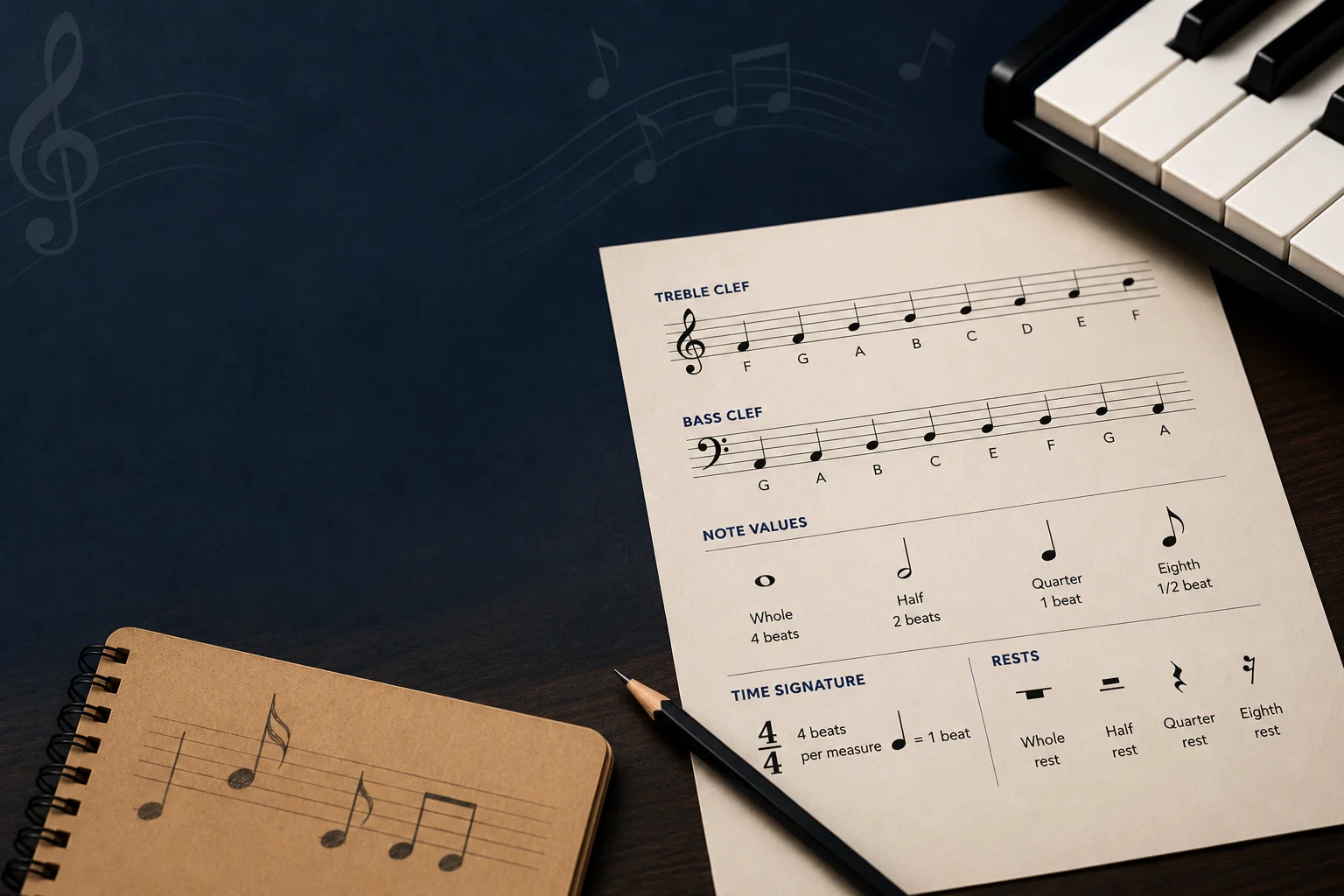
Table of Contents
Have you ever seen a sheet of music and wondered how it all makes sense? … all the dots, the lines and squiggly symbols?
Don’t worry, you are definitely not alone. This is very common among beginners; learning how to read music feels like decoding a secret language until the dots on the page start turning into melodies in your head. And that “Aha” moment is the most satisfying part of learning music; it’s way easier to understand than it looks. In this blog, we’ll walk you through exactly how to read music, one simple concept at a time, so you can go from confused beginner to confident reader without feeling overwhelmed. So, whether you are a parent supporting your child’s music lessons, a hobbyist finally getting back to your old dream or a curious music lover, this blog is for you.
What is Sheet Music?
In simple terms, sheet music is a system to help musicians know what to play, how long to play it and how it should sound. Think of it as a recipe: instead of ingredients and steps, you get notes, symbols, and instructions that guide pitch, rhythm, and expression. It may feel intimidating at first, but don’t be afraid. Every symbol on that page answers three questions: what note to play, the duration you need to hold it, and how it should feel. Once you start seeing sheet music through that lens, it becomes much easier.

Understanding the Staff and Clefs
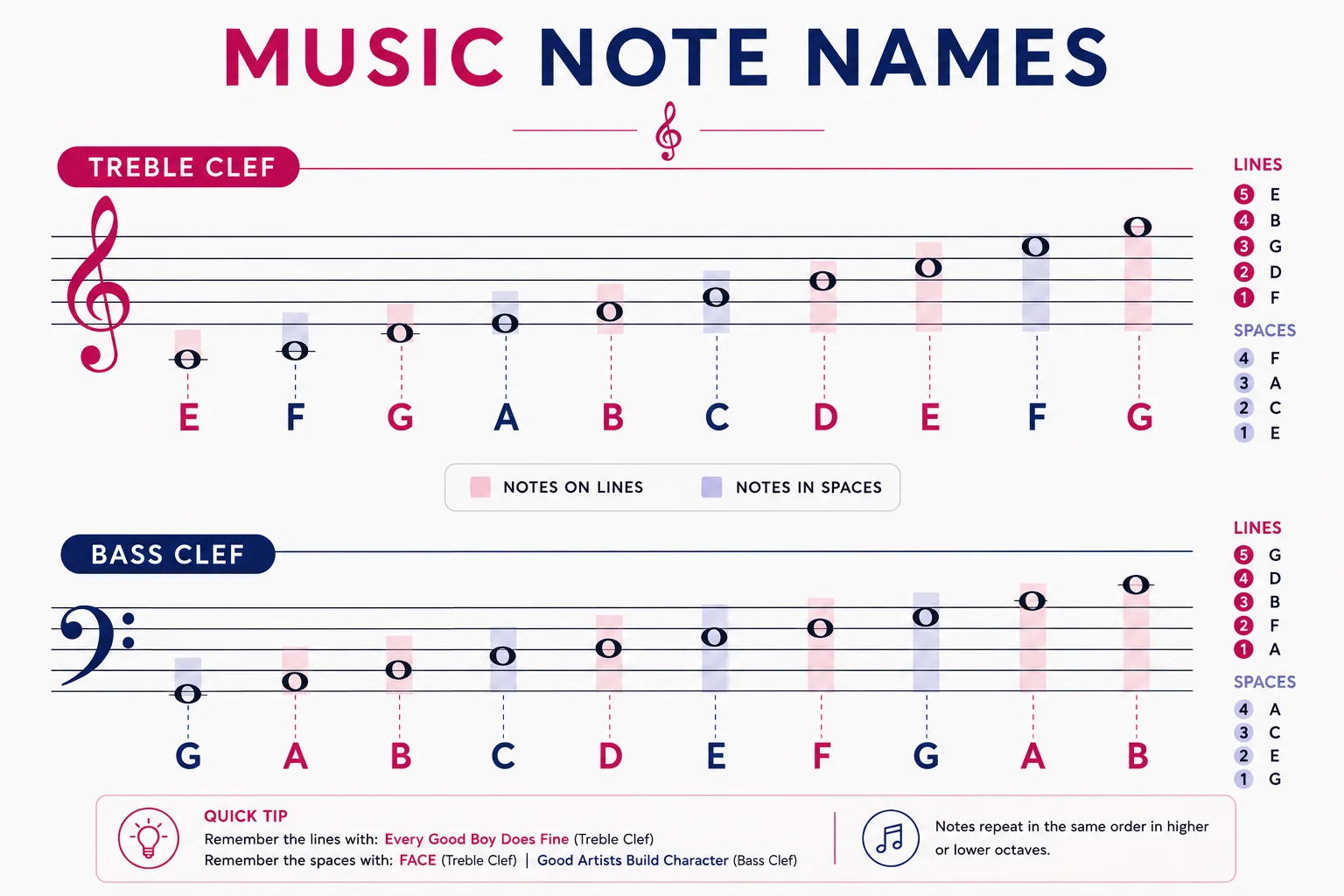
A staff is five horizontal lines with four spaces and notes in between, and that’s where you start learning how to read music. The position of a note on the staff tells you its pitch, while a symbol called a clef tells you which range of pitches you are working with. The two most common clefs are the treble clef, used for higher-pitched instruments and the right hand on the piano and the bass clef, used for lower-pitched instruments and the left hand on the piano.
Every line and space on the staff corresponds to a specific note and once you memorise these positions, reading individual notes becomes second nature.

How to Read Music Notes
This is where things get real. Learning how to read music notes essentially implies connecting a note’s position on the staff to a sound on your instrument. To remember it easily, the lines from bottom to top in the treble clef spell E-G-B-D-F (every good boy does fine), while the spaces spell F-A-C-E.
The bass clef has its own memory tricks. The lines read G-B-D-F-A (Good Boys Do Fine Always) and the spaces read A-C-E-G (All Cows Eat Grass). These aren’t official mnemonics; musicians coined them for fun to make them easier to remember. You can also coin terms you find easier to remember or associate with.
Note Duration and Rhythm (Whole, Half, Quarter, Eighth Notes)
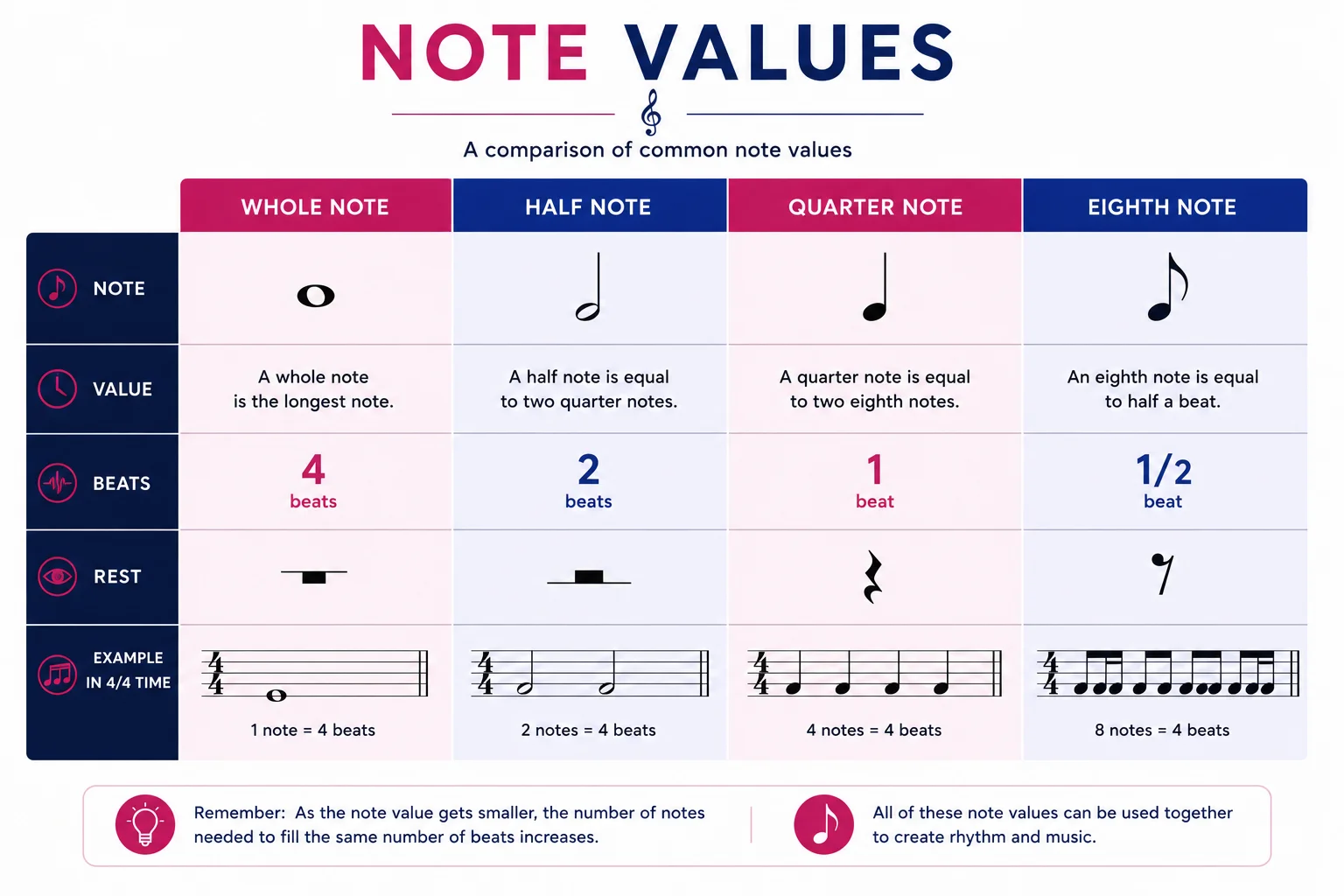
Reading pitch is only half the story; rhythm is the other half. Every note also has a duration, shown by how it is drawn:
- A whole note is held for four beats and looks like a hollow oval
- A half note gets two beats and adds a stem to that hollow oval
- A quarter note gets one beat and is a filled-in oval with a stem
- An eighth note gets half a beat and adds a small flag or beam to the stem
The best way to remember these rhythms is to clap them out loud before playing to internalize the timing.
Time Signatures
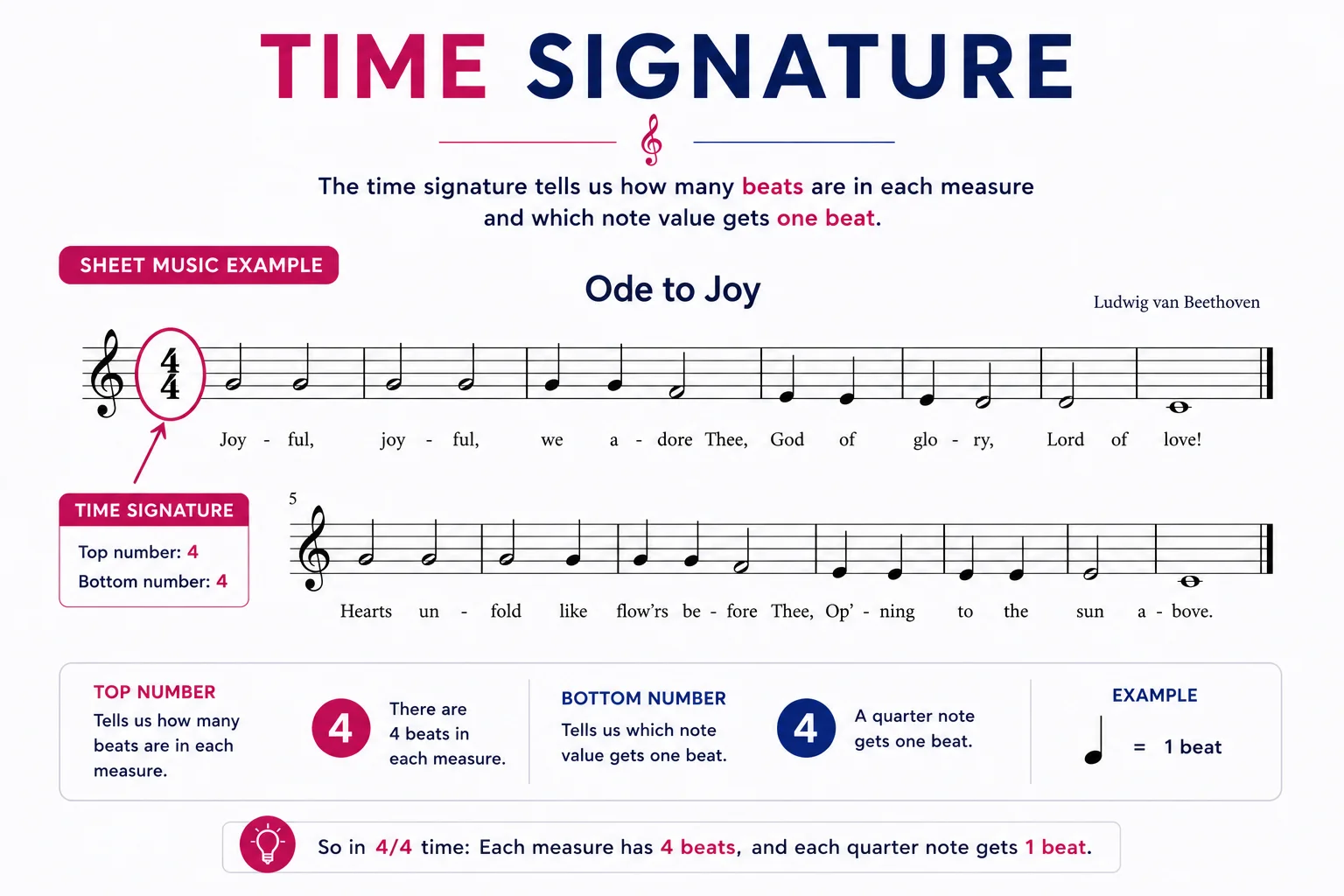
Look at any sheet; at the very start of a piece, you will see two stacked numbers. That is the time signature. The top number tells you the number of beats in each measure and the bottom number tells you what kind of note counts as one beat.
For example, 4/4 time, which is the most common time signature, means four beats per measure with a quarter note equal to one beat. Once you understand time signatures, learning how to read music with steady rhythm becomes far more intuitive, especially when paired with a metronome during practice.
Key Signatures and Scales
Now that you know what the clef is, right after it, you will spot a cluster of sharps (#) or flats (♭). They are the key signatures. They indicate the notes that must be played consistently sharp or flat throughout the piece. They help the composer avoid marking every single note individually. These key signatures are closely tied to scales and identifying common ones like C major (no sharps or flats) or G major (one sharp) makes it much easier to predict how a piece will sound before you even play a note.
Rests and What They Mean
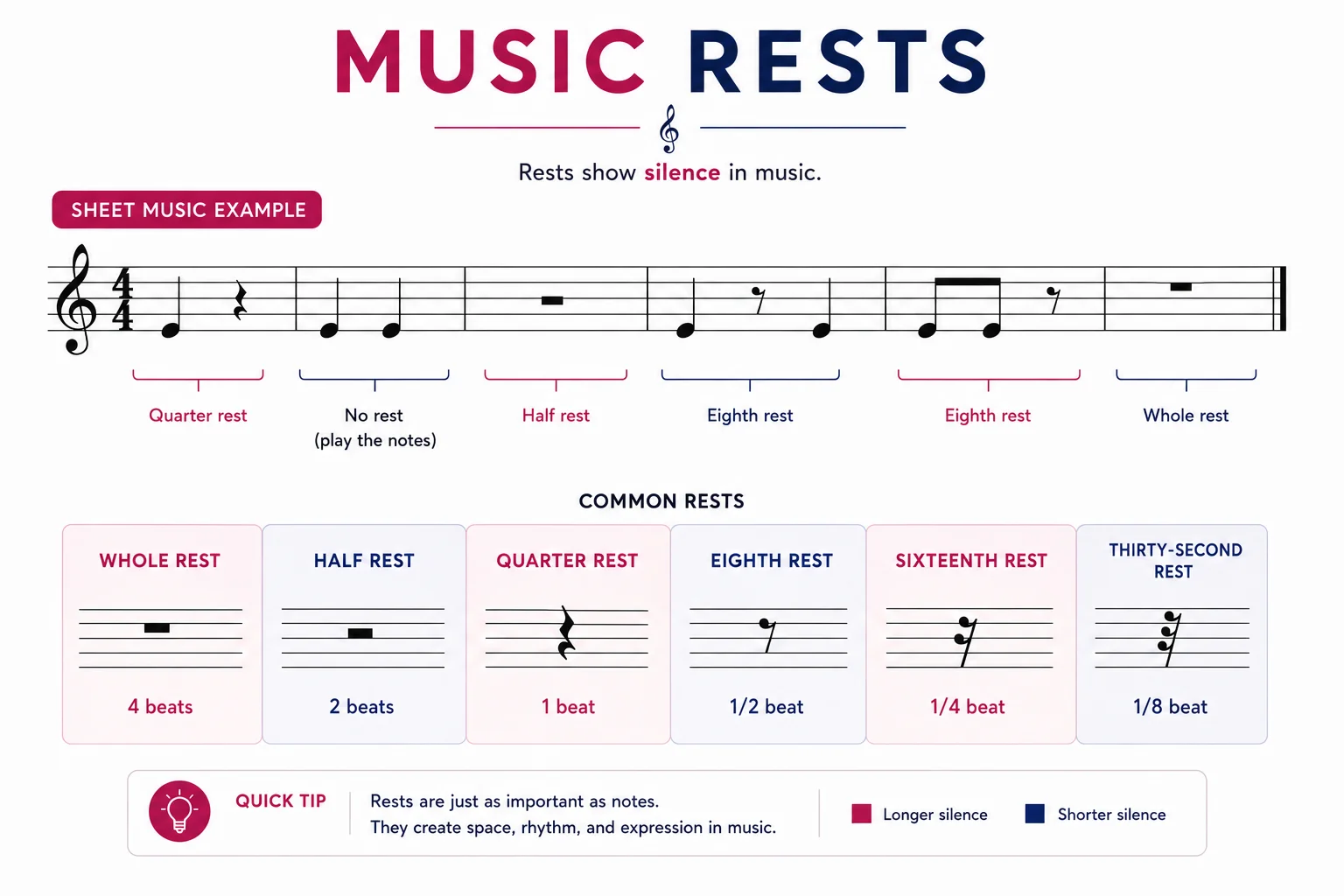
Music is more than just about sounds. Sometimes, silence matters just as much. Rests imply the moments where you pause instead of play and just like notes, they come in different durations: whole rests, half rests, quarter rests and so on. Many beginners rush through rests or skip them completely. But timing the silences correctly is just as important as timing your notes. A well-placed & timed pause can add real emotional weight to a piece.
Dynamics, Tempo and Expression Marks
Sheet music is more than just notes and rhythm. It also tells you how to play emotionally. Dynamics markings like piano (soft) and forte (loud) guide volume, while tempo markings like allegro (fast) or adagio (slow) guide speed.
Here you will also come across expression marks like crescendo (gradually louder) or legato (smooth & connected), which shape the mood and storytelling of a piece far more than the notes alone ever could.
How to Read and Write Music: Basic Notation Rules
For every learner, the next progression after comfortably reading is how to read and write music themselves. And here are a few basic rules that make this transition smoother:
- Always start by drawing the staff and clef before placing any notes
- Keep note stems consistent, pointing up (↑) for lower notes and down (↓) for higher notes
- Group notes clearly within each measure according to the time signature
- Leave adequate spacing between measures for readability
Writing music forces you to understand notation on a deeper level, which in turn makes you a faster, more confident reader.
Common Symbols You’ll See in Sheet Music
Here are some commonly seen symbols in sheet music:
- Repeat signs, to tell you to play a section again
- Fermata, a symbol that tells you to hold a note longer than written
- Slurs, curved lines connecting notes that should flow smoothly together
- Accidentals, sharps, flats or naturals appearing mid-piece outside the key signature.
By recognising these at a glance, you can save yourself from constant confusion mid-practice.
Step-by-step: How to Read Sheet Music for Beginners
For all the beginners, here’s a simple structured approach to how to read music without feeling overwhelmed:
- Begin by identifying the clef and key signature before anything else
- Clap or tap the rhythm of a line before attempting to play it
- Name the notes out loud, slowly before playing them on your instrument
- Practice short phrases rather than tackling an entire piece at once
- Increase speed gradually, once the speed feels comfortable
- Revisit tricky measures repeatedly instead of skipping past them
These step-by-step method will keep you from being stuck and discouraged early on.
Tips and Exercises to Practice Reading Music
Here are some simple habits for those of you wondering how to read music more fluently.
- Use flashcards to drill note names on both treble and bass clefs
- Practice sight-reading a new, simple piece every week
- Play along with a metronome to strengthen rhythmic accuracy
- Sing note names while pointing at sheet music to connect sound with symbol
Focused and consistent practice for even 10 minutes a day results to real fluency over a few months.
Common Mistakes Beginners Make
Here are a few mistakes that tend to slow learners down more than the material itself:
- Memorising songs by ear instead of actually reading the notation
- Ignoring rests and rushing straight through pauses
- Skipping ky and time signatures at the start of a piece
- Practicing only fast passages while avoiding tricky rhythms
Being aware of these early on can save months of frustration later.
Start Reading Music with Confidence
By learning how to read music, you open up new avenues for your practice. One where, you are not just playing by memory, but truly understand what’s on the page. And while self-practice can take you far, structured guideline takes your further, faster.
That’s exactly what, we at Artium Academy offer. As India’s leading online music learning platform, Artium Academy helps thousands of students learn vocals and instruments through tailored, 1:1 live class. Our online music courses are curated by legendary musicians including Louiz Banks, Raju Singh, Sonu Nigam, Gino Banks, KS Chithra, Aruna Sairm and Shubha Mudgal, giving every students access to decades of real musical expertise.
So, if you are ready to finally understand sheet music instead of just memorising songs, there’s no better time to start. Book a free trial class with us today and take the first confident step toward truly reading and understanding music.
FAQ
Q1. How long does it take to learn how to read sheet music?
Answer: Most beginners can grasp basics within a few weeks of consistent practice, though genuine fluency in sight-reading typically develops over several months of regular exposure.
Q2. What is the easiest way to read music notes for beginners?
Answer: The easiest way is to start small and slow. Begin with note-name mnemonics for treble and bass clefs and keep practicing everyday.
Q3. Do I need to know how to read sheet music to play an instrument?
Answer: It is not a hard-fast rule as many musicians play by ear. However, reading notation significantly speeds up learning and opens access to a much wider range of music.
Q4. What’s the difference between treble and bass clef?
Answer: Treble clef notes represent higher pitches, typically used for the right hand on piano or higher-range instruments, while bass clef notes cover lower pitches.
Q5. How can I practice reading sheet music at home?
Answer: Use flashcards, sight-read simple pieces weekly and practice clapping rhythms before playing them, ideally along with a metronome for accurate timing.
Q6. Is it possible to read & write music without a teacher?
Answer: It is possible with dedicated self-study, but a teacher helps catch small mistakes early and accelerates understanding of trickier concepts like key signatures.
Q7. What basic symbols should I learn first?
Answer: Start with clefs, time signatures, note durations and rests since these form the foundation almost every other symbols build open.
Q8. Can I learn to read sheet music as an adult?
Answer: Absolutely. Adults often learn notation faster than expected, since they can grasp logical patterns and structure more quickly than younger beginners.
Q9. What apps or tools help with learning to read music notes?
Answer: Flashcard apps, sight-reading trainers and metronome apps are all useful tools, though structured lessons still offer the most reliable, tailored progress.
Q10. How is reading sheet music different from reading guitar tabs?
Answer: Tabs show finger placement on specific strings and frets, while sheet music conveys pitch and rhythm universally, making it usable across almost any instrument.