
All Topics
- Alchemizing Music Concepts for Students
- Anuv Jain Songs
- Artist Spotlight
- artium gift card
- Artium Maestros
- Artium News
- Artium Practice Studio
- Artium Tech Blog
- Best Coke Studio Songs
- Best Female Singers
- Birthday songs
- Bollywood Love Songs
- buying guide
- Carnatic Music
- Child Singers
- Devotional Music
- Editorials by Ananth Vaidyanathan
- English Love Songs
- Festival
- Film Music
- Ghazal Music
- Guitar
- Hindustani Classical Music
- Indian Classical Music
- Indian Folk Music
- Insights
- Instagram Reels Viral Songs
- Instruments
- Karaoke
- Karaoke Singing
- Keyboard
- Kids Music
- maestros
- Music Education
- Music for Kids
- Music Games
- Music Industry
- Music Instruments
- Music Legends
- Music Press Release
- Music Technology
- Music Theory
- Music Therapy
- Music Tools
- Piano
- piano guide
- Songs
- South Devotional Music
- Success Stories
- Tamil Film Music
- Tamil Singers
- Telugu Film Music
- Telugu Singers
- Tools
- Uncategorized
- Uncategorized
- Uncategorized
- Uncategorized EN US
- Vocal Range
- Vocal Singing
- Vocals
- western classical music
- western music
- Western vocal music
What Is Timbre in Music? Meaning, Types & Examples
What Is Timbre in Music? Meaning, Types & Examples
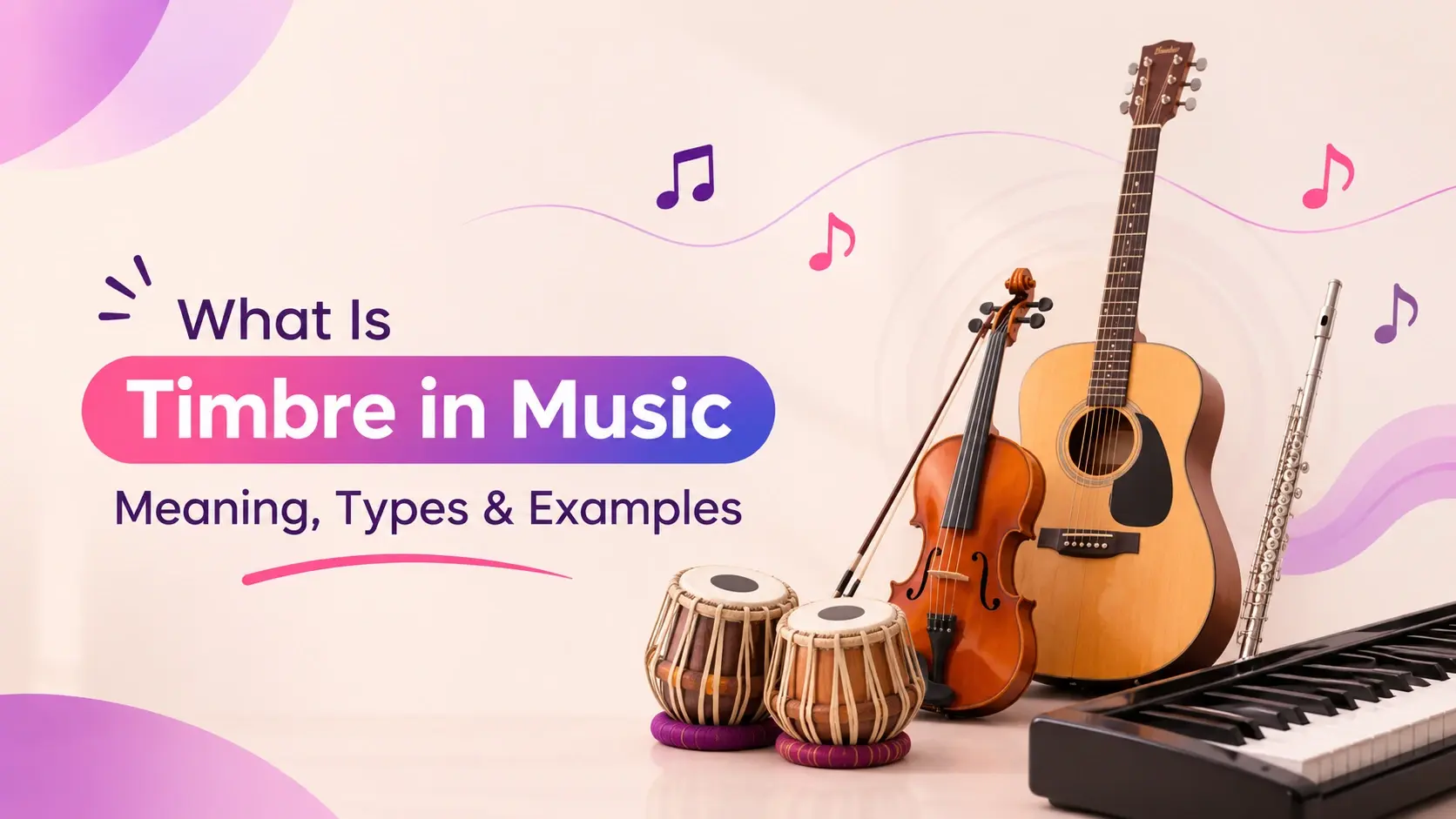
Table of Contents
Quick Summary
| Timbre in music describes a sound’s tone colour or tone quality. Timbre is what makes a particular musical sound different from another, even when they have the same pitch and loudness. For instance, a note played on the violin and the same note played on the flute sound different. That’s because each instrument produces a different set of overtones. |
Introduction
Ever asked yourself how a guitar and a piano produce such different sounds, even when they’re playing the same note? That’s the timbre in music. Timbre (TAM-ber) is the colour or the texture of a sound, the element that makes it possible to identify, for example, an instrument or a singer even when they’re singing the same note and at the same volume. In fact, you use it all the time, whether you’re recognizing a friend’s voice on a phone call or identifying a sitar in a film’s song.
In this guide, we will explain timbre in simple words: what it is, how to produce it, the types of timbre and how to train your ear to hear it. Whether you’re a beginner, a music parent or a music hobbyist, this is a guide for you. Learning about the concept of timbre is an important part of music education as it will make the way you listen, sing and play the instrument totally different.
Define Timbre: What Is Timbre in Music?
Timbre (also called “tone colour”) is the sound’s “colour” (the “character” of the sound or tone quality).
The following timbre music definition has three components you can easily recall:
- Pitch: how high or low the note is
- Loudness: how soft or strong it is
- Sound quality: what is left when the first two are the same, which is the timbre
Musicians also refer to it as tone colour, or tone quality. Imagine two people saying the word “namaste” at the same volume. It’s the same word, and they are saying it at the same volume, but your brain can still distinguish the singers from each other. That’s exactly what musical timbre is. It’s the sound’s fingerprint.
What Is Timbre in Sound? The Science Behind Timbre
So, what is timbre in sound from a scientific point of view? Every time you sing a note, the instrument generates more than a single frequency. Each sound has a primary frequency, named the fundamental, as well as other, weaker, and tone above or else they’re called harmonics or else overtone.
This is how this affects what you are hearing:
- The fundamental decides the pitch you recognise.
- What determines the colour of a sound is its overtones. A flute has very little in the way of strong overtones, and sounds clean and smooth. A trumpet has plenty of strong overtones, and sounds bright and commanding.
- The sound envelopes how a note develops in time. The four stages are attack (onset), decay (the swift dip), sustain (the held volume) and release (the fade).
A piano note starts sharply and fades slowly. A violin note can begin softly and swell. Even this small difference changes the timbre you hear. In short, what is timbre in sound? It is the mix of overtones and the way a note unfolds over time.
What Creates the Timbre of Instruments?
Instrument timbre is affected by how the instrument is constructed and how it is played. Here are the key elements:
- Material: Wood, metal, brass, skin and plastic all vibrate differently. A wooden flute produces a softer timbre to that of a metal instrument.
- Shape and size: a longer string or tube gives lower notes and the shape of the body contributes its colour to the musical timbre.
- How the sound is made: Strings are plucked or bowed, air is blown through tubes, and membranes are struck. Each method gives a different instrument timbre.
- Resonance: It’s basically the reason why a hollow guitar or a wooden shell of a tabla projects these specific overtones and balances out the sound, which is a major reason why piano timbres, guitar sounds and drum sounds are unique.
Hence a sitar, with its gourd resonator and sympathetic strings, has a shimmering sound that no other instrument can match.
Key Factors That Affect Musical Timbre
There are many factors that influence the timbre of a piece of music. Let’s take a quick look at all of these factors one by one:
- Harmonic content: Whether a sound sounds warm or crisp depends on the relative levels of overtones it has. This is the single most important thing to affect musical timbre.
- Attack and decay: a percussive onset, such as a tabla hit, can produce a completely different instrument timbre than a gently bowed violin note.
- Vibrato and articulation: A slight wavering of the pitch, or the attack and release of a note, is warm. A singer using vibrato alters the music’s tone color on the very same pitch.
- Material and construction: Spruce, rosewood and brass all give different tonal character to an instrument. Two guitars of different woods will never sound the same.
- Playing technique and dynamics: A piano key played gently sounds mellow, and the same key played hard sounds brighter. This is one reason piano timbres vary from player to player.
- Room and recording setup: The shape of the hall, microphone placement and recording device all alter the timbre that finally filters down to your ears. Even timbre in a musical sound itself can seem different in a small and in a hall.
Types of Musical Timbre
Timbre being a quality, we define it by words. Here are the most common ones, with a one-line definition for each:
- Bright: Bright instruments are sharp and shining, with strong high overtones. A trumpet would be an example of a bright instrument timbre.
- Dark: Deep and heavy, not much high overtones. A low cello note is dark in musical tonality.
- Warm: soft and comfortable, like a soft flute or an easy singing voice. The warm musical timbre is perceived as close and familiar.
- Harsh: Rough, unforgiving or unpleasant to the ear. An overdriven electric guitar commonly produces a harsh instrument timbre.
- Mellow: Smooth and gentle, like a clarinet in its lower range or soft piano timbres played with a light touch.
- Nasal: A slightly buzzing quality, like an oboe or a shehnai. Many learners define timbre of the shehnai this way.
- Breathy: Airy, with an audible breath. A bansuri often has a breathy musical timbre.
- Rich: Full and layered, with many overtones. A grand piano is a classic case of rich piano timbres.
- Thin: Light and less full, like a small whistle. A clear example of the thin instrument timbre.
Instrument Timbre by Family
All of the instruments within a family will have the same personality for how they sound.
- Strings (violin, guitar, sitar, veena): Warm, expressive and shimmering. Their instrument timbre changes a lot between bowing and plucking.
- Woodwinds (flute, clarinet, bansuri): Airy and soft. Their musical timbre often feels natural and breathy.
- Brass (trumpet, trombone): Bold, bright and powerful, with strong overtones in the instrument timbre.
- Percussion (tabla, drums, mridangam): Sharp attack and quick decay. Pitched percussion adds a clear musical timbre to the rhythm.
- Keyboards (piano, harmonium, organ): Wide variety. Piano timbres range from soft and round to bright and crisp.
- Electronic instruments (synthesisers, digital keyboards): Almost any instrument timbre can be designed, which makes them very flexible.
If you enjoy keyboards and want to hear these differences yourself, you can learn piano online at your own pace.
How Do You Describe Piano Timbres?
Piano timbres are not all the same, even though the keys look identical. A few things change the sound:
- Grand versus upright: A grand piano usually sounds fuller and more resonant. An upright can sound softer and more compact.
- Hammers and soundboard: Soft felt hammers give a round, warm tone. Harder hammers give a brighter, sharper one.
- The room: The space where the piano sits adds its own colour to the sound.
- Touch and pedal: Gentle fingers create a mellow tone, strong fingers bring brightness, and the sustain pedal adds a rich, flowing glow.
To describe piano timbres, you can use words like bright, round, warm, crisp, percussive or glassy. For example, one piano may sound clear and sparkling, while another sounds deep and velvety. Listening to the same melody on two different pianos is a lovely way to notice this.
What Is Timbre in Singing?
When people ask what is timbre in singing, the answer is simple: it is the natural colour of your voice. It is the reason two singers can sing the same song in the same key and still sound completely different.
Your vocal timbre depends on:
- Your body and vocal cords: The size of your vocal tract, mouth and chest gives you a unique musical timbre.
- Registers: Chest voice sounds fuller and heavier, head voice sounds lighter, and falsetto sounds airy. Each one is a different type of musical timbre in your own voice.
- Resonance: Where the sound vibrates in your body (chest, mouth or head) changes the timbre, much like the body of an instrument shapes instrument timbre.
Timbre is not the same as range. Soprano, alto, tenor and bass describe how high or low a voice sits, while timbre describes how that voice feels to the ear. Singers can shape their timbre with good breathing, posture and vowel placement, but your natural voice always stays unique.
Examples of Timbre in Action
Here are some simple ways to hear timbre for yourself:
- One melody, three sounds: Play or find “Twinkle Twinkle Little Star” on a piano, a violin and a flute. The notes are the same, but each instrument timbre feels different.
- Orchestral contrast: Listen to a trumpet and a cello playing the same phrase. One feels bold and the other feels deep, which shows musical timbre clearly.
- Guitar tones: A clean acoustic guitar has a soft, woody instrument timbre, while an overdriven electric guitar sounds gritty and loud.
- Jazz saxophone: The smoky, breathy sound is a good way to define timbre through a real example.
- Indian classical sounds: The sitar’s shimmer, the tabla’s crisp tap and the bansuri’s airy tone each show musical timbre in a different, beautiful way.
Try a “listen and compare” exercise. Pick any song you love, close your eyes, and try naming every instrument. You will start noticing timbre in music everywhere.
How Timbre Shapes Emotion in Music
Timbre is one of the strongest tools for creating mood. The same melody can feel completely different depending on who plays it.
- A warm cello gives a comforting musical timbre that often feels emotional.
- A bright trumpet has an instrument timbre that feels confident and celebratory.
- A soft piano with gentle piano timbres feels calm and reflective.
- A harsh electric guitar has a musical timbre that feels intense and energetic.
Film composers use this all the time. A lone violin can make a scene feel lonely, while heavy brass can build tension. Timbre helps tell the story long before any words are sung.
The Role of Timbre in Different Musical Styles
Every style of music has its own timbre identity:
- Classical: Rich, blended orchestral sounds, with careful attention to instrument timbre.
- Jazz: Warm, smoky and expressive musical timbre from saxophones, trumpets and piano.
- Rock: Distorted guitars and powerful drums create an edgy instrument timbre.
- Pop: Polished vocals and clean, layered sounds, where the musical timbre is often smooth and bright.
- Electronic: Synthesisers allow producers to design brand new timbres from scratch.
- Indian classical: The sitar, sarod, tabla and bansuri give Hindustani music its unmistakable colour, and each instrument timbre carries a distinct feeling.
- Folk: Natural, earthy sounds from traditional instruments, with a very human musical timbre.
If you swapped the instruments in a song, the genre itself would feel different. That is how powerful timbre in music is.
Timbre vs Pitch vs Dynamics
These three are often mixed up, so here is a quick way to separate them:
- Pitch: How high or low a note is. Two instruments can share the same pitch and still have a different instrument timbre.
- Dynamics: How soft or loud a note is. Playing louder can slightly brighten piano timbres, but dynamics is not the same as timbre.
- Timbre: What the sound feels like, its colour and character. When you define timbre next to pitch and dynamics, it is the quality that makes each sound unique.
If pitch and dynamics are the same, timbre is what is left. That is why we can tell a flute from a violin at the same note and volume.
How to Develop an Ear for Timbre in Music
Like any skill, hearing timbre improves with practice. Try this simple routine:
- Listen actively: Pick one song a day and focus on one instrument at a time to notice its instrument timbre.
- Name the instrument: Try to identify every instrument by ear before looking it up.
- Compare recordings: Listen to the same song by two artists and note how the musical timbre feels different.
- Describe in words: Use words like bright, warm, airy or rich. This helps you define timbre in your own language.
- Compare piano timbres: Listen to a grand piano, an upright and a digital keyboard playing the same piece.
- Use your voice: Hum or sing a phrase softly and then strongly, and notice how the colour of your musical timbre changes.
Ten minutes a day is enough to begin noticing a real difference within a few weeks.
Why Understanding Timbre in Music Matters for Music Students
Learning to hear and use timbre helps you grow in many ways:
- Better performance: You learn to shape your instrument timbre, not just play the right notes.
- Stronger singing: You understand your own voice and use your musical timbre with confidence.
- Smarter composing and arranging: You can choose the right sounds, from piano timbres to strings, for the mood you want.
- Sharper listening: A clear timbre music definition in your mind helps in exams, ear training and group playing.
Conclusion
Timbre in music is the colour and character of a sound, the quality that helps you tell a piano from a violin or one singer from another. It comes from overtones, the sound envelope, materials, technique and even the room. Once you learn to define timbre and listen for it, every song feels richer.
If you have ever wished to sing, now is a lovely time to begin. Book your free 1:1 trial class with Artium Academy and learn from certified teachers at your own pace.
Frequently Asked Questions
Timbre in music is the tone or “colour” of a sound that differentiates one voice or instrument from another, even when the two sounds have the same pitch and loudness.
Basically, timbre is the quality of a sound. This is why a guitar and a flute have different tones when playing the same note. Often, the definition of timbre in music is just shortened to “tone colour”.
Timbre in sound is the combination of the overtones with the sound envelope. Pitch is something that tells you whether a sound is high or low, and timbre tells you what kind of sound it is.
The timbre of a piece of music is most often described by adjectives such as bright, dark, warm, harsh, mellow, nasal, breathy, rich and thin.
Timbre is affected by the material, size, shape, resonance, and technique of playing, as well as the method of sound production from either string, air or strike.
Piano Timbres Your Timbres are listed as bright, round, warm, crisp or percussive and fluctuate depending on which Piano you’re playing, the Hammers, the Room, Your Touch and Pedal.
Vocal timbre is the natural colour of your voice. You can’t replace it but healthy breathing, posture and a good vowel placement will help you to shape it.
Because every instrument has a different overtone structure and a different envelope, even when playing the same pitch the overall instrument sound quality is different.
Active listening, identifying instruments on the fly, comparing recordings, or talking about what you hear in words. Just a few minutes each day makes a difference.
Timbre enables students to perform with expression and composers to select the appropriate instrument for setting mood and emotion.