
All Topics
- Alchemizing Music Concepts for Students
- Anuv Jain Songs
- Artist Spotlight
- artium gift card
- Artium Maestros
- Artium News
- Artium Tech Blog
- Best Coke Studio Songs
- Best Female Singers
- Birthday songs
- Bollywood Love Songs
- buying guide
- Carnatic Music
- Child Singers
- Devotional Music
- Editorials by Ananth Vaidyanathan
- English Love Songs
- Festival
- Film Music
- Ghazal Music
- Guitar
- Hindustani Classical Music
- Indian Classical Music
- Indian Folk Music
- Insights
- Instagram Reels Viral Songs
- Instruments
- Karaoke
- Karaoke Singing
- Keyboard
- Kids Music
- maestros
- Music Education
- Music for Kids
- Music Games
- Music Industry
- Music Instruments
- Music Legends
- Music Press Release
- Music Technology
- Music Theory
- Music Therapy
- Music Tools
- Piano
- piano guide
- Songs
- South Devotional Music
- Success Stories
- Tamil Film Music
- Telugu Film Music
- Time Theory
- Tools
- Uncategorized
- Uncategorized
- Uncategorized
- Uncategorized
- Vocal Range
- Vocal Singing
- Vocals
- western classical music
- western music
- Western vocal music
How Many Guitar Chords Are There? A Complete Beginner’s Guide
How Many Guitar Chords Are There? A Complete Beginner’s Guide
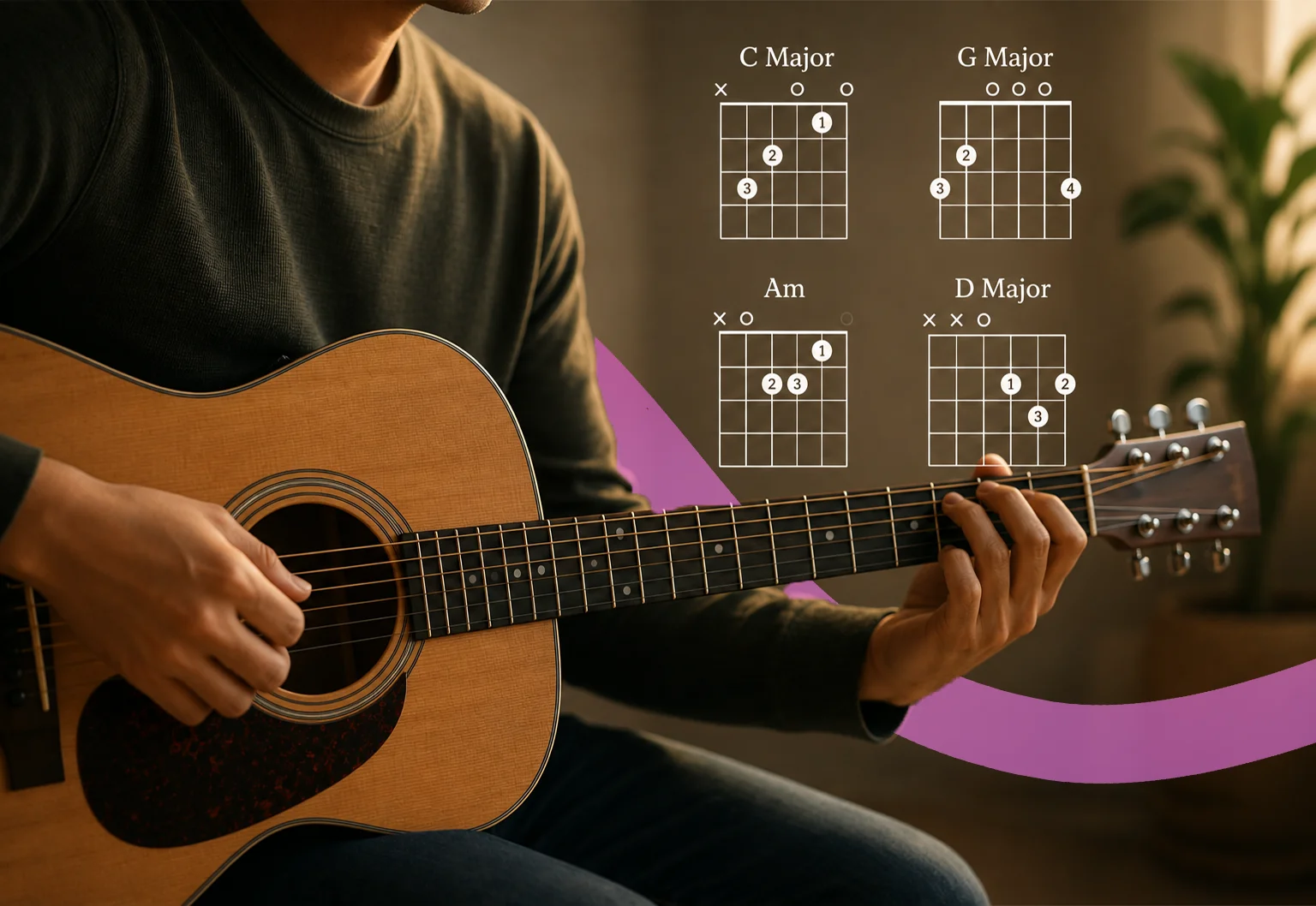
Table of Contents
If you ask how many guitar chords are there there is no number. Different chord qualities, the twelve root notes and many voicings, inversions and extensions create a range of guitar chords. Beginners can start with eight to twelve shapes. Acoustic and electric guitars use the basic guitar chords but the sound, playing style and guitar setup can make each guitar chord feel different.
How Many Guitar Chords Are There in Total?
The number of guitar chords depends on what you count as a chord. In music theory there are 12 notes. Each note can be used as the starting point for different types of guitar chords, such as:
- Major.
- Minor.
- Diminished.
- Augmented.
- Suspended.
- Seventh.
- Sixth.
- Ninth, eleventh, and thirteenth chords.
This creates hundreds of guitar chord names. On a guitar each guitar chord may also have shapes, inversions, fingerings and voicings. For example C major can be played as an open guitar chord, a barre guitar chord or a higher‑position voicing.
Some guitar references estimate 338 used guitar chords and more than 2,000 practical guitar chord shapes when variations are included. These figures are estimates rather than universal totals because different sources count guitar chord qualities and voicings differently.
So how many guitar chords are there in terms? There are 12 root notes for each guitar quality but thousands of possible guitar chord variations and playable shapes. The main thing to remember is that you don’t need to learn every guitar chord by heart. As a beginner you can start playing songs with fewer than 15 basic guitar chord shapes.
How Many Chords Are There in Acoustic Guitar?
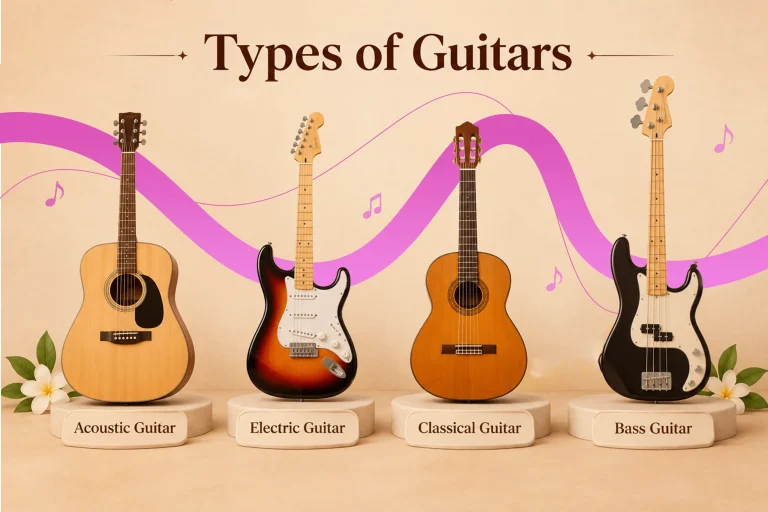
People often ask how many chords are there in a guitar because acoustic players frequently use open‑position guitar chords. However an acoustic guitar does not have a chord system from other guitars. A standard‑tuned acoustic guitar can play the minor seventh barre, power, suspended and extended guitar chords as an electric guitar. The difference is usually in the playing style, tone, string tension and the ease of forming shapes.
Common acoustic guitar chords include:
- C major.
- G major.
- D major.
- A major.
- E major.
- E minor.
- A minor.
- D minor.
- F major.
- D7 and A7.
Acoustic guitars are especially popular for guitar chords because their natural resonant sound makes simple strumming effective. Fingerstyle players may also use voicings, inversions and extensions. If you are researching how many guitar chords are there in a guitar the practical answer is the same as for any standard‑tuned six‑string guitar: there are 12 root notes and many guitar chord qualities with hundreds or thousands of shapes.
How Many Electric Guitar Chords Are There?
The question of how many electric guitar chords are there has the answer as the acoustic guitar question. Electric guitars can play the guitar chord structures provided they use the same tuning.
Electric guitars are often associated with:
- Power chords.
- Barre chords.
- Seventh chords.
- Suspended chords.
- Jazz and extended voicings.
- Chords played with distortion or effects.
Power chords are very common in rock and metal music. They usually have the root note and the fifth note, but no minor third. This gives them a simple sound. Some people find electric guitars easier for playing barre chords because they have strings and less tension. Acoustic guitars are often better for learning chords and practicing smooth strumming. So how chords can you play on an electric guitar? There is no number. It depends on the tuning, the type of music, how well you know the fretboard and how chord shapes you want to learn.
How Many Major Chords Are There in Guitar?
If you are a beginner and want to know how many major guitar chords there are the simplest answer is 12. This is because there is one guitar chord for each note in the 12‑note scale.
A, A♯/B♭, B, C, C♯/D♭, D, D♯/E♭, E, F, F♯/G♭, G, and G♯/A♭.
A major triad contains three essential notes:
- Root.
- Major third.
- Perfect fifth.
For example a C major guitar chord contains C, E and G. The major third gives the guitar chord its stable character.
Although there are 12 guitar chord names each one can be played using different guitar shapes. C major alone can be played as an open guitar chord, a barre guitar chord, a partial guitar chord or an alternative voicing higher on the neck.
So the answer to how many major guitar chords there are in guitar is 12 major guitar chord names, but far more major guitar chord shapes and voicings.
So the answer to how many major guitar chords are there in guitar is 12 major guitar chord names, but far more major guitar chord shapes and voicings.
So the answer to how many major guitar chords there are in guitar is 12 major guitar chord names, but far more major guitar chord shapes and voicings.
How Many Minor Chords Are There in Guitar?
If you are wondering how many minor guitar chords are there there are 12 minor guitar chord names, one for each chromatic root note.
The 12 minor guitar chords include:
A minor, A♯/B♭ minor, B minor, C minor, C♯/D♭ minor, D minor, D♯/E♭ minor, E minor, F minor, F♯/G♭ minor, G minor, and G♯/A♭ minor.
A minor triad is built from:
- Root.
- Minor third.
- Perfect fifth.
For example the notes in A minor are A, C and E. Compared with a guitar chord the third is lowered by one semitone creating a darker or more reflective sound. For beginners E minor and A minor are usually among the minor guitar chords because they use simple open shapes.
Types of Guitar Chords You Should Know
Open Chords
Open guitar chords use one or more strings. They are usually played near the headstock. They are the shapes most beginners learn.
Popular open chords include:
- G major.
- C major.
- D major.
- A major.
- E major.
- E minor.
- A minor.
- D minor.
Barre chords
Barre guitar chords use one finger to press down strings across the same fret. The remaining fingers form a guitar chord shape.
The most useful beginner barre shapes are based on:
- E major and E minor shapes.
- A major and A minor shapes.
Power Chords
Power guitar chords are commonly written with a “5,” such as E5, A5 or G5. They are built from the root and perfect fifth sometimes with the octave added. They are widely used in rock, punk, metal and alternative music. Because they do not contain a minor third they can sound neither clearly major nor minor.
Seventh Chords
Seventh chords add a seventh note to a basic triad. Common examples include:
- C7.
- G7.
- D7.
- A minor 7.
- E minor 7.
- C major 7.
Suspended and Extended Chords
Suspended chords replace the third with another note. The most common types are:
- Sus2, which uses the second instead of the third.
- Sus4, which uses the fourth instead of the third.
How Many Chords Do You Need to Play Most Songs?
Most beginners need between eight and twelve well‑practised guitar chords to play a number of popular songs.
A useful starting group is:
- G major.
- C major.
- D major.
- E major.
- A major.
- E minor.
- A minor.
- D minor.
- F major.
- D7.
- A7.
- E7.
Many songs use four‑guitar chord progressions. A progression such as G–D–Em–C appears in pop and rock arrangements while A–D–E is common in blues and country music.
How to Start Learning Guitar Chords as a Beginner
Follow a consistent process:
1. Learn how to read chord diagrams. Understand the strings, horizontal frets, finger numbers, open strings and muted strings.
2. Begin with open guitar chords. Start with Em, Am, C, G, D, E and A.
3. Practise guitar chord transitions. Move between two guitar chords slowly such as G to C or Am to E.
4. Use a rhythm. Strum four downstrokes per guitar chord before trying complicated patterns.
5. Add songs. Choose songs with three or four guitar chords so you can practise technique and musical timing together.
6. Introduce shapes gradually. Learn F major, seventh guitar chords and basic barre guitar chords after your open guitar chords feel comfortable.
7. Record your practice. Listening back can help you notice buzzing, muted strings, uneven rhythm or delayed guitar chord changes.
A structured best online guitar course can provide lessons, demonstrations, and practice plans. Artium Academy also helps learners build skills progressively instead of trying to memorise every chord at once.
Tips to Memorize Chords Faster
Use these techniques to make guitar chord learning easier:
– Learn guitar chords in families. Practise C, F and G together because they frequently appear in the songs.
– Memorise the shape, not only the name. Notice where the root note is and how the fingers relate to one another.
– Say the guitar chord name aloud. This connects the sound, shape and musical name in your memory.
– Practise without looking. Glance at the diagram, place your fingers then check each string.
– Use a guitar chord‑change timer. Choose two guitar chords and switch between them for 60 seconds while maintaining technique.
– Focus on accuracy before speed. A slow clean transition is more useful than a noisy one.
– Practise away, from the guitar. Visualise placing your fingers on the fretboard while travelling or taking a break.
– Learn songs you enjoy. Musical context makes guitar chord shapes easier to remember.
For working professionals and older learners, learning guitar for indian classical music can offer flexible practice schedules and guided feedback. The most effective approach is one that you can follow consistently.
FAQs
There is no fixed answer to how many guitar chords there are in total. Each basic chord quality has 12 root notes. Guitar chords can appear in thousands of shapes, voicings, inversions and extensions.
The number of guitar chords you can play on a guitar is practically the same as on a standard-tuned electric guitar. Both instruments use the chord names and structures although acoustic players often prefer resonant open guitar chords.
How many guitar chords are there on a guitar? An electric guitar does not have a fixed chord count. It can play the guitar chords as an acoustic guitar, with power guitar chords, barre guitar chords and extended voicings being especially common.
There are 12 major guitar chords, one for each root note in the chromatic scale. Each major guitar chord can have shapes and fretboard voicings.
There are 12 minor guitar chords. They are formed from the 12 root notes with each minor guitar chord using a minor third and a perfect fifth.
You can begin playing many songs with eight to twelve guitar chords. Start with G, C, D, A E, Em Am, Dm and F expand your guitar chord vocabulary gradually.
The easiest guitar chords usually include Em Am, C, G, D, E and A. These guitar chord shapes use strings and do not initially require a full barre.
No. Chord theory is the same on both instruments when they use the tuning. The main differences involve tone, string tension, action, volume and playing technique.
Many learners can become familiar with eight to ten basic chords within a few weeks of regular practice. Clean transitions and confident rhythm may take several months. An instructor at Artium Academy can help create a realistic practice routine based on your experience, goals, and available time.
A major guitar chord uses a root, a third and a perfect fifth. A minor guitar chord uses a root, a third and a perfect fifth. Lowering the third by one semitone changes a guitar chord into a minor guitar chord.