

All Topics
- Alchemizing Music Concepts for Students
- Anuv Jain Songs
- Artist Spotlight
- artium gift card
- Artium Maestros
- Artium News
- Artium Tech Blog
- Best Coke Studio Songs
- Best Female Singers
- Birthday songs
- Bollywood Love Songs
- buying guide
- Carnatic Music
- Child Singers
- Devotional Music
- Editorials by Ananth Vaidyanathan
- English Love Songs
- Festival
- Film Music
- Ghazal Music
- Guitar
- Hindustani Classical Music
- Indian Classical Music
- Indian Folk Music
- Insights
- Instagram Reels Viral Songs
- Instruments
- Karaoke
- Karaoke Singing
- Keyboard
- Kids Music
- maestros
- Music Education
- Music for Kids
- Music Games
- Music Industry
- Music Instruments
- Music Legends
- Music Press Release
- Music Technology
- Music Theory
- Music Therapy
- Music Tools
- Piano
- piano guide
- Songs
- South Devotional Music
- Success Stories
- Tamil Film Music
- Telugu Film Music
- Time Theory
- Tools
- Uncategorized
- Uncategorized
- Uncategorized
- Uncategorized
- Vocal Singing
- Vocals
- western classical music
- western music
- Western vocal music
What Is a Tanpura? The Drone Behind Indian Classical Music
What Is a Tanpura? The Drone Behind Indian Classical Music
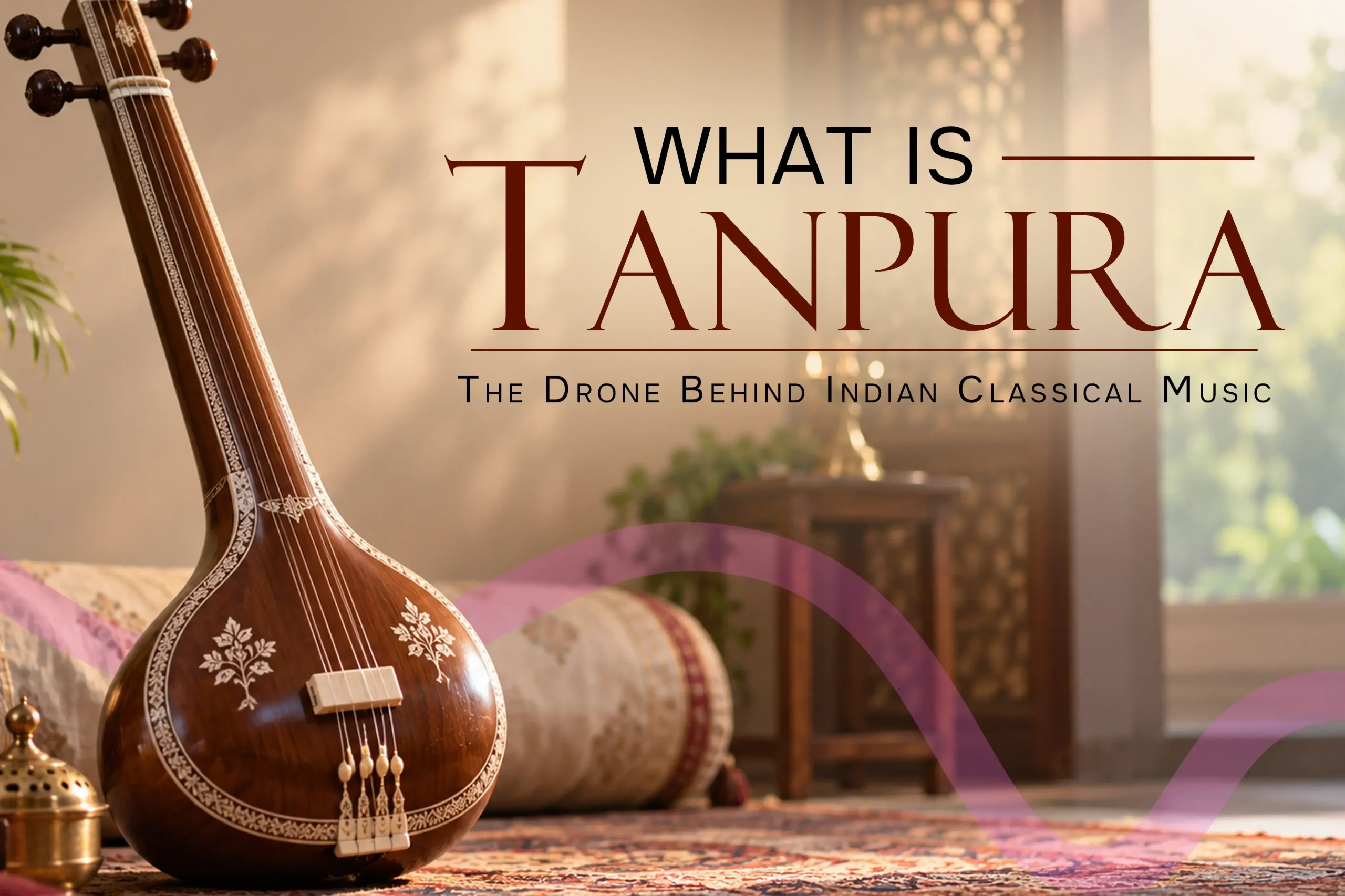
Table of Contents
Quick Summary
| A tanpura is a fretless string instrument that creates the continuous drone heard in Indian classical music. Then playing melodies the tanpura establishes the tonic pitch or Sa helping singers and instrumentalists remain in tune. Its resonant sound supports raga performance, voice practice and attentive listening. |
Introduction
Indian classical music begins with a sense of pitch, atmosphere and focus. Before a vocalist sings or an instrumentalist develops a raga the steady sound of the tanpura creates a foundation. Understanding what is tanpura helps beginners appreciate why this simple instrument is so central to Hindustani and Carnatic music.
Unlike a guitar, sitar, or violin, the tanpura does not perform a tune. Its open strings are plucked in a repeating pattern to create a rich, sustained drone. This sonic base gives a performer a constant reference for Sa, the tonic note, and other important notes in the scale. At Artium Academy, learners can use this idea of pitch reference to build stronger listening, singing, and musical awareness.
What Is a Tanpura? (Definition and Overview)
So what is a tanpura instrument? A tanpura, also called tambura, is a fretless plucked‑string instrument used to produce a continuous harmonic drone in Indian classical music. It is not generally used for phrases, fast rhythm patterns or improvisation in the way a sitar or sarod may be used.
The answer to what’s tanpura lies in its role: it provides the tonal home of a performance. The drone usually highlights the tonic note, Sa along with Pa or Ma depending on the raga and musical setting. A singer repeatedly hears these notes. Can return to them throughout the performance.
The tanpura is sometimes discussed alongside the phrase “What is a tanpura or shruti box?” Although both provide a pitch reference they are not identical. A traditional tanpura is a string instrument while a shruti box is typically a bellows‑driven or digital drone instrument.
Tanpura vs Other Indian Classical Instruments
The tanpura is often confused with Indian string instruments because of its shape. However its function is very different.
| Instrument | Main Role | Frets | How It Produces Music | Key Difference from Tanpura |
| Tanpura | Continuous drone and pitch reference | No | Open strings plucked repeatedly | Does not usually play melody or rhythm |
| Sitar | Melody, raga development, improvisation | Yes | Strings are plucked while notes are stopped on frets | Plays melodic phrases and has frets |
| Sarod | Melody and improvisation | No | Strings are stopped against a smooth fingerboard | Fretless like tanpura but melodic |
| Santoor | Melody and rhythm | No | Strings are struck with wooden mallets | Played by striking, not plucking a drone cycle |
| Harmonium | Melody and vocal support | Keyboard | Air passes through reeds | Produces selected notes through keys |
| Shruti box | Sustained drone | Not applicable | Bellows or electronic sound system | A pitch device rather than a string instrument |
The tanpura is one of the most popular musical instruments in Indian classical music. Its enduring importance comes from its unique role in establishing and sustaining pitch, rather than from flashy solos or fast technical displays.
What Is a Tanpura Instrument Used For?
The primary use of a tanpura is to establish shruti or the chosen pitch framework of a performance. It creates a background that allows singers and instrumentalists to hear whether their notes are aligned with the raga’s tonal centre.
A tanpura is used for:
- Supporting vocal practice and classical vocal performances.
- Establishing Sa before a musician begins singing or playing.
- Helping performers recognise small differences in pitch.
- Creating a calm and resonant musical atmosphere.
- Supporting instruments such as sitar, sarod, bansuri, violin, and harmonium.
When people ask what is tanpura it is useful to think of it as the ground beneath a performance. The melody may travel through notes but the tanpura continually reminds the listener and performer where home is.
For students learning music at Artium regular drone‑based practice can improve note stability, breath control and confidence with scales.
History and Origins of the Tanpura
The tanpura developed within the tradition of Indian classical music, where drone‑based accompaniment became essential to raga performance. Its name is related to the tambur family of long‑necked lute instruments found across parts of Asia and the Middle East.
Over time the Indian tanpura evolved into a drone instrument. Of frets and melody‑focused playing its design prioritised resonance, sustained tone and overtone richness. It became especially important in Hindustani music though related tambura instruments are also used in Carnatic music.
Traditional acoustic tanpuras are still valued for their organic resonance. At the time electronic tanpuras and mobile applications have made drone practice much easier for contemporary learners. Artium Academy’s free online music tool tanpura/shruti box gives you the sound of the instrument without needing a physical one.
How Does a Tanpura Work? (Structure and Strings)
To understand what a tanpura instrument is, look closely at its construction. Each part contributes to its resonant drone.
- Tumba: The large hollow resonator at the bottom. It may be made from a dried bottle gourd or carved wood.
- Tabli: The flat wooden soundboard placed over the resonator.
- Dand: The long, hollow, fretless neck through which the strings run.
- Khunti: Large tuning pegs at the top used to make major tuning adjustments.
- Moni: Small movable beads near the lower end of the strings that help with fine tuning.
- Bridge: The curved bridge supports the strings and shapes their resonance.
- Jawari: Fine cotton threads placed between the strings and bridge. These help create the tanpura’s distinctive buzzing, overtone-rich sound.
A tanpura commonly has four strings although five and six‑string versions also exist. The strings may be made from steel and brass or copper. A common tuning is:
Sa−Pa−Sa−SaSa – Pa – Sa – SaSa−Pa−Sa−Sa
In some ragas Ma replaces Pa:
Sa−Ma−Sa−SaSa – Ma – Sa – SaSa−Ma−Sa−Sa
The strings are not pressed against frets. Instead they are plucked openly in a repeating cycle. Their vibration interacts with the bridge and jawari threads creating a layered sound full of overtones.
How to Hold a Tanpura Correctly
Learning how to hold a tanpura begins with posture. Correct holding supports playing and prevents unnecessary strain in the shoulder, wrist and back.
For a seated position:
- Sit cross-legged on the floor or sit upright on a stable chair.
- Rest the tumba gently on the floor beside you.
- Keep the long neck angled upward, leaning lightly against the shoulder.
- Hold the instrument securely without gripping the neck too tightly.
- Keep the plucking hand relaxed near the strings above the bridge.
For practice the tanpura should be close enough for you to hear clearly without forcing your body into an awkward position. Beginners often benefit from using a drone first then learning how to hold a tanpura when they have access to an acoustic instrument.
A common mistake is holding the neck rigidly. The tanpura needs support. The body should remain relaxed so that the hand can pluck smoothly and evenly.
How to Play Tanpura: Step-by-Step Basics
Learning how to play tanpura is about creating a continuous drone rather than playing melodies.
- Tune the strings: Set the tonic note, or Sa, and tune the strings to a pattern such as Sa–Pa–Sa–Sa. Use the pegs for major tuning and moni beads for small adjustments.
- Check the jawari: Each string should produce a soft, resonant buzz. Avoid adjusting the jawari without guidance.
- Pluck steadily: Pluck the open strings one after another, allowing every note to ring clearly.
- Keep the flow even: Use a gentle, unhurried motion instead of a strong rhythmic beat.
- Listen carefully: Check that the drone sounds balanced, clear, and in tune.
Learners are encouraged to listen to the tanpura drone as it helps develop stronger pitch awareness.
How to Practice Singing with Tanpura
The way to understand how to practice singing with tanpura is to use the drone as a pitch guide not as accompaniment that can be ignored. Start slowly. Focus on matching your voice to the sound of Sa.
Try this beginner routine:
- Set the tanpura or digital tanpura to a comfortable pitch.
- Listen quietly to the drone for 20 to 30 seconds.
- Sing a long, steady Sa and try to blend it with the drone.
- Sing Sa–Re–Ga–Ma–Pa–Dha–Ni–Sa slowly.
- Descend using the same scale.
- Return to Sa after every phrase.
- Record yourself and check whether the note sounds stable.
Learning how to practice singing with tanpura also improves listening skills. Or simply asking, “Am I singing loudly enough?” ask, “Is my note settling into the drone?” This shift helps develop accuracy. At Artium Academy students can pair exercises with a consistent digital drone before progressing to more detailed raga‑based practice. This habit is especially useful for beginners who are developing control over pitch and voice placement.
Final Thoughts
A tanpura is far more than a background instrument. Its steady drone establishes the centre of Indian classical music supports accurate pitch and creates the resonant space in which a raga can unfold. Once you understand what tanpura is, its sound becomes more meaningful: it is the musical foundation beneath every melodic movement. Whether you practise with a tanpura, shruti box or digital tool, regular listening can sharpen your ear and improve vocal control. Begin your classical music journey with Artium Academy. Book your free 1:1 trial class to receive guided support for your singing practice.
What change do you think regular tanpura practice could make to a beginner singer’s pitch control? Tell us in the comments!
FAQs
A tanpura is a string instrument without frets that creates a drone. The role of tanpura is to set the tonic pitch and help singers and instrumentalists stay in tune during classical music practice and performance.
To learn how to hold a tanpura sit upright, place the resonator on the floor and let the neck of the tanpura rest lightly against your shoulder. Keep both shoulders relaxed and position the plucking hand comfortably near the bridge of tanpura.
A tanpura creates a repeating drone. Usually has no frets. A sitar has frets. Is used to play melodies, raga phrases and improvisations.
A traditional tanpura may include a dried gourd or wooden resonator, a wooden soundboard and neck metal strings, wooden tuning pegs, a bridge and cotton jawari threads.
To learn how to practice singing with tanpura, set a Sa listen to the drone of tanpura and sing sustained notes and simple scales. Return frequently to Sa to check whether your voice remains in tune.
Basic tanpura playing is accessible because tanpura uses strings in a repeating sequence. Achieving tuning, an even plucking motion and a balanced jawari sound takes patience and attentive listening.
Electronic tanpuras and apps are useful for pitch practice because they provide a reliable drone. A real tanpura offers acoustic resonance and helps learners understand the physical playing technique of tanpura.
Most tanpura have four strings. Some varieties have five or six strings depending on the tradition and tuning requirements.
The tanpura keeps the centre present throughout a performance. Tanpura allows performers to judge intonation, explore the raga with confidence and return to Sa whenever needed.
Beginners can learn posture, tuning concepts and plucking patterns through reliable instructional resources. However guidance from a teacher is helpful, for tuning, jawari adjustment, posture and accurate raga practice.