
All Topics
- Alchemizing Music Concepts for Students
- Anuv Jain Songs
- Artist Spotlight
- artium gift card
- Artium Maestros
- Artium News
- Artium Tech Blog
- Best Coke Studio Songs
- Best Female Singers
- Birthday songs
- Bollywood Love Songs
- buying guide
- Carnatic Music
- Child Singers
- Devotional Music
- Editorials by Ananth Vaidyanathan
- English Love Songs
- Festival
- Film Music
- Ghazal Music
- Guitar
- Hindustani Classical Music
- Indian Classical Music
- Indian Folk Music
- Insights
- Instagram Reels Viral Songs
- Instruments
- Karaoke
- Karaoke Singing
- Keyboard
- Kids Music
- maestros
- Music Education
- Music for Kids
- Music Games
- Music Industry
- Music Instruments
- Music Legends
- Music Press Release
- Music Technology
- Music Theory
- Music Therapy
- Music Tools
- Piano
- piano guide
- Songs
- South Devotional Music
- Success Stories
- Tamil Film Music
- Telugu Film Music
- Time Theory
- Tools
- Uncategorized
- Uncategorized
- Uncategorized
- Uncategorized
- Vocal Singing
- Vocals
- western classical music
- western music
- Western vocal music
Saxophone Explained: How It Works and How to Start Learning
Saxophone Explained: How It Works and How to Start Learning
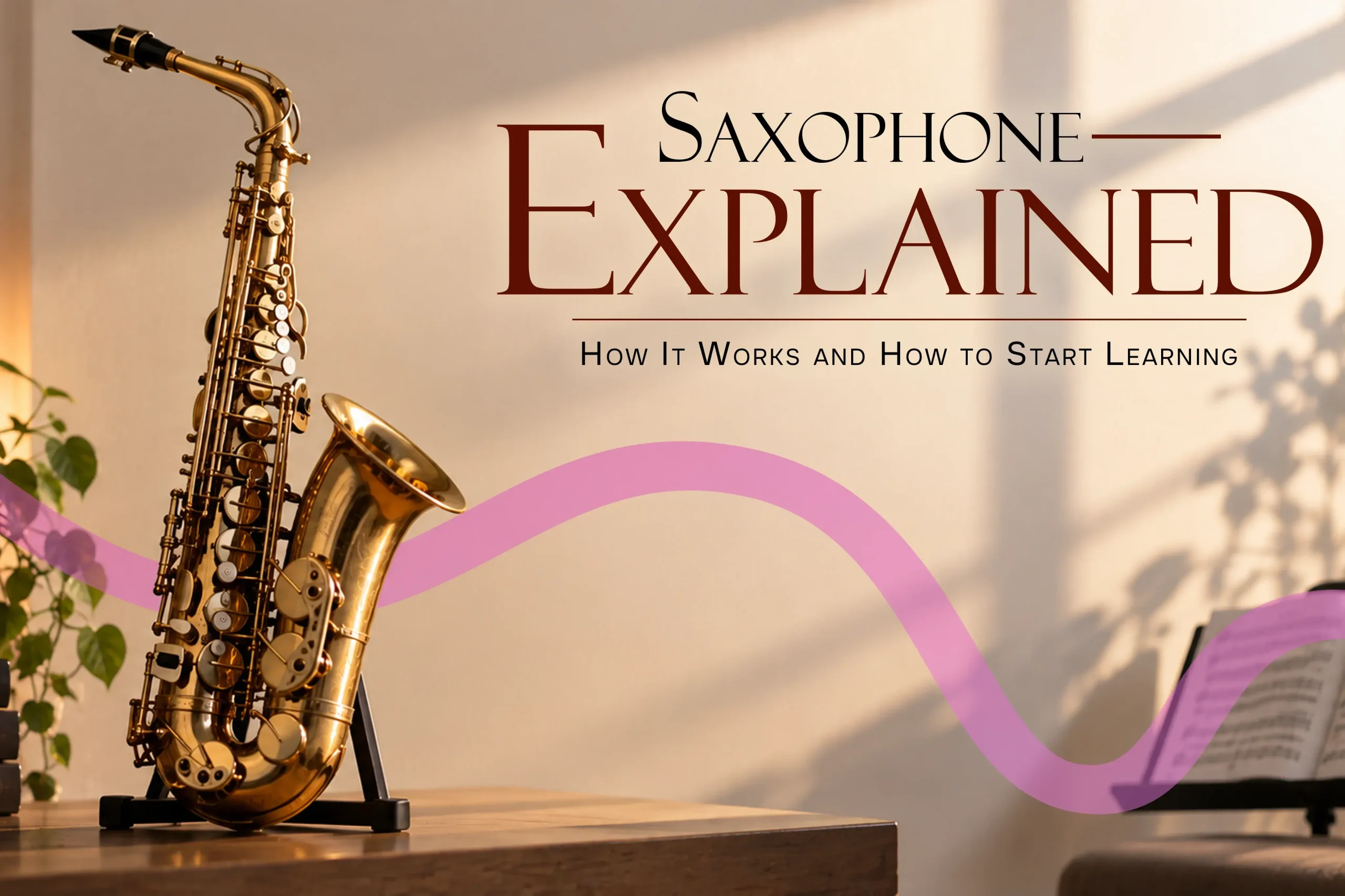
Table of Contents
Quick Summary
| A saxophone is a single-reed woodwind instrument with a bright, expressive sound. It is played by blowing into a mouthpiece while using the keys to produce different notes. Saxophones come in types such as soprano, alto, tenor and baritone, each with a distinct size, pitch and tone. |
Introduction
The saxophone instrument has a bright, expressive sound that can feel equally at home in a jazz solo, a film-song arrangement or a school music performance. Although it is made mainly from metal, it belongs to the woodwind family because sound begins with a vibrating reed.
If you are curious about learning this instrument, you may have questions such as:
- What is the meaning of the saxophone?
- How is the sound produced?
- Which type should a beginner choose?
- Is the saxophone difficult to play?
- How long does it take to learn?
- Can you learn it with guidance from home?
This guide answers these questions in language. It covers the parts of the instrument playing technique, common saxophone types, practice habits and tips for selecting your instrument.
The saxophone is not limited to one tradition. You can hear it in jazz, pop, rock, film music, marching bands, concert music and some contemporary Indian arrangements. With practice and patient guidance beginners can start producing sounds and melodies step by step.
What Is a Saxophone? Saxophone Meaning
A saxophone is a metal single-reed woodwind instrument. You create sound by blowing through a mouthpiece fitted with a piece of material called a reed. The reed. The air moves through the instrument’s body to create a tone.
The word “saxophone” comes from its inventor, Adolphe Sax, an instrument maker. The name combines “Sax” with “phone” meaning sound. In terms the saxophone meaning is an instrument designed to produce sound through the work of the reed and the player’s breath.
The saxophone is classified as a woodwind even though its body is usually made of brass or another metal. This classification is based on how it produces sound not on the material used to make it. A clarinet is also a single-reed woodwind while a flute produces sound differently through an air edge.
Main parts of a saxophone
A saxophone has several important parts:
- Mouthpiece: The part you place in your mouth.
- Reed: A thin strip attached to the mouthpiece that vibrates when you blow.
- Ligature: A small device that holds the reed in place.
- Neck: The curved section that connects the mouthpiece to the main body.
- Body: The long tube where most of the keys and tone holes are located.
- Keys: Metal mechanisms that open and close tone holes.
- Bell: The flared end through which the sound leaves the instrument.
- Thumb rests: Supports that help you hold the saxophone comfortably.
The mouthpiece, reed and your mouth shape work together to begin the sound. Your fingers then control the keys to change the pitch.
Saxophone Pronunciation and Quick Facts
The saxophone pronunciation is “SACK-suh-fohn”. In form it is commonly written as in British English. The word “sax” is widely used by musicians and teachers.
Here are a few facts about this saxophone instrument:
- It is a single-reed woodwind instrument.
- It usually has a curved metal body, although soprano saxophones may be straight.
- Its keys control the opening and closing of tone holes.
- It is available in several sizes and pitch ranges.
- The alto saxophone is a common starting point for beginners.
- Saxophones are often associated with jazz, but they are also used in pop, classical, rock, marching bands and film music.
- The instrument can produce soft, warm, breathy, bright or powerful sounds depending on the player’s technique and equipment.
Knowing the saxophone pronunciation can make it easier to discuss the instrument when searching for teachers, buying accessories or joining music communities.
How Does a Saxophone Musical Instrument Work?
The saxophone musical instrument works through a combination of breath, reed vibration, air movement and finger positions.
Step 1: Air enters the mouthpiece
When you blow into the mouthpiece your breath reaches the reed. The reed is attached to the underside of the mouthpiece using a ligature.
Step 2: The reed vibrates
The air causes the reed to move rapidly against the mouthpiece. This vibration interrupts the airflow. Create waves.
The reed does not produce the note by itself. Its vibration starts the sound while the shape and length of the saxophone body help determine the pitch.
Step 3: Air travels through the body
The air moves through the saxophone’s tube. Because the tube is conical it gradually becomes wider towards the bell. This shape contributes to the instrument’s tone and response.
Step 4: Keys change the pitch
When you press a key a pad covers or uncovers a tone hole. This changes the length of the air column inside the instrument.
- A longer vibrating air column creates a lower note.
- A shorter vibrating air column creates a higher note.
By using finger combinations you can play notes and scales.
Step 5: The bell projects the sound
The sound eventually leaves through the bell. The bell helps project the sound into the surrounding space although the full tone is shaped by the instrument, mouthpiece, reed and player.
Breath and embouchure
Your embouchure is the way you position your lips, teeth and mouth around the mouthpiece. It helps control the reed and prevent air from escaping. Yamaha describes embouchure as the shape of the mouth and the use of the muscles around it when playing a wind instrument.
Types of Saxophones
There are types of saxophones. They differ mainly in size, pitch range, shape and musical role.
1. Soprano saxophone
The soprano is one of the smallest common saxophones. It is often straight or only slightly curved and has a high, clear sound. It can sound beautiful but may require careful control of breath, embouchure and pitch. For this reason, many complete beginners start with another type before moving to soprano.
2. Alto saxophone
The alto saxophone is medium-sized. Has a balanced sound. It is commonly used in school bands, jazz groups, pop music and beginner programmes.
Many new learners choose alto because:
- It is lighter and easier to hold than larger saxophones.
- Its keys are comfortably spaced for many players.
- It requires less air than a tenor or baritone.
- Beginner learning materials are widely available.
- Its sound is easy to hear without being excessively low or powerful.
This does not mean alto is the choice. Your age, hand size, musical goals and access to an instrument should also influence the decision.
3. Tenor saxophone
The tenor saxophone is larger than the alto. Has a fuller sound. It is strongly associated with jazz, popular music, rhythm and blues and big-band playing. Tenor can be a choice if you prefer a sound or hope to play in a style where tenor saxophone is commonly featured. However its size and air requirements may feel more demanding for learners.
4. Baritone saxophone
The baritone saxophone is the largest of the four used saxophones. It produces a tone and often supports the bass range in ensembles. Because it is larger and heavier it may not be the instrument for a young beginner. It is often selected after a learner has developed saxophone technique or when a band specifically needs its sound.
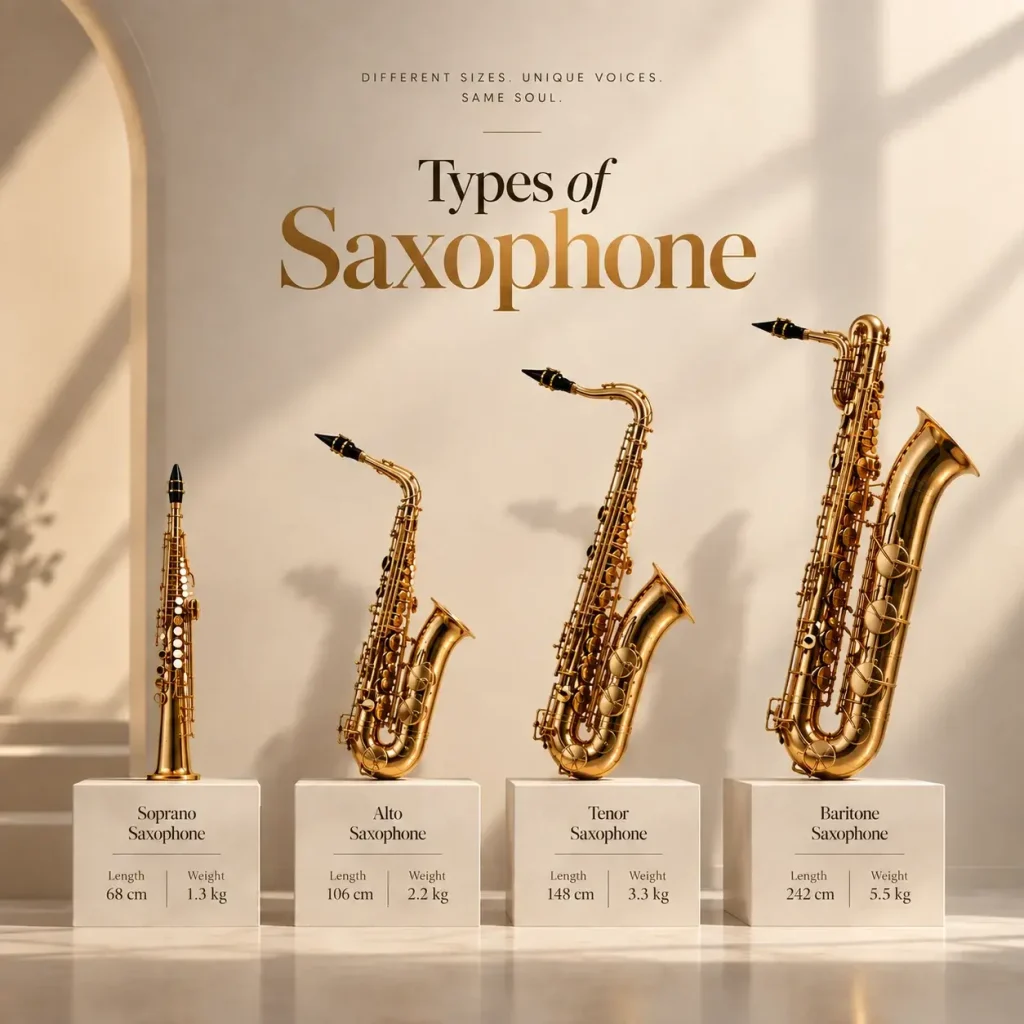
Comparing the common types
| Type | General sound | Size | Common uses | Beginner considerations |
| Soprano | High and focused | Small | Jazz, classical, pop | Requires careful pitch and embouchure control |
| Alto | Bright and balanced | Medium | School bands, jazz, pop | A practical starting choice for many beginners |
| Tenor | Warm and full | Large | Jazz, pop, rhythm and blues | Needs more air and physical support |
| Baritone | Deep and powerful | Very large | Concert bands, jazz, ensembles | Heavier and usually less convenient for first-time learners |
How to Play Saxophone: Basics for Beginners
Learning how to play saxophone involves more than pressing keys. You need to develop posture, breathing, a relaxed embouchure and accurate finger coordination.
1. Assemble the saxophone carefully
Attach the neck to the body, place the mouthpiece on the neck cork and position the reed on the mouthpiece. Secure the reed with the ligature, attach the neck strap and adjust it so the mouthpiece reaches your mouth comfortably. Handle every part gently to avoid damaging the neck, mouthpiece or keys.
2. Prepare the reed
Lightly moisten the reed before playing and make sure it is not cracked. Its tip should align with the mouthpiece while the ligature should hold it securely without being too tight. Store the reed in a case after playing. A reed that is too hard can make playing uncomfortable while one that is too soft may produce a sound.
3. Maintain a stable posture
Sit or stand with your back straight and your shoulders relaxed. Let the neck strap support the saxophone so your hands can move freely over the keys. Avoid raising your shoulders, bending your neck, gripping the instrument tightly or locking your elbows.
4. Form the embouchure
Place your teeth gently on the mouthpiece. Cushion the reed with your lower lip. Close your lips, around the mouthpiece to create a seal but do not bite. Much pressure can stop the reed from vibrating and make the sound thin or strained.
5. Start with long tones
tones involve holding one note for several seconds. They help improve breath control, airflow, embouchure, tone quality and awareness of tension. Begin with notes and gradually try to hold them for longer while keeping the sound even.
6. Learn basic finger patterns
Once you can produce a sound, learn a few simple notes. Play each note separately and practise moving between two or three notes. After that try a scale. Apply the notes to an easy melody. Focus on transitions and steady rhythm, than speed.
7. Use a metronome
A metronome gives a beat. Helps you get better at timing. Start by playing one note for each beat. As your notes get clearer work on scales and melodies with rhythms. Slowly make the tempo faster.
8. Learn to read music gradually
Finger charts and copying others can help you start but reading music will make you more independent. Start with note names, rhythms, rests, bar lines, time signatures and simple scales. You don’t need to learn all music theory at once; add ideas as they are useful in your practice.
You don’t need to know every theory idea before playing songs. Learn each idea when it is useful in your practice.
Saxophone in Different Music Genres
The saxophone is an instrument because its sound can change a lot with breath, how you start notes, how loud or soft you play and the equipment you use.
1. Jazz
Jazz is one of the music types strongly connected with the saxophone. Musicians often use improvising changes in rhythm, expressive bends and changes in sound.
Beginners don’t need to improvise. You can start by listening to phrases and singing them and then trying to play them. This helps your ear.
2. Pop music
Pop songs might use the saxophone for a hook, a solo, background lines or a fuller sound. The instrument can add warmth and movement without being the part.
Playing pop music can be encouraging because you might know the melody and understand how the saxophone fits into the song.
3. Classical music
The saxophone also appears in works, chamber music, concert bands and orchestras. Playing saxophone often focuses on a good sound, correct pitch, controlled volume and detailed way of playing.
4. Rock, funk and rhythm and blues
In these styles the saxophone may add riffs, punchy notes and expressive solos. A good way of starting notes and correct rhythm are very important.
5. Indian and film music
Although the saxophone is not a classical instrument its sound can be heard in film songs, fusion music, live performances and instrumental covers. A learner interested in music can explore melodies from film music or local songs while building skills.
If you also want to explore other instruments that complement your musical interests, you can browse Artium Academy’s Most Popular Musical Instruments.
How to Choose Your First Saxophone
Choosing your saxophone is more than picking the cheapest one. A good adjusted saxophone can make learning easier while a bad one can make basic notes hard.
1. Choose a suitable type
For beginners an alto saxophone is a good start because it is easy to handle and has a range that is often used. However a tenor might be better if you really like the sound or have a teacher and instrument that supports that choice.
You should consider:
- Your age and physical comfort.
- Hand size and reach.
- The music you want to play.
- Whether you will play alone or in an ensemble.
- Availability of teachers and learning material.
- Whether you can rent before purchasing.
2. Buy or rent thoughtfully
Renting can be helpful if you are not sure if saxophone is right for you. If you buy an instrument make sure it is checked by an experienced teacher.
Check:
- Whether the keys move smoothly.
- Whether pads seal properly.
- Whether the neck fits securely.
- Whether the mouthpiece and ligature are included.
- Whether the case protects the instrument.
- Whether replacement parts and servicing are accessible.
3. Consider the complete setup
The saxophone is only one part of the setup. You may also need:
- Reeds.
- A neck strap.
- Cleaning materials.
- A music stand.
- A tuner or metronome.
- A protective case.
- A suitable mouthpiece.
Beginner saxophones vary widely in price depending on brand, condition, quality and included accessories. Instead of relying only on a low price, consider durability, adjustment quality and after-sales servicing. Prices also vary between new and used instruments, so local dealers and teachers can provide more accurate, current guidance.
Tips to Improve Your Saxophone Playing
Improvement comes from regular, focused practice rather than occasional long sessions.
1. Practise regularly
Try to practice for 20–30 minutes each day. Divide your time into warm-ups, breathing exercises, long notes, finger exercises, scales, songs and a quick review.
2. Record yourself
Recording your playing can help you notice uneven notes, rushed rhythms or changes in volume. Focus on improving one issue at a time.
3. Practise slowly
Start difficult exercises and songs at a slow tempo. Once your notes and rhythm become accurate, gradually increase the speed.
4. Listen to skilled players
Listen to saxophonists in the styles you enjoy. Pay attention to their breathing, phrasing, tone, volume and use of pauses. This can help you develop your own musical style.
5. Keep your saxophone clean
Clean the inside of the instrument after playing and store the reed properly. Keep the mouthpiece clean, and never force the keys or try to repair stuck pads yourself.
6. Practise articulation
Use gentle “too” or “doo” syllables to practise starting and separating notes. Your tongue should lightly interrupt the airflow without stopping it completely.
7. Learn with a teacher
A teacher can correct your posture, embouchure, fingering and rhythm before incorrect habits develop. This guidance is especially helpful when you are just starting.
Online music learning can also work well when classes are live and interactive. A structured Online Western Music Course may be useful if you want to strengthen your broader understanding of melody, rhythm and musical performance, even though Artium Academy does not currently offer a saxophone-specific course.
Can You Learn Saxophone Online?
Yes you can learn parts of saxophone playing online like reading music, rhythm, breath control, listening and practice. However live feedback is important because a teacher needs to check your posture, mouth position, finger placement and sound.
When choosing online lessons, look for:
- Live classes with personal feedback.
- A structured plan suited to your level.
- Regular practice activities.
- A patient and experienced teacher.
- Flexible class timings.
Saxophone is commonly heard in Hindustani-inspired fusion, Hindi film music and Western music arrangements. While Artium Academy does not currently offer saxophone classes, its structured online courses in Hindustani music, Hindi film music and Western vocals can help learners strengthen their understanding of melody, rhythm and musical expression.
Final Thoughts
The saxophone is a metal instrument that makes sound with breath, a vibrating reed and finger movements. Beginners should focus on posture, how they hold the mouth, breathing and regular practice. Alto saxophone is a choice while Artium Academy’s online singing classes can help build your music foundation.
Ready to Start? Before learning the saxophone, build your musical foundation with Artium Academy. Book a free 1:1 trial class to develop your understanding of rhythm, melody and singing with guidance from certified teachers.
Frequently Asked Questions
The saxophone is a metal instrument that makes sound with a vibrating reed. It is called a woodwind because of how it makes sound, not because of the material it is made from.
The usual way to say saxophone is “SACK-suh-fohn”. It is also called “sax” in music talks. The way to say it can be a bit different in accents. The first part is usually the loudest.
You blow into the mouthpiece making the reed vibrate. The vibration sends air through the saxophones body while the keys change the air column length and alter the pitch.
Start with an instrument, learn how to put it and care for it, develop a relaxed mouth shape and practice steady breathing. Begin with simple notes, basic finger positions and easy songs. A teacher’s feedback can help avoid habits.
The four main types are soprano, alto, tenor and baritone. Soprano has the range and baritone has the lowest. Alto and tenor are often used for beginners and groups.
There is no one for everyone. Alto is often a starting point because it is a size and has lots of teaching materials. However your age, hand size, music preference and teachers advice should also be considered.
The first sounds might take time because you need to control breath, mouth shape and fingers. Many learners find the finger system easy. Making a sound needs practice. Difficulty depends on your music experience. How much help you get.
The saxophone is used in jazz, pop, rock, funk, rhythm and blues classical music, concert bands, marching bands and film music. It can also be, in fusion and modern Indian music.
The cost changes based on the type, brand, condition, and quality of what comes with it. The service available. New and used saxophones have prices. Before buying, have a teacher or repair person check the saxophone and think about renting if you’re not sure if you like the saxophone.
If you practice every day you can play songs in the beginning. Making a sound playing with the rhythm and using expressive playing takes more time. How long it takes depends on what you mean by “well”. How much you have played before.