
All Topics
- Alchemizing Music Concepts for Students
- Anuv Jain Songs
- Artist Spotlight
- artium gift card
- Artium Maestros
- Artium News
- Artium Practice Studio
- Artium Tech Blog
- Best Coke Studio Songs
- Best Female Singers
- Birthday songs
- Bollywood Love Songs
- buying guide
- Carnatic Music
- Child Singers
- Devotional Music
- Editorials by Ananth Vaidyanathan
- English Love Songs
- Festival
- Film Music
- Ghazal Music
- Guitar
- Hindustani Classical Music
- Indian Classical Music
- Indian Folk Music
- Insights
- Instagram Reels Viral Songs
- Instruments
- Karaoke
- Karaoke Singing
- Keyboard
- Kids Music
- maestros
- Music Education
- Music for Kids
- Music Games
- Music Industry
- Music Instruments
- Music Legends
- Music Press Release
- Music Technology
- Music Theory
- Music Therapy
- Music Tools
- Piano
- piano guide
- Songs
- South Devotional Music
- Success Stories
- Tamil Film Music
- Telugu Film Music
- Time Theory
- Tools
- Uncategorized
- Uncategorized
- Uncategorized
- Uncategorized
- Vocal Range
- Vocal Singing
- Vocals
- western classical music
- western music
- Western vocal music
Manjira Instrument Explained: Types, Sound, and How to Play
Manjira Instrument Explained: Types, Sound, and How to Play
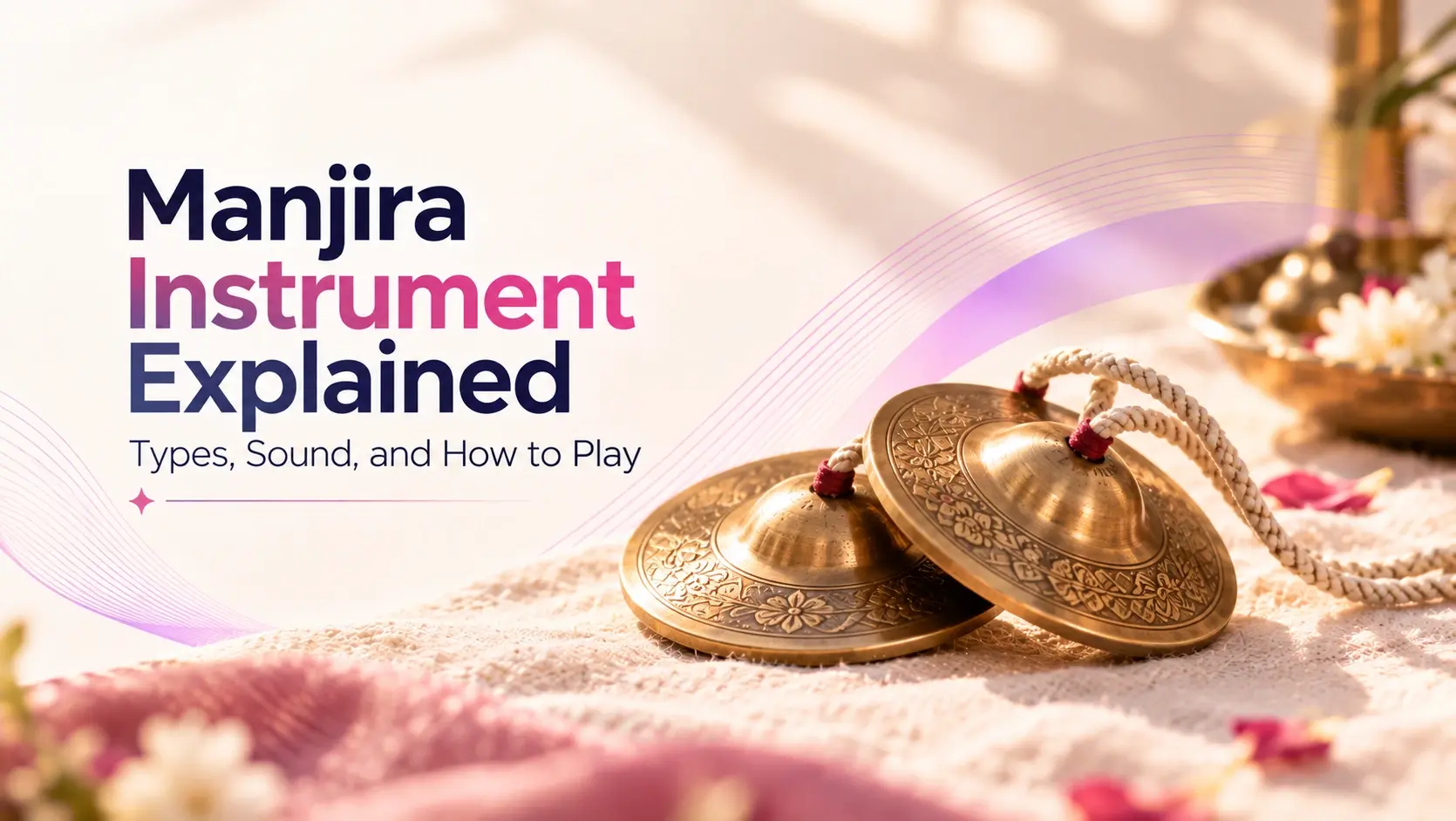
Table of Contents
Quick Summary
| The manjira instrument is a set of small cymbals held in the hand and played by striking them together. They are a percussion instrument used in bhajans, kirtans, aartis and folk music traditionally made of brass, bronze and bell metal. The manjira musical instrument is a pair of small hand cymbals with a higher centre and a piece of cord for holding. Often in brass, bronze or wooden the pair is held in the hands and then hit together. |
Introduction
Have you ever listened to a bhajan, aarti, kirtan or village folk performance? If you have, you would have heard a very distinct “ting-ting” sound, the sound of the musical instrument manjira. It appears to be very modest, two small discs of metal attached to a cord but it can create a lot of sound for singers and musicians!
Learning to play the manjira musical instrument, an easy percussion instrument, doesn’t require you to know how to read music, and it’s pretty simple to pick up. With the basic techniques that can be learnt in just a couple of practices, the musical instrument manjira can be played very easily and if done musically (without rushing, without cutting the sound, not breaking the beat) takes patience and regular practice.
Learn all about the manjira instrument in this article. Discover the types, sound, parts, and how to play in this detailed explanation.
What Is a Manjira? (Overview)
Manjira instrument is a hand cymbal, three or more pairs of small, round cymbals with a raised centre (or boss) and marginally bowed edge. The centre of the cymbal has a cord or a strip of cloth through it that you can use for a comfortable grip.
Basic Indian Hand percussion musical instruments A pair of small cymbals used to keep rythme. It is hit like the tabla to hold the beat rhythm, the taaL during the singing. It is a traditional Indian musical instrument and played by hand.
The manjira musical instrument is sometimes called jalra, taal, karatala, and khartal. Names and shapes vary from place to place, but the concept is roughly the same: pair of tiny cymbals for maintaining rhythm.
Manjira Instrument in English
Manjira Instrument is also known as Indian hand cymbals, finger cymbals, or small cymbals. They are a pair of small round discs of metal which are worn in the hands and clashed together to make a ringing sound. They may be made of various materials, typically brass or bronze and are suspended on a cord or strip of cloth.
Manjira Instrument is a term originating from the Indian languages, may be also spelled as manjeera, manjira, or manjeera. Other terms such as jalra, taal, or karatala are used in various regions for a similar, but a different instrument. The names are common, but the instrument is similar, being a hand-held cymbal mostly used for rhythm.
The manjira is played with the hands, as opposed to large cymbals used in Western music which are played with drum sticks. They are popular in bhajans, aartis, kirtans, temple singing and folk music. Their distinct metallic sound allows a singer to keep the beat without drowning out the voice.
So, if you are looking for “manjira instrument in English” you’ll get the easiest answer: a pair of tiny Indian hand cymbals used to keep time in devotional and folk music.
History and Cultural Significance of the Manjira
For centuries the manjira continues to be in the frayed canvas of Indian musical life. The instrument is synonymous with temples, devotional singing, folk festivals and the local gatherings. Images of such hand cymbals can be seen in numerous ancient temple sculptures highlighting the significance of this instrument in India.
The musical instrument manjira used to be traditionally played along with bhajans, devotional songs sung in praise of a deity- and kirtans- where the singer repeats divine words rhythmically. It’s also a staple for folk performances in various states of India.
Its small size and portability made the manjira instrument the obvious choice for travelling singers, temple musicians and village performers. To this day, the sound of the manjira can be heard in people’s homes, temples, cultural programmes and music classes.
If you ever wish to learn Hindi devotional music online, understanding rhythm through instruments such as the manjira can make your singing feel more steady and expressive.
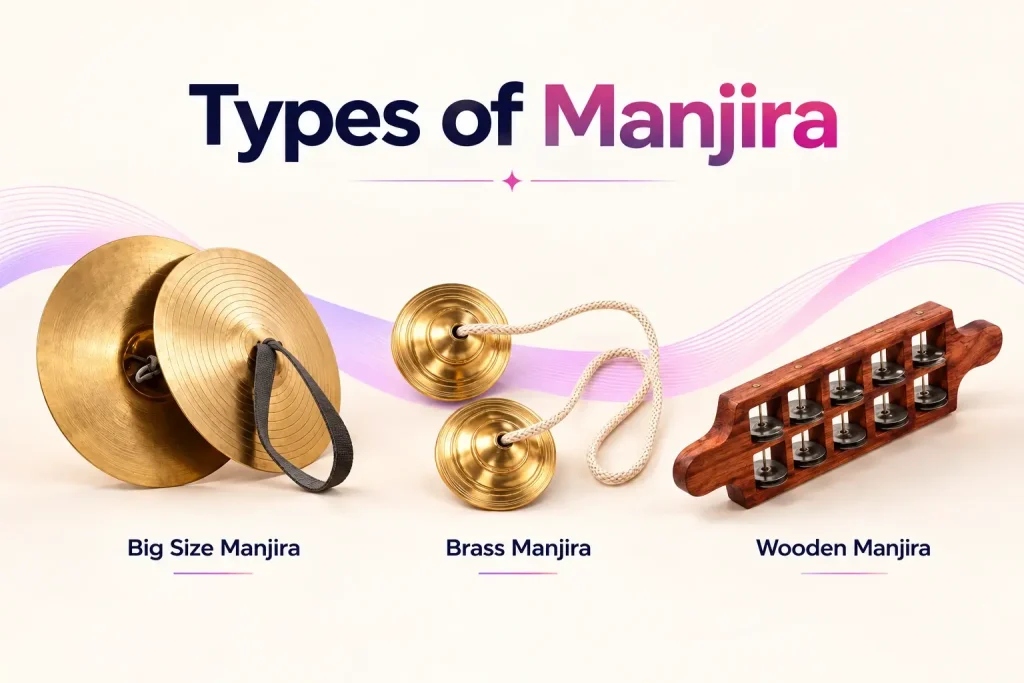
Types of Manjira
Manjira instruments has various sizes, materials and designs. Different kinds of manjiras have different sounds depending on the metal, thickness, size and how it is played.
1. Big Size Manjira
A big size manjira instrument will have bigger cymbals and tends to give a low, full & resonance sound. Larger size mandiras are used in band, temples & folk music where the tempo/ rhythm has to be prominent.
The cymbals are larger, which may give the impression of being a little weightier when being held. Suitable for beginners, but they should be played softly and not hit forcefully due to their large size, as they can be quite loud and sharp.
Other regional names used for the larger clash cymbals include bortaal, majutaal etc. which however differ from the manjira instrument used in bhajans.
2. Brass Manjira
Most of us would be familiar with the brass manjira. Brass is easy to find and reasonably priced, its sound is clear, bright and ringing. Brass, bronze, bell metal and other metal alloys are commonly used in making traditional manjira.
A good brass manjira usually has:
- A smooth, even surface
- A well-formed raised centre or boss
- A secure cord or cloth strip
- A balanced weight that feels comfortable in the hand
- A sustained, pleasant ring rather than a harsh clank
For most beginners, a very simple conventional brass manjira will be the best choice because it is available everywhere and good for bhajians/kiritans and folk music.
3. Wooden Manjira
A wooden manjira instrument is comparatively rare. The wooden manjira could be made out of woods like rosewood and teak and would have a softer, warmer sound which is a little less metallic.
Sometimes you might also find wooden models available. They are often used for particular folk or regional styles. These might be worth choosing if you want a softer sound or to practise without producing such a piercing metallic sound.
But wooden manjiras may not give the same long ringing sustain as brass or bronze ones. If your intention is more to accompany devotional singing, then in general a metal manjira is more traditional and more usual.
Parts of the Manjira and the Vibrating Part That Creates Sound
A single sound of a manjira instrument may be just two disks, but everyone of them can influence its sound.
- Cymbal disc: The round metal body of each manjira.
- Boss: The raised centre portion of the cymbal.
- Rim or edge: the part that is slightly curved outward, contributing to the ringing tone.
- Cord or cloth strip: The string passing through the centre, used to hold and control the instrument.
- Striking surface: The area where the two cymbals meet.
The vibrating part of manjira that creates sound is mostly the metal pan of a cymbal’s discs and rims. Metal discs are clanged together, and the vibrations are carried through the air in sound waves. This is where the ringing tone comes from.
You can damp the cymbals when you hit them by pressing them against each other. This cuts the sound off. That’s why it sounds dull, or doesn’t sound at all. To allow the manjira instrument to ring perfectly, strike it and immediately release the cymbals.
How to Play Manjira: Basic Technique
Learning how to play manjira is about control, timing, and relaxation. Do not beat too hard: a soft tap at the right moment makes a much better sound.
Step 1: Hold the Manjira Comfortably
You’re holding one cymbal in each hand. Wrap the cord between your fingers so your cymbals sit tight but won’t fall off. Loose wrists and shoulders, the keys to a good hold.
Step 2: Position the Cymbals
Hold the cymbals so that they face each other either flat or at a slight angle. Don’t squeeze them too tightly. When you squeeze the cymbals too tightly, the tension in your hands will affect the sound and the comfort of your palms.
Step 3: Strike Gently
Touch the cymbals briefly, then push apart immediately. Note that the cymbals should strike very lightly and be controlled so the edges or faces just make contact and then move apart. This makes the cymbals vibrate freely and ring clearly.
Step 4: Maintain a Steady Beat
Start with a simple four-count rhythm:
1 – 2 – 3 – 4
Tap one time on each of the numbers. Recite the numbers aloud, or set a metronome and tap slowly. Once ready, try:
1 and 2 and 3 and 4 and
This will give you two soft hits per beat and are helpful in practicing timing.
Step 5: Practise Open and Closed Sounds
An open strike is a quick separation of the cymbals which produces a long ringing tone. A closed strike is where the cymbals are left in contact for a moment to produce a shorter tone.
Both are helpful. For slower bhajans, you can benefit from open strikes. For faster ones, shorter, controlled strikes may help.
Performing with a consistent taal will make you feel the beat of the music and boost your musical hearing if you want to learn Hindustani classical music with the training of the manjira instrument.
Role of Manjira in Devotional, Folk, and Bhajan Music
The manjira instrument is a vital tool for devotional music. For bhajan or aarti it is used to keep the audience singing in unison. Its brightness cuts softly but firmly through the singing to hold the group together without drowning out the voice.
It is also common in folk music, accompanying community songs, festivals, dancing and local fairs. The manjira instrument can be heard in festivals, temple gatherings and cultural occasions in most regions of India.
With a group performance, the manjira instrument player may serve as a kind of time keeper. A beginner may help singers keep in time with him; while an experienced hand may incorporate minor variations without throwing the time off.
The musical instrument manjira is one of many instruments used in Hindustani classical music and Indian devotional traditions, though it is more generally used as an accompaniment for the beating of a rhythm.
Manjira vs Western Cymbals: Key Differences
The manjira is similar to cymbals, but not quite, as they are not the same size as the cymbals used in Western drum kits or orchestras.
| Feature | Manjira | Western Cymbals |
| Size | Small, hand-held pair | Often larger; may be mounted or hand-held |
| Playing style | Struck together by hand | Struck with sticks, mallets, or by hand |
| Common use | Bhajans, kirtans, folk and devotional music | Drum kits, orchestras, bands, marching music |
| Sound | Bright, ringing, rhythmic | Wide range: crash, ride, splash, and more |
| Cultural context | Indian devotional and folk traditions | Western classical, jazz, rock, and pop music |
Western cymbals originated from various musical traditions such as Turkish military orchestras, which played a role in European orchestral percussion. The other cymbal type is the manjira, a small pair of hand cymbals that have a long association with Indian devotional and folk music.
Therefore, despite sharing vibrating metal to produce sound, the manjira instrument is a different, traditional Indian percussion instrument with unique method and cultural significance.
Tips for Beginners Learning to Play Manjira
- Start slowly. Play only one strike per beat before considering faster ones.
- Use a light touch. A controlled hit sounds clearer than a heavy, pounding hit.
- Separate after striking. Doing this will allow the metal to freely vibrate, which results in a better tone
- Listen to bhajans. Pay attention to the manjira blending in with the singer instead of conflicting with his voice.
- Practise with a metronome. Practice for five to ten minutes a day.
- Keep your hands relaxed. Tension in your wrists will make playing tiring and may even dampen the sound.
- Clean and store carefully. Metal manjiras should be cleaned after using and the cord tied tightly to keep a good tone.
- Play with a singer. Singing along with a basic bhajan will show you how rhythm helps the melody.
The manjira instrument is a perfect traditional indian musical instrument which is simple yet significant. You can start with easy beats and then slowly move onto traditional devotional and folk styles.
If you like playing with instruments and rhythm, you can also see other instruments and practice tools at free online music tools from the Artium Academy.
Conclusion
Ever wonder how such a tiny pair of cymbals can keep a bhajan going? The musical instrument manjira may be tiny, but it has a mighty presence in Indian music. Its crisp, ringing tone lends rhythm, vitality, and precision to bhajans, kirtans, folk songs, and puja. The tone is produced by the vibration of its metal body and its straightforward stroke makes it an accessible instrument for beginners.
No matter if it is the brass manjira instrument, a big size manjira or wood, what truly makes the difference is practice and attention. Tap soft, open up the cymbals after every beat and stay in rhythm with the singer. This will bring you a great sense of Indian rhythm along with a good technique.
Get started with music now. Book your FREE 1:1 trial lesson with Artium Academy and experience the difference of having expert teachers guide you at your own pace.
Frequently Asked Questions
A pair of small hand cymbals to beat the time. Usually played during bhajans, aartis, kirtans and folk songs by clashing the cymbals together.
A big size manjira has big cymbals, a bigger size manjira generates deep louder and sonorous sound. A normal size manjira is small and heavy and easy to carry, which is comfort in devotional singing.
Both are not better than the other, they are good for different needs. Brass manjira sounds a more bright ringing tone, whereas wooden manjira sounds a softer and warmer tone. Brass manjira is more popular for bhajans and kirtans.
The cymbals-metallic discs-and edges-vibrate when we hit them, producing the soundwaves that result in the ringing sound of the manjira.
Using one cymbal in each hand, softly hit the cymbals and then immediately pull them apart so they can ring. First, practice slower beats, then speed up to faster rhythms.
Yes, the method is really easy to learn. The majority of beginners will be able to pick up on simple grooves very quickly but it requires consistent practice to play fluidly with singers and keep time.
The manjira is used in bhajans, aartis, kirtans, devotional songs and folk music in India.
Standard manjiras are commonly crafted from brass, bronze, bell metal, copper, zinc, or a similar metallic alloy. A cord or cloth strip is threaded through the centre of each cymbal.
They do come from the same general family of cymbals, but they are not the same. The manjira is a pair of small hand cymbals found primarily in Indian devotional and folk music, while Western cymbals tend to be larger and played with sticks or mallets.
It is used throughout India in temples, devotional congregations, folk festivals, and cultural events. It is especially prevalent in bhajan and kirtan traditions.