
All Topics
- Alchemizing Music Concepts for Students
- Anuv Jain Songs
- Artist Spotlight
- artium gift card
- Artium Maestros
- Artium News
- Artium Tech Blog
- Best Coke Studio Songs
- Best Female Singers
- Birthday songs
- Bollywood Love Songs
- buying guide
- Carnatic Music
- Child Singers
- Devotional Music
- Editorials by Ananth Vaidyanathan
- English Love Songs
- Festival
- Film Music
- Ghazal Music
- Guitar
- Hindustani Classical Music
- Indian Classical Music
- Indian Folk Music
- Insights
- Instagram Reels Viral Songs
- Instruments
- Karaoke
- Karaoke Singing
- Keyboard
- Kids Music
- maestros
- Music Education
- Music for Kids
- Music Games
- Music Industry
- Music Instruments
- Music Legends
- Music Press Release
- Music Technology
- Music Theory
- Music Therapy
- Music Tools
- Piano
- piano guide
- Songs
- South Devotional Music
- Success Stories
- Tamil Film Music
- Telugu Film Music
- Time Theory
- Tools
- Uncategorized
- Uncategorized
- Uncategorized
- Uncategorized
- Vocal Range
- Vocal Singing
- Vocals
- western classical music
- western music
- Western vocal music
Santoor Instrument: History, Types, Parts and How It Works
Santoor Instrument: History, Types, Parts and How It Works
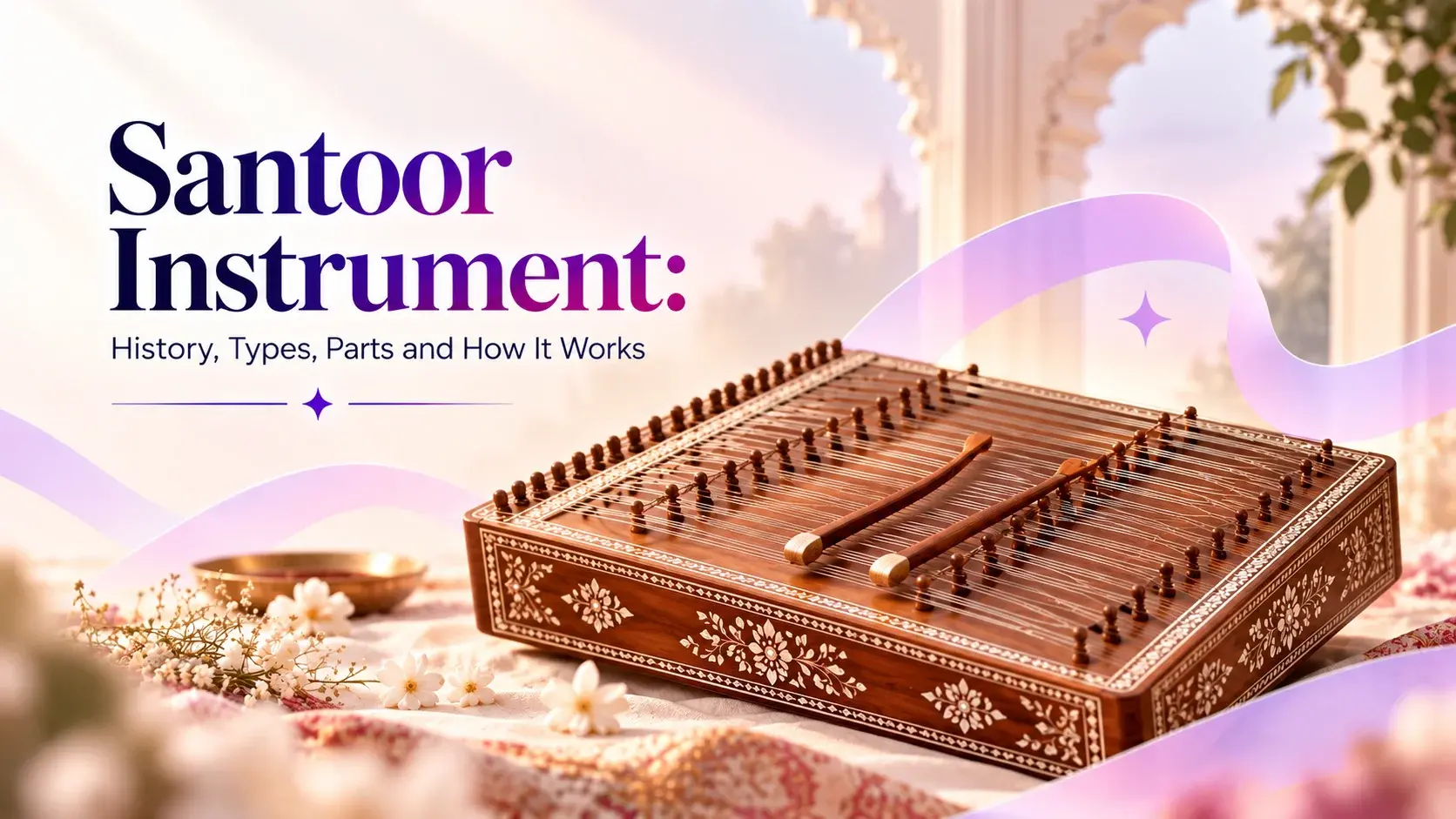
Table of Contents
Quick Summary
| The santoor instrument is a trapezoid shaped hammered dulcimer. Metal strings lie over a soundbox. It is played with light wooden mallets called mezrab. It began in Persia. Later grew in Kashmir. Today it is a respected solo instrument in Hindustani classical music with clear Indian, Kashmiri and Persian styles. |
Santoor Musical Instrument at a Glance
| Topic | Details |
| What it is | A trapezoid-shaped hammered dulcimer, adapted from the Iranian santur. |
| Where it’s from | A traditional instrument of Jammu and Kashmir, used in the Sufiana Mausiqi style. |
| Old name | Ancient Sanskrit texts refer to it as the shatatantri vina, the hundred-stringed veena. |
| Body | A trapezoid wooden box, usually made of walnut or maple. |
| Strings and bridges | The traditional form has 25 bridges with 4 strings each, so 100 strings in total. The four strings on a bridge are tuned in unison. |
| String count varies | Depending on the instrument, string counts range from about 40 to over 100, in steel, copper or brass. The Persian santur has around 72 strings. |
| Mallets | Light, specially shaped mallets called mezrab, held between the index and middle fingers. |
| How it’s played | Sitting cross-legged with the instrument on the lap. |
| Sound | A shimmering, bell-like tone. Striking nearer to or farther from the bridge changes the tone. |
| Glides (meend) | Struck strings can’t bend pitch, so players imitate meend with fast alternating strokes between neighbouring notes. |
| Big names | Pt. Shivkumar Sharma adapted the santoor for Hindustani classical music by changing its bridges and playing technique. Pt. Bhajan Sopori developed a style with a different bridge layout. |
| Did you know? | Ghulam Mohammad Zaz, described as the last santoor maker in Kashmir, received the Padma Shri in 2023. |
Introduction
If you have heard the bell-like tones of the santoor you know its sound is magical. It is often described as a mix of string and percussion sounds. It has carved a place in Indian classical music even though it entered the mainstream only recently.
For beginners who wonder about this instrument, questions often come up: Where did it come from? What types exist? How is it built?. How does it actually work? This guide will walk through everything you need to know about the santoor in language good for learners of any age.
Whether you’re exploring traditional Indian musical instrument options or simply want to understand how sound is created on the santoor, this post will give you a solid foundation.
What Is a Santoor Instrument?
The santoor is a stringed instrument that belongs to the hammered dulcimer family. Unlike the sitar or sarod which are plucked, the santoor makes sound when its metal strings are gently struck with mallets called mezrab.
The instrument has a wooden body (soundbox) with anywhere from 72 to more than 100 metal strings stretched across it.
These strings rest on bridges that divide the strings into different pitches. When you strike a string with the mezrab the vibration moves through the bridge to the soundboard producing the santoors resonant tone.
In music the santoor is normally made of walnut wood and has about 25 bridges, each holding four strings for a total of around 100 strings. This rich string arrangement lets players produce melodies and detailed ornamentations.
10 Ragas to Hear on the Santoor Musical Instrument
| Sr no | Raga | Thaat | Best time | What to listen for | Mood |
| 1 | Yaman | Kalyan | Early evening | Tivra Ma; all other notes natural | Calm, devotional |
| 2 | Bhoopali | Kalyan | Evening | Five notes only: Sa Re Ga Pa Dha | Peaceful, joyful |
| 3 | Bhairav | Bhairav | Early morning | Komal Re and komal Dha | Serious, devotional |
| 4 | Todi | Todi | Late morning | Komal Re, Ga and Dha; tivra Ma | Deep, serious |
| 5 | Bhairavi | Bhairavi | Morning (often ends a concert) | Komal Re, Ga, Dha and Ni | Tender, devotional |
| 6 | Bhimpalasi | Kafi | Afternoon | Komal Ga and Ni | Longing, romantic |
| 7 | Durga | Bilawal | Night | Five notes: Sa Re Ma Pa Dha | Calm, serene |
| 8 | Desh | Khamaj | Late evening and night | Both Ni forms; a rain-season feel | Romantic, light |
| 9 | Bageshree | Kafi | Late night | Komal Ga and Ni | Romantic, wistful |
| 10 | Malkauns | Bhairavi | Late night | Five notes: Sa komal Ga Ma komal Dha komal Ni | Meditative, deep |
Santoor Instrument Origin and History
Early Origins
The origin of the santoor is debated however most scholars agree that the santoor began in ancient Persia, which is the modern country of Iran. The word ‘santoor’ comes from a word that means ‘hundred strings.’ Some historical references say that similar hammered dulcimer instruments existed in culture from 2,000 to 3,500 years ago.
Ancient Indian texts also mention an instrument called the ‘shata veena,’ which means hundred stringed veena. This suggests that India may have had its version of a multi zither long before the Persian santoor arrived. Still the santoor that we know today is widely believed to have roots.
Development in Kashmir
The santoor found a home in the Kashmir valley. There it became a part of folk music and Sufi music. Kashmiri craftsmen began building santoor instruments using wood that is found locally. This gave the santoor a tone that fits the region’s musical traditions.
In Kashmir the santoor accompanied Sufi music and folk songs for centuries. It was played in homes at gatherings and during ceremonies. The santoors’ gentle sustained sound made it ideal for the quality of Sufi music.
Santoor in Indian Classical Music
For a time the santoor was mainly seen as a folk or accompaniment instrument. That changed in the twentieth century when maestros such as Pandit Shivkumar Sharma began adapting the santoor for Hindustani music.
Pandit Shivkumar Sharma is widely credited with transforming the santoor into a solo concert instrument. He modified the santoors structure making it larger adding strings and refining the placement of bridges. These changes helped the santoor meet the demands of ragas and intricate improvisation.
Today, the santoor is a staple in instruments used in hindustani classical music, and artists like Ulhas Bapat, Bhajan Sopori, and Kiranpal Singh have continued to expand its repertoire.
Types of Santoor
While the basic design remains similar the santoor has evolved into variations. Here are the main types that you will encounter:
1. Indian Santoor
The Indian santoor is wider and more rectangular than the santoor. It typically has between 25 and 31 bridges. Each bridge holds three or four strings. In total the Indian santoor has between 90 and more than 100 strings.
Made mainly from wood the Indian santoor is designed to produce notes that are suitable for the meend technique of gliding and the gamak technique of ornamentation.
The santoor’s mallets, called mezrab, are lightweight and made of wood. They do not have. Cotton wrapping. This allows strikes.
2. Kashmiri Santoor
The Kashmiri santoor is the traditional version used in folk and Sufi music of the Kashmir valley. It’s slightly smaller than the modern Indian classical santoor and often features decorative inlay work.
The number of strings can vary, but it generally has around 72 to 90 strings grouped in sets of three.
Kashmiri santoor mallets are typically made from walnut wood, matching the instrument’s body, and produce a softer, more mellow tone suited to folk melodies.
3. Persian Santur
The Persian santur is the ancestor of the Indian santoor. It has a more pronounced trapezoidal shape and typically features two sets of nine bridges, providing a range of about three diatonic octaves. The strings are grouped in courses of three or four, totaling around 72 strings.
Persian santur mallets (also called mezrab) are feather-light and often have tips wrapped in cotton or felt, producing a softer attack compared to the Indian style.
4. Middle Eastern and Regional Variations
Beyond Persia and India, similar hammered dulcimers exist across the Middle East and Central Asia. The Iraqi santur, Turkish santur, and Azerbaijani santur all share the basic trapezoidal design but differ in size, number of strings, and tuning systems.
These regional variations reflect local musical traditions, with some instruments tuned to microtonal scales unique to their culture.
Parts of Santoor
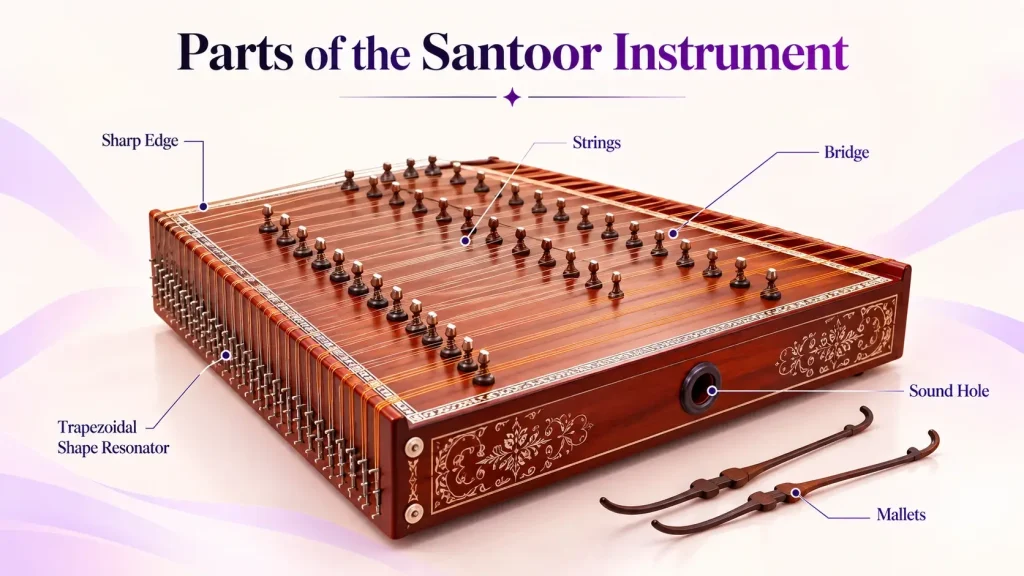
Understanding the parts of the santoor helps you appreciate how it produces sound and why each component matters.
1. Wooden Body or Soundbox
The main structure of the santoor is a box, usually trapezoidal or rectangular in shape. In santoor the box is normally made from walnut wood but teak and maple are also used. The body of the santoor acts as a resonating chamber amplifying the vibrations that come from the strings.
2. Soundboard
The top surface of the santoor is called the soundboard. This is where the bridges are placed and where the strings are stretched. The soundboard of the santoor is often made from wood, sometimes plywood or veneer that vibrates freely to project sound.
3. Metal Strings
The santoor has between 72 and over 100 metal strings depending on the type of santoor. These strings are usually made of steel or brass. Are grouped in sets of three or four per bridge. Each group of strings is tuned to the pitch creating a fuller tone when the santoor is struck.
4. Bridges
Bridges are pieces placed on the soundboard of the santoor. They lift the strings off the board. Transfer vibrations from the strings to the body of the santoor. Indian santoor usually has 25 to 31 bridges allowing players to adjust tuning for ragas.
5. Tuning Pins and Pegs
On one side of the santoor steel tuning pins or pegs are used to tighten or loosen the strings. By turning these pins with a tuning player can adjust the pitch of each string group on the santoor to match the desired scale.
6. String Hooks or Nails
On the side, from the tuning pins strings are secured using nails or hooks. These hold the strings in place on the santoor once they have been threaded through the tuning pins and stretched across the bridges.
7. Mallets or Mezrab
The mezrab are mallets held between the thumb, index and middle fingers. In santoor playing the mezrab are typically made of walnut. Have no padding allowing for precise articulate strikes on the santoor. Persian santur mallets may have cotton. Felt tips for a sound.
8. Sound Holes
Some santoor instruments have sound holes cut into the body or soundboard. These holes help project sound outward. Can affect the quality and resonance of the santoor.
How Is the Santoor Played?
Playing the santoor requires coordination, rhythm, and a gentle touch. Here’s a basic overview:
- Posture: Sit comfortably with your back straight. Place the santoor on your lap or on a low table at a height where your arms can move freely.
- Holding the Mezrab: Hold one mallet in each hand between your thumb, index, and middle fingers. Your grip should be firm but relaxed, allowing wrist movement.
- Striking the Strings: Use your wrists (not your whole arm) to strike the strings lightly. Alternate between your right and left hands for smooth, flowing melodies.
- Playing Scales: Begin by practicing simple scales like Bilawal (equivalent to the major scale). This helps you learn the string layout and build muscle memory.
- Rhythm and Timing: Use a metronome or tabla accompaniment to develop steady timing. The santoor’s percussive nature makes rhythm especially important.
For beginners, consistent practice with proper guidance is key. Many students can play simple pieces within 3–6 months of regular practice. If you’re interested in structured learning, you can explore options to learn hindustani music online with certified teachers who can guide you step-by-step.
Difference Between Santoor and Other String Instruments
| Feature | Santoor | Sitar | Sarod | Tabla (for context) |
| Playing Method | Struck with mallets (mezrab) | Plucked with fingers | Plucked with fingers | Struck with hands |
| Number of Strings | 72–100+ metal strings | 18–21 strings (main + sympathetic) | 17–25 strings (main + sympathetic) | N/A (percussion) |
| Body Shape | Trapezoidal/rectangular soundbox | Long neck with gourd resonator | Fretless metal fingerboard, gourd body | Two drums (dayan and bayan) |
| Sound Quality | Bright, shimmering, sustained | Sweet, resonant with sympathetic strings | Deep, introspective, sliding notes | Rhythmic, percussive |
| Frets | No frets (bridges divide strings) | Movable frets | No frets (metal fingerboard) | N/A |
| Typical Use | Solo, accompaniment in classical and folk | Solo in Hindustani classical | Solo in Hindustani classical | Accompaniment in classical and folk |
Conclusion
The santoor instrument is a blend of history, craftsmanship and musical innovation. From its origins to its development in Kashmir and its eventual place on the Hindustani stage the santoor has a rich story to tell.
We find that understanding the parts of santoor santoor types and how santoor works gives you an appreciation for the skill required to play santoor. Whether you are drawn to the shimmering tone of santoor or curious about how santoor fits into music santoor offers a path for learners of all ages.
If you’re inspired to explore further, Artium Academy offers structured, 1:1 live classes with certified teachers who can guide you through your musical journey. You can also learn devotional music online or explore our free music tools to build your skills at your own pace.
Want to learn singing along with santoor? Book your free 1:1 trial class with Artium Academy and learn from certified teachers at your own pace.
Frequently Asked Questions
The santoor originated in Persia (modern-day Iran). It was later adapted in India particularly in Kashmir. Today santoor is considered both a Persian and an Indian instrument with variations in each tradition.
Pandit Shivkumar Sharma is the Indian santoor player credited with bringing santoor into Hindustani classical music. Other notable players include Ulhas Bapat, Pandit Bhajan Sopori and Kiranpal Singh.
The santoor can be moderately challenging because of the strings of santoor and the coordination required to strike them. With practice and proper guidance beginners can learn the basics and play simple pieces within a few months.
The santoor is a dulcimer, a type of zither. The santoor belongs to the chordophone family (string instruments). Produces sound when the metal strings of santoor are struck with mallets.
While the santoor originated in Persia, santoor became deeply rooted in Kashmiri folk and Sufi music. The Kashmiri santoor is a variation used in the region’s music for centuries.
Santoor is believed to be over 2,000 years old with some references tracing instruments back 3,500 years in Persia.
There is no recognized santoor player named Meera Devi in Indian classical music. Prominent female santoor players include artists like Shubha Mudgal (though she is primarily a vocalist) and emerging talents. Meera Devi is not a known name in santoor literature.
Santoor is widely believed to have been invented in Persia (modern-day Iran) from where it spread to India, the Middle East and Central Asia.
Santoor is typically made of wood for the body, metal (steel or brass) strings, wooden bridges and steel tuning pins. The mallets (mezrab) are made of wood, walnut.
Santoor is commonly referred to as a ” dulcimer” or “struck zither.” The term “santoor” is also used directly in English when discussing the instrument.