
All Topics
- Alchemizing Music Concepts for Students
- Anuv Jain Songs
- Artist Spotlight
- artium gift card
- Artium Maestros
- Artium News
- Artium Practice Studio
- Artium Tech Blog
- Best Coke Studio Songs
- Best Female Singers
- Birthday songs
- Bollywood Love Songs
- buying guide
- Carnatic Music
- Child Singers
- Devotional Music
- Editorials by Ananth Vaidyanathan
- English Love Songs
- Festival
- Film Music
- Ghazal Music
- Guitar
- Hindustani Classical Music
- Indian Classical Music
- Indian Folk Music
- Insights
- Instagram Reels Viral Songs
- Instruments
- Karaoke
- Karaoke Singing
- Keyboard
- Kids Music
- maestros
- Music Education
- Music for Kids
- Music Games
- Music Industry
- Music Instruments
- Music Legends
- Music Press Release
- Music Technology
- Music Theory
- Music Therapy
- Music Tools
- Piano
- piano guide
- Songs
- South Devotional Music
- Success Stories
- Tamil Film Music
- Telugu Film Music
- Time Theory
- Tools
- Uncategorized
- Uncategorized
- Uncategorized
- Uncategorized
- Vocal Range
- Vocal Singing
- Vocals
- western classical music
- western music
- Western vocal music
Violin Instrument: History, Types, Parts and How It Works
Violin Instrument: History, Types, Parts and How It Works
Table of Contents
Quick Summary
| The violin instrument is a four‑stringed bowed chordophone that first appeared in Italy in the 1500s. The violin instrument is available in types and sizes ranging from full‑size (4/4) to smaller fractional sizes for children and it also comes in electric and baroque versions. Key parts of the violin instrument include the body (back and ribs) neck, fingerboard, bridge, tailpiece tuning pegs and inner components such as the soundpost and bass bar that give the violin instrument its tone. |
What Is a Violin Instrument?
The violin instrument is a string instrument that can be played with a bow or by plucking. The violin instrument has four strings tuned to G, D, A and E. Sound is produced when the bow’s horsehair vibrates the violin instrument’s strings. The vibrations travel through the bridge into the violin instrument’s body. The body then amplifies the sound.
The violin instrument is the member of the violin family, which also contains the viola, cello and double bass. In orchestras and ensembles the violin instrument often carries the melody. The violin instrument is famous for its singing tone.
Many beginners wonder how the violin compares to other string instruments like the guitar. Understanding the difference between a violin and a guitar can help you see where each instrument shines and which might suit your musical goals better.
When Was the Violin Invented?
The violin instrument as we know it today appeared in Italy between 1520 and 1550. No single person invented the violin instrument; instead the violin instrument evolved from bowed instruments such as the medieval fiddle, rebec and lira da braccio.
The earliest written record of the violin instrument comes from a Savoy treasury document dated 1523. The surviving violin instrument with a date inside is the “Charles IX” made by Andrea Amati in Cremona in 1564.
Andrea Amati of Cremona is often credited with creating the modern violin instrument design around the mid‑1500s. His work set the proportions and design that would influence violin instrument makers for centuries including the Stradivari and Guarneri instruments that followed.
Parts of a Violin
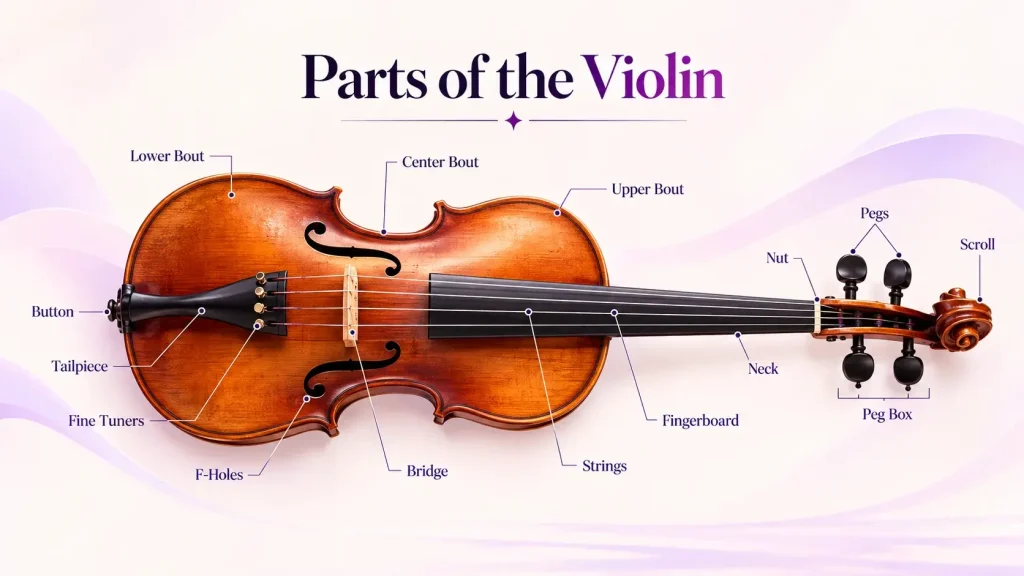
Understanding the parts of the violin instrument helps you care for the violin instrument and communicate better with your teacher. The violin instrument has three sections: the body, the neck and the head. Together these sections contain 80 components.
Main External Parts
Here are the main external parts of a violin you’ll interact with regularly:
- Scroll: The decorative spiral at the top of the violin’s head.
- Pegbox and Pegs: Four tuning pegs sit in the pegbox; turning them adjusts string tension for tuning.
- Nut: A small ridge at the top of the fingerboard that guides the strings.
- Neck: The long section you hold with your left hand; about 13 cm in length.
- Fingerboard: A smooth, black ebony strip running along the neck where you press the strings to change pitch.
- Body (Corpus): The hollow wooden box that amplifies sound, made of a top plate (belly), back plate, and ribs (sides).
- F-holes: Two f-shaped sound holes on the top plate that allow sound to project.
- Bridge: A small maple piece standing between the F-holes; it holds the strings above the body and transmits vibrations.
- Tailpiece: Anchors the strings at the bottom of the violin; often has fine tuners for precise adjustments.
- Chinrest and Shoulder Rest: Accessories that help you hold the violin comfortably and securely.
Internal Parts
Inside the violin, two crucial parts shape the sound:
- Soundpost: A spruce rod wedged between the top and back plates near the bridge. Often called the “soul” of the violin instrument it transfers vibrations. Affects tone quality.
- Bass Bar: A long strip of wood glued inside the top plate under the left foot of the bridge. It strengthens the top of the violin instrument. Helps transmit low‑frequency vibrations.
These internal parts are never seen by the player but are essential for the violin instrument’s sound production.
Types of Violin
Violins come in types and sizes to suit players of various ages, skill levels and musical styles.
By Size
Violins are sized in fractions with full‑size (4/4) being standard, for adults and older teens. Smaller sizes help children and smaller players reach notes comfortably:
- 4/4 (Full Size): Body length 35.5 cm; for adults and teens with arm length of 57 cm or more.
- 3/4, 1/2, 1/4, 1/8, 1/10, 1/16: Progressively smaller sizes for younger children. The 1/16 is the smallest type of violin commonly available.
By Style and Construction
- Acoustic Violin: The traditional hollow-body violin that projects sound naturally. Used in classical, folk, Carnatic, Hindustani, and many other genres.
- Electric Violin: A solid-body or semi-hollow violin with pickups that amplify the sound electronically. Ideal for stage performances, rock, fusion, and hindi film music arrangements.
- Silent Violin: A type of electric violin designed for quiet practice with headphones.
- Baroque Violin: A historical style with gut strings and a different bridge setup, used for period performances.
If you enjoy the violin’s role in melody and accompaniment, you might also like exploring vocals. Artium Academy offers structured online courses in Hindi film music, karaoke music, and western vocal music, all taught by certified teachers in 1:1 live classes.
How a Violin Works (Sound Production Basics)
Understanding how a violin produces sound can make practice more meaningful and enjoyable.
Step-by-Step: From Bow to Sound
1. Bow Hair Grips the String: The bow is strung with horsehair that is coated in rosin, a resin. When the learner draws the bow across a string the rosin creates friction that makes the string vibrate.
2. Strings Vibrate at Specific Pitches: Each of the four strings on the violin is tuned to a pitch (G3, D4, A4, E5). Pressing a string against the fingerboard shortens the vibrating length. Raises the pitch.
3. Bridge Transfers Vibrations: The vibrating strings move the bridge, which sits on the violins plate.
4. Body Amplifies the Sound: The hollow body acts as a resonator. Vibrations travel through the plate into the air inside the body and out through the F‑holes. The soundpost and bass bar help spread these vibrations evenly.
5. Tone Shaped by Wood and Setup: The type of wood (spruce top, maple back and ribs) varnish, bridge position and soundpost placement all influence the violins tone quality.
Practice Tips for Beginners
- Start with Open Strings: The learner should practice drawing the bow across each string (G, D, A E) to develop a clear steady tone.
- Use a Mirror: Check the bow angle and posture in a mirror to ensure the bow stays parallel to the bridge.
- Tune Regularly: Use a tuner or app to tune the violin before every practice session. This trains the ear. Makes practice more pleasant.
- Short, Focused Sessions: Fifteen to twenty minutes daily is better than one session per week. Consistency builds muscle memory.
- Explore Free Practice Tools: Artium Academy offers a range of free online music tools to support your practice between classes, including metronomes, tuners, and rhythm exercises that work well for violin learners.
Many beginners also explore other instruments alongside violin. Understanding the most popular musical instruments can help you see how violin fits into different genres and ensembles, and whether adding another instrument might enrich your musical journey.
Conclusion
The violin instrument has a history dating back to the sixteenth‑century Italy with a design refined over five hundred years. From its parts like the body, neck, fingerboard and bridge to its types and sizes the violin offers something for every learner. Whether the learner is drawn to ragas, Bollywood melodies or Western tunes the violin’s voice can carry the musical journey.
Many violinists find that learning to sing alongside their instrument deepens their musical understanding and expression. At Artium Academy, you can complement your violin practice with structured online music courses, all taught by certified teachers in 1:1 live classes.
Ready to start? Book your free 1:1 trial class with Artium Academy and learn from certified teachers at your own pace.
Frequently Asked Questions
A violin instrument is a four‑stringed bowed string instrument tuned in fifths (G, D, A E). It is the member of the violin family played with a horsehair bow or by plucking.
The violin emerged in Italy between 1520 and 1550 with the written reference, from 1523. Andrea Amati is often credited with creating the modern violins, around the mid‑1500s.
The best type of violin depends on your age, your size and your musical goals. Adults usually pick a full‑size (4/4) violin. Children usually pick sizes such as 3/4 or 1/2. Electric violins are suitable for performers who need amplification. A teacher can help you choose.
The smallest available size of violin is 1/16. It is designed for young children with short arm lengths.
The violin is challenging for beginners because it has no frets and requires intonation and bow control. However with practice and good guidance a student can progress steadily. Many people find the violin deeply rewarding
The violin is known for its singing tone and for its versatility across folk, Carnatic, Hindustani and contemporary genres. The violin often carries the melody in orchestras and ensembles.
The ten main parts of the violin are: the scroll, the pegs, the nut, the neck, the fingerboard, the body (back plates) , the F‑holes, the bridge, the tailpiece and the chinrest. Inside the violin the soundpost and the bass bar are also parts.
Other words for the violin are “fiddle” (in folk contexts) “violino” (Italian) and “Violine” (German).
The violin is held under the chin. Supported by a shoulder rest. The left hand presses the strings on the fingerboard to change the pitch. The right hand draws the bow across the strings. Plucks them (pizzicato).
Yes, the violin is good for your brain. Learning the violin engages brain areas. Improves memory, coordination, concentration and emotional expression. Studies show that musical training can enhance development in children and adults.