
All Topics
- Alchemizing Music Concepts for Students
- Anuv Jain Songs
- Artist Spotlight
- artium gift card
- Artium Maestros
- Artium News
- Artium Tech Blog
- Best Coke Studio Songs
- Best Female Singers
- Birthday songs
- Bollywood Love Songs
- buying guide
- Carnatic Music
- Child Singers
- Devotional Music
- Editorials by Ananth Vaidyanathan
- English Love Songs
- Festival
- Film Music
- Ghazal Music
- Guitar
- Hindustani Classical Music
- Indian Classical Music
- Indian Folk Music
- Insights
- Instagram Reels Viral Songs
- Instruments
- Karaoke
- Karaoke Singing
- Keyboard
- Kids Music
- maestros
- Music Education
- Music for Kids
- Music Games
- Music Industry
- Music Instruments
- Music Legends
- Music Press Release
- Music Technology
- Music Theory
- Music Therapy
- Music Tools
- Piano
- piano guide
- Songs
- South Devotional Music
- Success Stories
- Tamil Film Music
- Telugu Film Music
- Time Theory
- Tools
- Uncategorized
- Uncategorized
- Uncategorized
- Uncategorized
- Vocal Range
- Vocal Singing
- Vocals
- western classical music
- western music
- Western vocal music
Types of Flutes Explained: A Complete Guide to Flute Instruments
Types of Flutes Explained: A Complete Guide to Flute Instruments
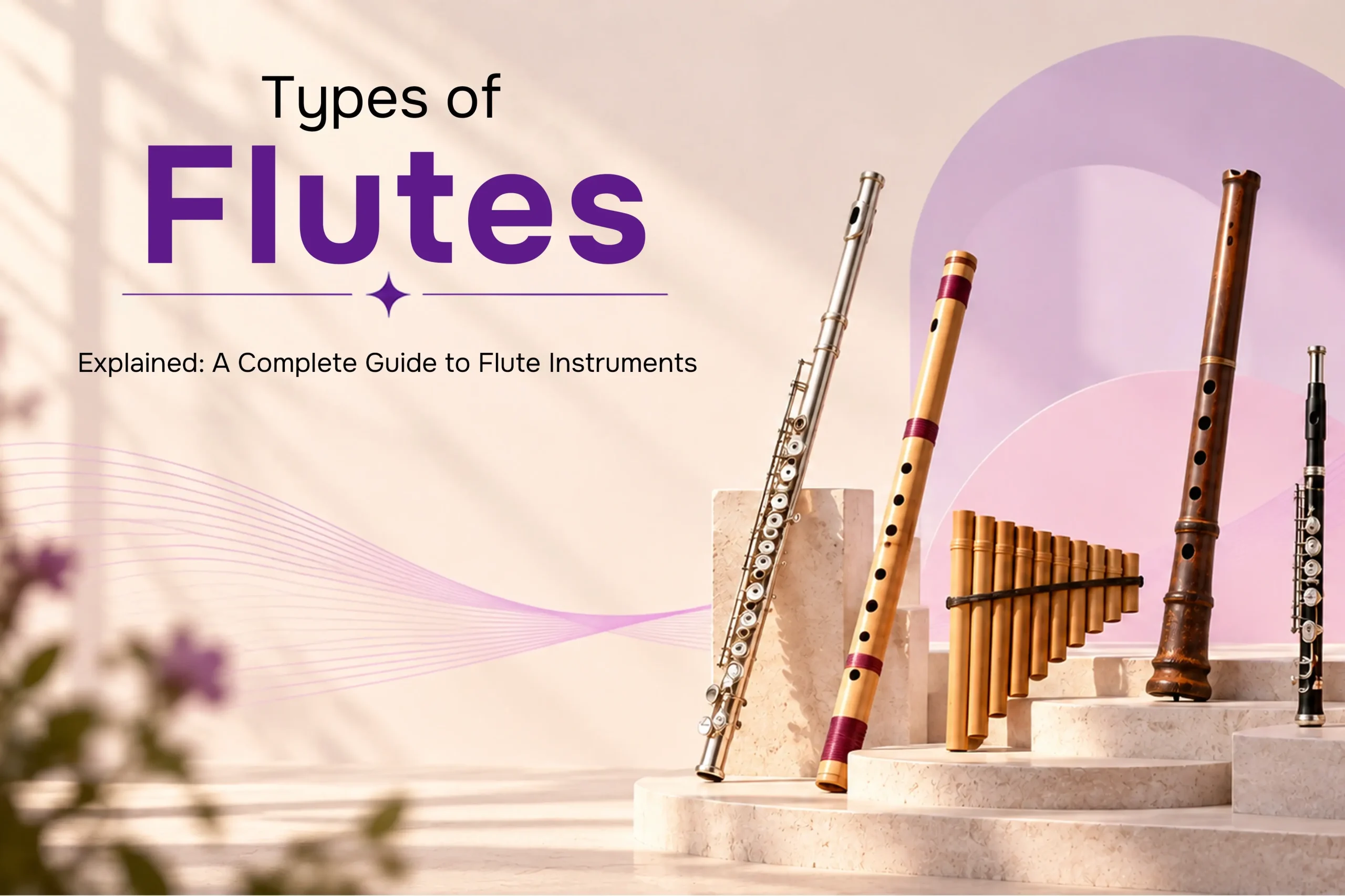
Table of Contents
Quick Summary
| Types of flute include the Western concert flute, piccolo, alto flute and bass flute; Indian flutes like the bansuri, venu and algoza; and flutes from other traditions such as the Japanese shakuhachi, pan flute, ocarina and Irish tin whistle. Flute instruments can vary widely in shape, construction, pitch and method of sound production: some are played from the side; some are blown from the end; and some use multiple pipes. These different kinds of flute illustrate how a single instrument family can produce a wide variety of different sounds. |
Introduction
Ever asked yourself how one flute can come across bright and soaring and another has a warm, airy or even meditative quality? The answer is to be found in the huge variety of flutes played all over the world. While air is integral to them all, the shapes, techniques and traditions are often totally distinct.
Some are played sideways (for example, the Western concert flute, or India’s bansuri); some are played end-wise (for example, the Japanese shakuhachi); some are a series of tubes (like the pan flute). From the bright, shrill notes of the piccolo to the deeply soulful sounds of the bansuri, each flute has its own unique character.
In this article, we’ll be looking at different types of flutes and their type of sound production, and how they are different-from all others that come from Western orchestras to Indian and world.
What Is a Flute? A Quick Overview
A flute is a musical instrument in the class of wind instruments that produces its sound when a musician blows air at or across an opening. It is not a reed instrument like the clarinet, which employs a reed to set the instrument in motion.
Flutes can be grouped by how you blow into them:
- Side-blown flutes: Air is blown across a hole into a tube being held horizontally. Examples are the Western concert flute and the bansuri.
- End-blown flutes: End-blown flutes are played with the instrument held vertically or tilted, making an opening at the end of the tube to receive the air. An example of an end-blown flute is the shakuhachi.
- Duct flutes: Duct flutes possess a mouthpiece that directs the air toward an edge. The common example of a duct flute is the tin whistle.
- Vessel flutes:Vessel flutes are low volume, closed vessels, rather than long thin tubes. An example is the ocarina.
This is why many flute instruments can be so different to other flutes, even though they are all based on an air column.
Quick Comparison of Different Types of Flute Instruments
This chart shows how the different types of flutes are categorized in the different genres of music by the styles and sounds of their play and make it easier to get an overview of their differences.
| Flute type | Tradition or region | How it is played | General sound |
| Concert flute | Western classical | Side-blown; usually has keys | Clear and flexible |
| Piccolo | Western classical | Side-blown; smaller than a concert flute | Bright and very high |
| Alto flute | Western classical | Side-blown; larger than a concert flute | Warm and mellow |
| Bass flute | Western classical | Side-blown; larger, lower-pitched instrument | Deep and airy |
| Bansuri | North Indian traditions | Side-blown; commonly bamboo and keyless | Warm and expressive |
| Venu | South Indian traditions | Side-blown; often associated with Carnatic music | Bright and agile |
| Murali | Indian regional traditions | Usually a simple flute; form varies by region | Folk or devotional in character |
| Algoza | Punjabi and Sindhi folk traditions | Two pipes played together | Rhythmic and lively |
| Shakuhachi | Japan | End-blown | Breath-rich and reflective |
| Pan flute | Andes and other traditions | Blown across a row of tubes | Airy and mellow |
| Ocarina | Found in traditions worldwide | Blown through a mouthpiece into a vessel | Soft and rounded |
| Tin whistle | Ireland and Celtic traditions | Duct or fipple mouthpiece | Clear and bright |
Each flute has its unique sound and tone quality, from the concert flute to the bansuri. The more kinds of flute instruments you get to try, the more you will be able to find the style of music that most appeals to you.
Different Types of Flutes: The Western Family
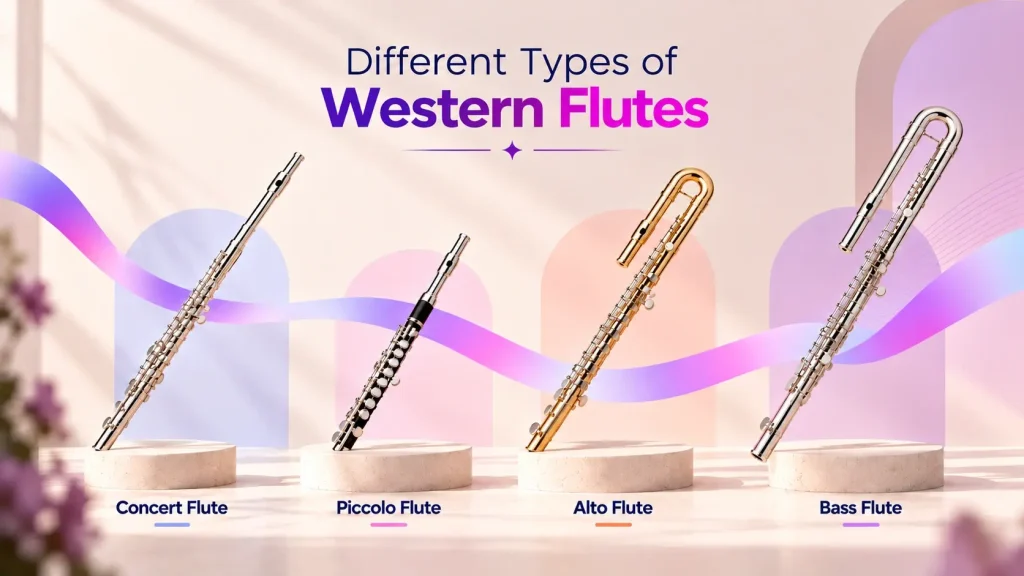
In the Western orchestral flute family, there are various sizes and registers. “Register” refers to the general range of a note that is produced, typically in high, middle, and low registers.
1. Concert Flute
This is the normal Western orchestral flute. It is played horizontally and usually made of metal, with keys that assist a performer to cover tone holes and alter the pitch. The tone can be bright and transparent in a high register, or soft and rounded in a lower one.
2. Piccolo
The piccolo is a small, high version of the concert flute. It can shine clearly over the orchestra, so is often used to provide a twinkly sound in a bright passage. The small size of the instrument does not mean it is automatically easier to play: good breath and pitch control require practice.
3. Alto Flute
The alto flute is bigger and deeper in tone than the concert flute. Its sonorous tone can be integrated with other instruments, or it can provide a serene melodic line. Due to its size, it might require a player to reposition and control their breath.
4. Bass Flute
The bass flute, bigger and lower in pitch, has a much deeper tone and, when played softly, an ‘airy’ sound. It can add to the flute choir. These Western types of flute all involve the side-blown hole, but their size determines their sound and feel.
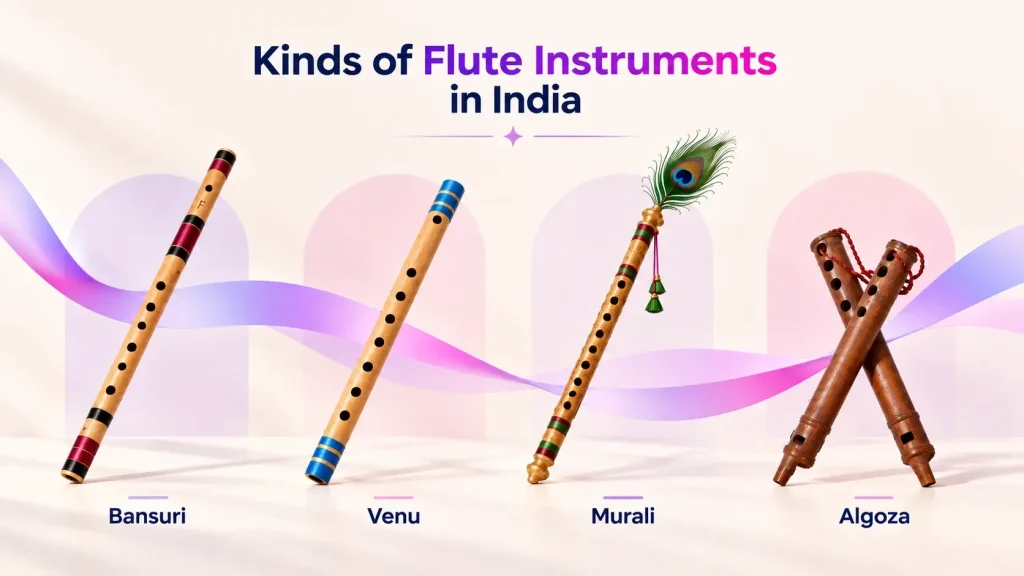
Kinds of Flute Instruments in India
There are also different regional styles and specific types of flute in Indian traditions. Names are often overlapping: one word that is used for a flute in one place or by one group, may be a more general word used elsewhere. The following distinctions are helpful guidelines rather than hard and fast rules.
1. Bansuri
The bansuri is a side-blown bamboo flute, typically used in Hindustani classical music and North Indian folk traditions. It usually has no keys and the notes are produced by the player adjusting the amount of air, finger holes and airflow. Longer flutes tend to produce a lower pitch.
Explore Bansuri as a traditional indian musical instrument to learn more about its place in Indian music.
2. Venu
Venu is a name for the South Indian flute used in Carnatic music. Venu usually refers to the bamboo transverse flute; other types of venu and playing techniques exist.
Nine notes are used, and some instruments have 8 finger holes (although this can be highly variable in both instrument design and playing). Because of the unusual melodic movements in Carnatic music, the instrument’s expressive possibilities are highly specific to the style and tradition.
3. Murali
Murali is a flute instrument type found in Indian musical and cultural contexts and has different significance in different places and references. Sometimes it is used for a flute in general and sometimes for specific types, depending on your source and location. If you find the name, be sure to look up the region and genre of music.
4. Algoza
The algoza is a folk instrument of Punjabi and Sindhi origin. It is a double flute played by the pan, who blows into both pipes simultaneously; one pipe provides a drone, the other a melody. Requires a rhythmic blowing of both pipes at once requires some mastery, and results in the lively its characteristic sound.
If you’re learning the bansuri, exploring Hindustani music can help you understand the musical tradition behind it. And if you enjoy devotional songs, you can also learn hindi devotional music online alongside your musical interests.
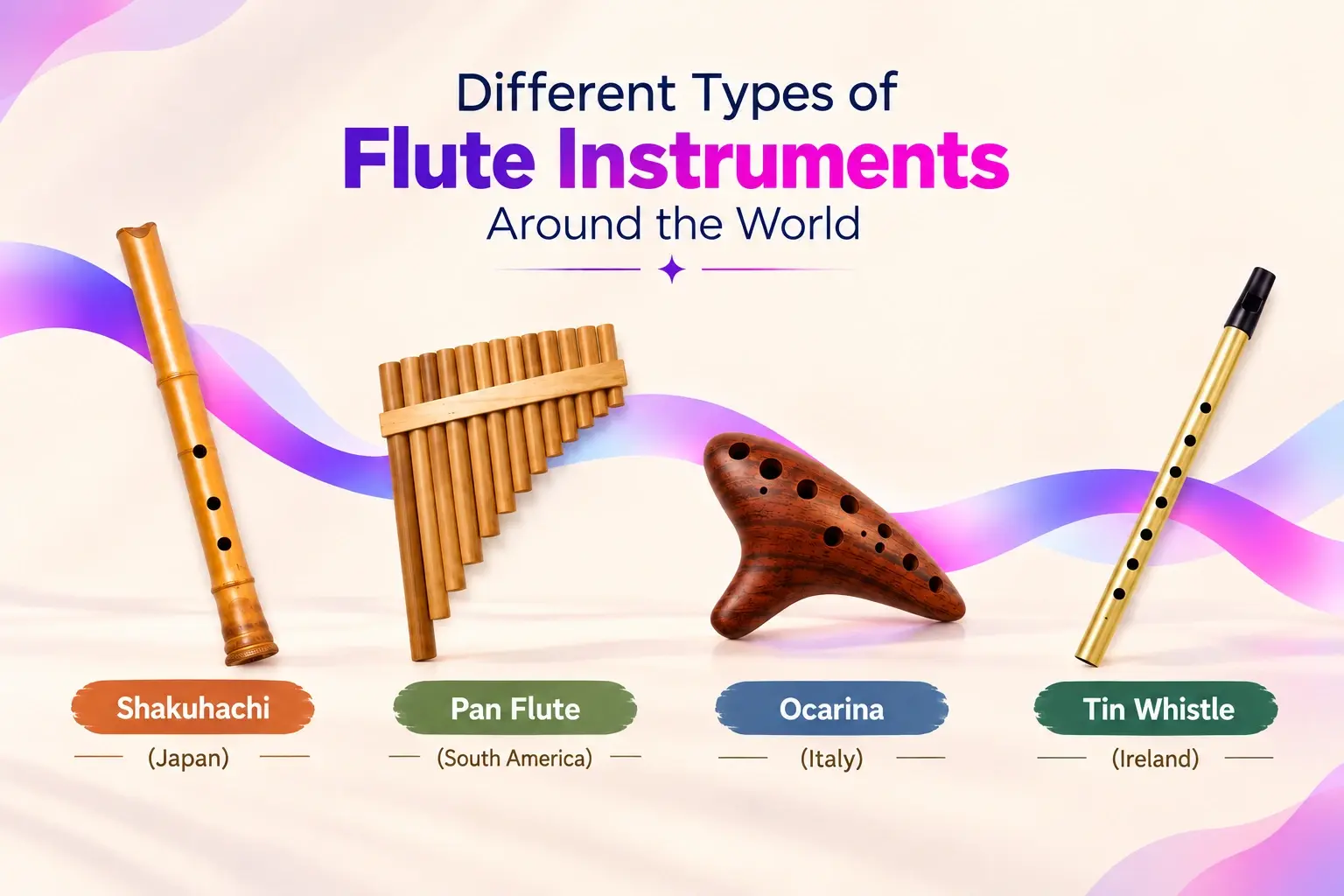
Different Types of Flute Instrument From Around the World
1. Shakuhachi (Japan)
The shakuhachi is a Japanese flute instrument type played by blowing across a mouth opening at the top end of the flute. The fingering and variations of airflow and blowing angle on the shakuhachi can alter the sound and is noted for expressive intonation and a breathy voice tone on traditional material.
2. Pan Flute (Andes, Romania, and Globally)
A pan flute or panpipes (in some traditions) is a flute instrument type made of multiple pipes of gradually increasing length. Each pipe produces a different note when blowing over the open end of each pipe. Panpipes are found in different musical traditions, and not all varieties are built in the same way or use the same music.
3. Ocarina
The ocarina is a flute instrument type, a globular or vessel-shaped flute with a mouthpiece and finger holes. It is not a tube, but a vessel, and thus the air in the instrument’s body vibrates. Ocarinas come in various shapes and tunings and are part of musical traditions throughout the globe.
4. Tin Whistle (Ireland and Celtic Tradition)
The tin whistle is a small flute instrument type, usually made of metal or plastic. Its mouthpiece directs the air, so playing it feels different from playing a concert flute or bansuri. It is closely associated with Irish and other Celtic music, where its bright sound is heard in performances and informal sessions.
Key Differences Between Flute Types (Material, Sound, Technique)
As you compare different types of flute instrument, these concrete distinctions should be taken into account:
- Material: You will find flutes of bamboo, metal, wood, plastic, and many other combinations. Material will influence the tone of the instrument; tone can also be affected by how the flute is played and put together.
- Shape and size: Shorter instruments like the piccolo have a higher pitch range than the much larger bass flute. Multiple tubes used in a pan flute, and an ocarina has a closed body.
- Finger holes and keys: he western concert flute generally has a system of keys. A standard bansuri will usually have no keywork, with the performer opening their fingers directly over the holes.
- Playing position: End blown flutes are played from either the mouth or end of the instrument; side blown instruments are held across the body. Mouthpiece: Mouthpieces direct the air down the duct flute.
- Musical role: A piccolo may add high, bright notes in an orchestra; a bansuri may carry a melody shaped around a raga; an algoza can combine tune and drone in folk music.
These characteristics influence how the instrument plays, but it’s not just one of them that will make it right or wrong for any given student.
How Flutes Produce Sound (Side-Blown vs End-Blown)
Different types of flutes produce sound by directing air against an edge, but the player’s technique varies. For example, sound is created when air flows across an opening and causes the air in the tube to vibrate in side-blown wind instruments like the concert flute and bansuri. The player modulates the pitch by covering finger holes and controlling their breath.
And an end-blown flute like the shakuhachi, where you blow across an opening at the end. A tin whistle is a duct flute where the mouthpiece directs the air down a channel towards a mouth edge. With a pan flute, the player blows across the open end of each tube. These different types of flute instrument show how shape and airflow give each flute type its own playing style.
How to Choose the Right Flute Type to Learn
No one size fits all flutes. If you are considering a flute for you or a child, consider:
- The music you want to play. A beginner interested in Hindustani classical music may be curious about a bansuri; a novice wanting to learn Irish folk might consider a tin whistle.
- How the instrument is held and played. Consider whether you prefer a side-blown flute, a vertical instrument or one with a mouthpiece that guides the air.
- Access to suitable teaching. Technique differs between instruments, so a teacher experienced on that instrument and style can be beneficial.
- The practical setup. Instrument size, availability, maintenance and where you can practice all come into play.
- Your own interest. AA rhythm or sonic pathway that really grabs you can make practicing feel more enjoyable.
Currently, Artium Academy doesn’t offer flute classes, but you can explore our other online music courses and free music tools. If you’d like to begin learning another instrument or develop your vocals, our live 1:1 classes with certified teachers offer a supportive place to start.
Tips for Beginners Starting Out on Any Flute Type
- Start with a comfortable posture. Relax your shoulders and do not squeeze the instrument.
- Practise a steady breath. Try a gentle puff. A gentle puff of air is more effective than blowing as hard as possible.
- Work on one sound at a time. Practice each sound separately. Practice making one note at a time, before trying the whole tune.
- Learn the instrument’s fingerings gradually. Begin with a few notes, and gradually add other notes, making sure your fingers reach the holes cleanly or press down on the keys properly.
- Use short, regular practice sessions. Short, frequent practice sessions are best. It might be easier to find just a few minutes than a half hour at a time.
- Listen closely. Note the sound of the instrument in the style you’re going to be learning. Attempt to copy the rhythm and tone with just a simple phrase.
- Seek instrument-specific guidance. Spit out the small mouthpiece or end plug when you are done playing. Seek instrument-specific advice.
Conclusion
Have you considered how your flute can be used for your next musical journey? Instruments such as the concert flute, piccolo, bansuri, venu, shakuhachi and pan flute all have different shapes, sounds and ways of playing.
We do not currently teach flute, but you can explore our other online music courses and free music tools. Ready to start your music-learning journey while enjoying your flute practice? Book a free 1:1 trial class with Artium Academy and learn from a certified teacher at your own pace.
Frequently Asked Questions
Most frequently mentioned varieties are Western concert flute, piccolo, alto flute, and bass flute; bansuri and venu in India; shakuhachi in Japan; pan flute; ocarina, tin whistle; and a number of other regional varieties.
Other well-known names include: concert flute, piccolo, alto flute, bass flute, bansuri, venu, murali, algoza, shakuhachi, pan flute, ocarina, and tin whistle.
A bansuri is a bamboo side-blown flute with six or more finger holes used in Hindustani classical music. It is fingered without keywork (keyless), unlike the Western concert flute which usually employs keywork to cover its tone holes and change notes.
It relies on what music you intend to play, what instrument you have access to and what guidance you can seek. It is best to select based on personal interest and practicality, not because one flute is inherently easier for everyone.
No. Some are blown from the side, some from the end, and there are duct flutes with a mouthpiece to direct your breath. Fingerings, breath control and position of the flute also vary.
The flutes can be made of bamboo, metal, plastic, or wood. Flutes are sometimes constructed of a number of tubes, as in the pan flute, while an ocarina features a body that is in the shape of a hollow vessel.
It’s not that one is objectively more difficult than the other. The fact that the instruments are played in different locations, use different fingering systems and produce sound in different ways means that it comes down to the individual learner and the music they wish to play.
Bansuri is primarily linked with Hindustani classical music while there are many venu players who are famous in Carnatic music.
Yes but you will still need to learn some new skills. Your listening experience and breath awareness may be advantageous but you will also need to adapt to the posture, fingerings and sound technique of the new instrument.
There is not a single number for all traditional flutes. Some bansuri are six or seven finger-hole instruments, and most venu designs have eight. Different instruments and traditions have different standards.