
All Topics
- Alchemizing Music Concepts for Students
- Anuv Jain Songs
- Artist Spotlight
- artium gift card
- Artium Maestros
- Artium News
- Artium Tech Blog
- Best Coke Studio Songs
- Best Female Singers
- Birthday songs
- Bollywood Love Songs
- buying guide
- Carnatic Music
- Child Singers
- Devotional Music
- Editorials by Ananth Vaidyanathan
- English Love Songs
- Festival
- Film Music
- Ghazal Music
- Guitar
- Hindustani Classical Music
- Indian Classical Music
- Indian Folk Music
- Insights
- Instagram Reels Viral Songs
- Instruments
- Karaoke
- Karaoke Singing
- Keyboard
- Kids Music
- maestros
- Music Education
- Music for Kids
- Music Games
- Music Industry
- Music Instruments
- Music Legends
- Music Press Release
- Music Technology
- Music Theory
- Music Therapy
- Music Tools
- Piano
- piano guide
- Songs
- South Devotional Music
- Success Stories
- Tamil Film Music
- Telugu Film Music
- Time Theory
- Tools
- Uncategorized
- Uncategorized
- Uncategorized
- Uncategorized
- Vocal Range
- Vocal Singing
- Vocals
- western classical music
- western music
- Western vocal music
Banjo Instrument Explained: History, Types, and How It Works
Banjo Instrument Explained: History, Types, and How It Works
Table of Contents
Quick Summary
| A banjo is a plucked stringed instrument with a round body with a drum-like body and a long neck, usually with a bright, resonant timbre. The standard banjo has four, five, and six strings and produces a distinctive staccato sound; the instrument is plucked or strummed. The banjo, which dates back from Africa, was developed in the Americas and is predominantly found in bluegrass, traditional Irish, folk, country, old-time, and jazz music. |
Introduction
Have you been wondering what that bright, lively sound in bluegrass music or old-time folk music is? It’s probably the banjo!
If you are someone who’s ever wondered “What is a banjo musical instrument?” while tapping along to a catchy tune, then this is the place for you.
No matter if you are just interested in exploring what this awesome stringed instrument is all about, a parent considering a musical instrument for a kid, or if you’re just a hobbyist looking to learn about something new, I am going to take you through all the information you need to know about this instrument in a friendly, human way.
As Artium Academy we see the feeling of learning music is very approachable, nurturing and truly understanding.
What Is a Banjo Musical Instrument?
The banjo musical instrument is a stringed instrument with a round body similar to a drum and a long fretted neck. The strings are stretched over a bridge held on a stretched membrane (the head) in the body and run to the tailpiece.
As you pluck or strum the strings, they vibrate and the vibration travels through the bridge to the head, which also amplifies the sound creating the bright ringing tone of the banjo.
Most banjos have 4, 5 or 6 strings. While you’ll find all three types of banjo in various genres, the 5-string banjo, with its “drone string” which creates a characteristic buzzing tone, is undoubtedly the most popular banjo type in American folk and bluegrass music.
If you’re aware of some guitar or ukulele, you’ll see the banjo is slightly different-but isn’t the idea of trying to fret to change notes exactly the same? That’s why it’s a perfect beginner’s choice when it comes to Western stringed instruments. Interested in other options? You may also love reading about the range of popular musical instruments that beginners may also be able to learn.
History and Origin of the Banjo
The history of the banjo instrument is interesting and goes far deeper than most people can imagine.
The Banjo’s African Origin
The banjo didn’t originate in America. Its antecedents are from West Africa. Instruments such as the akonting (played by the Jola people of Gambia), the ngoni, and the xalam-all of which are lute-like instruments with gourds for bodies and skins for heads-very much like the banjo.
In the transatlantic slave trade, the bringing of enslaved Africans to the Caribbean and the American South, these (or knowledge of how to build them) were brought there. They modified the designs with available materials and produced early Banajas. The banjos are also known as the” banza”.
For over a century, banjo was mainly a black American tradition, heavily linked to black music. Only at a later time it was associated with white Appalachian musicians, bluegrass music.
Evolution in American Folk and Bluegrass Music
In the 1800s, the banjo was introduced throughout America. During the 1830s, minstrel acts (including Joel Walker Sweeney of Virginia) played the instrument-much to the detriment of ‘race relations’.
The 5-string banjo with its short drone string (although sometimes shorter versions are used) became the norm for folk and now bluegrass music. In the early/mid 20th century, banjoists such as Earl Scruggs popularized a style of fast, rolling fingerpicking that is now known as bluegrass banjo.
The banjo is now heard throughout all musical styles-from traditional country and folk to indie rock and even pop (if you’re into Beyonce!) I mean, you probably heard it on some Beyonce songs, right?
Types of Banjo Music Instruments
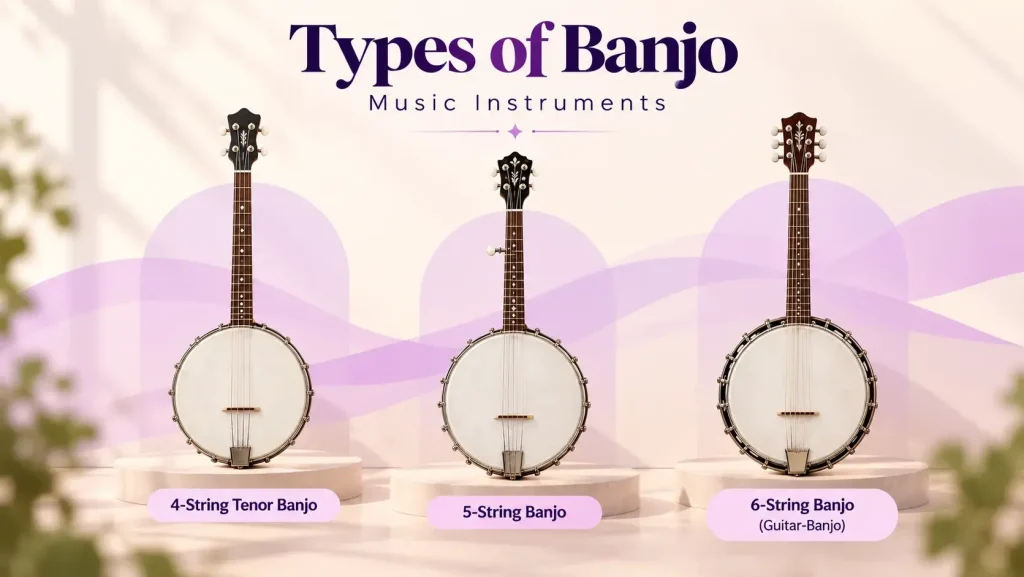
Not all banjos are created equal. The number of strings, tuning, and style of playing are going to be different depending on the genre you want to play and your skill level. These are the 3 most popular types you’ll come across:
1. 4-String Tenor Banjo
The 4-string tenor banjo is tuned in fifths, like a viola (C-G-D-A). It is common in traditional jazz (sometimes called “Dixieland”) and Irish folk music.
Easier to Play Than the 5-String. Due to it having less strings and a shorter neck it can make it easier for beginners to learn on. Generally played with a plectrum (pick) it makes for a punchy crisp sound that lends itself nicely to melody.
2. 5-String Banjo
This is the type of banjo that everyone always imagines – it features four regular length strings and one shorter drone string that starts at the fifth fret.
The 5-string banjo is the weapon of choice for bluegrass, old time folk, and country. It’s popular with fingerpicks (rolls for Scruggs style) or flatpickers. The drone string makes the banjo famous for that driving rhythm.
If you are thinking about taking up a string instrument and you are interested in a distinctive sound then the 5 string banjo is an excellent option for you.
3. 6-String Banjo (Guitar-Banjo)
A 6 string banjo is also known as a “banjitar” or a “guitjo,” the 6-string banjo is tuned exactly like a guitar (E-A-D-G-B-E).
However this gives it a wonderful sound, especially if you’re a guitar player who would love the brighter tone of the banjo but don’t want to bother with all new shapes to play the instrument. This is an instrument you would find in country, folk and even rock music. Not quite as traditional as a 5-string but also handy for a guitar player to take up.
If you develop an interest in learning western vocals alongside your banjo journey, you can explore Artium Academy’s online western music course, designed for beginners who want structured guidance in singing, music theory, and performance.
American Banjo vs Indian Banjo
If the words “Indian banjo” have sparked your curiosity, you might have read that it sounds like the American banjo that we’ve been talking about. To be honest, they’re really very different things.
| Feature | American Banjo | Indian Banjo |
| What it is | The classic round-bodied, drum-like string instrument with 4–6 strings | Often refers to the Bulbul Tarang, a keyboard-zither instrument; sometimes used for other fretted string instruments in Indian folk music |
| Origin | Evolved from West African lute instruments brought to the Americas by enslaved Africans | Evolved from the Japanese taishōgoto, arrived in India in the 1930s; also used for various Indian folk string instruments |
| Body Shape | Round, drum-like head with a resonator or open back | Rectangular wooden box with typewriter-style keys; or smaller fretted string instruments |
| Strings | 4, 5, or 6 steel strings | Typically 14 strings (2 melody/bass, 4 jhala/rhythm, 8 swarmandal/drone) on Bulbul Tarang |
| Playing Technique | Fingerpicking, clawhammer, or flatpick | Press keys with left hand while plucking strings with right hand using a plectrum |
| Sound | Bright, twangy, percussive | Bright, cutting, often electrified with a distorted guitar-like tone |
| Musical Genres | Bluegrass, folk, country, jazz, Irish music | Bhajans, qawwali, ghazal, Bollywood, Punjabi folk, festive celebrations |
| Cultural Context | Strongly associated with American folk and bluegrass traditions | Found in Indian devotional, folk, and film music; popular at outdoor celebrations |
| Learning Curve | Moderate (requires fingerpicking or flatpicking technique) | Moderate (requires coordinating keys and plucking) |
Another instrument which has sometimes been termed an “Indian banjo” is the bulbul tarang. This is another different, keyboard operated, zither-type instrument, completely different from the American banjo.
This makes it relevant to finding banjo instrument information, as the same name can give two quite different instruments in different musical genres.
Parts and Structure of the Banjo
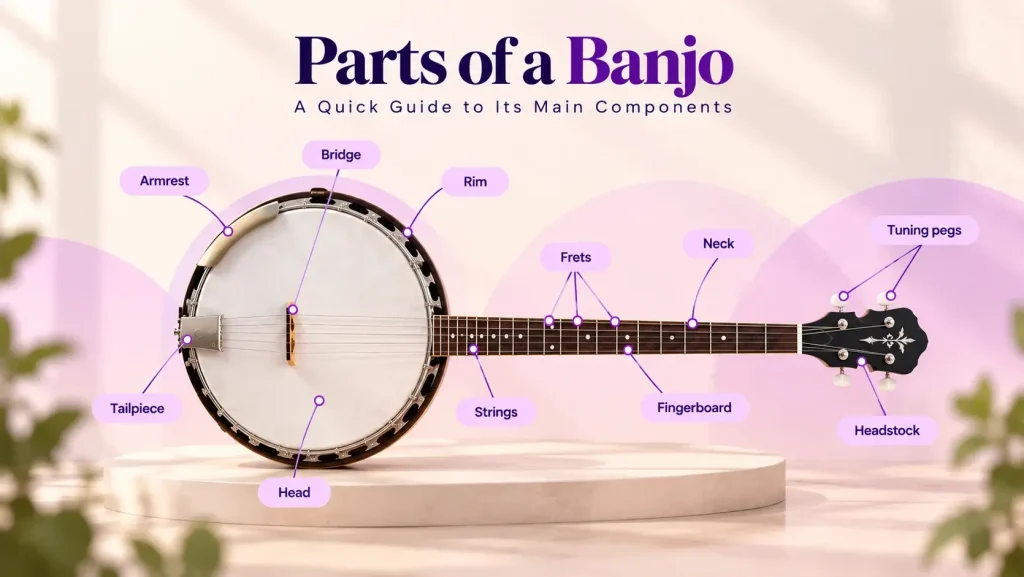
Knowing the components of a banjo will help you speak with confidence and will help you learn easier. Now for a quick guide to the basic parts:
- Neck: The long piece of wood with fret lines on it, onto which you press the strings to make different notes.
- Head: The sounding surface which vibrates to produce sound (also known as the “drum head,” usually made of plastic or skin).
- Body (Pot): The rim and frame that secure the head.
- Bridge: Small wooden block that sits on the head holding the strings up, transferring their vibrations.
- Strings: 4, 5 or 6 steel strings, 5-string banjo: one is shorter (drone string).
- Tuning Pegs (MACHINE Heads): Located at the head of the neck to tighten or loosen strings to tune the instrument.
- Tailpiece: It is used to secure strings on the bottom of the banjo.
- Resonator (optional): a wood back that projects sound outside the instrument making it louder (common in bluegrass).
Understanding these components can be useful when shopping for a banjo, diagnosing a poor sound, or just chatting with friends about the instrument.
How the Banjo Produces Sound
When you pick a banjo string, it resonates. This resonance moves through the bridge and makes the head (the drum part)vibrate like a snare drum; the body amplifies the sound, and if your banjo has a resonator, it reflects the sound to the audience.
The button explains why the banjo sounds so much different from a guitar-even if they’re playing the same notes. The plastic head, which is drum-like, gives it more brightness, sustain and that twang.
How the Banjo Is Played
There’s no denying the banjo can seem pretty intimidating at first, all those strings constantly moving, that rolling sound-it’s all pretty complex but, once you understand a few basic formations, it’s all just repeating.
Fundamental Hand Positions
● Fretting Hand (Left Hand for Right-Handed Players): Push the strings down against the frets on the neck of the guitar to change notes. When playing, use your fingertips and try to keep them close to the frets for clarity.
● Plucking Hand (The right hand if you are right-handed): This is the best part. Depending on your playing style, you can pluck with fingerpicks, a flatpick, or bare fingers.
Common Playing Styles
1. Bluegrass Style Fingerpicking
This is the most famous banjo sound. With metal or plastic picks on your thumb, index, and middle fingers, you play lots of rapid fire rolls across the strings. That short fifth string provides a drone, and that “bum-ditty” sound you hear so often is what you get with the forward roll, backward roll, or alternating thumb roll.
2. Clawhammer (Old-Time Style)
A strumming, percussive technique that involves plucking the strings with the back of the fingernails, while using the thumb for bass notes. It produces a foot-tapping, earthy feel often heard in old-time Appalachian music.
3. Flatpicking
With a single flat pick (like a guitar player’s pick), you strum or pick out individual notes. It’s especially good for folk, Irish tunes, and melodies that require a bright, clear sound.
4. Strumming
Beginners usually begin here-thumping out the chords to a song on the strum of the beat. Nothing makes you feel like a real guitar player faster than just playing along with a song.
5. Tuning Basics
The most common tuning for 5-string banjo is G tuning, in which open strings form a G major chord: g-D-G-B-D. The short 5th string is the highest (closest to the ceiling). Other common tunings are: open double C tuning g-C-G-C-D and sawmill g-D-G-C-D.
Banjo vs Guitar vs Ukulele: Key Differences
Stuck choosing instruments? Here’s a quick, beginner-friendly comparison to help you choose which feels right for your style. Whether you’re asking yourself, “What is the banjo? Or, comparing the Ukulele vs Guitar.
| Feature | Banjo | Guitar | Ukulele |
| Body Shape | Round, drum-like head | Hollow or solid wooden body | Small, guitar-shaped body |
| Strings | 4, 5, or 6 (steel) | 6 (steel or nylon) | 4 (nylon) |
| Sound | Bright, twangy, percussive | Warm, full, versatile | Soft, mellow, gentle |
| Tuning | Varies by type (5-string: open G) | Standard E-A-D-G-B-E | G-C-E-A |
| Best For | Bluegrass, folk, country | Almost any genre | Pop, folk, beginner-friendly strumming |
| Learning Curve | Moderate (unique technique) | Moderate (chords + fingerpicking) | Easier (smaller, fewer strings) |
Playing guitar already? The 6-string banjo will seem pretty familiar. Never played a stringed instrument before? The ukulele is often the softest introduction but the banjo has such a happy sound, it’s impossible to resist.
How to Start Learning the Banjo
Up for trying this? Here is the quick and easy way to take a shot at it:
● Pick the Right Banjo: A 5-string open-back banjo is the ideal beginner instrument for folk or bluegrass music. They are cheaper, lighter and more comfortable than a resonator banjo.
● Learn Your Basic Chords and Strumming: Begin by using simple chords such as G, C and D. Practice your strum pattern at a slow pace until you can get a clean sound and even beat.
● Know the tuning: The traditional 5-string banjo tuning is open G, g-D-G-B-D. Use a digital tuner to keep your strings in tune, this makes the lessons so much easier.
● Practice Fingerpicking or Flatpicking: If this applies to you, learn some fundamental bluegrass fingerpicking rolls, or some old-timey-style flatpicking patterns. Begin slowly and get faster as you go.
● Play Along with Songs: Play simple songs you like. Play along to them. It builds your sense of timing and helps your ear get used to your instrument.
● Seek Help from a Teacher: A teacher can help correct your posture, hand position, and technique early on to build good habits and fast-track your progress.
● Consistent Practice: Just 15-20 minutes a day. The minimum effective dose is even less.
Famous Banjo Players and Genres That Use It
Some remarkable musicians in various genres play the banjo:
● Earl Scruggs: Changed the face of banjo playing forever with his pioneering three-finger style.
● Bla Fleck: A musician with a virtuoso style who spins bluegrass into jazz, classical, and world music.
● Rhiannon Giddens: The new face of the banjo, a new music with a modernist edge, folk blues and Americana.
● Pete Seeger: 20th-century folk and protest singer-songwriter, also used the banjo.
● Mumford & Sons, The Lumineers: Modern bands that popularized the banjo sound in indie folk and pop.
Related genres containing the banjo are:
● Bluegrass
● Old-time folk
● Country
● Traditional jazz (Dixieland)
● Irish folk
● Indie folk and alternative rock
Conclusion
Still wondering where that twangy, happy sound came from? Well, now you know. The banjo instrument is not only an American musical tradition, but it is also an African-based instrument with a unique history, and it uses a happy, bright tone that can be adapted to many different musical genres.
It doesn’t matter if you’re after the traditional twang of a 5-string, the jazz bite of a 4-string, or the guitar-friendly tuning of a 6-string, there’s a banjo for you. The good news? You don’t have to be a genius to get started. With some patience, plenty of practice, and an expert teacher, anyone can do it!
And here’s the good part, if someday you develop a fondness for music-learning to sing Western vocals, music theory or pick up another instrument-during the duration of your banjo-having both majors is not an either/or situation. We at Artium Academy have helped thousands of new learners of all ages-to find their musical voice through certified teachers, 1:1 live classes, and a GRMP-recognized curriculum that meets you where you are.
Let’s get started! Book your free 1:1 trial class at Artium Academy and enjoy learning from experienced teachers.
Frequently Asked Questions
The banjo can be heard in genres including bluegrass, folk, country, traditional jazz and indie rock. It brings rhythm, melody, and that otherworldly twang.
The banjo musical instrument has a circular, drum-shaped head that produces sound in a different way than the wood of a guitar. It generally has 4 to 6 strings (guitar has 6), and the 5-string banjo includes a drone string that does not exist on guitars.
There are three major types: 4-string tenor banjo (used in jazz, Irish and other folk music), 5-string banjo (bluegrass and other folk music), and 6-string banjitar or banjo guitar (standard guitar tuning).
West African lute instruments such as the akonting, ngoni and xalam were the antecedents of the banjo. The slave trade brought such lute instruments to the Caribbean and America south, where the banjo was developed.
The banjo has a moderate learning curve. Students learning the 5-string will need to acquire new fingerpicking methods, but with guidance and consistent practice, they will begin to play simple songs after a few weeks.
Most standard banjos are 5-string (typically what you think of when you think of a banjo, like old time or bluegrass style) but you will also see 4-string and 6-string.
Banjo music is found in bluegrass, old-time folk, country, traditional jazz (i.e. Dixieland), Irish folk, and indie folk/alternative rock.
The banjo consists of a rim of wood or metal, a stretched membrane (head) (plastic or animal skin), a wooden neck with frets, steel strings, a bridge, tuning pegs and a resonator (wooden).
Yes! If you already play guitar, you can play 6-string banjo (banjitar) in the same tuning as your guitar, which means you can learn guitar chords. You’ll need to learn some new tunings and techniques for a 5-string banjo, but guitar experience will give you a head start.
Notable banjo players are Earl Scruggs (creator of contemporary bluegrass banjo), Bla Fleck (virtuoso in several genres), Rhiannon Giddens (traditional folk, Afro-Americana), Pete Seeger (folk and protest music), and blues and rock bands such as the Mumford & Sons.