
All Topics
- Alchemizing Music Concepts for Students
- Anuv Jain Songs
- Artist Spotlight
- artium gift card
- Artium Maestros
- Artium News
- Artium Tech Blog
- Best Coke Studio Songs
- Best Female Singers
- Birthday songs
- Bollywood Love Songs
- buying guide
- Carnatic Music
- Child Singers
- Devotional Music
- Editorials by Ananth Vaidyanathan
- English Love Songs
- Festival
- Film Music
- Ghazal Music
- Guitar
- Hindustani Classical Music
- Indian Classical Music
- Indian Folk Music
- Insights
- Instagram Reels Viral Songs
- Instruments
- Karaoke
- Karaoke Singing
- Keyboard
- Kids Music
- maestros
- Music Education
- Music for Kids
- Music Games
- Music Industry
- Music Instruments
- Music Legends
- Music Press Release
- Music Technology
- Music Theory
- Music Therapy
- Music Tools
- Piano
- piano guide
- Songs
- South Devotional Music
- Success Stories
- Tamil Film Music
- Telugu Film Music
- Time Theory
- Tools
- Uncategorized
- Uncategorized
- Uncategorized
- Uncategorized
- Vocal Range
- Vocal Singing
- Vocals
- western classical music
- western music
- Western vocal music
Mridangam Instrument Explained: History, Sound, and How to Play
Mridangam Instrument Explained: History, Sound, and How to Play
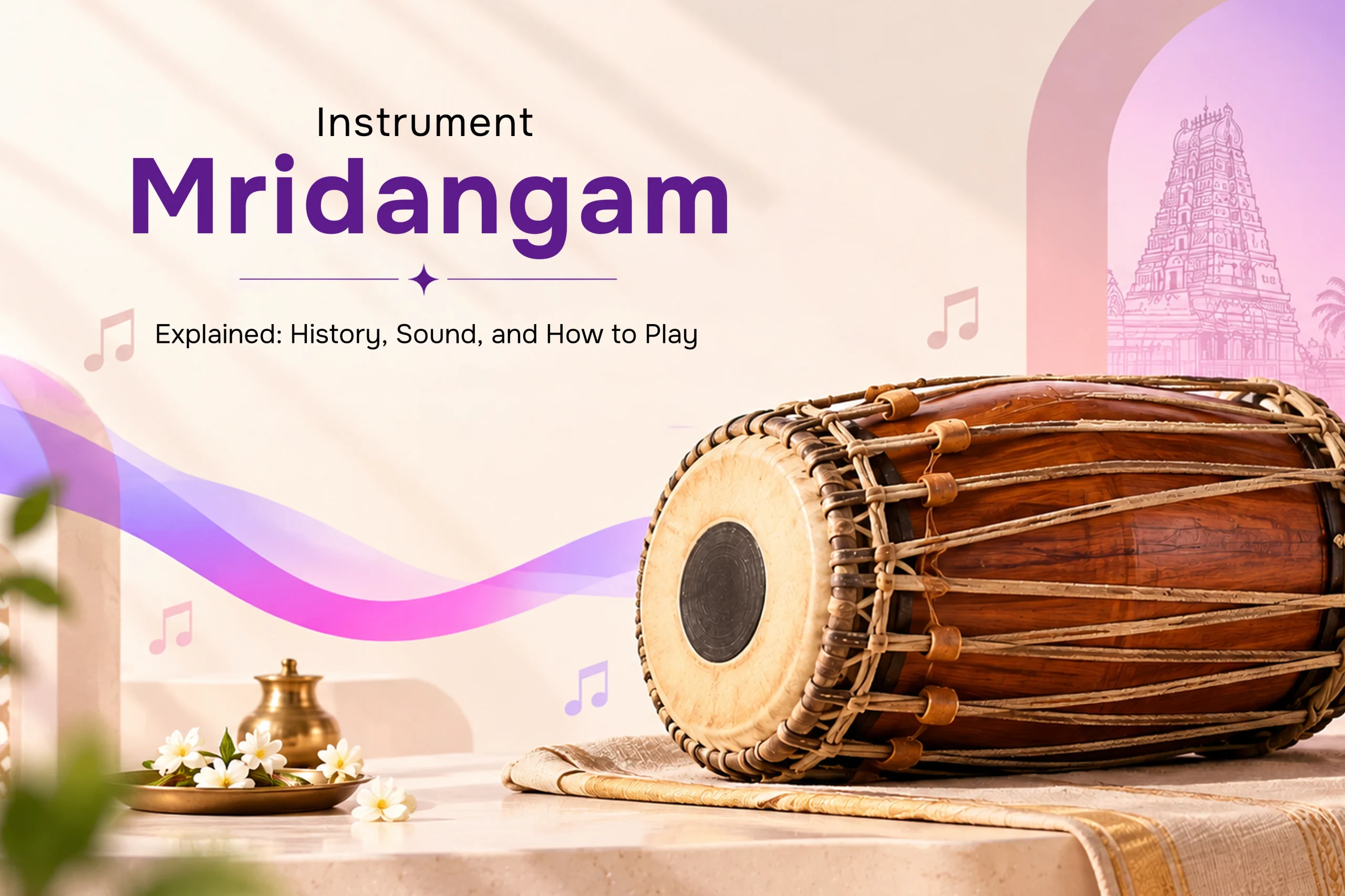
Table of Contents
Quick Summary
| The mridangam musical instrument is a double-headed, barrel-shaped musical instrument originating from South India. It is held horizontally and played with both hands. The mridangam is an integral part of Carnatic music, which is played in the northern and the southern parts of India: one side provides a resonant bass sound while the other produces a bright, sharp sound. Over thousands of years, the instrument has undergone various design changes in terms of the types of wood used, the type of leather straps used to hold the instrument and the types of instrument heads used. The four fundamental sounds played by the mridangam, tha, dhi, thom and nam, correspond to a variety of rhythms called bols. It differs from the tabla in its shape, sound and instrumentation, and is used in Carnatic music concerts and classical dance. |
Introduction
You may have encountered the mridangam instrument before if you listen to Carnatic music, a slow, warm, rhythmic thumping that underpins the vocals or violin. It’s not the accompaniment; the instrument interacts with the singer, reacts to improvisation, and provides the feeling of movement in the performance.
To most students, the mridangam is initially somewhat enigmatic. It has strange terminology, two types of drum-head, and syllables that sound odd-like tha, dhi, thom and nam. However, with a simple explanation of its components and fundamental strokes, it’s far more manageable and enjoyable.
In this simple guide you will learn everything about the mridangam instrument including origin, sound, shape and simple way to play. This is a beginner friendly article for fresh learners, parents looking for music tuition for their children and have a hobby to learn Indian classical music.
What Is a Mridangam Instrument? (Meaning of Mridangam)
The Mridangam musical instrument is a double-headed drum that’s played horizontally across the lap, and is mainly used in South Indian classical music. There’s one bass side (on the left if you’re right-handed) and one treble side, so a player can produce bass sounds on one end and treble sounds on the other.
The word mridangam is often associated with Mrida, which means Clay or Earth and with Anga meaning Body or Limb. It is said that the initial versions of the drums were made of clay and contemporary drums are largely constructed of hollowed wood.
Here in English, we typically refer to it as a south indian double-headed drum or simply as the mridangam percussion instrument. Therefore, in case you’re looking for mridangam in English, the most relevant English equivalents would be: a two-headed hand drum that’s the principal primary rhythmic accompaniment of southern Indian music.
Mrudanga vs Mridangam: Clearing the Confusion
In books, videos, and class names, you might encounter variations such as mridangam, mridanga, and mrudanga. They tend to represent similar percussion traditions, with differences based on local language.
- The most popular way of writing the Carnatic percussion instrument in South India is Mridangam.
- The mridanga is also used in other Indian linguistic and devotional practices including some that are part of kirtan traditions and also local classical (regional) traditions.
- Same concept: hand played, double headed drum with sound and rhythm.
For a beginner, simply don’t worry too much about the spelling differences at the beginning. The most important thing is getting the sound and posture of the instrument, and the basic strokes. When you go deeper, your teacher, or the tradition you have chosen, will be able to make that clearer.
| Term | Common Usage | Musical Context | Key Point |
| Mridangam | Most widely used spelling today | Carnatic music, South Indian classical concerts and dance | Refers to the two-headed barrel drum that accompanies Carnatic vocal and instrumental performances. |
| Mridanga | Common in Sanskrit-based, devotional, and regional contexts | Kirtans, bhajans, and some classical traditions | Often used for related hand drums; the exact instrument and playing style can vary by tradition. |
| Mrudanga | Regional spelling variant | Devotional and regional classical practices | Generally refers to a similar two-headed drum, though terminology and construction may differ locally. |
What Kind of Instrument Is the Mridangam?
The mridangam instrument is a membranophone, an instrument which produces sound by a vibrating stretched membrane or drumhead. The more specific classification is a double headed barrel drum played with the hands and fingers.
Its style is percussion as a lot of the focus is on rhythm. The instrument is not a basic drum that produces just one sound as the mridangam musical instrument has a variety of pitches and textures. The right side of the instrument has more defined pitches, whereas the left produces bass tones.
Thus, the Mridangam musical instrument is more than a drum. A good mridangam artist will be able to follow the art of shaping phrases, mimic speech and imitate syllables, generate anticipation and accommodate the mood of a Carnatic performance.
History and Origin of the Mridangam
The mridangam musical instrument is one of the oldest drums in India. Indeed, in India it is often one of the oldest drums with cone-shape drums appearing in Indian sculpture and ancient texts.
In South India, their strongest living tradition is as accompaniment in South Indian classical music, the classical music of South India and in Carnatic music. Mridangam musical instrument emerged as the main percussion instrument to accompany both vocal and instrumental Carnatic music, including South Indian classical dance over centuries.
The literal meaning of each individual word can be described as “a tomb of clay” for the drum name and clay for the word. The process of instrument-building moved to hard hollowed wood and the body of the drum began to be made out of common jackfruit wood.
The mridangam is a living instrument. It is part of classical concerts, dance productions, devotional concerts, fusion projects and the modern Indian musical scene, always as a classical instrument.
Structure and Parts of the Mridangam
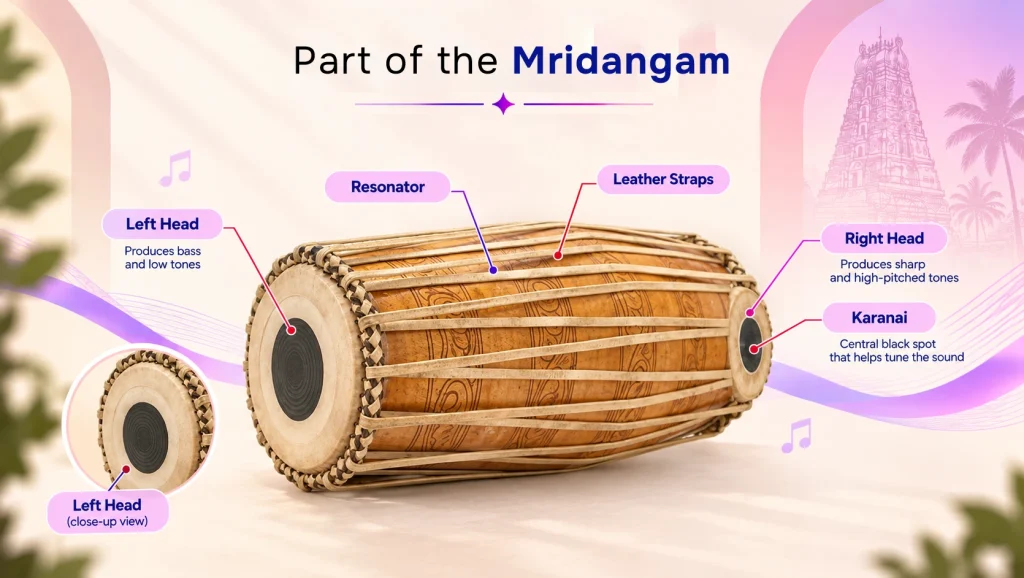
The mridangam musical instrument resembles a long, tapered barrel, with the center of the body thicker than either end. The body is typically single-body carved wood, with two skins bridged by leather rings and wood tuning wedges.
Main parts
- Body or shell: The hollow wooden barrel that makes the noise louder.
- Right head (valanthalai): The smaller playing surface. Usually played by the right hand in right handed playing. Produces a bright, ringing sound.
- Left head (thoppi): The bigger playing surface, which is normally used with the left hand. It gives the bass voice.
- Black patch on the right head: A piece of rice paste made with black material, which produces the resonant quality of the mridangam musical instrument
- Leather straps and wedges: These are used to attach the drumheads to the frame and for fine-tuning.
Generally, the left head is tuned lower than the right, producing the typical bass-and-treble sound. Prior to a performance, the left head receives a fresh application of paste to ensure the right bass sound.
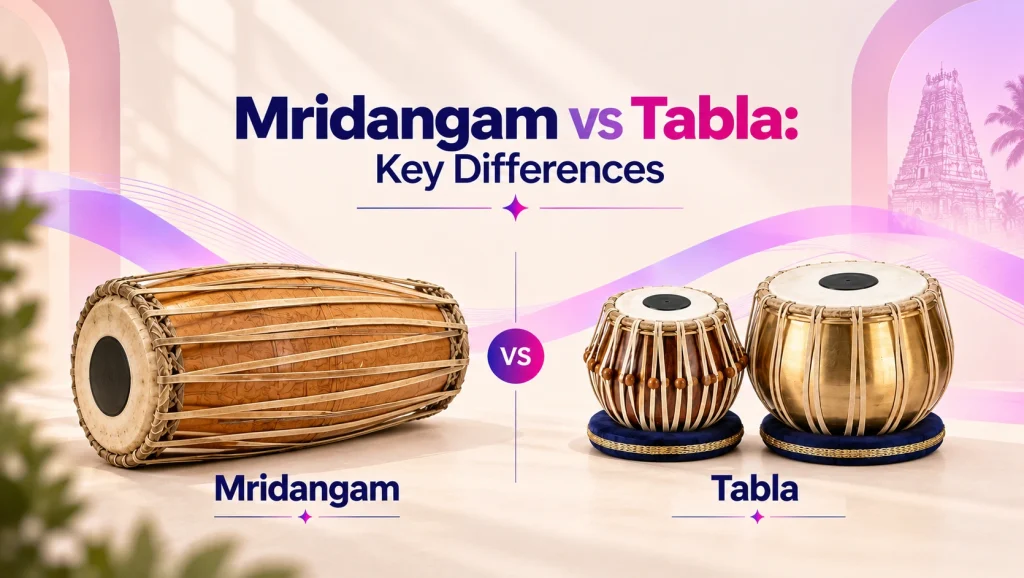
Mridangam vs Tabla: Key Differences
The mridangam musical instrument and the tabla are two Indian hand drums that are used in Indian classical music.
| Aspect | Mridangam | Tabla |
| Main tradition | Carnatic music, South India | Hindustani music, North India |
| Structure | One barrel-shaped body with two heads | Two separate drums: dayan and bayan |
| Shape | Horizontal barrel drum | Smaller wooden right drum and larger metal left drum |
| Sound character | Deep bass on one side, bright resonant tones on the other | Crisp, bell-like right-hand tones and deep bass from the left drum |
| Playing position | Held horizontally across the lap | Drums placed vertically in front of the player |
| Common syllables | Tha, dhi, thom, nam | Na, tin, ta, dha, ge |
The mridangam is a single, two-headed drum while the tabla comprises two individual drums, this fundamental difference is reflected in the way each instrument is held and played, and how it is tuned.
There is no “easier” instrument. If you like the Hindi film music and devotional music then the tabla may seem more natural, while if you prefer the Carnatic music then the mridangam may appeal more. But the ultimate decision will be based on your taste and the advice of your teacher.
How to Play Mridangam: Basic Techniques
The beginners’ steps to playing mridangam are posture, hand consciousness, and listening. There’s no need to jump into doing complicated rhythmic patterns. A regular, clear basic tone is more important than playing fast.
1. Hand Positions and Strokes
The mridangam musical instrument is held in front of the player, horizontally across the lap. A right-handed musician will typically strike the smaller treble head with the right hand and the larger bass head with the left hand.
Sit comfortably with your back straight, shoulders relaxed and wrists free of tension. Strike the drumheads with your hands in a comfortable manner; avoid hammering them.
Common beginner strokes include:
- Tha: Closed tone (non-vibrating sound) played to the left with the entire palm.
- Dhi: Closed tone struck on the black middle of the right head with middle, ring, and little fingers.
- Thom: Outer area of left head in open, resonant bass tone.
- Nam: A bright, ringing tone is sounded on the outside of the right head, usually with the index finger, and with the other fingers doing everything they can to prevent vibration.
Practice each stroke slowly at first. Pay attention to the sound you are making. Is it sharp and clean? Is your hand relaxed? Is your hand hitting the target area of the drum head? It’s the little things like this that matter.
2. Learning Basic Bols (Syllables)
Bols are Indian speak-out syllables for Indian drums / percussion. They’re essentially words for drum strokes that help you remember your patterns-until the hands can do them alone.
A normal beginner routine would be:
Tha – Dhi – Thom – Nam
Say it aloud while tapping out the strokes, softly. Or test yourself using:
Tha – Thom – Nam – Dhi
Practice slowly and evenly. When you can play the pattern comfortably, repeat it on a steady beat. Do not increase the tempo until you can hear each stroke distinctly.
A simple way to practice each day:
- Warm Up Your Hands and Wrists for Two to Three Minutes.
- Play each basic stroke separately, 10-15 times.
- Combine two strokes, such as tha-thom.
- Practise a four-stroke phrase such as tha-dhi-thom-nam.
- Play a simple Carnatic song and listen to how the mridangam instrument supports the singer.
It’s all about repetition. Even just 15-20 minutes a day of dedicated practice will help develop coordination, timing, and self-assurance.
Role of Mridangam in Carnatic Music
The role of a mridangam in carnatic music is both foundational and interactive. It keeps the time, sustains the vocalists or melodic instrument’s foundation, and provides encouragement to the vocalist or melodic instrument’s improvisation.
The mridangam instrument player in a Carnatic concert is not just an accompanist. The player listens, responds to phrases and at times, even exchanges, in a manner similar to what the tabla do, thus generating a spirited conversation between melody and rhythm.
In South Indian classical dance, a dance form that relies on the instrument to keep the dancers synchronized with the rhythmic cycle of the music (tala), the instrument is again a fundamental element that allows the singer/actor to remain in sync with the musical beat. The instrument’s versatility can be felt as the instrument alternates between support and improvisation.
For those who love Carnatic vocals, it is possible to learn carnatic music online and experience new levels of musical sensitivity to how time and musical notes are combined. Learning about mridangam musical instruments adds an extra layer of understanding to your singing, listening and timing.
Famous Mridangam Players
Some of the famous mridangam players contributed to develop the tradition of the modern mridangam. Their recordings serve as great listening practice for students of the instrument, as they demonstrate what the instrument can do in terms of versatility and expressivity.
Some common reputable names are:
- Palghat Mani Iyer: Known for his impeccable sense of rhythm, versatility and complete mastery of Carnatic accompaniment.
- Palani Subramaniam Pillai: Renowned for his effective and original way of playing the mridangam.
- T. K. Murthy: An immensely renowned mridangam exponent, who was the accompanist of several veteran Carnatic musicians.
- Umayalpuram K. Sivaraman: Appreciated for his technical acumen, tonal diversity and expressive playing.
- Karaikudi R. Mani: Known for exactness, inventiveness, and innovative percussion group compositions.
As you get used to hearing other musicians you will realize that mridangam instrument playing isn’t about speed at all. It’s about balance, anticipation, tone and musical interaction.
Conclusion
Mridangam brings Indian rhythm to life with its fascinating instrument that anyone who is interested in Carnatic music will learn to love. Its two heads offer a wonderful combination of bass and treble, and the spoken words make creating rhythmic patterns a breeze.
You don’t have to have previous knowledge to start enjoying or getting a hang of it. Just start listening. Practice the basic strokes patiently; slowly at first. Soon enough you will be able to feel the mridangam giving the performance its colour and emotional effect.
If you are also interested in devotional music, you can learn hindi devotional music online and develop a stronger feel for rhythm, melody, and expression across Indian musical traditions.
Ready to learn music alongside your favourite mridangam instrument? Book your free 1:1 trial class with Artium Academy and explore music learning with certified teachers at your own pace.
Frequently Asked Questions
The mridangam instrument is played along with and as the accompaniment to both the vocal and instrumental renderings of the classical music, providing a framework and support for the improvisations. The mridangam provides the primary rhythmic foundation.
Typically the word is traced to mrida, referring to clay or earth, and anga, meaning body or limb. Traditionally, mridangams were thought to have been constructed from clay, although these days, they are made of wood.
They are closely related terms. Mridangam usually refers to the South Indian Carnatic drum, while mrudanga or mridanga may be used in other regional or devotional traditions. The exact usage can vary by context.
The drum is a membranophone (or a drum), which is a category of musical instruments where sound is generated from vibrating drum heads. It is a two headed barrel drum and it is played with the hands.
The mridangam instrument is a double-headed barrel-shaped instrument played primarily in Carnatic music. The tabla is a pair of individual drums commonly used in Hindustani music.
Starting with your posture, hands relaxed, and the four fundamental strokes, tha, dhi, thom and nam. Practice one letter at a time, slow down to speak the syllable aloud, and build up speed from there.
Most of the mridangam’s association is to the South Indian classical music language known as the Carnatic music style. It is also used in South Indian classical dance.
Contemporary mridangam instruments generally feature a hollow wooden body (typically jackfruit wood) with skin drumheads, leather straps, and tuning wedges. Prior to these, the instrument was made of clay.
Both need patience, coordination and consistent practice. The mridangam instrument might seem hard at first because you need to play the right and left hand to produce different sounds but slow structured practice allows even beginners who are inspired to produce a good sound.
Notable mridangam artists are Palghat Mani Iyer, Palani Subramaniam Pillai, T. K. Murthy, Umayalpuram K. Sivaraman and K. S. Mani.