
All Topics
- Alchemizing Music Concepts for Students
- Anuv Jain Songs
- Artist Spotlight
- artium gift card
- Artium Maestros
- Artium News
- Artium Practice Studio
- Artium Tech Blog
- Best Coke Studio Songs
- Best Female Singers
- Birthday songs
- Bollywood Love Songs
- buying guide
- Carnatic Music
- Child Singers
- Devotional Music
- Editorials by Ananth Vaidyanathan
- English Love Songs
- Festival
- Film Music
- Ghazal Music
- Guitar
- Hindustani Classical Music
- Indian Classical Music
- Indian Folk Music
- Insights
- Instagram Reels Viral Songs
- Instruments
- Karaoke
- Karaoke Singing
- Keyboard
- Kids Music
- maestros
- Music Education
- Music for Kids
- Music Games
- Music Industry
- Music Instruments
- Music Legends
- Music Press Release
- Music Technology
- Music Theory
- Music Therapy
- Music Tools
- Piano
- piano guide
- Songs
- South Devotional Music
- Success Stories
- Tamil Film Music
- Telugu Film Music
- Time Theory
- Tools
- Uncategorized
- Uncategorized
- Uncategorized
- Uncategorized EN US
- Vocal Range
- Vocal Singing
- Vocals
- western classical music
- western music
- Western vocal music
Famous Tabla Players of India You Should Know
Famous Tabla Players of India You Should Know
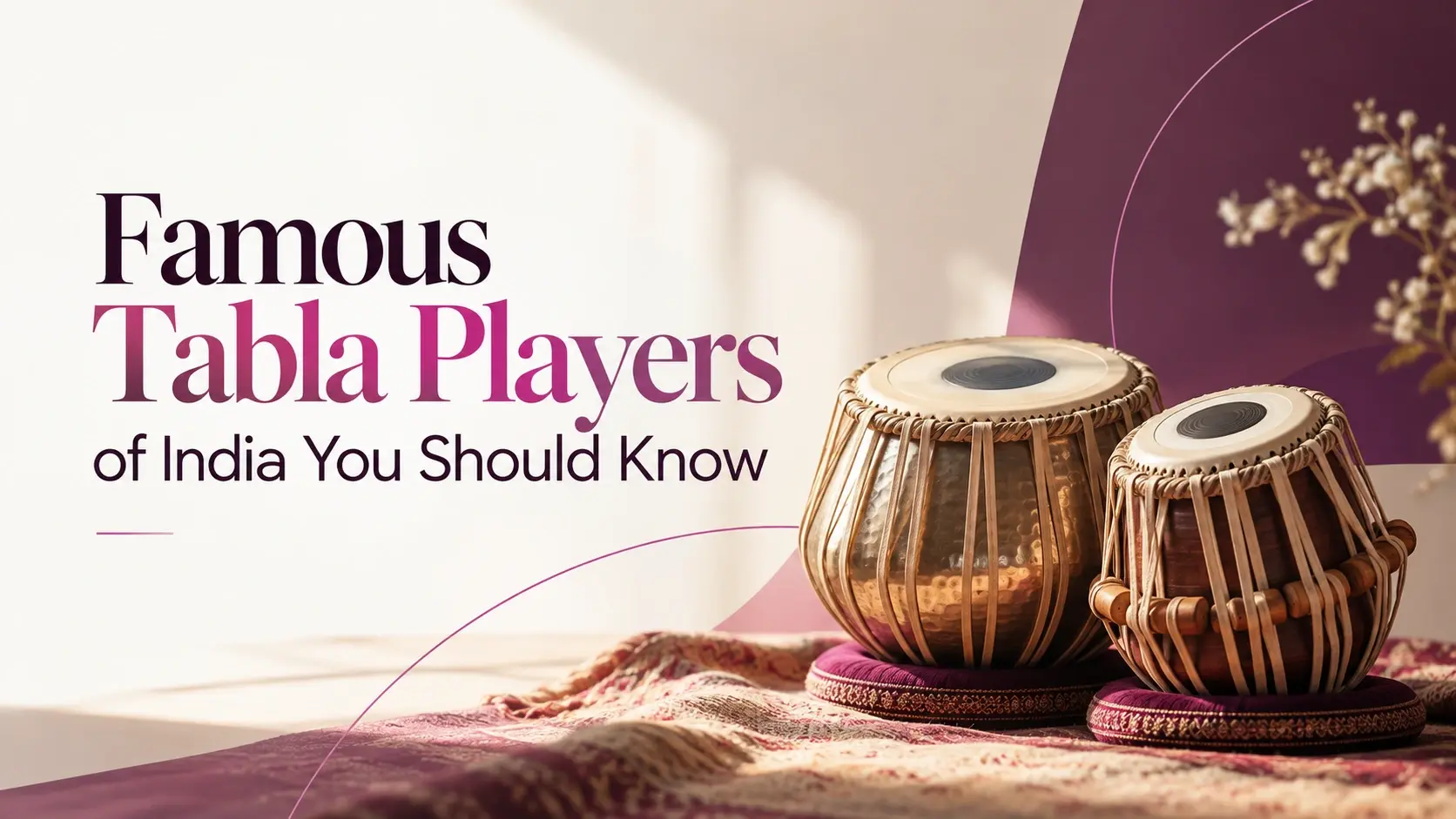
Table of Contents
Quick Summary
| Tabla is the heartbeat of Indian classical music and a handful of masters have shaped how the world hears it. This guide introduces famous tabla players of India, from legends of the past to artists performing today. You will also learn about the main tabla gharanas, what makes great artists stand out, how they train and how you can start learning tabla yourself. |
The Masters Behind the Beat
Close your eyes and picture a classical concert. A sitar glides through a raga, a singer begins a slow alaap, and then the tabla quietly enters. Then, suddenly, the whole performance gains a pulse. Few instruments change a room’s mood so quickly.
Behind that sound are remarkable people. Some of the most celebrated tabla players spend decades practicing before they ever play on a big stage. Their names are known across India and beyond and their playing has inspired generations of students.
In this blog, we will explore famous tabla players of India, from the great masters of the past to artists keeping the tradition alive today. We will also explore the gharanas they come from, what training looks like and how you can begin your own tabla journey.
Let us dive in.
Why the Tabla Holds a Special Place in Indian Music
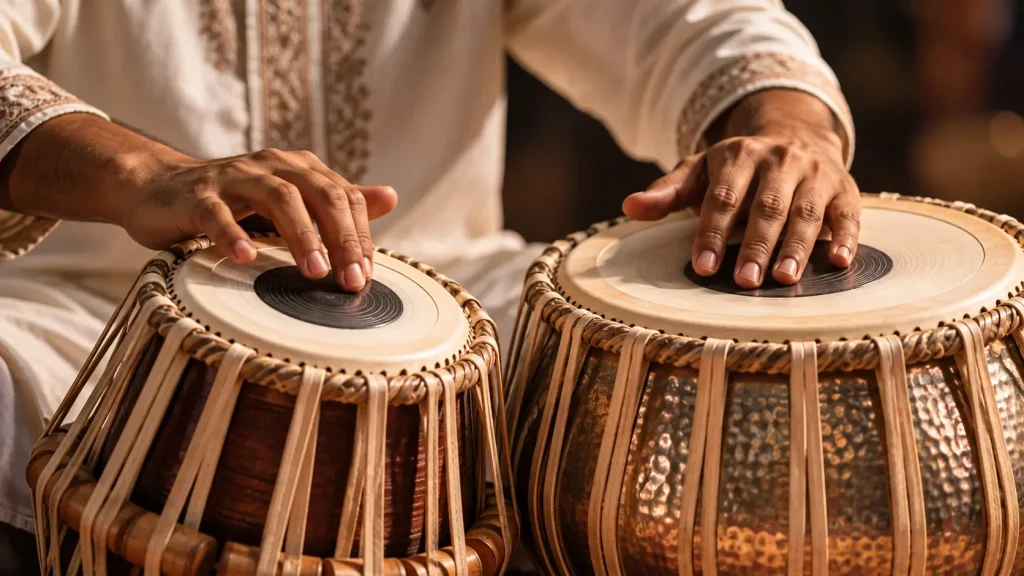
Tabla is a pair of hand drums. The smaller, higher-pitched drum, the dayan, is played with the right hand for most players. The larger bass drum, the bayan, is played with the left hand. Together they can produce an astonishing range of sounds, from sharp, clear strokes to deep rolling tones.
Here is why it matters so much:
- It keeps the rhythmic cycle or taal, steady for singers, instrumentalists and dancers.
- It works as a solo instrument with its own rich repertoire of compositions.
- It speaks through bols, spoken syllables musicians learn before playing them.
- It connects classical, devotional, folk and film music.
Some people credit the poet and musician Amir Khusro with inventing the tabla, but historians largely contest its relevance and the debate still continues. Whatever its origins, the tabla has been central to Hindustani music for centuries. It’s easy to see why people search for the greatest tabla players, since their skill is so visible and astonishing.
Famous Tabla Player Legends of the Past
Every art form has its legends. These are some of the famous Indian musicians whose work built the foundations of tabla as we know it. Greatness is always subjective and differs. So, think of this as Artium’s own selection based on influence and legacy.
Ustad Ahmed Jan Thirakwa (1892 – 1976)
Thirakwa, of the Farrukhabad tradition, is known as one of his time’s finest accompanists. He received the Sangeet Natak Akademi Award in 1970. He was the tabla player for the celebrated duet of shehnai maestro Bismillah Khan and sitar legend Vilayat Khan. Several well-known students trained under him, including Pandit Nikhil Ghosh.
Ustad Alla Rakha (1919 – 2000)
Alla Rakha, of the Punjab gharana, was born in Jammu and became one of the 20th century’s most respected tabla players. He accompanied sitar maestro Pandit Ravi Shankar for nearly three decades, helping carry Indian classical music to audiences around the world. He received the Padma Shri in 1977 and the Sangeet Natak Akademi Award in 1982 and founded the Alla Rakha Institute of Music in Mumbai in 1985.
Pandit Samta Prasad (1921 – 1994)
Samta Prasad, of the Benares gharana, was known for his powerful, brilliant playing. He received the Padma Shri in 1972 and the Padma Bhushan in 1991. Film music lovers might enjoy knowing that he played tabla in Hindi films including the 1975 classic Sholay. His students included R.D. Burman and Bappi Lahiri.
Pandit Kishan Maharaj (1923 – 2008)
Another giant of the Benares tradition, Kishan Maharaj began performing in concerts at about the age of eleven. He accompanied some of India’s greatest musicians and dancers and he received the Padma Shri in 1973 and the Padma Vibhushan in 2002. He was also admired for his collaborations with Carnatic percussionists, bringing together North and South Indian rhythm.
Famous Tabla Player in India Today
Tradition lives only when new voices carry it forward. Here are a few musicians who represent the tabla world today.
- Pandit Anindo Chatterjee
Born in 1954, Anindo Chatterjee is a leading exponent of the Farrukhabad gharana. He began playing at age five and trained for about three decades under Pandit Jnan Prakash Ghosh. He received the Sangeet Natak Akademi Award in 2002 and he accompanied many of Hindustani music’s best-known instrumentalists and vocalists. For many listeners, he is a famous tabla player in India whose accompaniment and solos remain a benchmark of clarity and control. - Ojas Adhiya
He belongs to a younger generation. He made his debut at the age of four, was listed in the Limca Book of Records as India’s youngest tabla artist and studied in Mumbai under a teacher of the Ajarda gharana. Today, he accompanies leading Hindustani artists and is building his name as a soloist. He has said he draws inspiration from several masters, including Ustad Zakir Hussain.
Young artists like him show that tabla remains very much alive and that its audience is growing.
Tabla Player Zakir Hussain: A Legacy in Indian Classical Music
A conversation about the tabla is incomplete without Ustad Zakir Hussain. Born in Mumbai on 9th March, 1951, he was the son and student of the legendary Ustad Alla Rakha. He began performing in concerts at about age seven and toured while still a teenager.
Zakir Hussain passed away on 15th December 2024 at the age of 73. The loss was felt across the music world and tributes poured in from every corner. But his work lives on and it remains one of the strongest reasons that people around the world fell in love with the instrument.
What made the tabla player Zakir Hussain so iconic?
- He brought tabla to global audiences without losing its classical roots.
- He was a founding member of Shakti, the fusion group started with guitarist John McLaughlin.
- He collaborated with musicians from many traditions, helping show that rhythm is a universal language.
- He received the Padma Shri in 1988, the Padma Bhushan in 2002 and the Padma Vibhushan in 2023.
- At the 2024 Grammy Awards, he won three Grammys in a single night, including for the Shakti album “This Moment”.
Many listeners also remember his warmth, humour and his habit of explaining rhythm so that everyone in the audience could feel it. For many students, he made the tabla look like a joyful conversation, not just a complicated art form.
Other Celebrated Tabla Players and Their Gharanas
You will often hear musicians mention gharanas when they talk about tabla. A gharana is a school or lineage, a style passed from teacher to student. Six styles are generally considered the main tabla gharanas. Each has its own character and many players learn from more than one.
| Gharana | Known for | Some Associated Names |
| Delhi | Often described as the oldest style with delicate, finger-focused playing | Early masters of the tradition |
| Lucknow | Graceful playing that suits dance accompaniment | Ustad Afaq Hussain Khan |
| Ajrada | Intricate compositions and sharp precision | Teacher in Mumbai’s tabla circles |
| Farrukhabad | Resonant strokes and rich compositions such as gats and relas | Ahmed Jan Thirakwa, Nikhil Ghosh, Anindo Chatterjee |
| Benares | A powerful sound and a strong solo tradition | Ram Sahai, Samta Prasad, Kishan Maharaj |
| Punjab | A pakhawaj-influenced style with bold, strong strokes | Alla Rakha, Zakir Hussain |
Other respected names include Pandit Kumar Bose of Benares and Yogesh Samsi of the Punjab tradition. Descriptions of styles are broad and individual artists often blend influences, so treat the table as a friendly map, not a rulebook.
Aneesh Pradhan: Artium’s Faculty Head for Tabla
Great tabla playing does not live only on big stages. It also lives in the classrooms where learners learn the basics and that is where Aneesh Pradhan’s work stands out.
Aneesh Pradhan is a tabla player, a disciple of Pandit Nikhil Ghosh and a scholar of Hindustani music. His repertoire draws from the Delhi, Ajrada, Lucknow, Farrukhabad and Punjab traditions. He performs as a soloist and an accompanist, has collaborated widely with vocalists and instrumentalists and has written books including Tabla: A Performer’s Perspective.
At Artium, he serves as Faculty Head for tabla and has curated our online tabla course. His mix of performance, research and teaching gives learners a thoughtful, well-rounded foundation. Rather than comparing masters, think of him as a guide who helps learners understand the tradition that those legends built.
What Makes These Tabla Players Stand Out
Talent alone does not create a legend. When we look at famous Indian tabla musicians, a few qualities appear again and again:
- Clarity of sound: Every stroke is clear and well formed, even at high speed.
- Rhythmic intelligence: They understand the structure of a taal so deeply that they can improvise inside it with ease.
- Sensitive accompaniment: Great players support a singer or instrumentalist rather than overpower them.
- Creativity within tradition: They respect their gharana while adding their own voice.
- Stage presence and humility: They connect with audiences and with fellow musicians.
These qualities take years to develop, which brings us to the next question.
Training and Discipline Behind Becoming a Great Tabla Player
Becoming a skilled tabla player is a long and rewarding journey. Traditionally, learners learn through the guru-shishya parampara, where a teacher passes knowledge directly to a student over many years.
Training typically involves:
- Learning bols and strokes slowly and accurately
- Practicing basic rhythmic cycles such as Teentaal, Keherwa and Dadra
- Daily riyaz or focused practice often for many hours at advanced levels
- Listening carefully to great recordings and live concerts
- Learning compositions, improvisations and how to accompany others
There is no fixed timeline. Many learners feel comfortable with the basics within the first year of steady practice, while real mastery can take many years. Patience, consistency and a good teacher matter more than speed.
How to Start Learning Tabla Inspired by the Greats
You do not need to copy tabla players’ careers to enjoy the tabla. Many people start simply because they love the sound. Here is a friendly way to begin:
- Listen to recordings by the masters above and notice how they use rhythm.
- Learn a few bols and a simple taal such as Teentaal, which has 16 beats.
- Practice a little everyday, even for 15 minutes.
- Use a metronome or a virtual tabla to build steady timing.
- Find a teacher who can correct your hand position and technique early.
If you’d like a step-by-step guide, our blog on how you can learn tabla online walks through what to expect. You can also try Artium’s free online tabla tool, which lets you choose a taal and tempo and listen to the beats as you practise.
For structured guidance, we offer online tabla classes curated by Aneesh Pradhan. The course is built across three levels from basic strokes and steady rhythm to advanced compositions and accompaniment, in live 1:1 sessions with a dedicated teacher.
Where to Watch and Listen to Famous Tabla Performances
Watching a master play is one of the best lessons you can give yourself. Here are some good places to start:
- Concert recordings and interviews on YouTube from well-known artists
- Classical music platforms and festival streams such as Darbar
- Live concerts at music festivals and cultural centres in your city
- Masterclass recordings, where legendary musicians explain their craft
- Duets and Jugalbandis, where tabla players respond to melodic instruments in real time
When you watch, try tapping the taal along. Notice how the tabla players listen, adjust, and sometimes smile when the music takes an unexpected turn.
Let the Rhythm Lead You
The story of the tabla is a story of devotion, discipline and joy. From Thirakwa and Alla Rakha to Anindo Chatterjee, Ojas Adhiya, and the unforgettable Zakir Hussain, these artists remind us that rhythm is both a craft and a way to connect with people. Learning about famous tabla players is often the first step towards loving the instrument yourself.
If you’d like to take that step, Artium Academy is here for you. With 45,000+ learners worldwide, we offer live, 1:1 online classes including a tabla course curated by Aneesh Pradhan. Our courses come with certification on par with renowned music institutions worldwide.
Learners can also join regular masterclasses with industry legends & experts, where they can ask questions and learn from the best. So, what are you waiting for?
Book a free trial class today and begin your own rhythm story.
Frequently Asked Questions
Zakir Hussain, thanks to his global fame and Grammy wins. However, greatness is subjective and legends such as Alla Rakha, Kishan Maharaj and Anindo Chatterjee are equally revered.
He combined deep classical training with an open, collaborative spirit. He brought tabla to audiences worldwide through Shakti and many collaborations, and he won three Grammy Awards at the 2024 ceremony.
Besides Zakir Hussain, notable names include Ahmed Jan Thirakwa, Alla Rakha, Samta Prasad, Kishan Maharaj and Anindo Chatterjee. Each belongs to a distinct gharana.
Clear strokes, strong rhythmic understanding, sensitive accompaniment and creative improvisation within tradition set great players apart. Years of disciplined practice support all of these.
It varies by person. Many learners feel comfortable with the basics after a year of regular practice, while advanced skill can take many years of guided training.
Yes, listening to great players is excellent for inspiration and ear training. But beginners should first learn basic strokes and taals from a teacher before trying to copy advanced styles.
Most come from gharanas, lineages where teachers passed techniques to students over generations. Styles such as Farrukhabad, Benaras and Punjab developed in different regions and shaped the greats we know today.
Most trained for many years under a guru, practising bols, taals, and compositions daily. They also listened closely to older masters and learned how to accompany other musicians.
You can find concerts and interviews on YouTube, classical music streaming platforms, festival streams, and live shows in your city. Masterclass recordings are another great way to learn from the best.