
All Topics
- Alchemizing Music Concepts for Students
- Anuv Jain Songs
- Artist Spotlight
- artium gift card
- Artium Maestros
- Artium News
- Artium Practice Studio
- Artium Tech Blog
- Best Coke Studio Songs
- Best Female Singers
- Birthday songs
- Bollywood Love Songs
- buying guide
- Carnatic Music
- Child Singers
- Devotional Music
- Editorials by Ananth Vaidyanathan
- English Love Songs
- Festival
- Film Music
- Ghazal Music
- Guitar
- Hindustani Classical Music
- Indian Classical Music
- Indian Folk Music
- Insights
- Instagram Reels Viral Songs
- Instruments
- Karaoke
- Karaoke Singing
- Keyboard
- Kids Music
- maestros
- Music Education
- Music for Kids
- Music Games
- Music Industry
- Music Instruments
- Music Legends
- Music Press Release
- Music Technology
- Music Theory
- Music Therapy
- Music Tools
- Piano
- piano guide
- Songs
- South Devotional Music
- Success Stories
- Tamil Film Music
- Tamil Singers
- Telugu Film Music
- Telugu Singers
- Tools
- Uncategorized
- Uncategorized
- Uncategorized
- Uncategorized EN US
- Vocal Range
- Vocal Singing
- Vocals
- western classical music
- western music
- Western vocal music
Guitar Size Chart: How to Pick the Right Size for Your Child
Guitar Size Chart: How to Pick the Right Size for Your Child
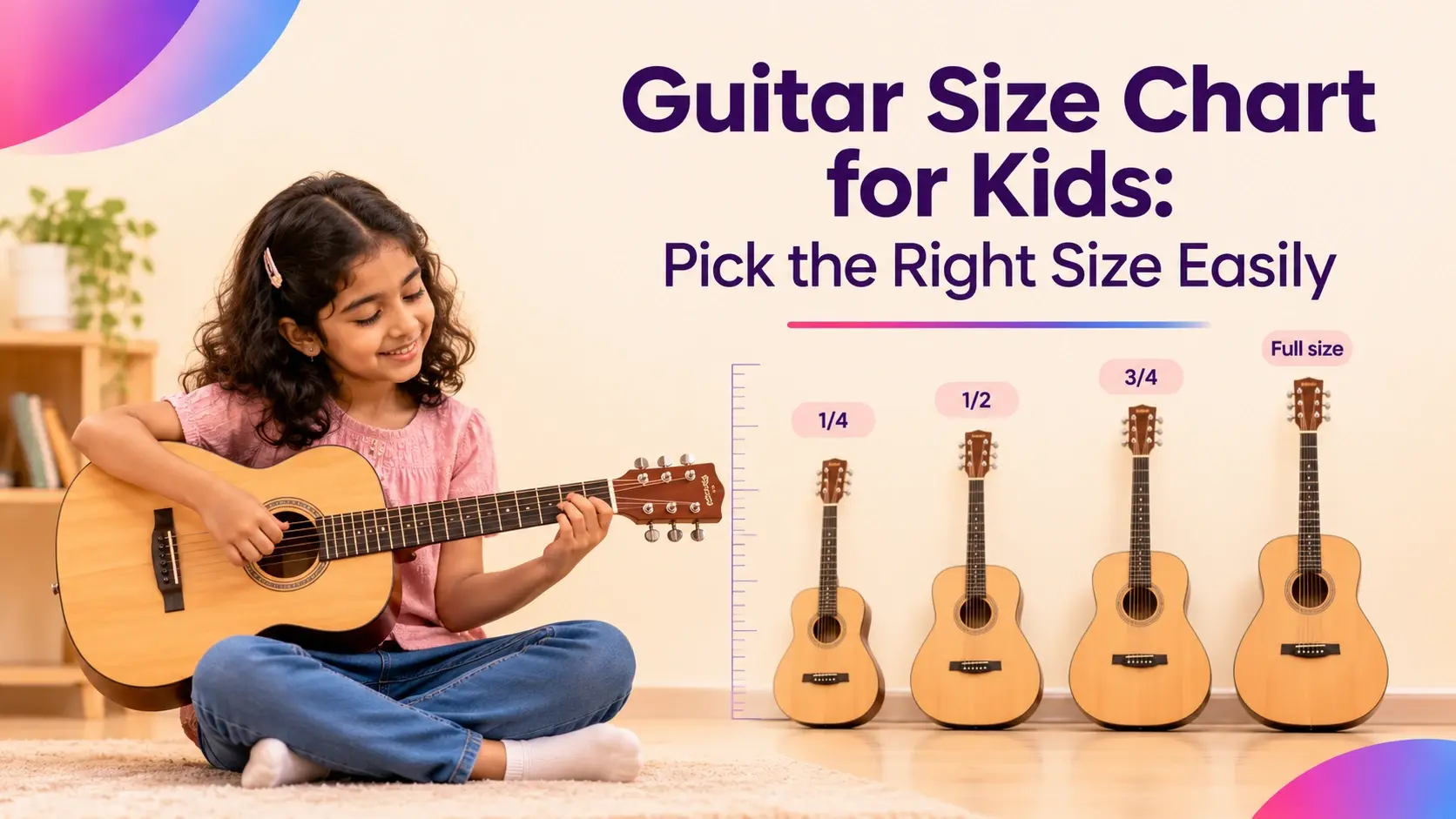
Table of Contents
Quick Summary
| The easiest way to put a child off music is picking the wrong guitar. This guide explores a simple guitar size chart for kids, from 1/4 to full size, with ages, heights and lengths. You will also find advice on bass guitars for kids, a measuring method and the most common buying mistakes to avoid. |
Why the Right Fit Changes Everything
Think of it like handing an adult-sized shoe to a seven-year-old and asking them to run. This is exactly how a young guitar aspirant will feel if they hold a guitar that is too big.
So, even if your child loves guitar, if the neck is too long to reach or the body is too wide to hug, it’ll quickly turn into a struggle. A good guitar size chart takes the guesswork out of this decision.
In this blog, we will explain how guitar sizes work, which size suits which age and how to double-check the fit at home. So, whether you are a parent, an adult hobbyist, or a young aspiring guitarist, you will leave knowing exactly what to look for.

Why Guitar Sizes Matter for Young Learners
Children have small hands, arms and posture; the right-sized guitar can protect their enthusiasm in several ways:
- Comfort: A guitar that fits lets the child sit upright without hunching or stretching
- Easier finger reach: Smaller instruments have shorter necks, so little fingers can press the strings properly.
- Better sound: Clean notes come from correct finger placement, which is much harder on an oversized guitar.
- Lasting motivation: Early wins keep children excited, while constant frustration makes them quit.
- Healthy habits: Good posture from day one avoids sore shoulders, wrists and backs.
A small guitar is not a toy. It is a real instrument, just scaled to a child’s body. Many have a slightly softer sound, but they play and tune like their bigger siblings.
Guitar Sizes Explained: The Full Guitar Size Chart
Before getting into the details, here is a quick overview. Remember, these figures are approximate, because every child grows at their own pace and brands differ slightly. Treat the chart as a starting point, not a strict rule.
| Guitar size | Typical age | Typical child height | Approx. total length |
| 1/4 size | 5-8 years | 110-130 cm | About 30 in (76 cm) |
| 1/2 size | 7-9 years | 120-140 cm | About 34 in (86 cm) |
| 3/4 size | 8-13 years | 130-150 cm | About 36 in (92 cm) |
| Full size (4/4) | 12 years & above | 150 cm & above | About 40 in (100 cm) |
See how the age ranges overlap. That is normal. A tall eight-year-old and a small ten-year-old may both suit a 3/4 guitar. Height and arm length matter at least as much as age.
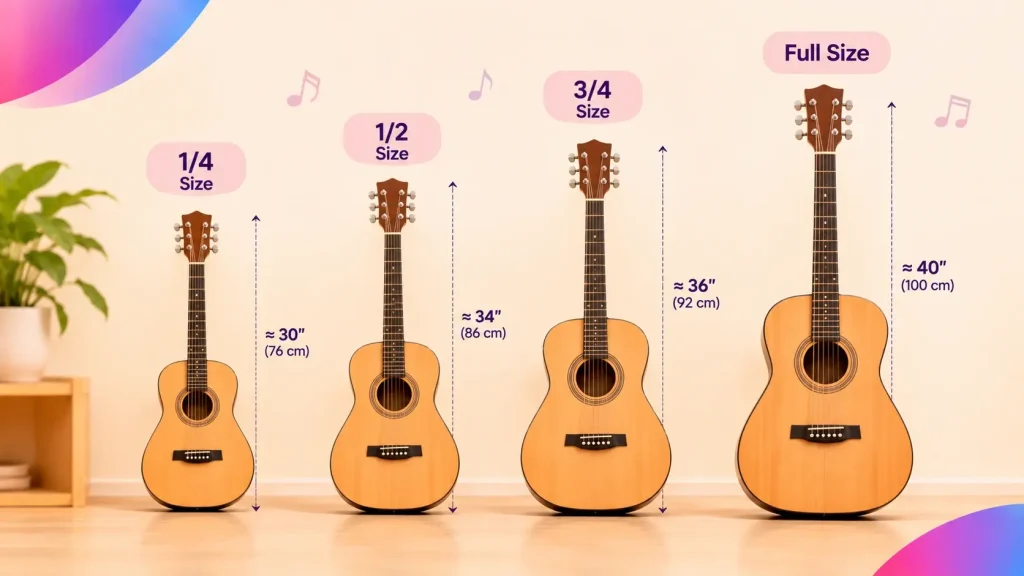
1/4 Size Guitar
This is the smallest standard guitar. It is perfect for young beginners, roughly ages 5-8. It is about 30 inches long, light and easy to hold. Many 1/4 guitars have nylon strings, which are gentle on tiny fingertips. If your child is very small or is only starting to explore music, this size keeps things fun.
1/2 Size Guitar
A 1/2-size guitar is around 34 inches long and usually suits children about 7-9 years old. It has a bit more room for growing hands while staying manageable. Some brands and shops give slightly different ages for this size. If your child is on the taller side for their age, check the neck length and arm reach before deciding.
3/4 Size Guitar
The 3/4 guitar, at about 36 inches is the “bridge” size between children’s and adult instruments. It generally suits ages 8-13, which makes it the longest-serving of the kids’ sizes. Some smaller adults and teens with small hands also find a 3/4 guitar more comfortable than a full-size one. There is no shame in choosing comfort over size.
Full Size Guitar
A full-size guitar, also called 4/4, is the standard adult instrument and is roughly 40 inches long. Most children are ready for it around 12-13, though some smaller teens stay on a 3/4 for longer. Moving up too early is a common error. If the guitar feels like a wrestling match, wait a little longer.
Acoustic Guitar Size Chart by Age and Height
Parents often search for an acoustic guitar size chart because they are the most popular first instrument. The sizing logic is the same as above, but a few extra details matter.
- Nylon or steel strings: Nylon strings (classical guitars) are softer on young fingers. Steel-string acoustics are brighter but harder to press.
- Body Shape: A deep, wide body can be tiring for small arms, so look for slim or compact shapes.
- Neck width: Narrower necks help small hands wrap around more easily.
Here is a simple guide to match your child’s height to an acoustic option:
| Child’s height | Suggested acoustic size |
| Around 110-130 cm | ¼ size |
| Around 120-140 cm | ½ size |
| Around 130-150 cm | ¾ size |
| 150 cm & above | Full size |
If you’d like a broader look at choosing an instrument, our guide to buying your first guitar covers acoustic, electric and classical options in detail.
Many parents ask whether to start on acoustic or electric. Electric guitars often have slimmer necks, but the amplifier and cables add to the cost. For most young beginners, a well-fitted acoustic or classical guitar is the simplest start.
Bass Guitar Size Charts for Kids
Is there a separate bass guitar size chart? Not in the same neat way. Bass sizing for children is less standardised than for acoustic guitars and you won’t find a universal 1/4 to 4/4 range.
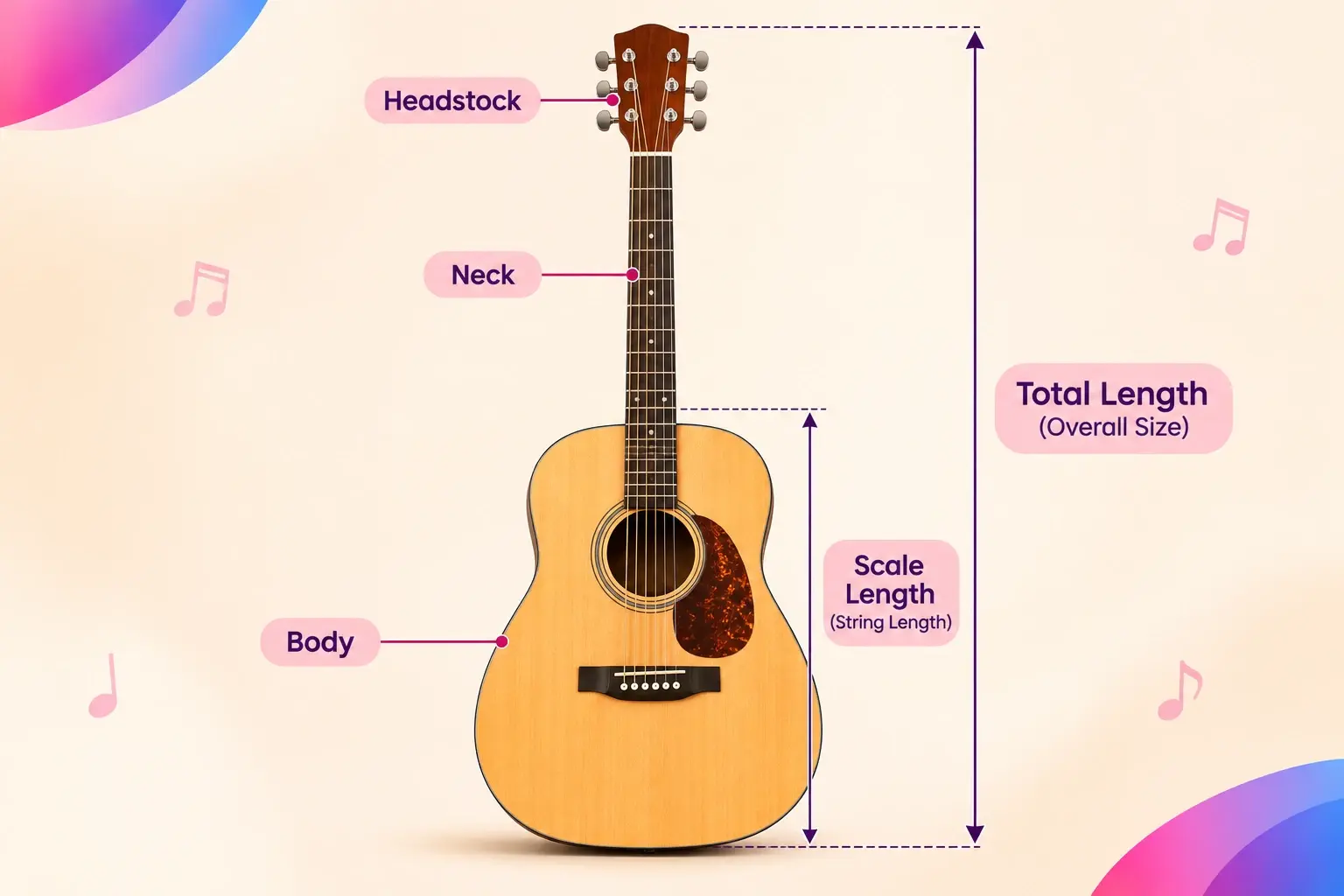
Instead, you will find the concept of scale length, which is the length of the vibrating part of the string. A standard bass has a long scale of about 34 inches. A short-scale bass is around 30 inches, so the frets sit closer together and the stretch is smaller.
For that reason, short-scale basses are usually recommended for children, teens and anyone with small hands. Here is a simple way to think about it:
- Younger kids and small teens: A short-scale bass is the friendlier choice
- Taller teens: A full-scale bass may be fine if their hands reach comfortably.
- Always check weight: Basses are heavier than guitars, so let your child hold one while standing and sitting.
Since the sizes vary by brand, the best test is trying it in person. If your child is curious about bass, a short-scale model is a fantastic place to begin.
Guitar Dimensions and Guitar Length Explained
When shops list guitar dimensions, you will see several numbers. Understanding them stops confusion later.
- Total guitar length: The distance from the top of the headstock to the bottom of the body. It is the number most size charts use.
- Body width and depth: These affect how comfortably a child can hold and strum the guitar.
- Neck width: A slimmer neck suits smaller hands.
- Weight: Lighter guitars are easier for kids to hold for longer.
For reference, a full-size classical guitar commonly has a scale length of around 650 mm, while smaller classical sizes are shorter. Acoustic body styles vary, so a full-size guitar’s length can differ slightly between models.
Think of guitar length as the big-picture number and scale length as the “finger-friendliness” number. Both are useful when you are comparing options.
How to Measure Your Child for the Right Guitar Size
Charts are helpful but nothing beats a quick hands-on check. You can do this at home with your child in just a few minutes.
- Check their height and age against the guitar size chart above to find a likely size.
- Measure their arm span by asking them to stretch both arms out wide and compare it with the chart.
- Do the elbow test: Have your child sit up straight with the guitar resting on their leg. The guitar’s body should rest comfortably against them, with the neck within easy reach.
- Test the fretting hand: They should be able to wrap their hands around the neck and press the first few frets without fully stretching their arm.
- Check their strumming arm: They should reach over the body without lifting their shoulder.
- Let them play for a few minutes: If they look relaxed and happy, you are probably close.
Another handy test is to ask whether they can see their own hand on the fretboard without leaning. If they cannot reach the first few frets comfortably, try the next size down.
When possible, take your child to a music shop and let them try two sizes back-to-back. It is the fastest way to find the right fit.
Common Mistakes When Choosing a Guitar Size
Even careful parents can slip up. Here are the mistakes we see most often:
- Buying a bigger guitar so the child can “grow into it”
- Choosing only by age and ignoring height or arm reach
- Picking a cheap guitar that is hard to tune or press
- Forgetting about weight and body depth
- Skipping a try-before-you-buy session
- Assuming every brand’s sizes are exactly the same
- Moving to a full-size guitar too soon because it looks more grown-up
The “grow into it” idea sounds sensible, but it usually backfires. A guitar that is too large makes learning harder from the very beginning.
Also, don’t buy an instrument that is hard to play just because it is cheap. A poorly set-up guitar with high strings can discourage even a talented child. If you are unsure where to start, our post on how to play guitar for beginners offers a gentle introduction for new learners.
Let Your Child’s Guitar Grow With Them
Choosing the right guitar size is about comfort, confidence and joy. Use the guitar size chart as your map, double-check with simple measurements amd let your child’s happy face be the final judge. As they grow, you can move up through 1/4, 1/2, 3/4 and full size at the right time.
Once the guitar fits, the next step is guidance. Artium Academy offers live, 1:1 online guitar classes, where trained teachers help beginners of every age build skills step by step. With over 45,000 learners worldwide, Artium is a trusted online music learning platform.
Our guitar course is curated by Raju Singh, an Indian music composer and the faculty head at Artium Academy. Students also earn globally recognised certifications, on par with those from renowned music institutions worldwide. They can also join quarterly masterclasses with legendary musicians as part of their curriculum.
Book a free trial class with us today and help your child take their first confident steps on guitar.
Frequently Asked Questions
Children aged 5-8 usually suit a 1/4 size, ages 7-9 a 1/2 size and ages 8-13 a 3/4 size. From around 12 or 13, most are ready for full size. Always check height and arm reach too.
Start with your child’s age and height, find the matching row and note the suggested size. Then confirm the fit by checking arm reach and posture. The chart is a guide, not a strict rule.
A 1/2-size guitar is about 34 inches long, while a 3/4-size is about 36 inches. The 3/4 has a longer neck and bigger body, so it suits slightly older or taller children.
A full-size adult guitar is typically around 40 inches long, though acoustic body styles vary a little by model. Full-size classical guitars commonly have a scale length of about 650 mm.
Yes, bass sizing works differently. Instead of 1/4 to 4/4 sizes, basses are mainly described by scale length. Short-scale basses, around 30 inches, are usually the best choice for children and small teens.
Most 6-year-olds are comfortable on a 1/4 size guitar. If your child is tall for their age, a 1/2 size may suit them, so check the reach before buying.
Check the total length, scale length, body depth and neck width listed by the seller. Compare them with your child’s arm span and hand size and ask if you can test the guitar in person.
Yes, especially between ages 5 and 12. Many families move through two or three sizes. Consider buying good second-hand guitars or renting to keep costs reasonable.