
All Topics
- Alchemizing Music Concepts for Students
- Anuv Jain Songs
- Artist Spotlight
- artium gift card
- Artium Maestros
- Artium News
- Artium Practice Studio
- Artium Tech Blog
- Best Coke Studio Songs
- Best Female Singers
- Birthday songs
- Bollywood Love Songs
- buying guide
- Carnatic Music
- Child Singers
- Devotional Music
- Editorials by Ananth Vaidyanathan
- English Love Songs
- Festival
- Film Music
- Ghazal Music
- Guitar
- Hindustani Classical Music
- Indian Classical Music
- Indian Folk Music
- Insights
- Instagram Reels Viral Songs
- Instruments
- Karaoke
- Karaoke Singing
- Keyboard
- Kids Music
- maestros
- Music Education
- Music for Kids
- Music Games
- Music Industry
- Music Instruments
- Music Legends
- Music Press Release
- Music Technology
- Music Theory
- Music Therapy
- Music Tools
- Piano
- piano guide
- Songs
- South Devotional Music
- Success Stories
- Tamil Film Music
- Telugu Film Music
- Time Theory
- Tools
- Uncategorized
- Uncategorized
- Uncategorized
- Uncategorized EN US
- Vocal Range
- Vocal Singing
- Vocals
- western classical music
- western music
- Western vocal music
Acoustic vs Electric Guitar: Key Differences Explained
Acoustic vs Electric Guitar: Key Differences Explained
Table of Contents
Quick Summary
| Among aspiring guitarists, one of the most common questions is choosing between acoustic vs. electric guitar. Apart from sound, feel and the kind of music to play, there are other factors. This guide breaks down the real differences in tone, learning curve, cost and genre fit. It clears up common misconceptions between acoustic-electric and semi-acoustic guitars. It’ll also help you figure out which one is right for you. |
It is an exciting feeling when you decide to learn guitar. The strings, the songs, the jams you visualise, and then the fork in the road: the major question: acoustic or electric guitar?
This question is more common than you think, and there’s no single “correct” answer. Both instruments share the same six strings, the same fretboard and the same fundamental technique. But the experience of learning and playing each one is genuinely different.
In this guide, we break down the real debate around acoustic guitar vs. electric guitar. We will cover how they sound different, which one might actually be easier to learn on, the cost to get started and the genres you can play on them. By the end, you will have a clear, honest answer for which guitar fits you, not just a list of specs.

Acoustic Guitar Vs Electric Guitar: Quick Overview
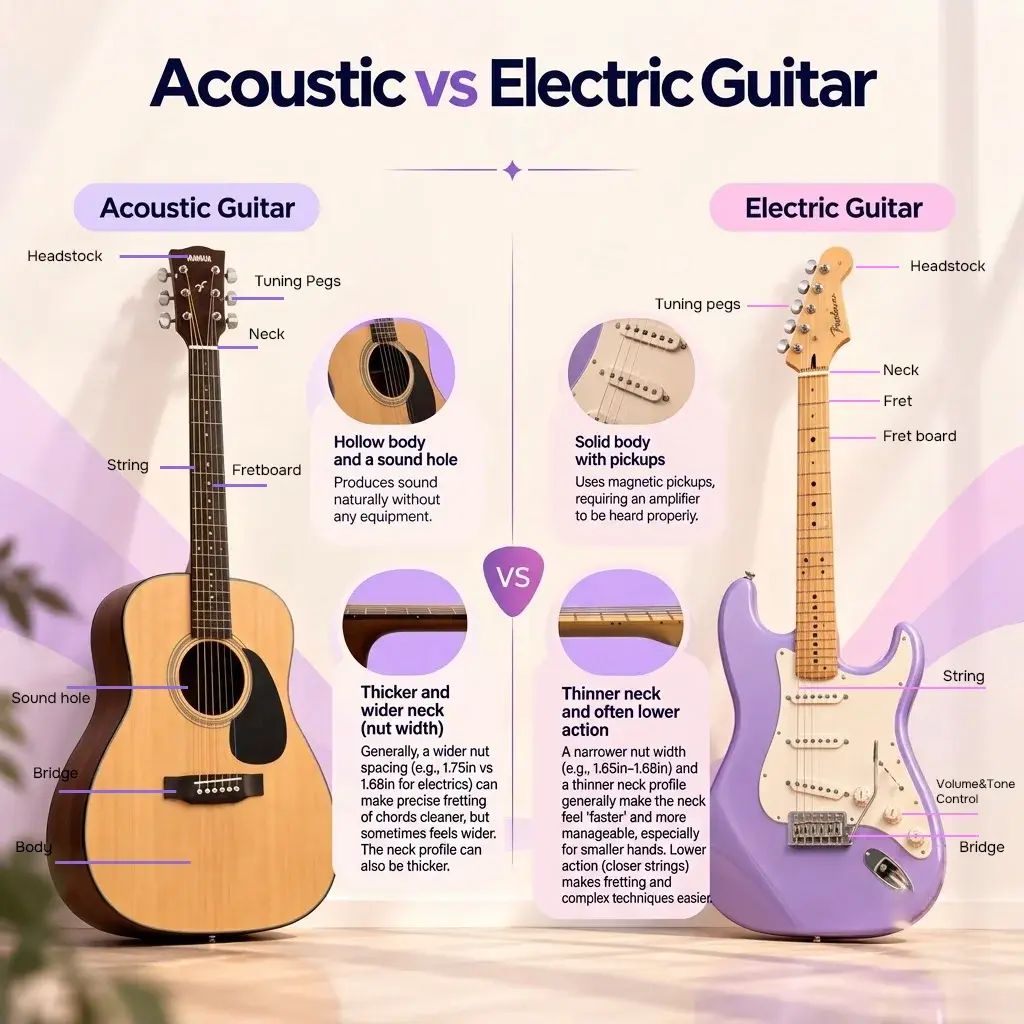
Before diving deep, here’s the short version of what separates these two instruments:
| Acoustic Guitar | Electric Guitar |
| It has a hollow body and a sound hole, producing sound naturally without any equipment | It has a solid body and uses magnetic pickups, requiring an amplifier to be heard properly |
| It has a thicker neck with strings spaced further apart | It has a thinner neck with lower string action, making notes easier to fret |
Keep these basics in mind. Nearly everything else in this guide builds on these core differences.
Sound and Tone Difference
This is the most common point of differentiation between acoustic vs. electric guitar. An acoustic guitar produces sound entirely through its hollow wooden body. String vibrations resonate through the sound hole, giving it a warm, natural, self-contained tone you can hear anywhere, with no equipment required.
An electric guitar works completely differently. Its solid body houses magnetic pickups that capture string vibrations and convert them into an electrical signal, which then needs an amplifier to actually produce audible sound. This setup gives the electric guitar enormous tonal flexibility. You can shape the sound with distortion, reverb, delay and dozens of other effects, something simply not possible on an acoustic guitar.

Is Acoustic Guitar Easier Than Electric?
This is one of the most common questions by beginners and the honest answer is: it depends on what you mean by “easier”.
Acoustic guitar is definitely easier than electric guitar in terms of convenience. You don’t need an amp setup or cables; you just have to pick and play. It is also excellent for building strong technique early on, since the wider string spacing and thicker neck naturally develop good finger independence.
That said, acoustic guitars typically have higher string action, meaning the strings sit further from the fretboard. This requires more finger pressure to fret a clean note, which can genuinely hurt for the first few weeks until your fingertips build up calluses.

Is an Electric Guitar Easier than Acoustic for Certain Techniques?
Now, since the question is flipped, the answer is: Yes. For certain techniques, electric guitar is quite noticeably easier.
Electric guitars have a thinner neck, lower string action and strings spaced closer together, which makes fretting notes require far less pressure. This makes techniques like fast solos, string bends and rapid chord changes considerably easier to execute in the early stages.
Bending strings is more comfortable because the lighter string tension makes it easier. Fast, technical passages feel more accessible thanks to the electric guitars’ narrow neck. You can practice quietly through headphones, which is a genuine advantage for late-night practice sessions.
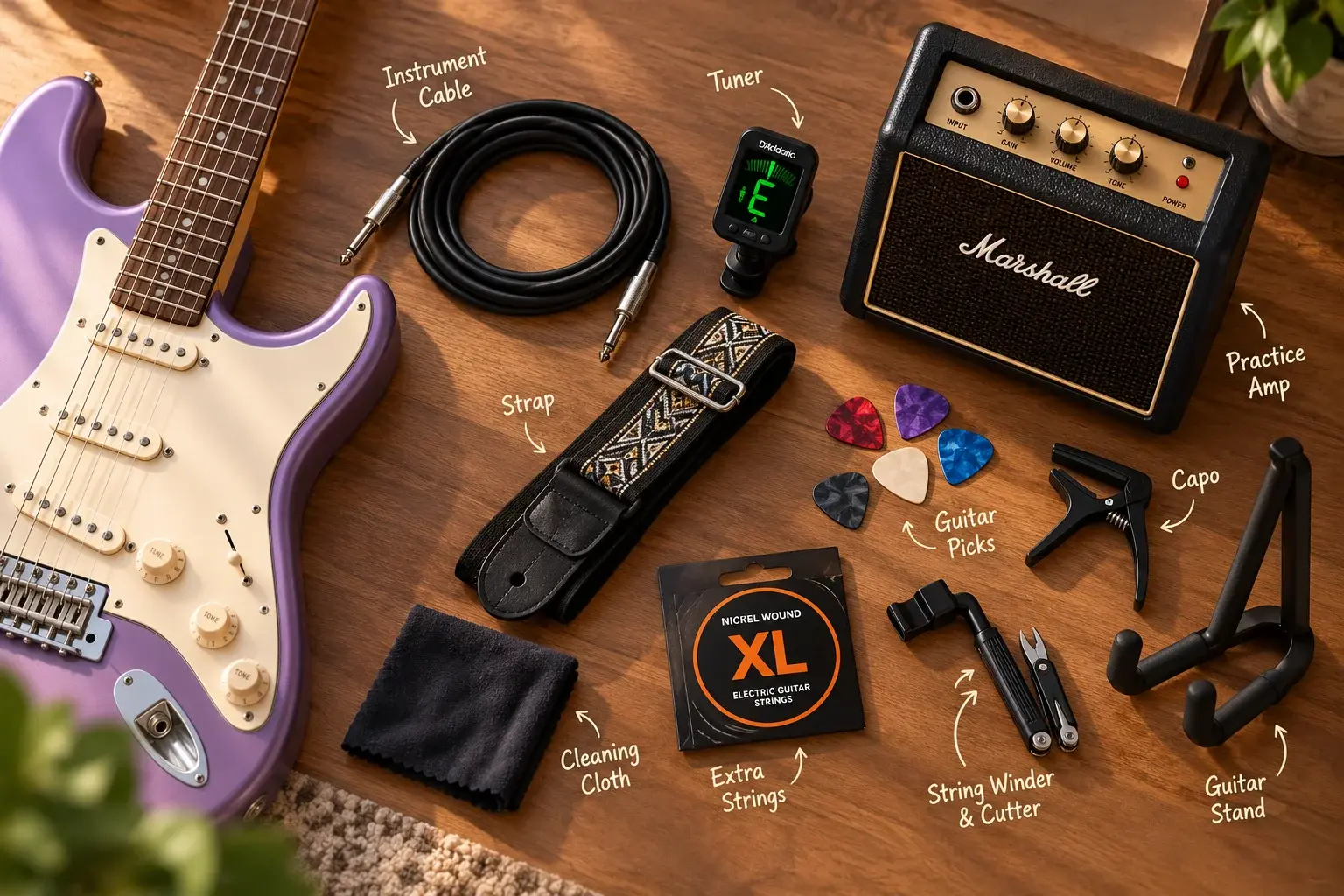
Yes, the only thing is, you need an amp and a few basic accessories to actually hear your electric guitar properly.
Difference Between Acoustic and Acoustic-Electric Guitars
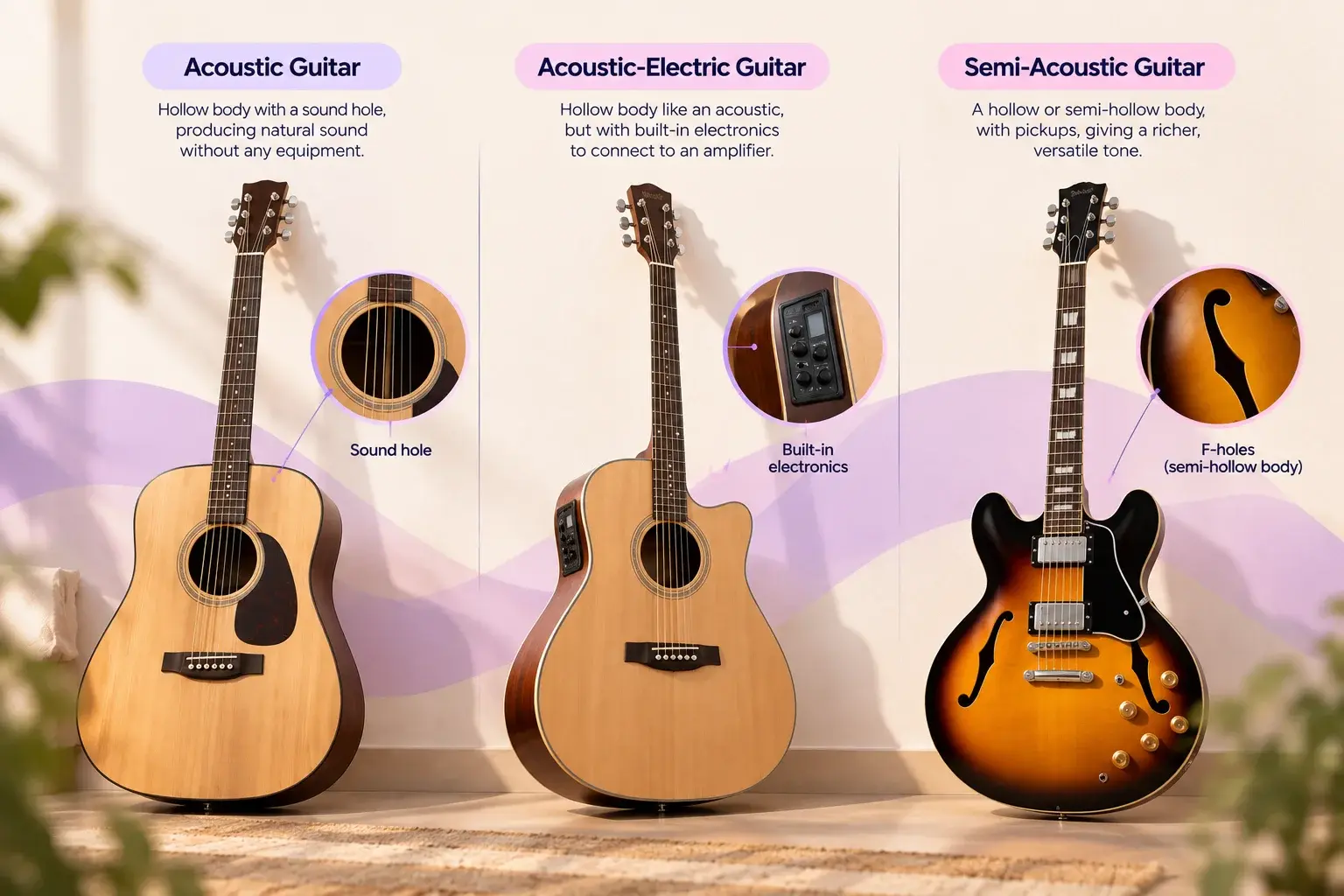
Once you are comfortable with the basics of both acoustic and electric guitar, there’s a third option. The acoustic-electric guitar. Understanding the difference between acoustic and acoustic-electric guitars is genuinely useful before you buy your first instrument.
An acoustic-electric guitar is a standard acoustic guitar fitted with a built-in pickup or microphone system. The tones are very similar to a regular acoustic guitar when unplugged. But it lets you plug into an amp for live performances or recording without changing the fundamental character.
One very important thing to clarify here is that there’s a significant difference between an acoustic-electric and a semi-acoustic guitar. So don’t mix up the two terms. A semi-acoustic guitar is not an acoustic guitar. Technically, it’s an electric guitar with a hollow or semi-hollow body. It sounds best with an amp and is commonly used in jazz and blues. By contrast, an acoustic-electric is a true acoustic guitar with amplification added for convenience.
Cost and Maintenance Comparison
Now, coming to the main question every beginner asks: what about the budget?
Acoustic guitars are generally more affordable to start with, since you only need the guitar. The average price for a beginner-to-intermediate acoustic guitar ranges from ₹7,000 to ₹15,000
Electric guitars usually cost more upfront and you will need an amp, a cable, and a tuner or pedal. A standard beginner-to-intermediate electric guitar typically ranges from ₹10,000 to ₹35,000 and above.
Acoustic guitars need fewer accessories long-term but require careful humidity control to prevent the wood from warping. Electric guitars need more setup and occasional maintenance on electronics, pickups and hardware, but tend to be more durable day-to-day.
So, once you add all the costs, acoustic guitars are more budget-friendly. But this gap has narrowed as affordable electric starter packs have become widely available.
Which Guitar type suits which music genre?
Your choice between an acoustic and an electric guitar depends on the genre you want to play.
You might want to learn acoustic guitar if you enjoy:
- Folk and singer-songwriter music
- Classical or flamenco guitar
- Country and bluegrass
- Unplugged, intimate performances.
You might want to learn electric guitar if you enjoy:
- Rock, metal or punk
- Blues and funk
- Pop and contemporary genres with heavy production
- Music that relies on solos, riffs and layered effects
That being said, plenty of genres genuinely overlap. Blues, for instance, sounds fantastic on either instrument, so don’t let this be the only factor in your decision.
Which Guitar Should Beginners Choose?
Here is the honest, practical answer to the acoustic vs. electric guitar question for beginners: there is no universally “right” first guitar. The best choice is the one that keeps you excited to pick it up and practice.
If you are drawn to a specific artist, song or genre, let that pull you toward the matching instrument. If you are unsure, acoustic guitar is often recommended as a first instrument. It requires fewer accessories and forces you to build solid technique early. But plenty of great guitarists started on electric and turned out just fine too.
Ready to Start Your Guitar Journey?
The debate around acoustic vs. electric guitars will continue forever. But as an aspirant, the most important step for you is to get started. Proper guidance and zero guesswork through YouTube tutorials will take you far.
At Artium Academy, our online guitar course is curated by renowned Bollywood music composer Raju Singh. His decades of experience have helped us shape a curriculum built on real, structured progress. Our guitar course is part of a globally recognized music programme (GRMP) that is Ofqual-accredited and aligned with the world’s leading music institutions. So, if you learn with us, your certification holds weight, whether you are building a portfolio or simply chasing a lifelong passion.
With live, 1:1 online classes, you get real-time feedback tailored to your instrument of choice right from the first lesson. So, book a free trial class and take the first step towards becoming the guitarist you’ve been meaning to be.
Frequently Asked Questions
Acoustic guitars produce sound naturally through a hollow body and sound hole. Electric guitars use magnetic pickups and require an amplifier to be heard properly.
It depends on the measure. Acoustic guitars require no extra equipment and build strong technique early on. But their higher string action can make fretting notes harder on your fingers at first.
Generally, yes. The thinner neck and lower string action on electric guitars make fast, technical playing like solos and bends noticeably easier to execute.
An acoustic-electric guitar is a standard acoustic guitar with a built-in pickup, so you can plug it into an amp while sounding identical to a regular acoustic when unplugged.
Acoustic guitars are typically more affordable to start with, since electric guitars require additional purchases like an amp and cable to be playable.
Yes, electric guitars need at least an amplifier and a cable to be heard at full volume, unlike acoustic guitars, which are fully self-contained.
Acoustic guitars are typically better suited to classical, folk and fingerstyle genres, thanks to their natural resonance and wider string spacing.
Many core techniques transfer between both, but some, like power chords and fast bends, are specific to, or easier on, electric guitars because of their construction.
Acoustic guitars are significantly louder unplugged because their hollow body is designed to project sound naturally.
Either is a valid starting point. Acoustic is often recommended for building foundational technique, while electric guitars suit beginners drawn to genres like rock or metal from day one.