
All Topics
- Alchemizing Music Concepts for Students
- Anuv Jain Songs
- Artist Spotlight
- artium gift card
- Artium Maestros
- Artium News
- Artium Tech Blog
- Best Coke Studio Songs
- Best Female Singers
- Birthday songs
- Bollywood Love Songs
- buying guide
- Carnatic Music
- Child Singers
- Devotional Music
- Editorials by Ananth Vaidyanathan
- English Love Songs
- Festival
- Film Music
- Ghazal Music
- Guitar
- Hindustani Classical Music
- Indian Classical Music
- Indian Folk Music
- Insights
- Instagram Reels Viral Songs
- Instruments
- Karaoke
- Karaoke Singing
- Keyboard
- Kids Music
- maestros
- Music Education
- Music for Kids
- Music Games
- Music Industry
- Music Instruments
- Music Legends
- Music Press Release
- Music Technology
- Music Theory
- Music Therapy
- Music Tools
- Piano
- piano guide
- Songs
- South Devotional Music
- Success Stories
- Tamil Film Music
- Telugu Film Music
- Time Theory
- Tools
- Uncategorized
- Uncategorized
- Uncategorized
- Uncategorized
- Vocal Range
- Vocal Singing
- Vocals
- western classical music
- western music
- Western vocal music
What Is an Acoustic Guitar? A Beginner’s Guide to the Instrument
What Is an Acoustic Guitar? A Beginner’s Guide to the Instrument
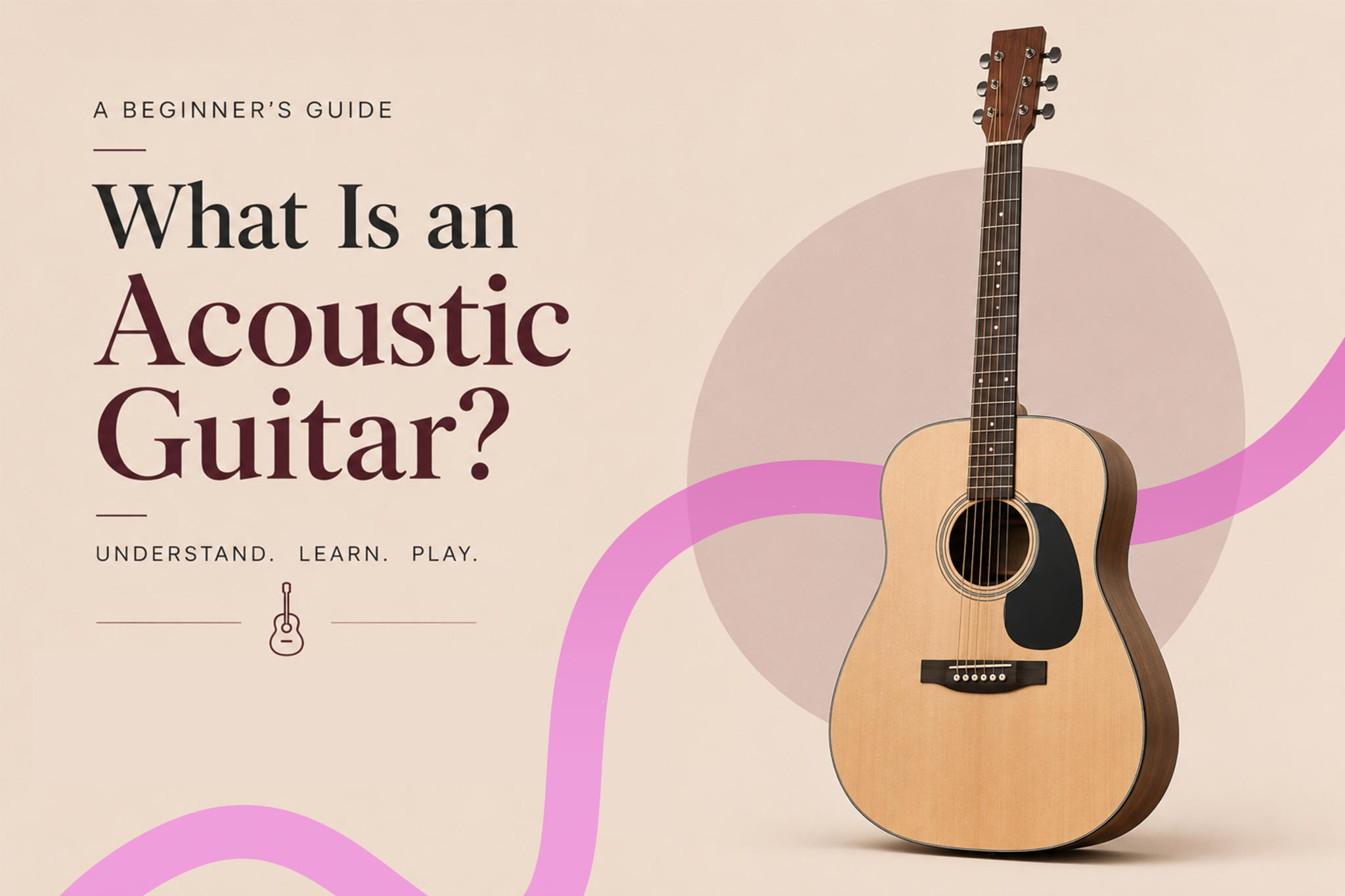
Table of Contents
Have you ever wondered when was the guitar invented or why one wooden instrument can fill a room without electricity? If you are asking what is a guitar the simple answer is that it is a string instrument that creates sound through vibrating strings and a hollow body.
An acoustic guitar is one of the instruments for beginners because it is portable, versatile and suitable for many styles, including pop, folk, rock, country, classical-inspired music and Hindi film songs. This guide from Artium Academy explains its parts, working method, chords, frets, types and tips for choosing your instrument.
Quick Summary
An acoustic guitar produces sound when its strings vibrate and resonate through the instrument’s body. It does not usually require an amplifier. Beginners should understand its parts, learn chords, practise regularly and choose a size and well‑set‑up instrument for progress.
What Is an Acoustic Guitar?
So what is a guitar in terms? It is a guitar that produces sound acoustically without depending on a speaker. When you pluck or strum its strings the vibrations travel through the bridge to the guitar’s top also called the soundboard. The soundboard vibrates along with the air inside the body. This movement projects sound through the hole creating the warm and natural guitar tone.
The guitar’s body shape, wood, strings and construction all influence its volume and tone. Most acoustic guitars have six strings. Are tuned from the string to the thinnest string as E, A D, G, B and E. They can be played with a pick, fingers or a combination of both.
Key Parts of an Acoustic Guitar
Understanding the parts can make your first lessons easier:
- Soundboard: The wooden surface of the body. It plays a role in producing volume and tone.
- Sound hole: The opening below the strings that helps project the sound from inside the guitar.
- Bridge: The piece on the body where the strings are held in place. It transfers string vibrations to the soundboard.
- Saddle: A strip fitted into the bridge that supports the strings and helps determine their height.
- Neck: The long wooden section connecting the body to the headstock.
- Fingerboard or fretboard: The surface on the neck where you press the strings to play notes and chords.
- Frets: Thin metal strips placed across the fretboard. Pressing a string behind a fret shortens its vibrating length. Changes its pitch.
- Nut: A strip between the headstock and fretboard that guides the strings.
- Headstock: The section of the guitar where the tuning machines are attached.
- Tuning machines: Pegs that allow you to tighten or loosen each string.
- Action: The distance between the strings and fretboard. Very high action can make a guitar uncomfortable for beginners.
- Cutaway: A curved section on some guitar bodies that makes higher frets easier to reach.
A well-maintained acoustic guitar should feel comfortable in your hands. If the strings feel extremely high, the guitar may need a professional setup.
Is Electric Guitar Easier Than Acoustic?
Many beginners ask, “is guitar easier than acoustic?” The answer depends on your goals, physical comfort and preferred music style.
Electric guitars usually have strings, slimmer necks and lower string action. These features can make pressing the strings and playing bends easier. However an electric guitar also requires an amplifier, cable, power source and additional equipment.
An acoustic guitar may have strings and higher action, which can feel harder on the fingertips at first. However it allows you to practise anywhere without setting up equipment. It also helps beginners develop chord shapes, rhythm and finger strength.
Comparing Learning Curves for Beginners
| Feature | Acoustic guitar | Electric guitar |
| String feel | Often firmer and thicker | Usually lighter |
| Equipment | Guitar, tuner, and pick are usually enough | Guitar, amplifier, cable, and accessories |
| Portability | Easy to carry and play anywhere | Less convenient because of extra equipment |
| Beginner challenge | Chord pressure and fingertip comfort | Muting, effects, and amplifier settings |
| Best suited for | Singing accompaniment, folk, pop, Bollywood, and unplugged music | Rock, metal, blues, pop leads, and solos |
| Early focus | Rhythm and chord changes | Notes, riffs, bends, and effects |
Neither instrument is automatically easier for everyone. If you want to accompany your singing or play popular songs, an acoustic guitar can be a practical first choice. If you dream of playing electric riffs and solos, starting with an electric guitar may be more motivating.
A consistent practice routine matters more than the instrument you select. Beginners can also learn guitar online through structured video lessons, live classes, and guided practice plans.
How Many Chords Are There in an Acoustic Guitar?
The question how many chords are there in acoustic guitar does not have one fixed answer. A guitar can play thousands of chord shapes because chords can be built from different notes, positions, inversions, extensions, and tunings.
For example a C major chord can be played in positions on the fretboard. You can also play minor seventh suspended, diminished, augmented and extended chords. In theory the number of guitar chords is extremely large.
Beginners do not need to learn all of them. A small group of chords can help you play hundreds of songs. Once you understand shapes you can gradually learn barre chords and movable chord forms.
Essential Beginner Chords to Learn First
Start with these chords:
- C major
- G major
- D major
- A major
- E major
- A minor
- E minor
- D minor
These chords appear in many beginner songs and chord progressions. Practise changing between two chords such as G to C or C to D. Then add a down-strumming pattern.
A useful beginner routine includes:
- Tune the guitar before practising.
- Place each finger close to the fret without touching it.
- Pluck each string separately to check for muted or buzzing notes.
- Change between two chords slowly.
- Increase speed only after the chord changes sound clean.
- Add simple strumming once your fingers remember the shapes.
Practising guitar finger exercises can improve finger independence, strength, and coordination. Begin slowly and stop if you feel sharp or persistent pain.
If you are still wondering how many chords are there in guitar, remember that learning eight to ten shapes is more useful at the beginning than memorising a large chord dictionary.
How Many Frets on an Acoustic Guitar?
The answer to how many frets on a guitar depends on its design. Most standard acoustic guitars have 18 to 20 frets while some models include 21 or more. A steel-string acoustic guitar may have 19 or 20 frets.
Frets divide the fingerboard into sections. Each fret generally raises the note by one semitone when you press a string behind it. The 12th fret is especially important because it produces the note as the string, one octave higher.
Acoustic guitars often have higher frets than electric guitars because the large body and sound hole limit access to the upper part of the neck. For chord playing, rhythm and beginner songs the standard fret range is more than sufficient.
When checking a guitar, run your hand gently along the edge of the fretboard. The fret ends should not feel sharp or scratchy. Also check that notes sound clear without buzzing.
How Do Acoustic-Electric Guitars Work?
If you are asking how do electric guitars work the main difference is that they combine an acoustic body with built-in electronics.
An electric guitar produces its unplugged sound in the same way as an acoustic guitar. When connected to a speaker, audio interface or mixing console its pickup captures the string or body vibrations. Sends the signal through a cable.
Common components include:
- Pickup: Detects string or body vibrations.
- Preamp: Strengthens and shapes the signal before it reaches an amplifier.
- Equaliser controls: Allow adjustments to bass, middle, and treble frequencies.
- Volume control: Adjusts the output level.
- Tuner: Many models include a built-in digital tuner.
- Battery compartment: Powers the preamp and onboard electronics.
Some guitars use an under-saddle piezo pickup while others use a microphone or a combination of types. Electric guitars are useful for stage performances, mic events, worship music, recording and live classes.
You can still play a guitar without an amplifier. When unplugged it works like a guitar. Plugging it in simply gives you volume and control.
Types of Acoustic Guitars Explained
guitars are available in designs. Their body shape, strings, scale length and construction affect comfort and sound.
1. Steel-String Acoustic Guitar
This is the type for pop, rock, folk, country and singer-songwriter music. It has steel strings that produce a projecting tone.
2. Classical Guitar
A classical acoustic guitar uses nylon strings, which feel softer on the fingertips than steel strings. A classical acoustic guitar usually has a neck. It is designed for music, flamenco, fingerstyle and certain traditional styles.
3. Dreadnought Guitar
A dreadnought acoustic guitar has a body and strong bass response. A dreadnought acoustic guitar is popular for strumming because it can produce volume. However the larger size of a guitar may feel less comfortable for children or smaller players.
4. Concert and Grand Concert Guitar
Concert and grand concert acoustic guitars are smaller than guitars and often feel more comfortable for people just starting out. A concert or grand concert acoustic guitar gives a sound and works well for fingerpicking and light strumming.
5. Auditorium and Grand Auditorium Guitar
Auditorium and auditorium acoustic guitars provide a balance between body size, volume, bass and treble. An auditorium or grand auditorium acoustic guitar is a choice for players who switch between strumming and fingerstyle.
6. Travel Guitar
Travel acoustic guitars are small and easy to carry. A travel acoustic guitar may have a body or a shorter scale length making it good for traveling for kids and, for players who prefer an instrument.
7. 12-String Acoustic Guitar
A 12-string acoustic guitar has six pairs of strings. This kind of guitar produces a sound that stands out. Playing it requires finger pressure and careful tuning. Because of these factors a 12-string acoustic guitar is usually better suited for players rather than as a first instrument.
8. Acoustic Bass Guitar
An acoustic bass guitar has strings and a larger body that is designed for notes. This type of guitar is different from a six-string guitar. It is usually chosen by players who’re interested in playing bass lines.
How to Choose Your First Acoustic Guitar
Choosing your guitar should not just be about picking the attractive color. Focus on how comfortable the guitar feels, how easy it is to play the sound it makes and how well it is made.
1. Select the Right Size: A size acoustic guitar is good for teenagers and adults. A ¾-size acoustic guitar might be more comfortable for kids, players or anyone who finds a full-size guitar hard to hold. A concert or travel acoustic guitar can also be a choice.
2. Check the Neck: The neck of the guitar should feel comfortable. It should not be too wide or too thick. Grip the neck with your hand. Make sure you can reach the strings without straining.
3. Test the Action: Press the strings of the guitar at the frets. If the strings are very high above the fretboard it may be hard to form chords. A music shop can often adjust the action of the guitar through a setup.
4. Inspect the Build: Look for the following on the guitar:
▸Smooth fret ends.
▸A straight neck.
▸No cracks around the bridge or neck joint.
▸Firm tuning machines.
▸A bridge that is securely attached.
▸Even finish and clean construction.
▸No major buzzing across several frets.
5. Choose the Right Strings: Steel strings are common on guitars while nylon strings are used on classical acoustic guitars. Do not put steel strings on a guitar unless the instrument is specifically designed for them.
Consider Your Budget
In India beginner guitars commonly range from ₹5,000 to ₹15,000 depending on the brand, materials, accessories and current offers. Some entry-level acoustic guitar models cost less while premium acoustic guitar instruments can be more expensive. Retail listings show beginner acoustic guitar models around ₹6,999 to ₹15,000 and acoustic guitar options under ₹10,000. A guitar bag, tuner, extra strings, picks and a stand may add to the cost of the guitar. Before buying try the guitar in person if possible or purchase from a seller with a return and warranty policy. A comfortable setup acoustic guitar will usually help you practice more than an acoustic guitar that is difficult to play. For more options, view our store page to explore beginner-friendly guitars and accessories.
Frequently Asked Questions
An acoustic guitar is used for strumming, fingerpicking, songwriting, accompaniment, live performances, recording and music practice. It can support singing and works in genres such as pop, folk, country, rock, classical and film music.
There is no answer. Acoustic guitars are simple to carry and use. Their strings may feel firmer. Electric guitars often have strings. Require an amplifier and additional equipment. The best choice is the instrument that matches your interests.
There is no limit. A guitar can play thousands of chord shapes and variations. Beginners can start with chords such as C, G, D, A, E, Am, Em and Dm.
A standard acoustic guitar usually has 18 to 20 frets. Some designs have 21 or more. The exact number varies by model.
An acoustic guitar produces sound through its strings and hollow body. An electric guitar includes a pickup and preamp allowing you to connect it to an amplifier or sound system.
No. A regular acoustic guitar does not need an amplifier. An electric model can be plugged in when you need volume for a stage, rehearsal or recording setup.
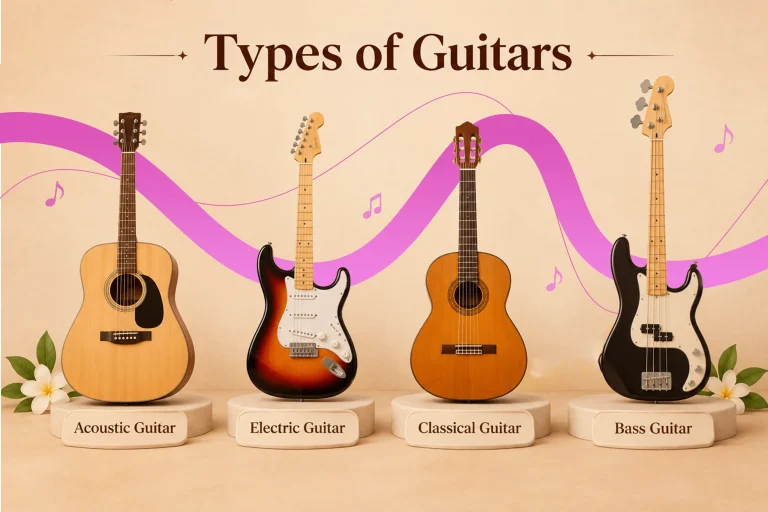
The main types include steel-string, classical dreadnought, concert, auditorium, travel, 12-string and acoustic bass guitars. Each type has features, body sizes, string materials and tonal qualities.
In India a beginner acoustic guitar may cost ₹5,000 to ₹15,000. Prices vary according to brand, construction, accessories, seller and offers. A professional setup may cost extra.
Yes, many beginners learn through online lessons, books, practice apps, and structured courses. However, teacher feedback can help correct posture, tuning, chord technique, and rhythm more quickly. Artium Academy offers guided music-learning resources for students who prefer structured support.
A size acoustic guitar is suitable for adults and older teenagers. A ¾-size, concert or travel acoustic guitar may be more comfortable, for children, smaller players or beginners who find a full-size body to manage.