

All Topics
- Alchemizing Music Concepts for Students
- Artist Spotlight
- artium gift card
- Artium Maestros
- Artium News
- Artium Tech Blog
- Best Coke Studio Songs
- Best Female Singers
- Bollywood Love Songs
- buying guide
- Carnatic Music
- Devotional Music
- Editorials by Ananth Vaidyanathan
- English Love Songs
- Festival
- Film Music
- Ghazal Music
- Guitar
- Hindustani Classical Music
- Indian Classical Music
- Indian Folk Music
- Insights
- Instagram Reels Viral Songs
- Instruments
- Karaoke
- Karaoke Singing
- Keyboard
- Kids Music
- maestros
- Music Education
- Music for Kids
- Music Industry
- Music Instruments
- Music Legends
- Music Technology
- Music Theory
- Music Therapy
- Piano
- piano guide
- Songs
- South Devotional Music
- Success Stories
- Tamil Film Music
- Telugu Film Music
- Time Theory
- Tools
- Uncategorized
- Uncategorized
- Uncategorized
- Uncategorized
- Vocal Singing
- Vocals
- western classical music
- western music
- Western vocal music
A Musicological Study: The Evolution of Music from Nāda to A New Structured Raga Derivation Framework
A Musicological Study: The Evolution of Music from Nāda to A New Structured Raga Derivation Framework
Table of Contents
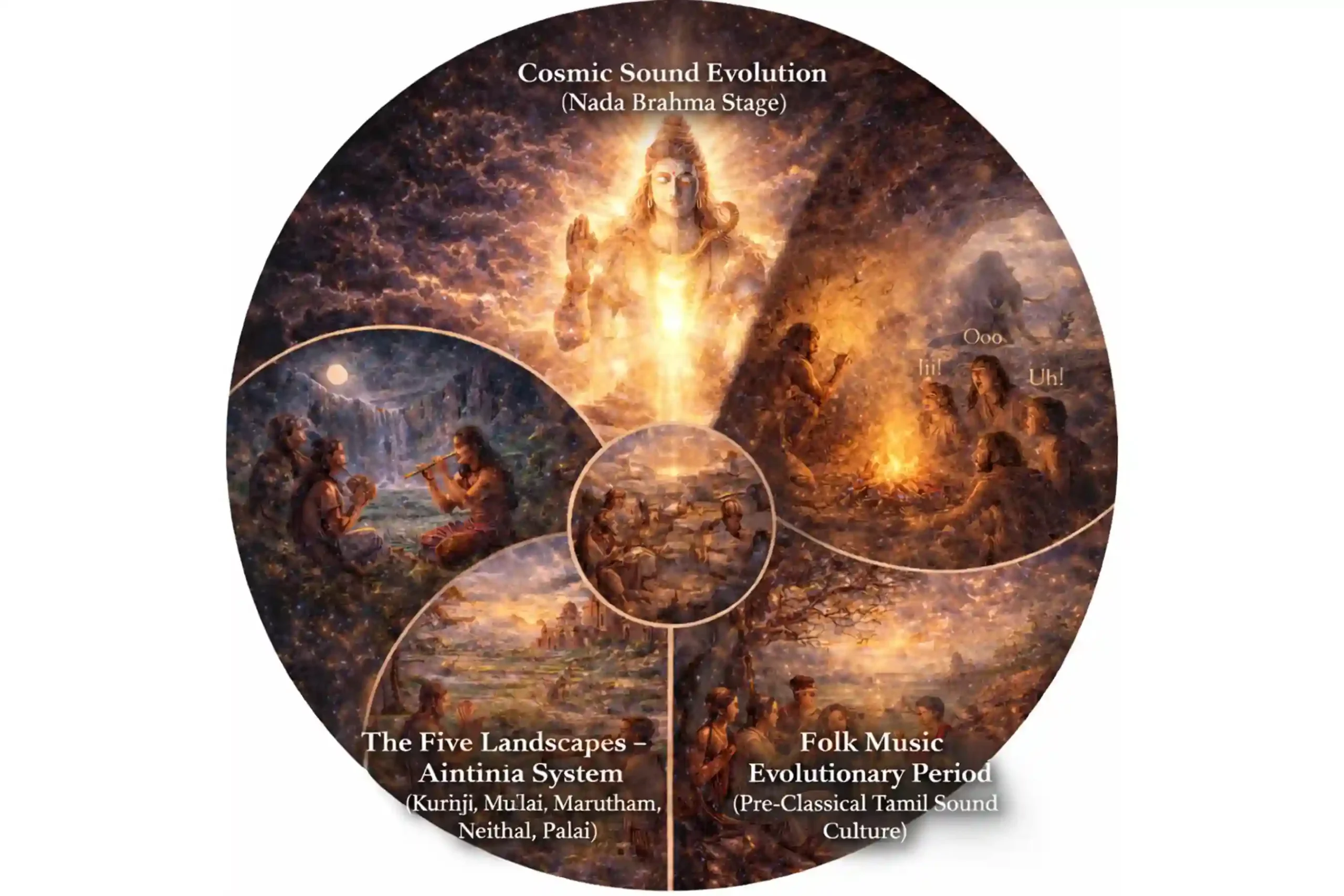
Music is not merely an art created by humans; it is a phenomenon that arose naturally with the universe itself. In cosmological thought, a minute primordial seed survived the great dissolution (pralaya) and later expanded to recreate the Sun, the Moon, celestial forms, and all living beings. This original emergence can be described poetically as the universe arising within the music of the nurturing sky.
The process of embryonic development mirrors this cosmic musicality. Just as music offers peace through an indescribable form of sound, embryonic growth unfolds through subtle vibrations, forming life in profound silence and calm. These vibrations are not random; they are ordered, rhythmic, and meaningful, much like music itself. Carnatic Music, therefore, existed before the world took form, not as melody or song, but as Nāda, the fundamental sonic principle.
Sound Before Form: The First Cosmic Age
This idea is beautifully articulated in Paripāṭal, particularly through the verses of Kīraṇḍaiyār. He describes a primordial state where form did not yet exist, but sound alone prevailed. This era, where existence was perceived through vibration rather than shape, may be understood as the First Cosmic Age.
Poetic Reference (Conceptual Summary)
Second Song – Invocation to Lord Tirumāl
Song link:
Composer: Kīraṇḍaiyār
Paṇ Composer: Nannākanār
Paṇ: Pālaiyāzh
The poem praises the ancient natural order where sound precedes creation, affirming that the universe itself unfolds from sonic essence.
From Cosmic Sound to Human Language
As the universe evolved over approximately 4.54 billion years, sound gradually transformed from cosmic vibration into biological rhythm, and eventually into structured communication. Today, research estimates that the world contains over 6,000 languages, all originating from this gradual refinement of sound.
Among these languages, music emerged where sound, meaning, emotion, and structure intersected. Musical instruments evolved from natural materials, such as wood, reeds, and animal skin, initially used in daily life and later refined into instruments for rhythm and melody.
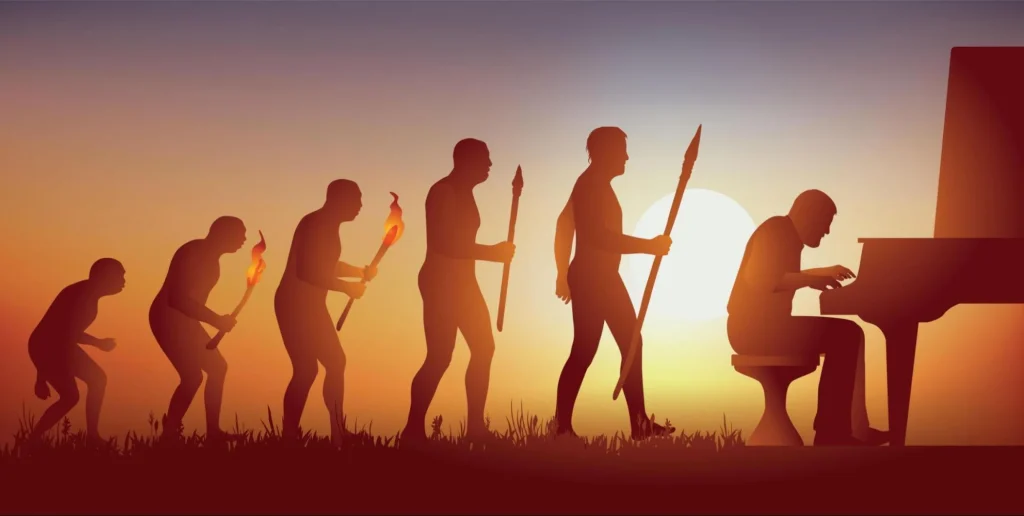
Music and language evolved together, much like the developmental stages of a newborn child: sound first, meaning later, structure last.
The Growth of Music and Language in India
In the Indian subcontinent, linguistic and musical evolution occurred gradually. Linguists explain that as humans subtly altered the sounds they heard through repetition, emotion, and context, new languages emerged from older ones.
Music followed the same path, becoming increasingly structured while retaining emotional depth.
Age of Languages and Early Musical Evidence
| Language | Approx. Age (Years) | Earliest Evidence |
|---|---|---|
| Tamil | 5,000+ | Sangam literature, Keeladi inscriptions |
| Sumerian | 5,100+ | Cuneiform tablets |
| Egyptian | 4,700+ | Pyramid inscriptions |
| Sanskrit | 3,500+ | Rig Veda (oral tradition) |
| Greek | 3,500+ | Linear B tablets |
| Chinese | 3,300+ | Oracle bone inscriptions |
| Kannada | 2,300+ | Halmidi inscription |
| Telugu | 2,000+ | Bhattiprolu inscriptions |
| Malayalam | 1,200+ | Vattezhuthu records |
| Hindi | 1,200+ | Early Khari Boli texts |
| English | ~1,400 | Anglo-Saxon laws |
Tamil Music: The Earliest Structured Rāga System
Based on evidence from the Sangam literature and later grammatical and musicological sources, the Tamil musical tradition may be regarded as one of the earliest structured melodic traditions. Literary and analytical studies indicate that early Tamil music operated within a systematically organized melodic framework that is comparable in function to later rāga systems.
Although the technical term “rāga” emerged in subsequent theoretical traditions, the Tamil Paṇ system demonstrates an early and coherent application of structured melodic grammar.
Continuity into Modern Carnatic Music
Many ancient Tamil Paṇs continue to exist in contemporary Carnatic music under transformed nomenclature and revised classificatory systems. This evolution reflects historical continuity rather than discontinuity.
In particular, although Indaḷa Paṇ later came to be identified under the name Māyāmāḷavagauḷa, no fundamental alteration is observable in its underlying swarasthāna structure, scalar movement (ārohaṇa–avarohaṇa), grammatical constraints, or core melodic identity.
The change may therefore be understood primarily as one of theoretical articulation and terminological reformulation rather than the creation of an entirely new melodic entity. Structural comparison suggests that the melodic essence remained continuous across historical phases.
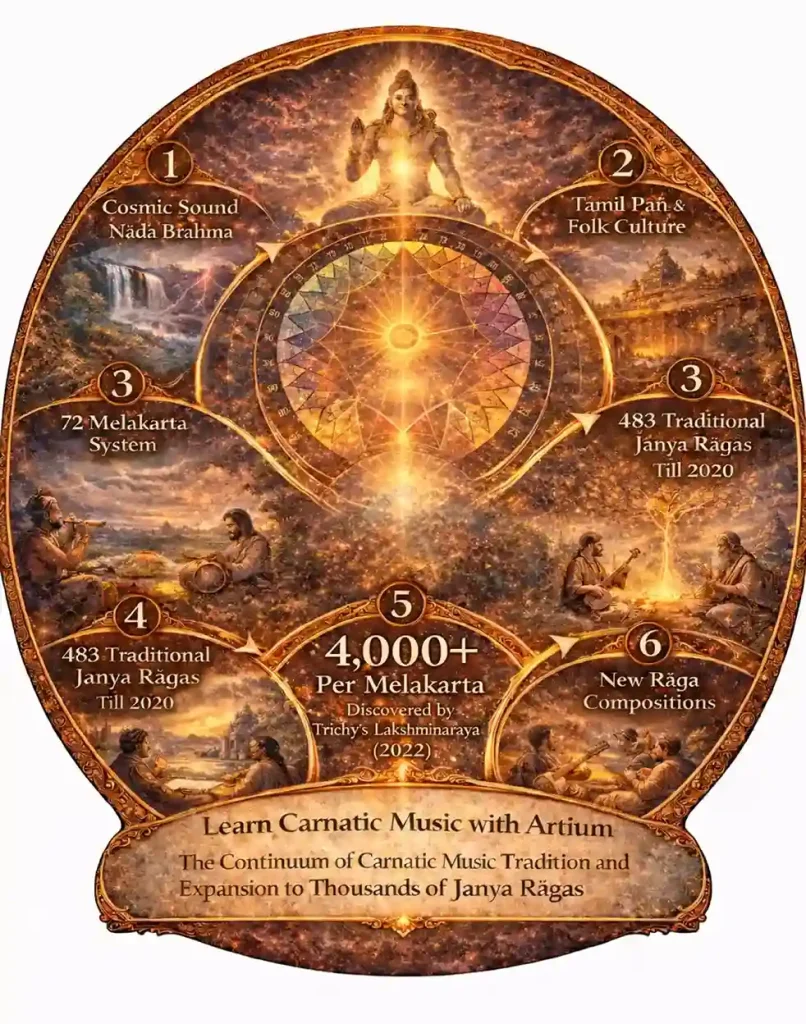
Over several centuries, the Tamil Paṇ tradition interacted with regional musical practices, folk idioms, and evolving theoretical models. In the 17th century, Venkatamakhin articulated a systematic scalar classification framework. This framework was subsequently standardized in the 18th century by Govindacharya, resulting in the codified 72 Melakarta system.
Modern Carnatic music may therefore be understood not as a rupture from earlier Tamil musical systems, but as a historically layered development in which earlier Paṇ structures were rearticulated within a formalized theoretical framework.
Early Tamil Melodic Organization
- Origins traceable to early historic Tamil culture, with evidence preserved in Sangam texts
- Structured use of 103 Paṇs within a functional melodic framework
- Early application of rāga-like scalar organization prior to the Melakarta–Janya hierarchical classification system
- Absence of a codified parent–child taxonomy in its earliest stages
- Aesthetic and emotional mapping based on landscape (tiṇai), season, and time
Transmission Across Languages
Sanskrit
- Paṇ names translated into Sanskrit
- Same 103 Paṇ system adapted linguistically
Kannada & Telugu
- Tamil Paṇ concepts absorbed via Sanskrit
- Classical compositions emerged
- In the 17th century, Venkatamakhin codified the 72 Melakarta system
Malayalam & Hindi
- Continued use of the Melakarta framework
- Hindustani music developed 10 Thāṭs
- Clear mother–child rāga classification
Stages of Musical Evolution
| Stage | Period (BCE) | Key Feature | Musical Nature |
|---|---|---|---|
| Emotion | 500,000–300,000 | Vocal reaction | Crying, shouting |
| Sound | 300,000–250,000 | Pitch awareness | Raw tones |
| Controlled Voice | 250,000–150,000 | Swaric control | Extended notes |
| Repetition | 150,000–100,000 | Rhythm | Clapping, stamping |
| Meaning | ~100,000 | Symbolic sound | Social music |
| Proto-words | ~70,000 | Stable sounds | Melodic speech |
| Language | ~50,000 | Grammar | Music separated |
The Five Great Paṇs and Landscapes
| Landscape | Paṇ | Time & Season |
|---|---|---|
| Kurinji | Kurinjippāṇ | Night, winter |
| Mullai | Mullaippāṇ | Evening, rainy |
| Marutham | Marudappāṇ | Dawn |
| Neithal | Neitharpāṇ | Late afternoon |
| Palai | Pālaiyppāṇ | Midday (situational) |
This time-landscape theory is codified in Tolkāppiyam.
Modern Music, Carnatic Music.
Many ancient Paṇs survive today under new names.
For example: Indaḷa Paṇ → Māyāmāḷavagauḷa
Through centuries of evolution, we can trace that all are deeply connected to human emotion, time, environment, and expression, etc.Like this, the 72 Mela kartha system evolved with the help of the 103 pan system and folk music ect, by tandardised by Govindacharya in the 18th century (building on earlier work by Venkatamakhi)
Then Devotional Preservation: The Bhakti Period
Between the 6th and 7th centuries CE, the Bhakti movement played a decisive role in preserving Tamil melodic traditions.
The hymns of:
Tēvāram and Tiruvācakam were rendered in specific Paṇs within temple practice. During this era, Music and poetry functioned as inseparable devotional music forms. Temple traditions preserved melodic continuity. Paṇ identities survived through lived performance.
Systematization and the Melakarta Framework Through cultural transmission. Paṇ concepts entered Sanskritic terminology. Melodic structures influenced Kannada and Telugu compositions. In the 17th century, Venkatamakhi codified the 72 Melakarta system — a comprehensive scalar classification method. Later, Hindustani music organized rāgas into ten Thāṭ frameworks. Several ancient Paṇs survive today under transformed names. For example: Indaḷa Paṇ corresponds closely to Māyāmāḷavagauḷa.
Historical Scope of Janya Rāgas
Traditionally:
Each Melakarta supported 10–20 commonly practiced janya rāgas.
Across 72 Melakartas, approximately 400–483 rāgas were documented.
Mathematical possibilities allowed up to 483 simple varja (note-omission) combinations per Melakarta.
Structural Discovery of Janya Rāgas (2022)
In 2022, Trichy S. Lakshmipriya conducted a systematic structural study of all 72 Melakarta rāgas under the guidance of Dr. P. Natrajan.
Through rigorous rāga–lakṣaṇa based validation, including analysis of ārohaṇa–avarohaṇa structures, scalar coherence testing, and aesthetic identity assessment, the research demonstrated that the Melakarta framework structurally supports a very large expansion of derivative rāgas.The study showed that the Melakarta system can generate 4000+ structured janya rāgas, along with several thousand vakra configurations derived through permissible melodic pathways.
Each rāga in the study was validated using the following criteria:
- Clear ārohaṇa–avarohaṇa structure
- Compliance with traditional rāga lakṣaṇa principles
- Distinct scalar identity within the Melakarta framework
- Aesthetic individuality consistent with rāga grammar
Based on systematic structural permutations of varja (note-omission) patterns, the research further demonstrated that Carnatic music accommodates possible varja rāga configurations within the Melakarta system.
Ishai priya ragam a janya from the 15th Melakarta Māyāmāḷavagauḷa:
Arohanam: S R₁ G₃ M₁ P S
Avarohanam: S N₃ D₁ P M₁ G₃ R₁ S
This rāga is named “Isai Priya” (Īsai Priya) and was discovered and formally structured by Lakshmi Priya.
Isai Priya is a janya rāga derived from the 15th Melakarta, Māyāmāḷavagauḷa. Its arohanam and avarohanam structurally correspond to the scalar framework associated with the ancient Tamil Paṇ Indhalam, thereby demonstrating continuity between the Tamil Paṇ tradition and the later Melakarta classification.
Swarasthāna Structure (15th Melakarta – Māyāmāḷavagauḷa)
- S (Shadjam)
- R₁ (Shuddha Rishabham)
- G₃ (Antara Gandharam)
- M₁ (Shuddha Madhyamam)
- P (Panchamam)
- D₁ (Shuddha Dhaivatam)
- N₃ (Kakali Nishadam)
Isai Priya, as a janya of Māyāmāḷavagauḷa, operates strictly within these swarasthānas without the inclusion of anya swaras. The rāga employs a varja-based structure in ascent, omitting Dhaivatam and Nishadam, while retaining the full scalar descent aligned with its Melakarta parent.
Thus, from a theoretical standpoint, Isai Priya exemplifies how a janya rāga can emerge through selective omission while preserving the parent scale’s swarasthāna integrity. The rāga maintains scalar coherence, Lakshana compliance, and aesthetic individuality within the grammatical framework of the 15th Melakarta.
This further supports the conclusion that the Melakarta system is dynamically expandable within grammatical boundaries rather than numerically fixed.
This work establishes that the Melakarta framework is dynamically expandable within grammatical boundaries rather than numerically fixed.
From Theory to Living Music
The structural findings were translated into practical musicianship: Original compositions were created in newly structured rāgas.Lyrics were aligned with rāga grammar. Characteristic phrases were demonstrated. Notational documentation provided compositional evidence. Thus, theoretical expansion became artistic realization.
Learn Carnatic Music with Artium
From primordial Nāda to refined Rāga, music is not a human invention, it is a living continuum of cosmic vibration shaped into aesthetic experience. Carnatic music is not merely sound. It is structured emotion, disciplined imagination, and codified beauty, refined through centuries of scholarship, devotion, and creative genius.
From the ancient Paṇ traditions of Tamil music to the mathematically elegant Melakarta system, this tradition has always embodied both vastness and precision. Within its framework lies immeasurable creative potential. The expansion and validation of 4000+structured Janya Rāgas demonstrate that Carnatic music is not a static heritage; it is an evolving intellectual and artistic universe.
At Artium, learning carnatic music means: Understanding the science behind swara and shruti, experiencing rāga as emotions, etc. Discover the depth. Experience the lineage. Participate in a tradition that continues to unfold. Modern music is not separate from the past; it is the latest flowering of an ancient sonic principle that began as vibration itself. Step into the continuum.
FAQs
Nāda is the primordial vibration that exists before form — the supreme sonic principle not yet shaped into structured music. In musicology, Nāda is understood in two forms: Āhata Nāda, the struck sound produced by instruments like the vīṇā or the human voice, and Anāhata Nāda, the unstruck inner vibration experienced spiritually. Carnatic music gradually systematizes Nāda into Swaram, Rāgam, Tālam, and Kīrtanam. From Nāda arise the seven swaras and twelve swara-sthānas, forming the foundations of Melakarta and Janya rāgas.
The 103 Paṇs of Tamil music, transmitted from the Sangam era, were established melodic systems preserved through oral tradition. Distinctions such as Ri₁, Ri₂, and Ri₃ were clearly realized in performance, though not formally codified in notation. When music theory later assumed written form, these tonal variations were organized into systematic swara-sthāna categories, culminating in the mathematical formalization of the 72 Melakarta system. During this codificatory phase, several Paṇ names underwent Sanskritization. However, this transformation affected terminology alone; the essential melodic grammar, ascent–descent structure, gamaka treatment, and performance continuity remained intact.
The Tamil Bhakti movement (6th–9th century CE) preserved ancient Tamil melodic traditions by embedding music within devotional practice. Hymns of Tēvāram by Tirugnanasambandar, Appar and Sundarar, and Tiruvācakam by Manikkavacakar were set to specific Paṇs (ancient Tamil melodic modes). Sung daily in temples by Odhuvars, these compositions ensured continuous oral transmission of Paṇ structures. Temples functioned as cultural conservatories, safeguarding melodic grammar and devotional expression. This living tradition later influenced the evolution of Carnatic rāga systems, preserving Tamil music heritage.
Paṇs evolved from the Sangam era through the Bhakti period and continue as part of the Tamil musical heritage today. Ragas such as Sankarābharanam and Harikambhoji underwent name changes due to linguistic adaptation and historical transition, yet their essential melodic identity remained intact. The mode of rendition, tonal structure, gamaka usage, and grammatical framework remained unchanged. Likewise, the literary traditions they rendered, including Tēvāram and kīrtanas, preserved their core musical character. Thus, the transformation occurred mainly in nomenclature, not in intrinsic musical form or compositional grammar.
Historically, earlier documented traditions listed a few hundred janya rāgas under the 72 Melakarta framework. In 2022, Trichy S. Lakshmipriya systematically demonstrated, through structural and mathematical analysis, that by employing only the varja method—omitting specific swaras without the use of anya swaras or vakra movements— 4000+ musically derivable janya rāgas can emerge from a single Melakarta rāga. When vakra permutations are incorporated, the generative scope expands by several thousands further. What was once regarded as an oral assumption concerning “thousands of rāgas” is now analytically substantiated through codified classification within the Melakarta system.
Artium Academy helps students understand the glorious history of Carnatic music by combining structured online pedagogy with historical context. Beyond practical lessons, Artium integrates theory modules that explain the evolution from Nāda to Rāga, the Melakarta system, Bhakti-era compositions, and contributions of great composers.
Through curated courses, expert mentors, interactive sessions, and digital resources, students learn not only how to sing but also why the music evolved the way it did. This blended approach connects tradition, theory, and performance, making Carnatic music’s rich heritage accessible to modern learners worldwide.



Thank u so much 💓