
All Topics
- Alchemizing Music Concepts for Students
- Anuv Jain Songs
- Artist Spotlight
- artium gift card
- Artium Maestros
- Artium News
- Artium Practice Studio
- Artium Tech Blog
- Best Coke Studio Songs
- Best Female Singers
- Birthday songs
- Bollywood Love Songs
- buying guide
- Carnatic Music
- Child Singers
- Devotional Music
- Editorials by Ananth Vaidyanathan
- English Love Songs
- Festival
- Film Music
- Ghazal Music
- Guitar
- Hindustani Classical Music
- Indian Classical Music
- Indian Folk Music
- Insights
- Instagram Reels Viral Songs
- Instruments
- Karaoke
- Karaoke Singing
- Keyboard
- Kids Music
- maestros
- Music Education
- Music for Kids
- Music Games
- Music Industry
- Music Instruments
- Music Legends
- Music Press Release
- Music Technology
- Music Theory
- Music Therapy
- Music Tools
- Piano
- piano guide
- Songs
- South Devotional Music
- Success Stories
- Tamil Film Music
- Telugu Film Music
- Time Theory
- Tools
- Uncategorized
- Uncategorized
- Uncategorized
- Uncategorized
- Vocal Range
- Vocal Singing
- Vocals
- western classical music
- western music
- Western vocal music
Guitar Anatomy – Understanding the Different Parts of the Guitar
Guitar Anatomy – Understanding the Different Parts of the Guitar
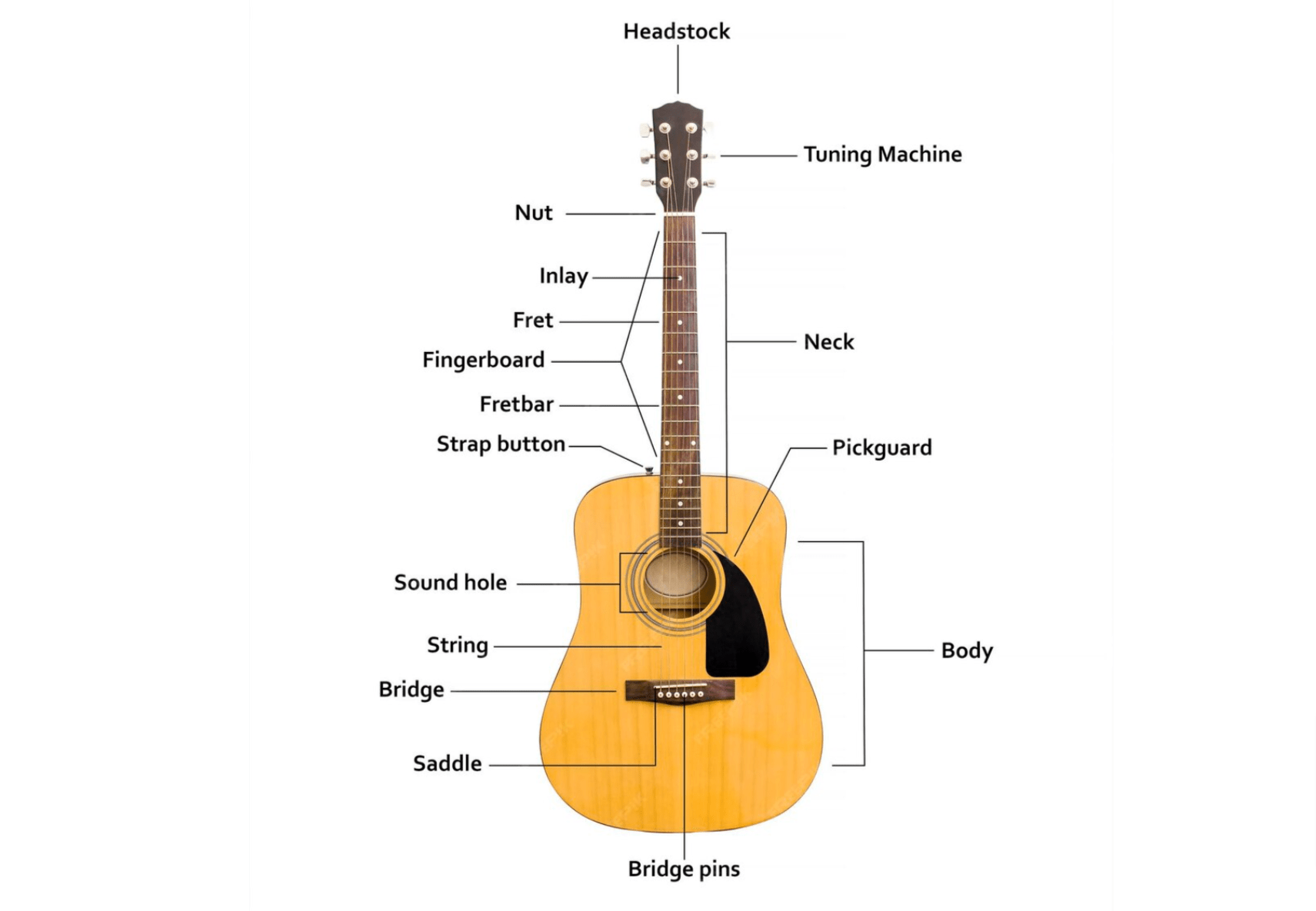
Table of Contents
Quick Summary
| Guitar anatomy is the study of the parts that make up a guitar: the headstock, neck, body, strings, bridge and more. Knowing the different parts of the guitar helps you play with better technique, tune and maintain your instrument, and choose the right guitar, whether acoustic or electric. |
Introduction
It is often said that the guitar’s sound can paint a thousand different emotions. But have you ever wondered how a piece of wood and some strings can create such music? The secret lies in its design, and understanding how all the parts connect is key for anyone wanting to learn guitar—be it through online guitar classes, an online guitar course, or simply practising on your own. Learning about the different parts of guitar can help you play better and can also help you take better care of your guitar, whether it’s acoustic or electric. In this blog, we’ll dive into the names of guitar parts and their functions, and explore the differences between these two wonderful types of guitars!
But before that…
If you’re really excited to start your journey in music, start with a free trial lesson today!

Acoustic guitar diagram callouts
| Part | Where to label it | What it does |
|---|---|---|
| Headstock | Top end of the guitar, beyond the nut | Holds the tuning machines and supports string tension. |
| Tuners / tuning machines | Knobs on the headstock | Tighten or loosen strings to change pitch and tune the guitar. |
| Nut | Small grooved strip where the headstock meets the fretboard | Keeps strings aligned and helps set string height above the fretboard. |
| Neck | Long wooden section between headstock and body | Connects the headstock to the body and houses the fretboard. |
| Fretboard / fingerboard | Flat front surface of the neck | The surface where players press strings to form notes and chords. |
| Frets | Metal strips across the fretboard | Divide the neck into precise note positions and help produce accurate pitch. |
| Body | Large hollow section of the guitar | Resonates and projects the guitar’s acoustic sound. |
| Soundhole | Circular opening in the upper body, under the strings | Allows sound from the vibrating body to project outward. |
| Bridge | Wooden piece on the lower body, below the soundhole | Anchors the strings and transfers their vibration to the guitar top. |
| Saddle | Thin strip set into the bridge | Supports the strings and influences action, intonation, and tone. |
| Pickguard | Protective plate beside or below the soundhole | Protects the body finish from pick scratches and strumming wear. |
| Pickups | Not present on a standard acoustic guitar | Mark as “Not applicable, acoustic guitars use a soundhole and hollow body to project sound.” |
| Controls | Not present on a standard acoustic guitar | Mark as “Not applicable, volume/tone controls are typically found on electric guitars.” |
Electric guitar diagram callouts
| Part | Where to label it | What it does |
|---|---|---|
| Headstock | Top end of the guitar | Holds the tuners and anchors one end of each string. |
| Tuners / tuning machines | Knobs along the headstock | Adjust string tension to tune each string. |
| Nut | Grooved strip between headstock and fretboard | Guides and spaces the strings while supporting correct string height. |
| Neck | Long section connecting headstock and body | Provides the playing surface and supports the fretboard. |
| Fretboard / fingerboard | Front face of the neck | Area where fingers press the strings to play notes and chords. |
| Frets | Metal strips across the fretboard | Create precise note divisions along the neck. |
| Body | Main solid or semi-hollow section | Houses the bridge, pickups, controls, and electronics. |
| Soundhole | Usually not present on solid-body electric guitars | Mark as “Not applicable — most electric guitars use pickups and an amplifier instead.” |
| Bridge | Metal hardware on the lower body | Anchors strings and transfers vibration toward the pickups. |
| Saddle | Small adjustable pieces on the bridge | Set string height and help fine-tune intonation. |
| Pickguard | Plate on the body, often below the strings | Protects the finish from scratches caused by the pick or fingers. |
| Pickups | Magnetic bars under the strings, near the bridge and neck | Convert string vibrations into an electrical signal sent to the amplifier. |
| Controls | Knobs and selector switch on the lower body | Adjust volume, tone, and pickup selection. |
The Different Parts of the Guitar (15 Parts)
Every guitar, acoustic or electric, shares the same core parts. We will walk through them from the top of the guitar to the bottom.
The Headstock Area
1. Headstock
The headstock is the top of the guitar. It contains the tuning pegs and has the logo on it. The headstock’s angle and size determine the way the strings leave the nut.
2. Tuning Pegs (Machine Heads)
Tuning pegs, also called tuners or machine heads, are the knobs that turn to tighten or loosen each string. Tighter is higher, looser is lower. Good quality tuners keep your tuning longer. If you’re unsure, start by learning how to tune a guitar with a tuner.
3. Nut
A narrow grooved piece where the headstock joins the neck. Normally constructed from bone, plastic or graphite. It evenly spaces the strings and defines their height at the end of the fretboard. If the nut is filed poorly it can result in excessive buzzing or tuning problems on open strings.
The Neck Area
4. Neck
The neck is the section you hold with your fretting hand. It is long and skinny, with the fretboard running along it. The headstock is attached to the body of the guitar by the neck, which can be slim, chunky, tapered or rounded in shape.
5. Fretboard (Fingerboard)
The fretboard is the flat strip on the front of the neck. Most players find the fretboard is made out of either rosewood, maple or ebony. This is the part where you push down on the strings with your fingers to get notes and chords.
6. Frets
The thin strips of metal attached to the fretboard. One fret = one semitone. A typical guitar will have 19-24 frets. When you fret a string just behind a fret, you are effectively reducing its vibrating length and thus raising the pitch.
7. Position Markers (Inlays)
These are the dots or markers on the fretboard, typically on the third, fifth, seventh, ninth and twelfth fret. They’re a reference point so you don’t have to count frets. Most guitars also have small dots on the side of the neck for this purpose.
8. Truss Rod
The truss rod is the metal rod in your neck. It keeps the tension of the strings from bowing the neck, so the neck remains straight. It is out of view, but you may see the adjustment nut in the end of the neck or the soundhole. Adjust the rod only if you are sure of what you are doing or have the professional adjust the instrument.
9. Neck Heel
The heel is the rounded block where the neck is attached to the body. Having a small heel or a cutaway will enable easier access to the higher frets.
The Body Area
10. Body
The body is the largest part of the guitar and produces the sound. On the acoustic guitar the body is hollow and adds resonance to the sound (amplifies). On an electric guitar the body is solid (or semi hollow) and requires pickups and an amplifier to be heard.
11. Bridge
The bridge is attached to the body and anchors the strings at the lower end. It transmits the vibrations on the strings to the body on an acoustic guitar. Electric guitars may have fixed bridges, tune-o-matic bridges or tremolo bridges.
12. Saddle
Saddle The thin strip sitting on top of the bridge that the strings sit on. Like the nut, it helps to define the vibrating length of each string. The saddle height affects action and intonation of the strings.
13. Strings
Most guitars have six strings, tuned from thickest to thinnest as E, A, D, G, B, E. Seven and twelve-string guitars add extra strings for lower notes or a fuller, shimmering tone. Strings are made of steel, nickel, or nylon on classical guitars.
14. Strap Pins (Strap Buttons)
These are the two metal knobs on the body of your guitar, one at the bottom and one near the neck or upper bout. These hold your guitar strap so you can comfortably play your guitar standing up. Strap Locks: These add extra security so your guitar does not fall off.
15. Pickguard
This is a thin plastic or acrylic plate on the body under the strings. The pickguard prevents the guitar’s finish from scratches due to picks and strumming. Almost all acoustic guitars have one; the majority of electrics have a pickguard for electronics.
Acoustic vs Electric Guitar: Parts Compared
| Part | Acoustic Guitar | Electric Guitar |
|---|---|---|
| Body | Hollow, with soundhole | Solid or semi-hollow, no soundhole |
| Sound source | Body resonance | Pickups + amplifier |
| Strings | Thicker, steel or nylon | Thinner, lighter |
| Bridge | Simple bridge and saddle | Fixed, tune-o-matic or tremolo |
| Controls | Usually none | Volume, tone, pickup selector |
| Needs amp? | No | Yes |
| Neck | Wider, more tension | Slimmer, easier to bend notes |
Which Guitar Parts Matter Most for Beginners?
No, You don’t need to learn all of the parts in one day. Begin here:
- Strings, and their names (E A D G B E): The above are for tuning, as well as the chords.
- Tuning pegs & nut: Determine how well your guitar stays in tune.
- Frets and fretboard: The responsible for all your notes and chords.
- Bridge and saddle: They contribute to string height and ease of play.
- Pickups and knobs (electric only): Required to manage your amplified sound.
Using a capo? It clamps across the fretboard to raise the pitch of every string. See What Is a Capo? to learn how it works with the parts above.
Conclusion
Now that you know the different parts of a guitar, you’re one step closer to strumming your favourite songs. To master this amazing instrument, read our blog on “The Complete Guide to Learning Guitar for all Skill Levels.”
As you get more comfortable and familiar with this amazing instrument, you will find that the guitar is not just an instrument, it’s a gateway to creativity and expression.
To nurture this creative expression, we at Artium Academy have designed the best online guitar lessons in collaboration with guitar legend Raju Singh. Along with teaching you in detail about guitar anatomy, our one-on-one courses also have in-depth sessions on sight reading and staff notations. From rudimentary exercises for picking, strumming and fretting for beginners to mastering the application of key performance techniques for advanced levels, our courses cover every aspect of guitar learning, all from the comfort of your own home. So book our trial guitar class today and step and get one step closer to understanding and utilising your guitar perfectly.

FAQs
The nut is located at the top of the neck near the headstock and guides the strings into proper spacing before they reach the fretboard. The saddle sits on the bridge at the body end and supports the strings while transferring their vibrations to the guitar body for sound production.
Cutaways are curved indentations on the guitar body near the neck joint that allow easier access to higher frets. They’re common on electric guitars and some acoustic models, making it comfortable to play solos and chords in the upper register without the body blocking your hand.
A truss rod is a metal rod inside the guitar neck that counteracts string tension to keep the neck straight. Proper truss rod adjustment prevents warping, maintains optimal string action, and ensures comfortable playability across all frets.
Position markers or inlays are dots, blocks, or custom designs on the fretboard that indicate specific fret positions (usually 3rd, 5th, 7th, 9th, 12th, etc.). They help players quickly locate notes and chords without counting frets, especially useful during fast playing or performances.
Bridge pins secure the ball ends of acoustic guitar strings into the bridge holes, holding them firmly in place while allowing proper vibration transfer to the soundboard. They also make string changes easier and help maintain correct string alignment across the saddle.
Yes, acoustic-electric guitars include built-in pickups and preamps that capture string vibrations and send them to an amplifier or PA system. They retain their hollow body for natural acoustic sound but offer the flexibility to plug in for live performances or recording sessions.
The rosette is a decorative ring surrounding the acoustic guitar’s soundhole, traditionally made from wood inlays or printed designs. While primarily aesthetic, it also reinforces the soundhole edge and protects the soundboard from pick scratches during strumming.
Electric guitar bridges vary from fixed bridges (stable tuning, simple design) to tremolo/vibrato systems (pitch-bending effects) to tune-o-matic bridges (precise intonation adjustment). Each design affects sustain, tuning stability, and playing techniques available to the guitarist.
Heavier string gauges produce fuller tone and volume but require more finger pressure and can increase neck tension, potentially requiring truss rod adjustment. Lighter strings are easier to bend and fret but may produce less sustain and volume, especially on acoustic guitars.
Regular maintenance includes wiping down strings and fretboard after playing, occasional oiling of wooden fretboards, checking tuning pegs for smooth operation, cleaning pickups on electric guitars, and monitoring bridge and saddle condition for wear. Proper care extends instrument life and maintains optimal sound quality.