
All Topics
- Alchemizing Music Concepts for Students
- Anuv Jain Songs
- Artist Spotlight
- artium gift card
- Artium Maestros
- Artium News
- Artium Practice Studio
- Artium Tech Blog
- Best Coke Studio Songs
- Best Female Singers
- Birthday songs
- Bollywood Love Songs
- buying guide
- Carnatic Music
- Child Singers
- Devotional Music
- Editorials by Ananth Vaidyanathan
- English Love Songs
- Festival
- Film Music
- Ghazal Music
- Guitar
- Hindustani Classical Music
- Indian Classical Music
- Indian Folk Music
- Insights
- Instagram Reels Viral Songs
- Instruments
- Karaoke
- Karaoke Singing
- Keyboard
- Kids Music
- maestros
- Music Education
- Music for Kids
- Music Games
- Music Industry
- Music Instruments
- Music Legends
- Music Press Release
- Music Technology
- Music Theory
- Music Therapy
- Music Tools
- Piano
- piano guide
- Songs
- South Devotional Music
- Success Stories
- Tamil Film Music
- Telugu Film Music
- Time Theory
- Tools
- Uncategorized
- Uncategorized
- Uncategorized
- Uncategorized
- Vocal Range
- Vocal Singing
- Vocals
- western classical music
- western music
- Western vocal music
How to Learn Indian Music in Malaysia
How to Learn Indian Music in Malaysia
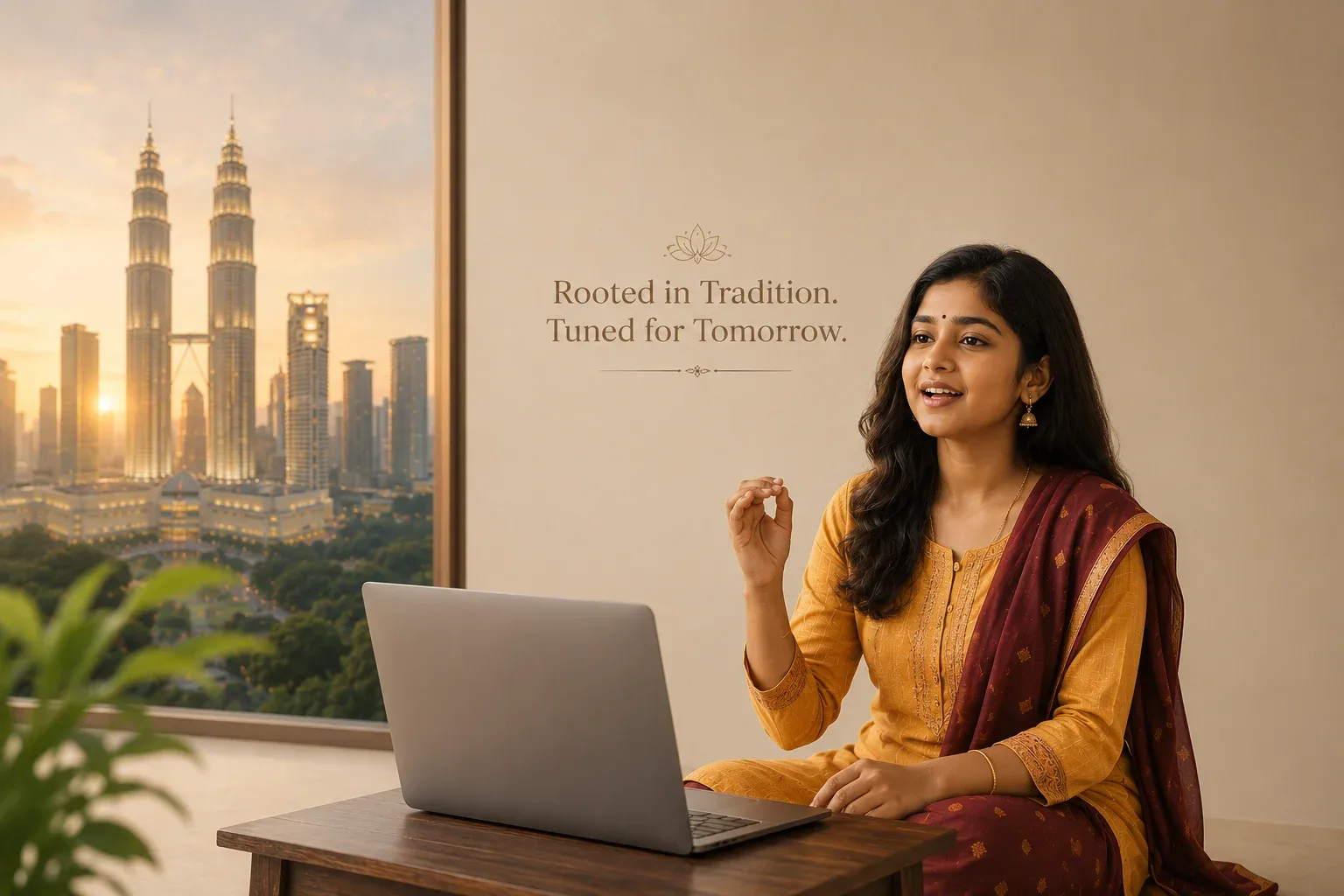
Table of Contents
Walk through Brickfields in Kuala Lumpur during Deepavali or watch the golden chariot wind its way through George Town during Thaipusam and you will feel it instantly: Malaysia’s Indian community doesn’t just preserve its musical heritage, it lives it out loud.
With nearly 2 million people of Indian origin calling Malaysia home and a Tamil cultural base that runs deep, with temples, cultural associations, and festivals, the appetite to learn Indian music in Malaysia has never been stronger. Yet many aspiring musicians here face the same frustrating gap: they want to learn, but finding a qualified guru nearby is not always easy.
This guide changes that. Whether you are a parent scouting Indian singing classes in Malaysia, a hobbyist curious about ragas or a student searching for online Indian music classes in Malaysia, we are walking you through everything from choosing Carnatic or Hindustani to costs, exams, and how to get started in 2026.
Indian Music in Malaysia: Where things stand
The Malaysian Indian community is overwhelmingly Tamil-speaking. This has shaped a strong, visible ecosystem of Carnatic music classes in Malaysia. Temples, Thaipusam processions and cultural associations have kept Carnatic vocal and instrumental traditions alive for generations with music forming an integral part of devotional life. On the other hand, Hindustani classical music classes in Malaysia remain comparatively uncommon. It is important to understand that this interest is growing steadily, and aspirants are increasingly drawn to ghazals, bhajans, and Bollywood-style singing.
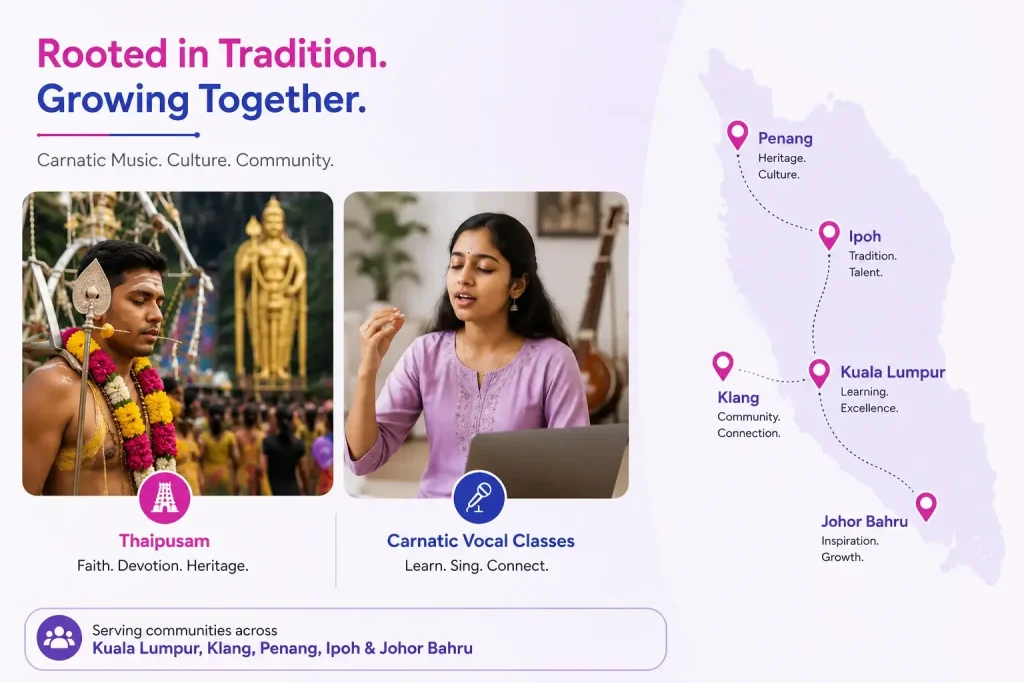
Most structured Indian music learning in the country is concentrated in a few key hubs:
- Kuala Lumpur
This is home to the largest concentration of schools and private tutors offering Indian music classes in Kuala Lumpur - Klang
Klang is a strong Tamil cultural centre with long-running Carnatic schools - Penang
Penang is anchored by its historic Little India and vibrant Thaipusam traditions - Ipoh
This is home to devotees and temple-linked musical practices - Johor Bahru
This is a growing hub with online and hybrid class options.
Carnatic or Hindustani – Which Should You Choose?
As a beginner, you’re likely to get this question a lot. Here’s a clear side-by-side comparison to help you decide:
| Factor | Carnatic Music | Hindustani Music |
| Origin | South India (Tamil Nadu, Kerala, Karnataka, Andhra Pradesh) | North India, shaped by Persian & Mughal influence |
| Repertoire | Kritis, Varnams, devotional compositions | Khayal, Thumri, Dhrupad, Bhajans |
| Language of Lyrics | Primarily Tamil, Telugu, Sanskrit, Kannada, Malayalam | Primarily Hindi, Urdu, Bhraj Bhasha |
| Notation Style | Swara-based with fixed composition | More improvisational, raga-centric |
| Learning Curve | Structured, technical, gamaka heavy | Flexible, expressive, exploratory |
Now, coming to the question: which suits you? For those of you coming from South India with strong ties to temples or culture, Carnatic music classes in Malaysia will feel more natural. For those drawn to film music, ghazals or bhajans, Hindustani classical music classes Malaysia might resonate more with your musical taste. Understand that there are no right or wrong answers here; over time, aspirants in Malaysia explore both traditions.
What Can You Learn in Indian Music?
Indian music offers a wonderfully wide canvas and here’s what’s realistically available to Malaysian learners today.
Vocals [Carnatic, Hindustani, Light Music, Film Songs]
Vocal training remains the most popular entry point. Students typically begin with:
- Sarali varisai, Janta varisai and Alankarams (Carnatic foundational exercises)
- Geethams, Swarajatis and Varnams, progressing to kritis by composers like Tyagaraja
- Basic swaras and alankars, followed by simple Hindustani bandishes and bhajans
- Light classical, devotional (Thevaram, Thiruppugazh) and popular Tamil/Hindi songs
Instruments [Tabla, Guitar, Keyboard]
Beyond vocals, several instruments are commonly taught, including:
- Tabla – for rhythm-focused learners interested in Hindustani accompaniment
- Mridangam – the traditional Carnatic percussion instrument, also available online
- Guitar – Widely popular among younger Malaysian aspirants wanting versatility
- Keyboard/piano – Often paired with Indian vocal training for accompaniment skills
Which Indian Classical Music Course to start with, by age
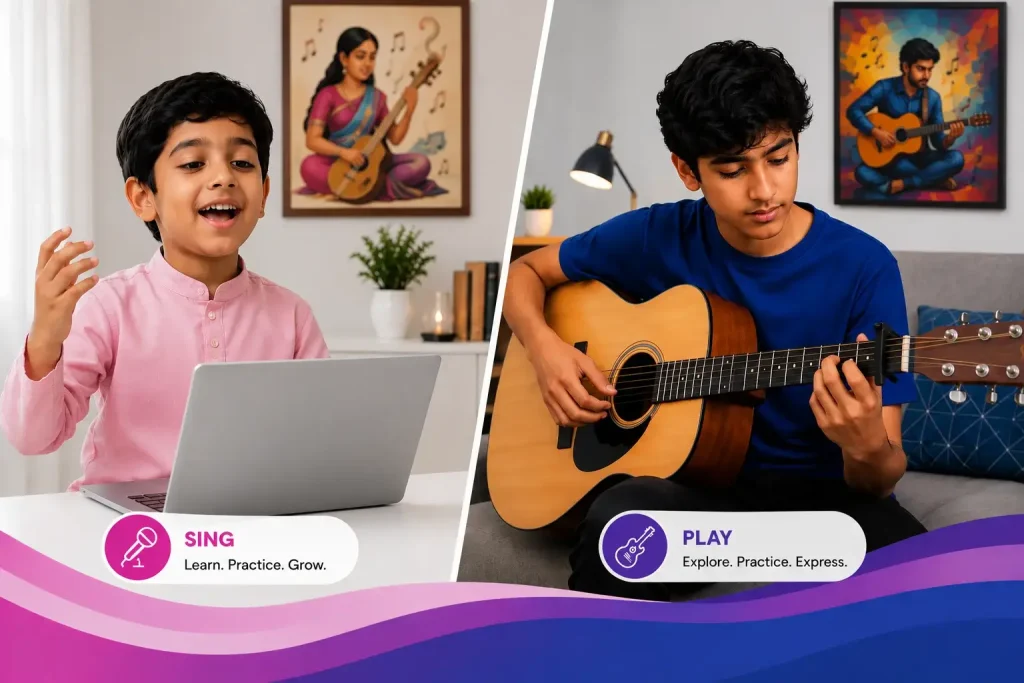
Kids (5-8 years): Best started with simple vocal exercises and rhythm games.
Teens: Can start directly with structured Carnatic or Hindustani vocal training or pick up guitar/keyboard alongside academic commitments.
Adults: Often gravitate towards devotional music, ghazals or revisiting classical training they started as children; it is genuinely never too late to start.
Your options for learning Indian Music in Malaysia
Learners from Malaysia generally have three routes:
Local Carnatic/Hindustani schools
Institutions such as Nadhalaya Music Academy (Kuala Lumpur), Bala Saraswathy School of Music (Klang) and Kalakendira Dance Academy’s Sangeetham classes have trained generations of students in Carnatic vocal and theory.
Private tutors, in-person or online
Independent teachers across KL, Petaling Jaya and Subang Jaya offer both Carnatic & Hindustani vocal lessons, often through tutoring marketplaces
Online Indian music platforms
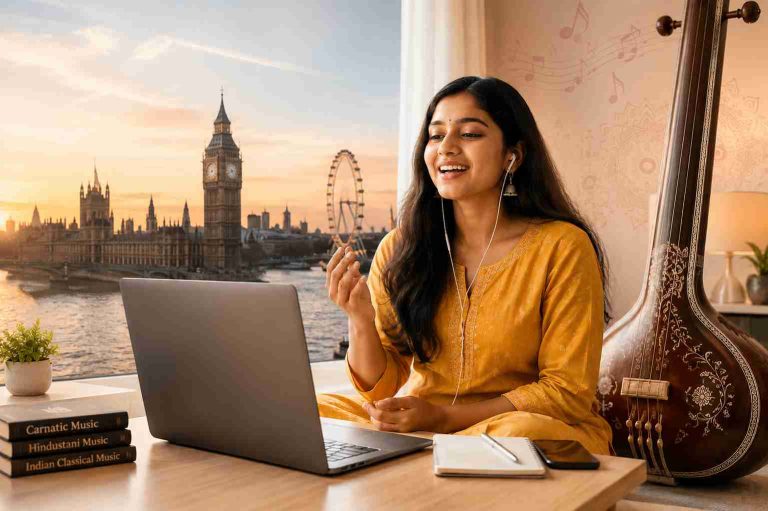
For those wanting to learn Indian music online from India while living in Malaysia, dedicated online academies connect Malaysian students directly with India-based teachers, bringing authentic training without geographic limits.
For many Malaysian families, especially those without a nearby specialist teacher, online Indian music classes in Malaysia have become the practical bridge to quality education.
How much does it cost to learn Indian music in Malaysia
Naturally, one of the first questions every parent and hobbyist asks is: How much do Carnatic music classes cost in Malaysia?
Here are approximate typical rates for these classes:
| Format | Approximate Cost (RM/Hour) |
| Carnatic vocal (beginner/intermediate) | RM 21-50/hour |
| Hindustani vocal (beginner/intermediate) | RM 26-29/hour |
| Mridangam/instruments lessons | RM 15-75/hour |
| Package rates (5-10 hours) | RM 75-260, depending on teacher |
Know that these prices vary depending on the teacher’s experience, whether lessons are online or in-person and whether you opt for package pricing. It is worth comparing a few options before committing to a long-term course.
Certifications & exams Malaysian students can take
For students who want structured, internationally recognised milestones, there are solid options for Indian classical music exams in Malaysia:
Trinity College London exams have been held in Malaysia since as early as 1921, with over 20 public venues and nearly 100 private centres now offering both digital and face-to-face music assessments.
ABRSM-style graded exams are also accessible through select schools and international curricula.
Internationally-mapped certification offered by Artium Academy is designed to align with global standards such as Trinity, ABRSM and Gandharva Mahavidyalaya benchmarks, giving Malaysian students internationally recognised proof of their progress.
These certifications hold immense value. They give structure to a student’s learning journey and provide credible proof of skill for portfolios, scholarships or further study.
Practice Tips for Learners Outside India
Learning Indian classical music while based in Malaysia comes with a few unique challenges, but none of them are insurmountable.
- Set a consistent practice schedule. Even 20-30 minutes of daily riyaz builds noticeably faster progress than irregular, longer sessions.
- Use digital tanpura and tala apps. These are perfect substitutes when a live accompaniment isn’t available at home.
- Record your practice sessions. Listening back helps you catch pitch and rhythm errors your ear might miss in the moment.
- Stay connected to live music. Attending temple concerts, Thaipusam performances or community cultural events keeps your ear tuned to authentic phrasing and style.
- Choose teachers who understand cross-time zone learning. A good online teacher will structure lessons and homework to work around Malaysia’s time difference from India.
How Artium can make learning Indian music possible
This is exactly the gap Artium Academy exists to close for Malaysian learners.
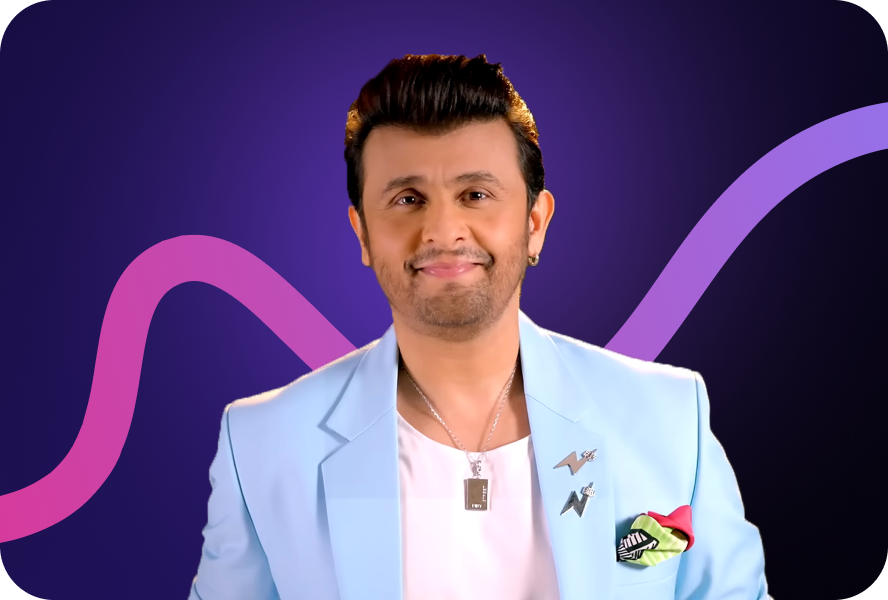
We are one of the world’s most trusted online music education platforms, with over 45,000 students worldwide. Artium connects Malaysian students directly with certified teachers, no travel, no compromise on quality. Every course is certified by legendary musicians, including Sonu Nigam, KS Chithra, Aruna Sairam, Shubha Mudgal, Louiz Banks and voice expert Ananth Vaidyanathan. For Malaysian families, this specifically means
- Live 1:1 online Carnatic & Hindustani vocal lessons, structured around your time zone
- Courses mapped to internationally recognised standards including Trinity, ABRSM and Gandharva Mahavidyalaya frameworks
- Options ranging from online music classes for kids in Malaysia as young as five to advanced adult learners
- A completion certificate at the end of every structured course
Artium Academy was built to be the trusted online music academy for learners across Southeast Asia, and Malaysia’s vibrant, music-loving Indian community is very much at the heart of that mission.
Your Musical Journey Starts Here
Malaysia’s deep cultural roots and growing digital access mean there has never been a better time to learn Indian music in Malaysia. Whether your heart is set on Carnatic kritis, Hindustani khayals or simply singing your favourite devotional song with confidence, the path forward is closer than you think.
If you have been searching for “Indian music classes near me” without much luck, or simply want the flexibility of learning from home, Artium Academy’s live online courses, backed by legendary musicians and internationally recognized certifications, offer Malaysian learners of all ages a genuine, structured way to begin their journey.
FAQs
Yes. Several platforms like Artium Academy offer live 1:1 online Carnatic vocal classes designed specifically for international students including those based in Malaysia.
Most teachers recommend starting between 5 and 8 years old for foundational training, though teens and adults can absolutely begin at any stage with equally rewarding results.
Not necessarily. Teachers usually guide pronunciation and meaning in lessons, so beginners can start with correct technique first and gradually build language familiarity.
This depends on the composition’s complexity and the student’s level, but most intermediate students can learn to sing a moderately placed kriti within a few months of consistent, focused practice.
Yes, when structured well. Live 1:1 online music classes with an experienced teacher, regular feedback and recorded sessions for review can match and, in flexibility, often exceed traditional in-person training.
For vocal training, no instrument is required initially; a smartphone or laptop with a stable internet connection is enough. As you progress, a keyboard, tanpura app or basic harmonium can support your practice.