
All Topics
- Alchemizing Music Concepts for Students
- Anuv Jain Songs
- Artist Spotlight
- artium gift card
- Artium Maestros
- Artium News
- Artium Tech Blog
- Best Coke Studio Songs
- Best Female Singers
- Birthday songs
- Bollywood Love Songs
- buying guide
- Carnatic Music
- Child Singers
- Devotional Music
- Editorials by Ananth Vaidyanathan
- English Love Songs
- Festival
- Film Music
- Ghazal Music
- Guitar
- Hindustani Classical Music
- Indian Classical Music
- Indian Folk Music
- Insights
- Instagram Reels Viral Songs
- Instruments
- Karaoke
- Karaoke Singing
- Keyboard
- Kids Music
- maestros
- Music Education
- Music for Kids
- Music Games
- Music Industry
- Music Instruments
- Music Legends
- Music Press Release
- Music Technology
- Music Theory
- Music Therapy
- Music Tools
- Piano
- piano guide
- Songs
- South Devotional Music
- Success Stories
- Tamil Film Music
- Telugu Film Music
- Time Theory
- Tools
- Uncategorized
- Uncategorized
- Uncategorized
- Uncategorized
- Vocal Range
- Vocal Singing
- Vocals
- western classical music
- western music
- Western vocal music
Understanding ABRSM Music Exams: A Complete Guide for Beginners
Understanding ABRSM Music Exams: A Complete Guide for Beginners

Table of Contents
As a parent, there is nothing better than watching your child light up while playing their favorite song. It is a feeling of quiet pride seeing music become something real and personal. Seeing this, at some point, a question naturally arises: “How do we make this more structured? How do we know they are actually progressing?”
This is exactly where competitive music exams like ABRSM come in.
You may have heard this word from your child’s teacher and aren’t entirely sure what it means. Or, you are a student who wants to understand what these exams involve before signing up. Either way, you are at the right place. In this blog, we’ll address everything you need to know about ABRSM music exams: what they are, why they matter, how they work and how you can start preparing for them with confidence.
Let’s get started!
What is ABRSM?
ABRSM stands for the Associated Board of the Royal Schools of Music. It is one of the world’s most respected and renowned music examination boards, established in 1889 in the United Kingdom. The ABRSM music exams are backed by four of the UK’s greatest conservatories: the Royal Academy of Music, the Royal College of Music, the Royal Northern College of Music and the Royal Conservatoire of Scotland. It is one of those prestigious institutions where millions of learners from 90+ countries take part in its music examinations every year. Whether you are learning piano in Mumbai, guitar in London or singing in Singapore, ABRSM offers a universally recognised framework to measure and celebrate your musical progress.
Let’s just say: ABRSM is right up there, offering global gold standards in international music certification for students of all ages.

Why choose ABRSM Music Exams?
Now, before we answer how these exams work, let’s answer the most important question: why bother?
Well, here’s why thousands of students and parents worldwide choose ABRSM:
- Global recognition
ABRSM music certification is acknowledged by music schools, colleges, universities and conservatories worldwide. - Structured progression
Its graded system ensures systematic skill-building from beginner to advanced levels. - Objective assessment
Exams are marked by trained, independent examiners, not your own teacher, ensuring a fair, impartial evaluation. - Academic value
Higher-grade ABRSM results (grades 6,7,8) are recognised as equivalent to UCAS points in the UK, supporting university applications.
- Motivation and milestones
A goal can make students focused, practising consistently and genuinely excited about progress. - A lifelong credential
Regardless of whether the student becomes a professional musician, an ABRSM certification is a lifelong achievement that speaks to discipline, dedication, and artistry.
Types of ABRSM Music Exams
ABRSM offers different types of exams to suit different learners adn goals. Here’s a quick overview:
- Practical Grades (Face-to-face)
This happens live in front of an ABRSM examiner. Students are expected to perform pieces, play scales and arpeggios, complete sight-reading and undergo aural tests. These exams are held at designated centres during three seasonal windows: spring, summer and autumn. - Performance Grades (Digital/online)
This is a more flexible and modern option introduced to make the ABRSM online exam accessible worldwide. Students can record a video of themselves performing four pieces and submit it through ABRSM’s platform at any time of the year. No scales or sight-reading are required.
- Music Theory Exams
Written exams covering the building blocks of music like notation, rhythm, scales, harmony and more. Grades 1-5 are now taken online at authorized centers, while Grades 6-8 are paper-based. - Practical Musicianship Grades
An alternative to the theory exam route, assessing musical listening, reading and real-time playing skills. - Diplomas
Advanced-level qualifications for musicians who wish to demonstrate professional-level performance, teaching or directing abilities.
Understanding ABRSM Grade Levels
The ABRSM grades follow a clear progression from beginner to advanced. Here’s how the levels break down:
| Grade level | Stage | Who It’s for |
| Initial grade | Pre-beginner | Young starters, first-timers |
| Grade 1-3 | Beginner | New learners building a foundation |
| Grade 4-5 | Intermediate | Developing technique & repertoire |
| Grade 5 theory | Gateway | Required before grades 6-8 practical |
| Grade 6-8 | Advanced | Serious students pursuing excellence |
| Diplomas (DipABRSM, LRSM, FRSM) | Professional | Pre-professional & professional musicians |
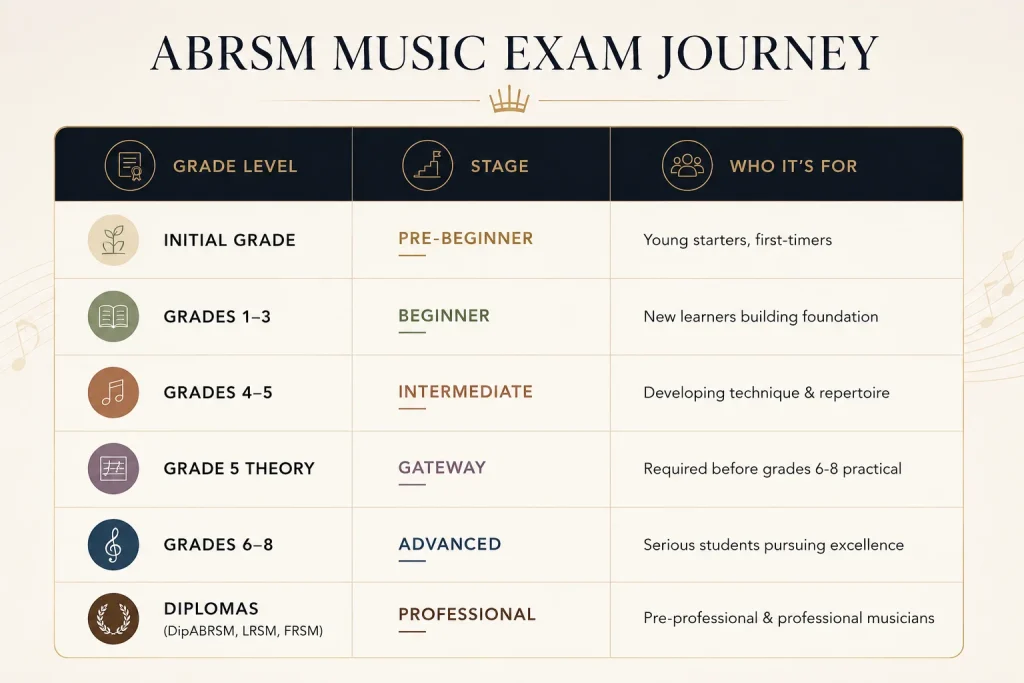
NOTE: To sit a practical exam for grades 6, 7, or 8, students must first pass grade 5 music theory (or grade 5 practical musicianship). This ensures advanced students have the musical knowledge to interpret and perform at a high level.
Instruments covered under ABRSM
A wide range of instruments and disciplines is available under the ABRSM exams. Their syllabus covers:
- Piano: One of the popular ABRSM exam subjects globally
- Bowed strings – Violin, viola, cello, double bass
- Woodwind – Flute, clarinet, oboe, saxophone, bassoon
- Brass – Trumpet, Horn, trombone, tuba
- Guitar – Classical and Jazz guitar.
- Singing – Classical vocal, singing for music]
- Drum kit: Available for practical and performance grades
- Keyboard and organ
- Jazz instruments (available in select countries like India, the UK & Singapore)
So, whether your child is preparing for an ABRSM piano exam, an ABRSM guitar exam or an ABRSM singing exam, there’s a structured pathway waiting for them.
ABRSM practical exam structure
Let’s look more closely at what happens in a standard ABRSM practical exam. The exam has four main components:
Three pieces: Every student performs three different pieces from the official ABRSM syllabus repertoire list. Each piece comes from a different category (lists A, B & C), ensuring stylistic variety
Scales and arpeggios (for instrumentalists): This is a technically critical element that tests the student’s command of keys, patterns and fluency. Singers perform an unaccompanied song instead.
Sight-reading: The student is given a short, unseen piece of music to play or sing at sight. This tests their musical literacy and real-time decoding skills.
Aural tests: A set of listening exercises assessing the learner’s ability to identify pitch, rhythm, melody, harmony and musical features by ear.
There are 150 marks in total, with Pass, Merit and Distinction bands rewarding different levels of achievement.
ABRSM theory exams explained
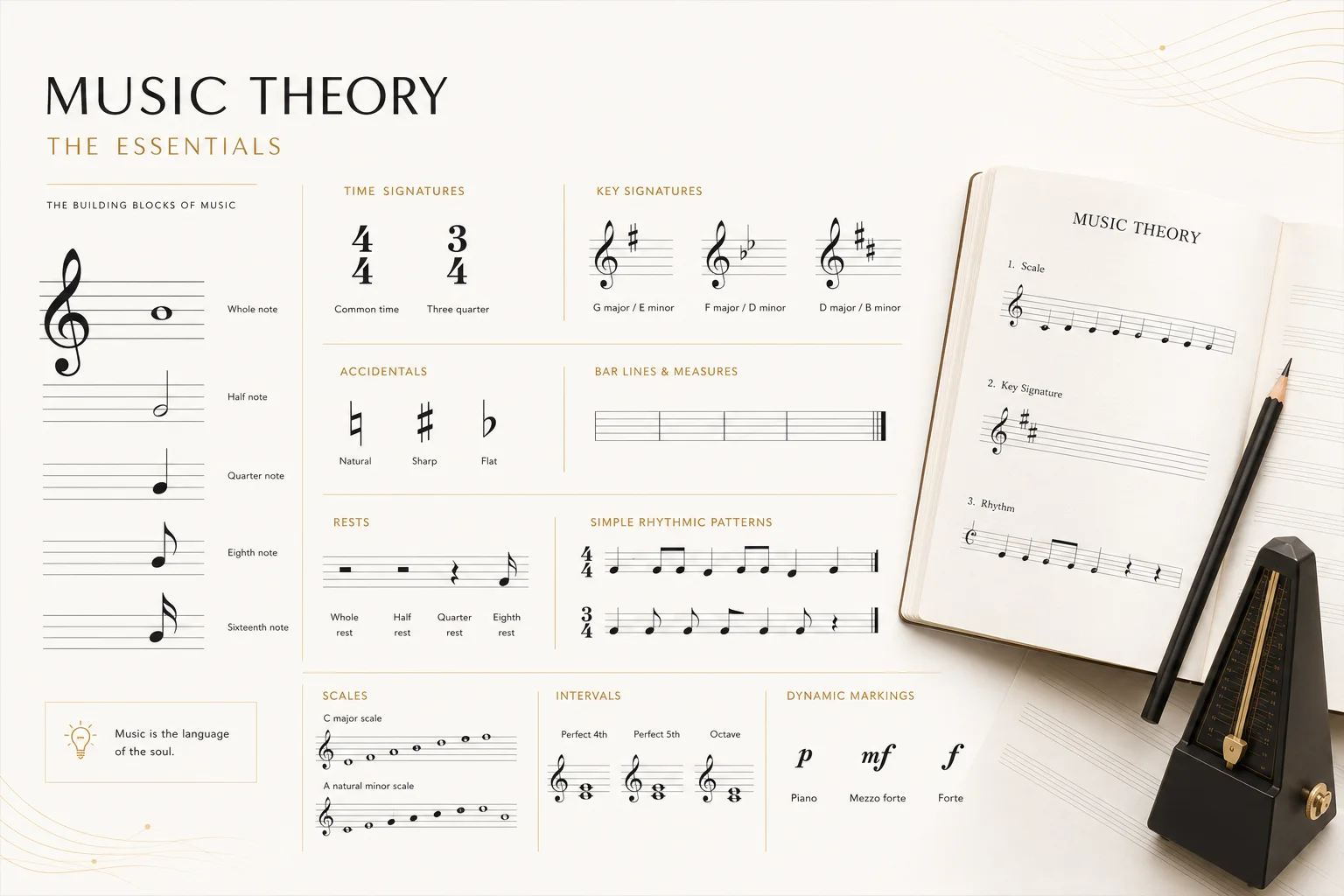
The ABRSM theory exam is the written counterpart to the practical exam and it is one of the most important components in a student’s musical development:
Grade 1-5 cover:
- Note values & rests
- Time & key signatures
- Scales – major, minor, harmonic, melodic
- Intervals, chords and cadences
- Musical terms & ornaments
- Composition exercises
Grade 6-8 move into:
- Four-part harmony
- Counterpoint
- Orchestral score reading and analysis
Grade 1-5 theory exams are now taken online at authorised centres with results available within a few weeks. Grade 5 theory is the most widely taken and it is essential for progressing to the higher practical grades.
How ABRSM exams are assessed
All the examiners under ABRSM are general musicians and not subject-specific specialists. This ensures there is consistent, impartial assessment across all instruments and grades. Examiners use universal marking criteria that evaluate:
- Musical understanding – Does the student understand the character and style of the music?
- Technical control – Is the execution accurate, controlled and well-prepared?
- Expression and communication – Is there musical sensitivity and personal expression?
- Results are shared as detailed score breakdowns, giving students & teachers actionable feedback on exactly where to improve
How to register for an ABRSM exam
The registrations for ABRSM exams are very straightforward:
- Create an ABRSM account at abrsm.org
- Choose your exam type – practical, performance, grade or theory
- Choose your instrument & grade
- Find an available date and authorised centre near you (for practical & theory) or prepare to suit digitally (for performance grades)
- Pay the exam fee online
- Receive your confirmation by email
For grades 1-5 theory (online) and performance grades, exams are available on demand, meaning you choose when you are ready and not when a fixed session falls.
How to Prepare for ABRSM Music Exams
Preparation is the key to success. And the good news is that a clear, structured approach works perfectly for ABRSM.
- Learn your pieces early
Get ahead by working on all three pieces in advance and not in the final weeks. - Practice scales and arpeggios daily
Consistency is key. Even 10-15 minutes/day of focused learning on technical work builds significant fluency over time. - Work on sight-reading regularly
Sight reading improves fastest with daily exposure to new material, not last-minute cramming.
- Train your ear
Listen actively to recordings, sing intervals and clap rhythms to build strong aural skills. - Music theory + practical work
Theory is not separate from playing. Understanding music enriches performances enormously.
- Do mock exams
Run through the full exam format with a parent before the real thing. Getting comfortable with the format reduces exam-day anxiety.
Common mistakes to avoid during ABRM preparation
Every teacher has seen their students lose marks they did not need to lose. Here are the most common mistakes to avoid during your preparation –
- Neglecting theory
Theory is important. Many students focus so hard on pieces that they sidestep theory, only to find themselves unable to progress past the grade 5 practical. - Ignoring aural training
Don’t leave the aural tests to chance. Practice it diligently
- Leaving sight-reading too late
It is the component students most underestimate, and it improves with consistent, gradual exposure. - Choosing pieces you can’t play
The pieces you choose should be playable, within reach and enjoyable. - Not understanding the marking criteria
Read the ABRSM syllabus carefully. Knowing what examiners look for removes unnecessary guesswork
ABRSM Vs Trinity: What to choose
This is one of the most common questions parents ask. Although both are UK-based music exam boards, they have distinct philosophies:
| Feature | ABRSM | Trinity College London |
| Focus | Technical rigour + all-round musicianship | Expressiveness + stylistic flexibility |
| Theory requirement | Grade 5 theory required for grades 6-8 | No theory prerequisite |
| Exam format options | Practical (face-to-face) + performance grades (digital) | In-person + digital grades |
| Repertoire style | Classical-focused with some contemporary | Wide range including rock & pop |
| Aural test weight | 12% of the total mark | 10% of the total mark |
| Sight-reading weight | 14% of total mark | 10% of total mark |
| Best for | Classical learners pursuing rigorous training | Students who prefer flexibility & modern styles |
The verdict? ABRSM offers classical, rigorous all-round musicianship training and hence is considered the gold standard. Trinity college of London offers more stylistic freedom and is often preferred by singers, performers and students who find traditional theory challenging. The right choice depends on your child’s goals, learning style and musical personality.
Benefits of earning an ABRSM Certification
The benefits of ABRSM music certification go far beyond just a certificate on the wall:
- It is a globally recognised credential accepted by music colleges, universities and cultural institutions worldwide.
- UCAS points for grades 6, 7 & 8 in the UK – supporting university applications
- It acts as proof of discipline and commitment to music schools, scholarship committees and future employers.
- It enhances students’ musical foundations once they complete even their Grade 5 ABRSM. They develop noticeably stronger in ear training, sight-reading and musical understanding.
- It adds to learners’ confidence. There is nothing like the feeling of walking out of an exam having performed your absolute best.
How online music classes can help you prepare for ABRSM exams
The biggest benefit of living and learning music online in 2026 is that it no longer matters where you live. Quality music education is right at your fingertips. Whether you are based in Chennai, Dubai, London or Toronto, you can prepare for ABRSM exams online.
Online music classes for ABRSM preparation offer:
- Live 1:1 coaching from experienced teachers who know the ABRSM syllabus thoroughly
- Flexible class schedules around school and work timetables
- Recorded session review to identify and correct errors between classes
- Access to theory resources, aural training apps and sight-reading tools within a single platform
- Progress tracking aligned to ABRSM grade milestones
For those of you who want to learn music online with the structure and rigour that ABRSM demands, the right online platform can make a huge difference.
Start your ABRSM journey with Artium Academy
ABRSM music exams are prestigious and taking these exams implies the start of a lifelong commitment to musical excellence. And behind every successful ABRSM candidate is a great teacher and a well-designed learning programme.
At Artium Academy, we offer world-class music instruction to every student, whether an ABRSM aspirant or simply someone in love with music. Our online music courses are certified by legendary Indian musicians like Sonu Nigam, KS Chithra, Aruna Sairam, Shubha Mudgal, Louiz Banks and Raju Singh. This ensures that each and every student receives a globally accredited education rooted in authentic musical tradition.
With over 43,000 students learning worldwide, Artium Academy offers live 1:1 classes in Carnatic music, Hindustani vocal, film music, Western vocals, guitar, piano and more. This kind of structured, personalised preparation sets students up for music grade exams success and a lifetime of musical joy.
FAQs
Yes. ABRSM is one of the most respected international music certification systems in the world backed by the Royal Schools of Music in the UK and used by millions of students across 90+ countries. Higher ABRSM grades are recognised by universities and conservatories and in the UK grades 6-8 can carry UCAS points, making ABRSM a strong choice for both serious and hobby learners.
Overall difficulty is similar, but the boards emphasise different strengths. ABRSM is often seen as more demanding in scales, aural tests and theory (especially with grade 5 theory required before grades 6-8), while Trinity is viewed as more flexible and expressive with broader repertoire and fewer compulsory supporting tests. Rather than one being “harder”, it is more accurate to say ABRSM suits students who thrives on technical and theoretical rigor while Trinity suits those who prefer stylistic variety and performance-focused assessment.
In India, ABRSM operates through authorised centres and teachers offering the same graded music exams for kids and adults as in the UK including practical grades, performance grades and music theory. Many Indian students use ABRSM to benchmark their piano, violin, guitar and the certification is commonly accepted by schools, colleges and foreign universities as evidence of structured music training.
The highest levels in the ABRSM system are the performance, teaching and conducting diplomas: ABRSM, LRSM and FRSM. Before reaching diplomas, the graded exam ladder goes from initial grade through grades 1-8 with grade 8 widely considered the advanced school or pre-college level for most instruments.
Yes. ABRSM is widely recognised across Europe, Asia, the Middle East and many other regions as a leading standard for graded music exams. Its certificates are accepted by international music schools, conservatories and universities and are often used by students applying for performance programmes, scholarships or music-related academic courses abroad.