
All Topics
- Alchemizing Music Concepts for Students
- Anuv Jain Songs
- Artist Spotlight
- artium gift card
- Artium Maestros
- Artium News
- Artium Practice Studio
- Artium Tech Blog
- Best Coke Studio Songs
- Best Female Singers
- Birthday songs
- Bollywood Love Songs
- buying guide
- Carnatic Music
- Child Singers
- Devotional Music
- Editorials by Ananth Vaidyanathan
- English Love Songs
- Festival
- Film Music
- Ghazal Music
- Guitar
- Hindustani Classical Music
- Indian Classical Music
- Indian Folk Music
- Insights
- Instagram Reels Viral Songs
- Instruments
- Karaoke
- Karaoke Singing
- Keyboard
- Kids Music
- maestros
- Music Education
- Music for Kids
- Music Games
- Music Industry
- Music Instruments
- Music Legends
- Music Press Release
- Music Technology
- Music Theory
- Music Therapy
- Music Tools
- Piano
- piano guide
- Songs
- South Devotional Music
- Success Stories
- Tamil Film Music
- Tamil Singers
- Telugu Film Music
- Telugu Singers
- Tools
- Uncategorized
- Uncategorized
- Uncategorized
- Uncategorized EN US
- Vocal Range
- Vocal Singing
- Vocals
- western classical music
- western music
- Western vocal music
Veena vs Sitar: Key Differences, Sound, and Which to Learn
Veena vs Sitar: Key Differences, Sound, and Which to Learn
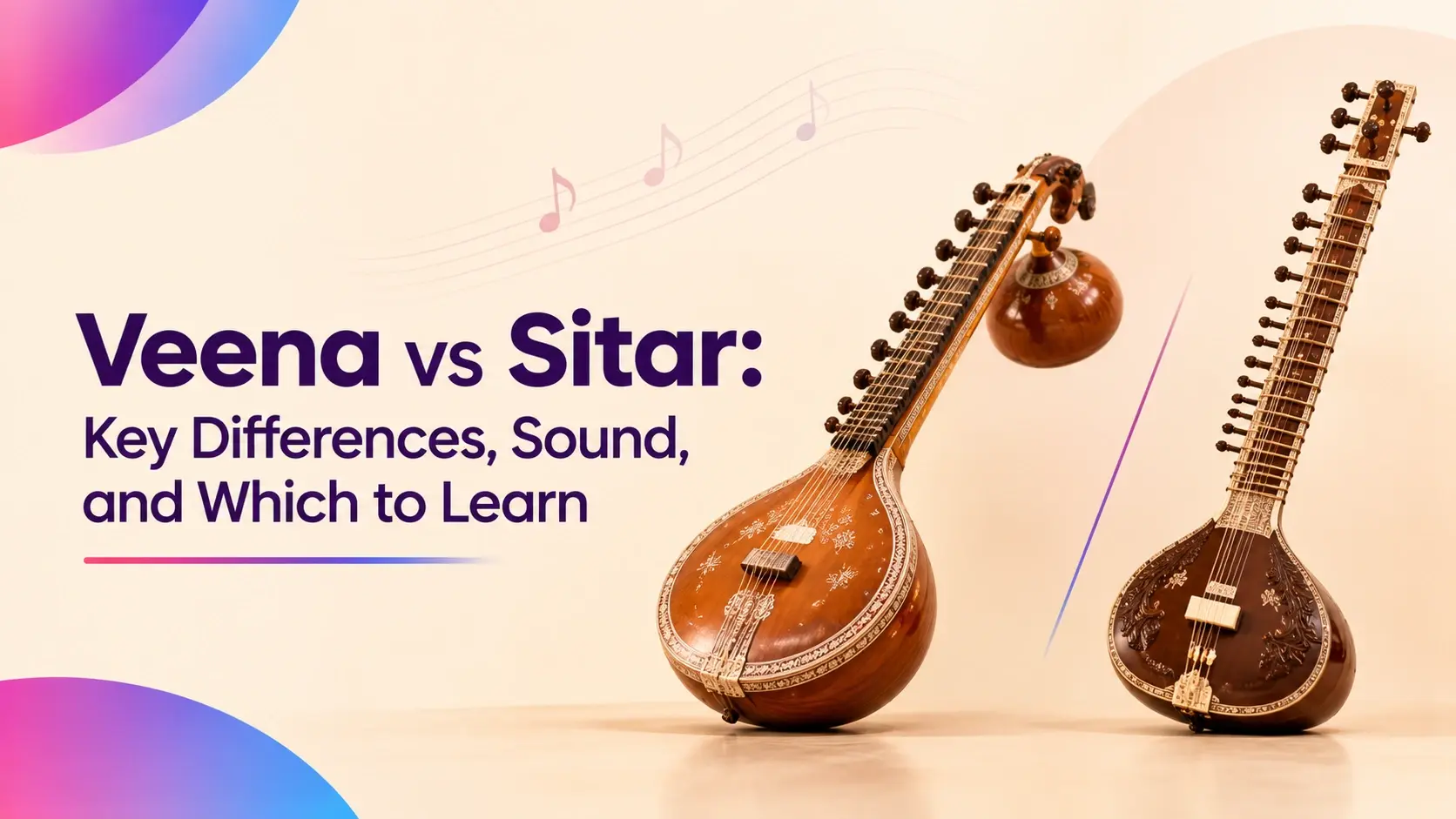
Table of Contents
Quick Summary
| Veena vs sitar is basically about tradition. The veena is a traditional South Indian stringed instrument of Carnatic music with a warm, sustained sound and fixed frets. The sitar is a North Indian stringed instrument of Hindustani music with a bright, shimmering sound and movable frets and sympathetic strings. Neither instrument is better than the other. Get the veena if you are into Carnatic music or the sitar if you are into Hindustani music. Both sitar and veena are great instruments to learn, and you can learn both online sitting at home with a qualified teacher. |
Introduction
If you have ever watched a concert and wondered about the veena vs sitar question, you are not alone. Both are plucked string instruments, both look graceful, and both have a long neck and a gourd. Many beginners mix them up, and some assume one is simply a regional version of the other.
Because yes, sitar and veena are actually two different tools, with unique sounds, techniques, and environments. To put it plainly: sitar vs veena let’s take a look at the differences, explore their sounds, origins, and to help you figure out which instrument is right for you, Whether you are a parent choosing for your child, an adult restarting music, or a curious beginner, you will find clear, practical answers here.
Veena vs Sitar at a Glance
Here is a quick comparison to get you started.
| Feature | Veena (Saraswati Veena) | Sitar |
| Music tradition | Carnatic (South Indian) | Hindustani (North Indian) |
| Age | Ancient, mentioned in very old texts | Developed around the medieval period |
| Main playing strings | 4 playing strings, plus 3 side strings for rhythm and drone | 6 or 7 main strings |
| Sympathetic strings | None | Usually 11 to 13 |
| Frets | Fixed frets, set in wax | Movable, curved frets |
| Sound | Warm, deep, sustained, voice-like | Bright, shimmering, buzzing |
| Signature techniques | Gamakas (graceful oscillations) | Meend (string bends), jhala (fast strumming) |
| Playing position | Seated, instrument held across the lap and resting on the shoulder | Seated, instrument held diagonally across the body |
This table is a summarized view of the differences between veena and sitar. The points below are elaborated in simple words.
What Is a Veena?
The veena is one of the oldest string instruments that India had. The term is applied to a family of instruments so it would be wise not to assume that someone is talking about the same instrument when they use the word “Veena”. The most popular veena today is the Saraswati veena. However, there are a number of veenas that have their own character.
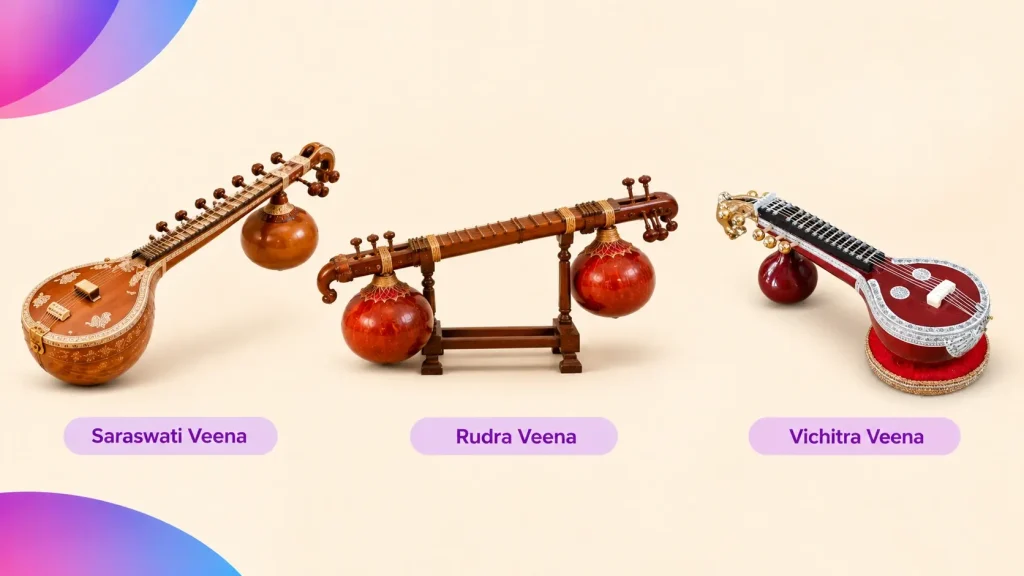
Types of Veena (Saraswati Veena, Rudra Veena, Vichitra Veena)
1. Saraswati Veena
Most often seen is this type of veena. It possesses a large resonator or gour, a long, hollow neck with fixed frets and the carved end called the yali (dragon-head). This is the main veena of Carnatic music.
2. Rudra Veena
A deep, meditative instrument with two large gourds at either end of a long tube. It is associated with the dhrupad style of Hindustani music and has a slow, grounded sound.
3. Vichitra Veena
An instrument without a fret, produced by running a glass ball or glass slider over its strings to achieve a smooth, continuous glide between notes. (somewhat rare today, and generally considered a Hindustani feature).
Similarly the veena is not just a South Indian instrument, though the Saraswati veena is what most new learners learn on.
Veena in Carnatic Music
This is the instrument that accompanies Carnatic music and can be played individually (solo). Its sound closely resembles the human voice, which is why so many Carnatic musicians believe a veena can teach us how to better understand a raga. Performers keep close to the vocals, following the words and contours of each phrase.
What Is a Sitar?
The sitar is a long-necked musical instrument, most famous for its shimmering sound. The sitar has large, curved frets, a wide gourd, and extra strings that produce its distinctive, layered tone. It became most familiar to the world in Ravi Shankar’s concerts or through Indian films or Western fusion.
Parts and Structure of the Sitar
- Tumba: The big gourd at the bottom that makes the sound thicker.
- Dandi: The long, hollow neck.
- Pardas (frets): Curved metal frets that are repositionable.
- Main strings: six or seven, plucked with a wire plectrum used on the finger (the mizrab).
- Tarab (sympathetic strings): Narrow strings under the frets which are not plucked but are made to vibrate, creating a subtle sheen.
- Bridge (jawari): A level bridge that creates a singing, buzzing quality to the sitar.
Sitar in Hindustani Music
As a showcase instrument in hindustani music the sitar is king. A sitar piece is generally initiated by a slow, unmetered alap, then developed with a gat (composition with tabla) and, possibly, a return to the jhala (upbeat section). If you want to learn hindustani classical music, the sitar is a good window into how ragas unfold.
Veena vs Sitar: Which Is Older? (Origin and History)
Where the veena vs sitar questions are concerned, the veena is definitely the older instrument. There is historical evidence of veena-type instruments existing in ancient Indian writings, and the term was in use for myriad stringed instruments over the course of thousands of years. The modern sitar evolved sometime during the middle ages.
Is the Sitar Descended from the Veena?
Partly, yes. Most historians believe the sitar developed from older Indian string instruments, including veena-type instruments, and was shaped by Persian influence such as the three-stringed setar. The popular story that Amir Khusrau invented is a legend rather than a proven fact. So when people ask about veena vs sitar which is older, the best summary is that the veena is the ancient root, and the sitar is a later branch in the same family tree.
Veena vs Sitar Instrument: Body, Neck, Frets, and Strings
Looking closely at the veena vs sitar instrument design, you will find clear structural differences that shape how each one sounds and feels.
Number of Strings and Sympathetic Strings
The Saraswati veena is four- main-stringed with three ( below the main strings) side-stringed for talam and drone, no sympathetic strings. The sitar has generally six or seven main-stringed and a set of sympathetic strings placed underneath for that glow-time resonance.
Fixed Frets vs Movable Frets
The notes on the sitar are movable, allowing for a much wider range of variety in intonation than the five thick metal frets of the veena. This capability also makes the sitar much more flexible, because the musician can reposition the frets to accommodate a different raga or pull a string across a fret to get more notes (another technique that makes sitar playing easier, but requires fine-tuning for a beginner).
Wood, Gourd, and Construction
The Saraswati veena is traditionally carved from wood of jackfruit, generally one piece of wood. The sitar most commonly is made from seasoned toon or teak wood with a gourd for resonating chamber. Both Veena makers and sitar makers are engaged in skilled hand finished craftsmanship which is one of the reasons why both instruments require care in high humid or extreme dry weather.
Veena vs Sitar Sound: Tone, Resonance, and Character
The quickest way to hear the veena vs sitar sound contrast for yourself is to compare a relaxed voice to a bustling run-of-stream. The veena sounds full, round, soft and comfortable. The sitar sounds sparkly, multi-layered and buzzing just after each note.
Gamakas and Sustained Notes on the Veena
Gamakas are the elegant shakes, slides and curves that adorn a note in Carnatic music. The veena player uses a finger to slide a string horizontally over a fret, ornamenting the tone with a beautiful flexibility that is warm and rich throughout. Listening to a veena can be like listening to a singer.
Meend, Jhala, and Sympathetic Resonance on the Sitar
On the sitar, the signature sound comes from meend, a long pull of the string that makes a note glide upward, and jhala, a fast, rhythmic strumming section. The sympathetic strings continue to buzz gently in the background so that each phrase seems to float. That contrast in veena vs. sitar sound is a significant reason why listeners feel a certain allegiance to each instrument.
How Each Instrument Is Played (Posture and Technique)
Seated floor playing posture and technique are different for each instrument.
Veena: You sit cross-legged, the instrument rests on your lap, the upper gourd is against your chest or near your left shoulder. Your left hand presses the strings on the frets, producing gamakas. The right hand plucks using fingertips or small finger picks.
Sitar: The sitar is held with the thin long instrument slanting across your body, the gourd resting on your foot or on your lap. The left hand glides up and down the frets and pulls the strings for meend, the right index finger wears the wire mizrab to pluck.
Whatever style you use, in both cases, a good chair back and ‘wrist’ posture help to protect your back and wrists. A few short regular practice sessions are better than the same amount of practice in longer, tiring ones.
Veena vs Sitar Difference in Music Traditions: Carnatic vs Hindustani
It is an easy one to recall that the greatest veena vs sitar distinction is in the kind of music served.
- Carnatic music (South India): Composition is the cornerstone. The veena is nearer to the song, with a focus on well-maintained forms, beat and be applied.
- Hindustani music (North India) is conducive to spontaneous elaborate improvisations within the confines of a raga. A sitar can take its time to build up a mood before it hurries along.
Both traditions use ragas and talas, so what you learn in one will help you understand the other later. If you are curious about the wider family of instruments used in hindustani classical music, you will notice how the sitar sits alongside tabla, sarod and flute in a typical concert.
Cultural and Spiritual Significance (Saraswati and the Veena, Ravi Shankar and the Sitar)
It is connected to the goddess Saraswati. She is the goddess of education and music. The goddess always has a veena in her hand, so the instrument has a silent spiritual significance for many families, children start their lessons with a prayer to her.
The sitar is most famously associated with Pandit Ravi Shankar, who took the instrument to concert halls and also introduced audiences beyond India to Indian classical music. To many ears, the sound of the sitar is the sound of Indian music.
Famous Veena Players and Famous Sitar Players
The best way to learn is to listen to a top artist. Here are a handful of the most popular.
Famous veena players
- Veena Dhanammal: A gentle, highly expressive style that influenced generations. Her instrumental playing is an example of the warm, voice-like, qualities of the veena.
- Emani Sankara Sastry: A highly respected veena artist known for his skill and for bringing the instrument to wide audiences. His technique shows how the veena vs sitar difference in fixed frets and gamakas works in practice.
- Jayanthi Kumaresh: Not just a renowned performer and teacher but an accomplished veena evangelist who has taken the veena to collaborations. Her concerts provide an ideal opportunity for a new ear to listen to the veena vs sitar sound difference.
Famous sitar players
- Pandit Ravi Shankar: The man who popularized the sitar worldwide. His music remains the easiest way to appreciate the kind of difference in tone and style between sitar and veena.
- Ustad Vilayat Khan: Sung like a singer, that is gayaki ang, style of sittingar, giving closer to human voice.
- Anoushka Shankar: A modern sitar player merging traditional techniques with emerging trends, demonstrating the versatility of the sitar in today’s music landscape.
Veena vs Sitar: Which Is Better to Learn?
If you’re wondering when people ask veena vs sitar which is better, the truthful answer is it depends on what music moves you. Neither is better. The one you’ll want to practice every day is the right one.
Learning Difficulty
Both require patience. The veena needs time for fingers to develop strength and control of gamakas so they don’t sound nasty. The sitar needs time for the skills of moving between plucking hand and pulling hand to become natural, and become familiar with all the extra strings. Neither “easy”, but both very achievable with a good teacher and good practice.
Cost and Availability of Instruments
A Quality veena or sitar is hand-made so cost and quality can differ greatly from maker to maker. You are more likely to find sitar at a music store throughout India. Veenas are more common in South India, or through a specialist maker. It’s best to talk to your teacher before buying rather than buying a too cheap or too fancy instrument.
Finding a Teacher (Online vs Offline)
Offline teachers are also useful. But if you’re after the best veena or sitar instructor there might be one who is not in your vicinity. Online lessons are exactly what you need; you don’t need to be living in a big city. Find certified teachers, one-to-one classes and a consistent programme to learn from.
Which Is Better for Beginners, Kids, and Adults
- Beginners: Pick the tradition whose music you enjoy listening to most. That motivation matters more than any technical difference.
- Kids: Kids can begin either, with a smaller instrument and short lessons. It has to be their choice and they need a teacher that can be patient.
- Adults: Adults can learn both well. They have the advantage of focus and the disadvantage of time, so put things in small doses, such as one raga or only one easy piece at a time.
If you’re still confused on veena vs sitar which one is better for you, listen to some short performances of each and see which one you want to listen to again.
Veena vs Sitar in Modern Music, Film, and Fusion
They have had a second life outside the concert hall. Sitar entered the Western pop and rock scene in the 1960s, and is still played by Indian film composers and in ‘fusion’ bands and music for meditations. Veena is heard in film music, devotional music and fusion collaborations, where it provides a really full sound. For students in the future, these examples highlight how knowledge from your instrument can be applied to many different styles of music, not only concerto playing.
Veena and Sitar vs Other Indian String Instruments (Sarod, Santoor)
When looking at options, you might also come across these other two popular tools:
- Sarod: A fretless, metal-fingerboard Hindustani instrument with a deep, rich and slightly metallic tone.
- Santoor: A hammered instrument with many strings stretched over a trapezoid box, played with two light mallets. It has a crisp, sparkling sound.
All of the other three, however, have unfretted fingerboards so it may be a little more challenging to see the note placement as a beginner.
Conclusion
In the sitar vs veena discussion, the real answer is that both are beautiful and both are worth learning. The veena offers a warm, voice-like sound rooted in Carnatic music, while the sitar offers a shimmering, expressive sound rooted in Hindustani music. Listen to both, notice which one draws you in, and choose the one you would happily practise every week.
If you ever wish to learn Hindustani classical music or Carnatic music while exploring the veena and sitar, you do not have to figure it out alone. Book a free 1:1 trial class with Artium Academy, meet a certified teacher, and see which instrument feels right for you, at your own pace.
Frequently Asked Questions
The major difference is the tradition and the build The veena is Carnatic and has fixed frets as well as no sympathetic strings. The sitar is Hindustani and has movable frets and sympathetic strings.
There’s no one right answer. Pick the one you like the sound of best, as this will motivate you to practise. That’s the most straightforward tip to help you decide the single-way veena vs sitar is better for you.
The instruments of the veena family were in use in very ancient times. The sitar evolved into its present shape long after.
The veena is deep, warm and undulating in mood, like a human voice; the sitar is bright, shimmering and has a buzzing, resonant quality due to its sympathetic strings.
Neither is easy, and neither is out of reach. The sitar asks for coordination with movable frets and string bends, and the veena asks for control of gamakas. A good teacher makes both manageable.
The Saraswati veena is central to Carnatic music, while the sitar is central to Hindustani music.
A sitar usually has six or seven main strings plus about eleven to thirteen sympathetic strings. A Saraswati veena has four main strings and three side strings, with no sympathetic strings.
Partly. Historians believe the sitar developed from older Indian string instruments, including veena-type instruments, along with Persian influences.
No. Beginners can start either instrument from scratch. A teacher will introduce the basic notes, posture and simple exercises first. In the veena vs sitar instrument comparison, neither one requires earlier training, only regular practice and patience.
Yes, but it is easier to start with one and build a steady base first. The veena vs sitar difference in frets, posture and technique means each instrument needs its own practice. Ragas and talas are common to both Carnatic and Hindustani music, so what you learn on one will help you understand the other later.