
All Topics
- Alchemizing Music Concepts for Students
- Anuv Jain Songs
- Artist Spotlight
- artium gift card
- Artium Maestros
- Artium News
- Artium Practice Studio
- Artium Tech Blog
- Best Coke Studio Songs
- Best Female Singers
- Birthday songs
- Bollywood Love Songs
- buying guide
- Carnatic Music
- Child Singers
- Devotional Music
- Editorials by Ananth Vaidyanathan
- English Love Songs
- Festival
- Film Music
- Ghazal Music
- Guitar
- Hindustani Classical Music
- Indian Classical Music
- Indian Folk Music
- Insights
- Instagram Reels Viral Songs
- Instruments
- Karaoke
- Karaoke Singing
- Keyboard
- Kids Music
- maestros
- Music Education
- Music for Kids
- Music Games
- Music Industry
- Music Instruments
- Music Legends
- Music Press Release
- Music Technology
- Music Theory
- Music Therapy
- Music Tools
- Piano
- piano guide
- Songs
- South Devotional Music
- Success Stories
- Tamil Film Music
- Telugu Film Music
- Time Theory
- Tools
- Uncategorized
- Uncategorized
- Uncategorized
- Uncategorized
- Vocal Range
- Vocal Singing
- Vocals
- western classical music
- western music
- Western vocal music
Vocal Training 101: Exercises and Tips to Improve Your Singing
Vocal Training 101: Exercises and Tips to Improve Your Singing
Table of Contents
Quick Summary
| Anyone can improve their singing with the right habits. Vocal exercises for singers including breathing, pitch and warm-up routines, plus a simple daily practice plan can do wonders. The training differs across classical, pop and playback styles. In this guide, you’ll learn all this, along with mistakes to avoid, ways to protect your voice, how long results usually take and whether online or in-person lessons suit you better. |
Your Voice Is More Trainable Than You Think
Ever sung along to a favourite song and thought, “I wish I sounded like that”?
Well, don’t worry! Almost all your favourite singers started in the same place, curious and a little unsure. The difference between where they began and where they are now is training, not luck.
Your voice works a lot like a muscle-powered instrument. With the right vocal exercises for singers, you can build breath control, steady your pitch and sing for longer without feeling strained. The best part is that you don’t need a perfect voice or any musical background to get started.
In this guide, we will break vocal training into simple, practical steps. We will cover exercises you can start today, a daily routine you can actually stick to and honest answers about timelines, mistakes and vocal health. Whether you sing Bollywood, classical, pop or devotional music, there’s something here for you. Let us get started.

What Is Vocal Training and Why Does It Matter?
Vocal training is the practice of learning to use your voice well. It covers how you breathe, how you produce sound, how accurately you hit notes and how you look after your voice over time.
People believe good singers are born that way. Well, while natural ability helps, technique is what makes a voice reliable, expressive and long-lasting. Here is why it matters:
- It builds breath control, so your notes stay steady and your phrases don’t run out of air.
- It improves pitch accuracy, helping you stay in tune.
- It strengthens your tone, making your voice sound fuller and more relaxed.
- It reduces strain, which helps protect your voice from fatigue.
- It builds confidence because you know what your voice can do.
That is why regular vocal exercises for singers sit at the heart of any good training plan. Think of it like learning to drive. You could manage without lessons, but proper training makes you safer, smoother and far more confident.
Vocal Training Exercises for Beginners
If you’re new to singing, start with simple, low-pressure vocal exercises for beginners. You do not need fancy equipment, only a quiet corner, a glass of water and about fifteen minutes. Here are the vocal exercises for singers we recommend first, split into three groups.
- Breathing Exercises
Good singing begins with good breathing. Most voice training exercises start here for a reason. Many beginners breathe high in the chest, which feels tight and runs out of air quickly. A lower, more relaxed breath gives you more steady air to work with. Try the following exercises:
- Stand or sit tall with relaxed shoulders.
- Place a hand on your lower ribs and belly.
- Breathe in slowly through your nose and feel your ribs and belly gently widen, rather than your shoulders lifting.
- Breathe out on a steady, quiet “sss” sound, like a slowly leaking tire.
- Count how long you can keep it smooth and aim to extend it gradually.
These are classic vocal exercises for beginners and a good target is to breathe in for a count of five and out for a count of nine. As you get comfortable, stretch the out-breath a little longer. Keep it relaxed, since forcing the air is the opposite of what we want.

- Pitch and Scale Exercises
Among the most useful vocal exercises for singers, pitch drills train your ear and voice to work together. Start with a simple five-note scale, singing up and down on a comfortable vowel such as “ah” or “oh”. If you practice Indian classical music, the same idea works with sargam, like Sa Re Ga Ma Pa, then back down. Here are a few easy ones:
- Five-note scales: Sing up and down slowly, matching each note to a piano or keyboard app.
- Sirens: Glide smoothly from a lower note to a high note and back, like an ambulance siren, to ease the move between lower and higher notes.
- Sustained notes: Hold one steady note for several seconds, then listen for any wobble.
- Humming scales: Hum up and down a scale to feel the sound resonate gently in your face.
Knowing your comfortable range makes all of this easier. If you are interested, our guide on how to find your vocal range is a handy next read.
Some singers also ask about deep voice vocal exercises. You can’t permanently change your natural voice type, but you can use your lower register with more control and comfort. Try a slow descending siren, humming down a scale and speaking in a relaxed, low tone. Do these deep voice exercises after a proper warm-up and keep each one short. Never push, growl or force your voice lower than it wants to go, as that can strain your vocals.
- Warm-Up Exercises Before Singing
Just as athletes warm up before a match, singers need to warm up before they sing. Warm-ups are voice training exercises that take roughly 10-20 minutes and prepare your voice gently. Here are some reliable vocal exercises for singers to try before you sing:
- Yawn-sigh: Yawn, then let the air out in a soft sigh to release tension in your throat.
- Lip trills: Blow air through relaxed lips so they flutter, like a motorboat and glide through a few pitches.
- Humming: Hum comfortably up and down a few notes, keeping your jaw loose.
- Straw exercises: Hum or glide through a drinking straw to ease your voice into action.
- Jaw loosening: Gently drop your jaw and wiggle it side to side to release tightness.
Research on exercises like straw phonation and lip trills suggests singers often find them helpful, though scientists are still studying exactly how they work. In practice, many teachers love them because they feel gentle and easy on the voice. Think of this as your daily voice workout, a calm start rather than a hard push.

Singing Training Techniques for Breath and Pitch Control
Once the basics feel comfortable, you can start building real control. Breath and pitch, work best together, so the best vocal exercises for singers combine the two. If you would like a refresher on building blocks first, our guide to the 7 fundamentals of singing covers posture, tone and more. Here are a few techniques to try:
- Phrase pacing: Sing a line from a song and plan where to breathe, so you never run out of air mid-phrase.
- Steady support: Keep the out-breath even from the first note to the last, rather than letting it fade or burst.
- Slow practice: Sing difficult passages at half speed, so your ear can catch tiny pitch slips.
- Record and compare: Record yourself and listen back. It is one of the quickest ways to spot problems.
- Relaxed jaw and neck: Check for tension in your jaw, tongue and shoulders every few minutes.
A common myth is that you should push hard from your stomach for more power. In reality, steady, relaxed support gives you better tone and keeps your throat free. If a note feels squeezed, take a breath, release the tension and try again more gently.
Vocal Practice Routine You Can Follow Daily
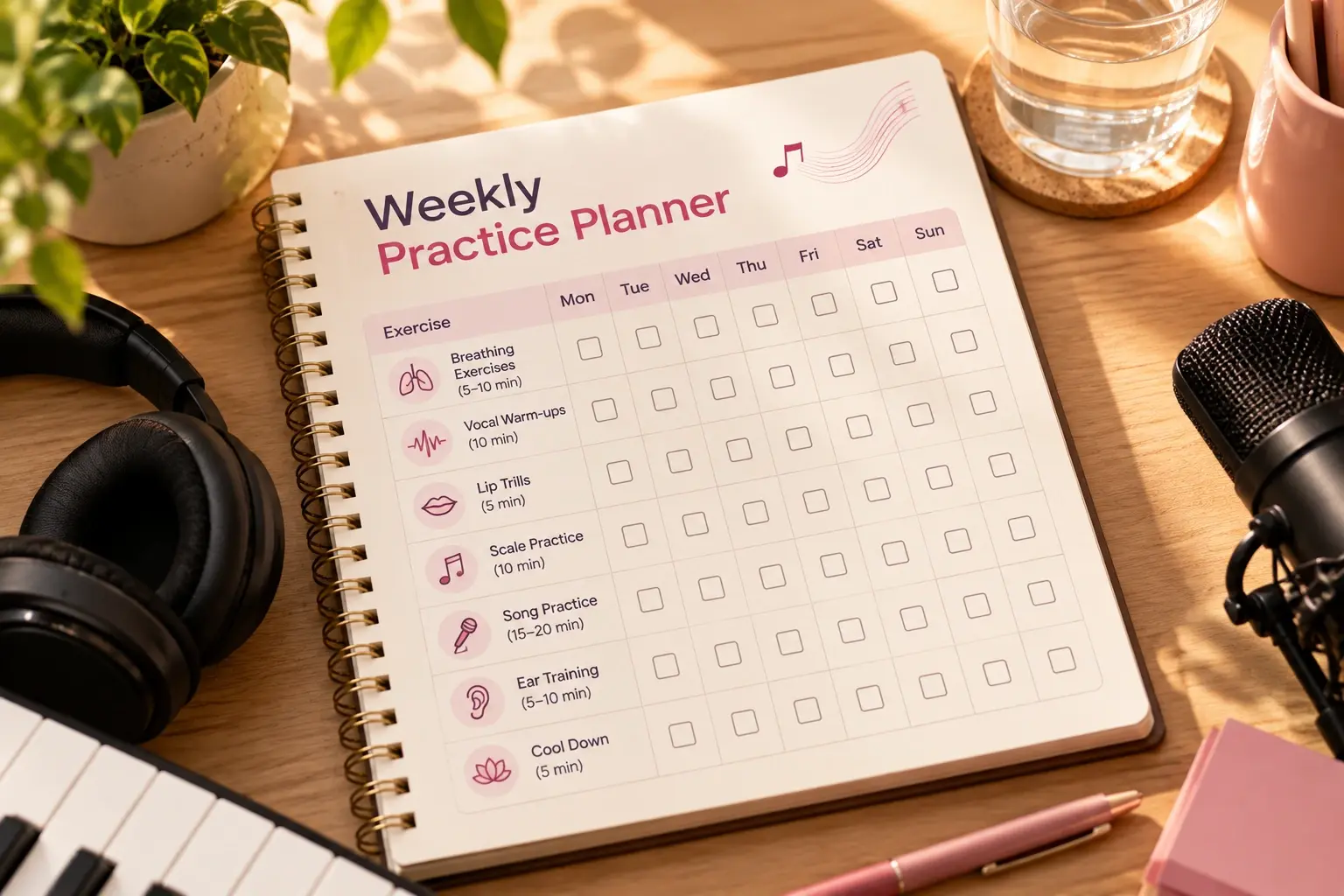
Consistency beats intensity. Fifteen minutes of focused practice daily will take you much further than one long session per week. The best vocal exercises are the ones you repeat daily. Here is a simple voice workout routine to follow:
| Step | Time | What to Do |
| Warm-up | 5 minutes | Yawn-sighs, lip trills & gentle humming |
| Breathing | 3 minutes | Slow inhale, steady “sss” exhale |
| Pitch work | 5 minutes | Five notes scales & sirens |
| Song practice | 5-10 minutes | Work on one section of a song, slowly |
| Cool down | 2 minutes | Easy humming & a few relaxed sighs |
Some days you will have more energy than others and that’s perfectly fine. If you are short on time, even a single vocal training exercise beats skipping practice altogether. Many learners also like to follow the voice lesson exercises their teacher assigns, since they are tailored to their needs.
Vocal Training for Different Genres (Classical, Pop, Playback)
Every style asks something a little different from your voice. The core skills are shared but the focus changes.
- Classical (Western & Indian): The focus is on pitch accuracy, breath stamina and a steady, resonant tone. In Hindustani and Carnatic traditions, daily riyaz on swaras, alankars and ragas build control and a deep sense of pitch.
- Pop: Here you will work on tone color, comfortable use of mic and smooth shifts between chest and head voice. Style and personality matter a great deal.
- Playback and film music: Playback singing asks for clear diction, emotional delivery and the ability to adapt to different moods and languages. Singers also need precision in the studio, where every note is heard closely.
Whichever style you love, the same core vocal exercises for singers carry across because strong fundamentals travel well. A singer with solid breath control and pitch can move between genres far more comfortably.
Common Mistakes to Avoid During Vocal Training
Everyone makes mistakes when they begin and even the best vocal exercises for singers can backfire if these habits creep in:
- Skipping warm-ups and jumping straight into difficult songs
- Pushing for high notes before your voice is ready
- Breathing high in the chest and lifting the shoulders
- Practicing for long stretches instead of short, regular sessions
- Singing through pain or heavy tiredness
- Copying another singer’s tone instead of finding your own
- Never recording yourself, which hides problems you can’t hear while singing
Remember, any good vocal training exercises should feel comfortable, so if something hurts, stop.
How to Protect and Maintain Vocal Health
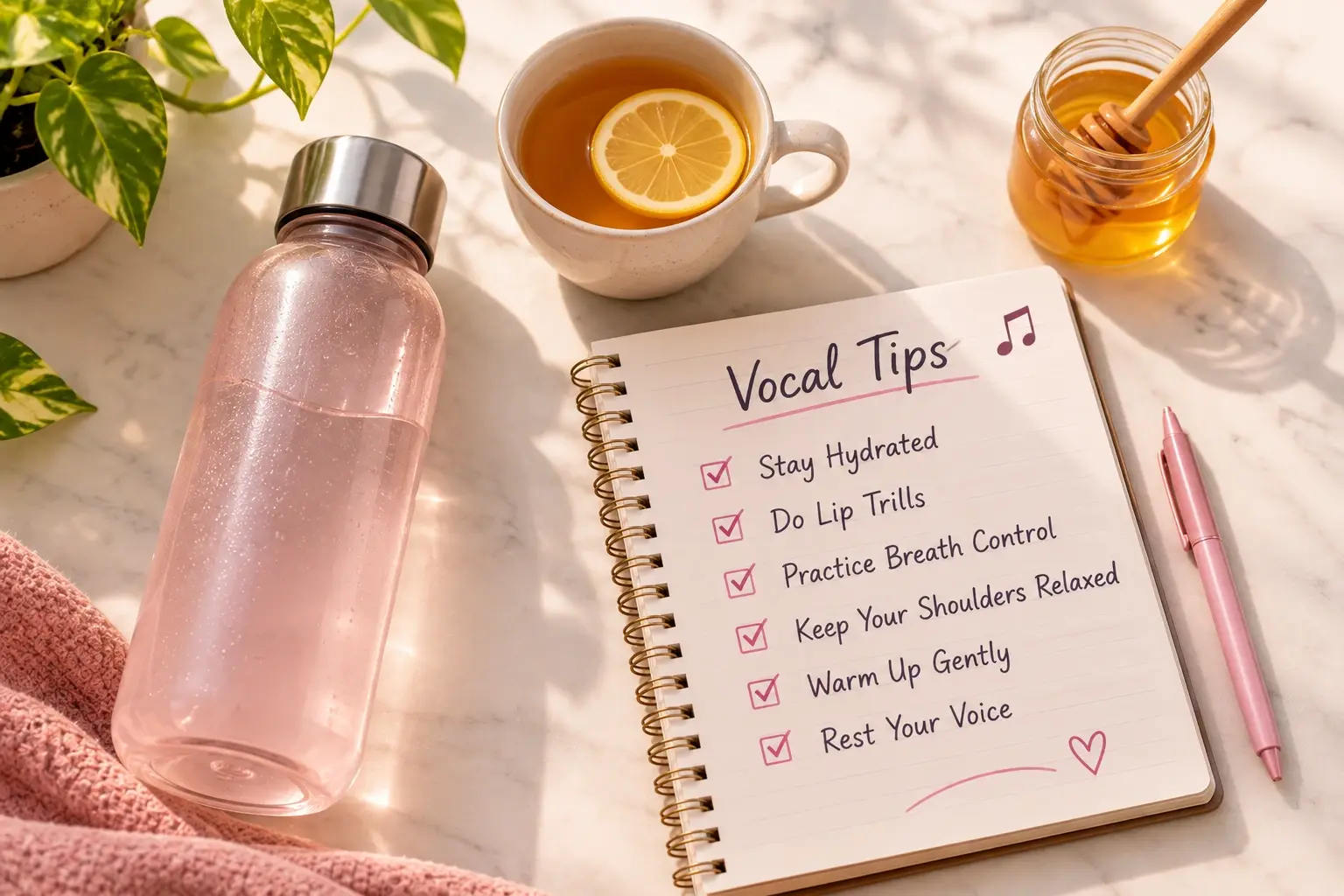
Your voice is delicate, so a little daily care goes a long way. Healthy habits matter as much as vocal exercises for singers, because they protect your voice and keep it sounding fresh:
- Drink water regularly throughout the day, as hydration supports a comfortable voice.
- Limit caffeine, alcohol and fizzy drinks which can leave you feeling dry.
- Avoid shouting, loud talking and forceful throat clearing.
- Swallowing or sipping water is gentler.
- Rest your voice when it feels tired and sing lightly if you are unwell.
- Stay away from smoking and secondhand smoke which irritate the vocal cords.
- Get enough sleep, since a tired body means a tired voice
For more practical ideas, see our post on 10 tips to keep your singing voice healthy. One important note: if you have lasting hoarseness, a sore throat or difficulty reaching notes you could reach before, see a doctor or voice specialist. Training cannot replace medical care.
How Long Does Vocal Training Take to Show Results?
This is the question every learner asks and the honest answer is: it depends. Your starting point, practice habits and the voice lesson exercises you follow all play a part. As a rough guide for someone practising 10-15 minutes daily:
- First month: Your pitch becomes steadier and breathing feels more natural.
- Around three months: Your comfortable range widens and your tone sounds more even.
- Around six months: You can sing full songs with better control and less strain.
- Around one year: Your confidence, stamina and personal style are visibly stronger.
These are general estimates, not promises. Some people progress faster, others need more time and both are completely normal. What matters is showing up regularly and repeating your vocal exercises for singers with care.
Online Vs In-Person Vocal Training: Which Is Better?
Both are better in their own ways. It all depends on your preference. Here’s a quick comparison for those who want to know:
| Factor | Online Training | In-person Training |
| Convenience | Learn from home, no travel | Needs travel to the place |
| Teacher choice | Access to teachers anywhere | Limited to your city |
| Flexibility | Easier to schedule around work or school | Fixed timings |
| Feedback | Live video feedback with recordings to revisit | Immediate, in-room feedback |
| Setup | Need a stable internet connection & a quiet space | Needs no tech setup |
Online learning is especially useful if you live far from a good teacher or have a busy schedule. In-person lessons suit people who enjoy face-to-face interaction. Many learners even mix the two. The key is working with a qualified teacher who guides your vocal exercises for singers with clear, personal feedback.
Start Small, Sing Often
Vocal training is not about becoming perfect overnight. It is about small, steady habits: a warm-up, a few breaths, a scale and a song you love. Keep up your daily vocal exercises for singers, protect your voice and you will be surprised by how far you can go.
If you would like expert guidance, Artium Academy is here to help. With over 45,000 learners worldwide, we offer live 1:1 online vocal courses in Western, Indian classical (Hindustani & Carnatic), popular & film music in Hindi, Telugu, Kannada, Tamil, and Malayalam, devotional music (North & South), Ghazal, and Karaoke.
These vocal courses are curated by legendary musicians including Sonu Nigam, K.S. Chithra, Aruna Sairam, Shubha Mudgal and voice science expert Ananth Vaidyanathan. These courses also offer globally recognised certifications on par with renowned music institutes around the world.
So, whether you are a beginner or a parent supporting a young singer, we have a path for you. Book a free 1:1 trial class with us today and take the first step toward the voice you have always wanted.
FAQs
Start with lip trills, humming, yawn-sighs, gentle sirens and slow “sss” breathing exercises. These vocal exercises for singers are easy on the voice and build breath control and pitch step by step.
Regular practice means singing songs you enjoy, while singing training is structured. It adds warm-ups, breathing work, pitch drills, and guidance on technique and vocal health.
Aim for about 10-165 minutes of focused daily practice, ideally with a warm-up first. Short, regular sessions work better than occasional long ones.
Yes. Most people can improve their pitch, breath control and tone with guided practice. Many who feel they “cannot sing” simply have not been shown how to use their voice yet.
Yawn-sighs, lip-trills, humming, straw exercises and gentle jaw loosening are excellent choices. Spend around 10-20 minutes easing into your range before tackling harder songs.
Many beginners notice steadier pitch and better breathing within a month of regular practice. Bigger changes in range, tone and confidence usually build over several months to a year.
You can learn the basics on your own but a teacher spots habits like throat tension or shallow breathing that you cannot hear yourself. Personal feedback usually speeds up progress and helps protect your voice.
Avoid skipping warm-ups, forcing high notes, breathing high in the chest and practising through pain. Recording yourself regularly also helps catch issues early.
Yes. Better breath support, relaxed posture and clearer articulation often make your speaking voice stronger and more comfortable as well. This helps if you speak a lot for work.
There is no single perfect age. Children are often ready for formal lessons around 7-9, when they can focus for a short session and follow guidance and adults can start at any age. A teacher will adapt exercises to a young voice, especially during adolescence.