
All Topics
- Alchemizing Music Concepts for Students
- Anuv Jain Songs
- Artist Spotlight
- artium gift card
- Artium Maestros
- Artium News
- Artium Practice Studio
- Artium Tech Blog
- Best Coke Studio Songs
- Best Female Singers
- Birthday songs
- Bollywood Love Songs
- buying guide
- Carnatic Music
- Child Singers
- Devotional Music
- Editorials by Ananth Vaidyanathan
- English Love Songs
- Festival
- Film Music
- Ghazal Music
- Guitar
- Hindustani Classical Music
- Indian Classical Music
- Indian Folk Music
- Insights
- Instagram Reels Viral Songs
- Instruments
- Karaoke
- Karaoke Singing
- Keyboard
- Kids Music
- maestros
- Music Education
- Music for Kids
- Music Games
- Music Industry
- Music Instruments
- Music Legends
- Music Press Release
- Music Technology
- Music Theory
- Music Therapy
- Music Tools
- Piano
- piano guide
- Songs
- South Devotional Music
- Success Stories
- Tamil Film Music
- Telugu Film Music
- Time Theory
- Tools
- Uncategorized
- Uncategorized
- Uncategorized
- Uncategorized
- Vocal Range
- Vocal Singing
- Vocals
- western classical music
- western music
- Western vocal music
What Is Crescendo in Music? Meaning, Examples, and Uses
What Is Crescendo in Music? Meaning, Examples, and Uses
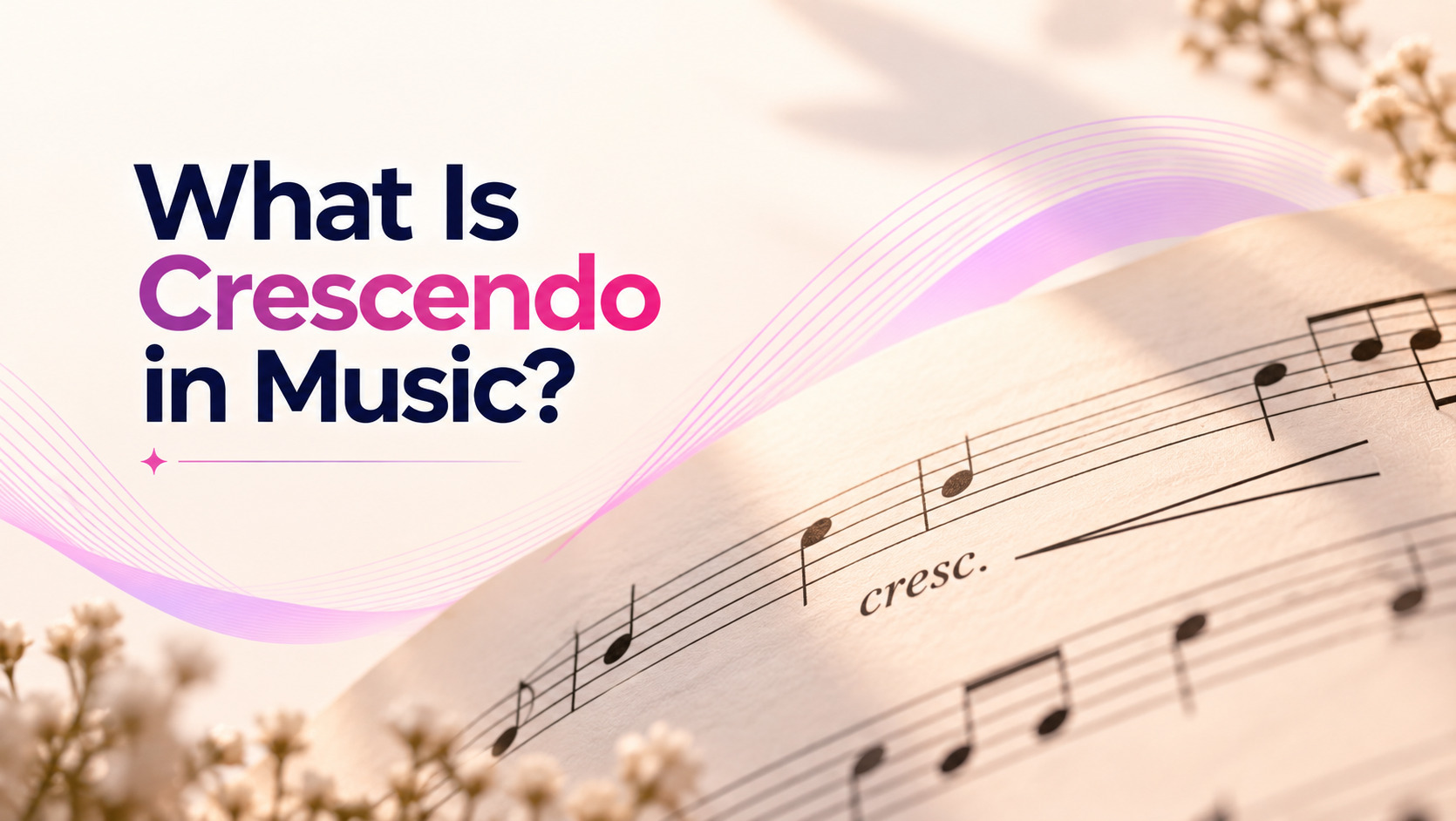
Table of Contents
Quick Summary
| Crescendo in music is a gradual increase of loudness, typically a smooth, progressive dynamic change from soft to loud. It can be notated as cresc. Or with a widening hairpin, which is a symbol like a dynamic marking with an opening out line: <. What is the opposite of crescendo in music? The word decrescendo (or decresc.) also means gradually getting softer or quieter, or decreasing the volume. |
Introduction
Ever heard a song where the music is gradually slowly increasing in loudness, crescendoing in power and intensity? That’s a crescendo in music.
This Italian word literally means “growing”, and in musical terms indicates the musician should gradually increase the volume, not suddenly. It is one of the simplest yet most effective ways to add emotional resonance, build tension and create anticipation in a musical work.
No matter what instrument you sing, play piano, guitar, violin or anything else, learning crescendo will help you go beyond the notes you’re playing. It will help you communicate a story.
Crescendo in Music Definition
Music crescendo definition: a progressive increase in loudness or intensity.
A crescendo in music is a type of dynamic mark that relates to loudness. It is not meant for you to jump into a loud section all at once. The crescendo instructs you to gradually increase from one level of sound to the next.
For example:
- Start softly, like a gentle conversation.
- Gradually increase your sound.
- Develop a fuller, richer volume by the phrase’s end.
“Gradually” is the key word. If you start softly and then instantly go loud, that is not a crescendo, it is a sudden change of dynamic.
How to Define Crescendo in Music Simply
Before we explain how to define crescendo music style to a beginner, you can play it to him/her and tell him/her to think of a wave rising from the beach.
A crescendo is like:
- A singer starting a line softly and allowing the voice to bloom.
- A guitarist playing softly at first, then playing more forcefully with each down stroke.
- A pianist gradually intensifying strike to each note.
- An orchestra gradually starts softly and ends loudly.
In simple words: crescendo means getting louder slowly and smoothly.
It’s more than just loudness. A well-executed crescendo also comes across as increasing emotion-hope, joy, anticipation, etc. That’s why composers frequently employ a crescendo near the beginning of a song just before the chorus.
Opposite of Crescendo in Music (Decrescendo/Diminuendo)
Another term for the opposite of crescendo in music is decrescendo, also known as diminuendo. While a crescendo tells you to become louder gradually, a decrescendo or diminuendo tells you to become softer gradually.
In simple words:
- Crescendo = slowly increase volume
- Decrescendo = gradually getting softer
- Diminuendo = gradually getting softer
They are all movement instructions. They are not going to change the notes you sing or play. They’re just going to change the volume at which you sing or play them.
Decrescendo and Diminuendo: Are They Different?
In a large majority of contemporary printed sheet music both terms are used interchangeably. They are often used for playing diminuendo.
But some players and composers choose to feel them in a bit different way:
- Decrescendo often suggests a clear, steady reduction in volume.
- Diminuendo is sometimes used when the music should fade more gently or diminish in intensity.
For a beginner, You need not worry too much about this difference as a beginner. In practice, you can simply treat both and as: “become softer over time.”
How They Are Written in Sheet Music
| Term | Meaning | Common notation |
| Crescendo | Gradually becoming louder | < or cresc. |
| Decrescendo | Gradually becoming softer | > or decresc. |
| Diminuendo | Gradually becoming softer | > or dim. |
The symbols < and > are referred to as hairpins because they resemble a thin hairpin or wedge. A crescendo hairpin opens towards the right (<); this indicates an increase in loudness. A decrescendo or diminuendo hairpin closes towards the right (>); this indicates a decrease in loudness.
You may also see the written abbreviations:
● cresc. for crescendo
● decresc. for decrescendo
● dim. for diminuendo
A Simple Way to Remember the Difference
Think of a balloon.
- A crescendo in music is like blowing a balloon up. Gradually making it louder.
- A decrescendo or diminuendo is like gently letting the air out of the same balloon. The sound becomes thinner and quieter.
They don’t happen all of a sudden. The transition is gradual and smooth.
Why These Markings Matter
Crescendos and decrescendos are used to sculpt the shape of music. If a conductor weren’t to include them it wouldn’t have any shape as phrases would be played at the same loudness.
For example:
- One singer may start softly, swell into an emotionally charged word, then decrescendo to rest.
- A musician might increase volume in a passage that rises in pitch before playing a diminuendo to gently end.
- A guitarist might have a gentle downbeat at the end of a song and just leave it hanging.
Both notes combine to give a breath to the music, wherein it rises and is energetic, and then falls and is calm, as in natural speech or emotion.
How to Practise Decrescendo and Diminuendo
- Sing or play one long note. Begin at a steady, comfortable medium volume.
- Reduce the sound gradually over eight counts. Do not let it disappear suddenly.
- Keep your tone steady. The note should remain clear as it becomes softer.
- Reverse the exercise. Crescendo to louder, then decrescendo to softer.
- Listen back to a recording. Observe if the changes in volume are even and if you can maintain your rhythm and pitch.
Related to this is control: it should be obvious from the listening that the music isn’t just cut off at the end but gradually and gradually fades away.
How Crescendo in music Is Notated in Sheet Music
In sheet music, a crescendo can be written in two main ways.
- The word or abbreviation:
A crescendo or the abbreviation cresc. Over or under the staff are also options. - The hairpin symbol:
A crescendo is written as two lines very close together on the left that then spread apart to the right: <. It resembles a sideways wedge or hairpin.
The length of the hairpin indicates the duration of the crescendo. A short symbol might indicate only a few beats; a long hairpin, a whole number of bars.
You might also notice this note before or after it:
- p (piano): soft
- mp (mezzo-piano): moderately soft
- mf (mezzo-forte): moderately loud
- f (forte): loud
For example, mp < f: play moderately soft, getting louder, and culminating in a loud dynamic level.
Examples of Crescendo in Popular and Classical Music
Crescendos are found in film music and pop songs, Indian classical music and Western classical music.
In Hindustani classical music
Long crescendos are common in orchestral music and are used to climax. Soft sustained notes are played on the strings, with other instruments gradually adding their sounds to make a gradually more ‘full’ and intense noise that can culminate in a big peak.
In film and background music
Imagine you are watching a film, and the lead character is about to enter a fight. The music has been quiet for some time, and then it builds as the moment approaches. That’s achieved using a crescendo.
In popular songs
A lot of songs will employ a crescendo leading into the chorus. The verses may start out mellow and reserved, building up to the point of the chorus with the singer and instrumentalists getting more and more intense as it gets closer.
In Indian music
Indian instrumental and vocal music also displays devices of shaping phrases by swelling or diminishing the sound, and the use of a crescendo may contribute richness to a raga investigation, a bhajan, a film song, or a modern arrangement.
The form may vary, but the thought holds true everywhere: the ability of sound to generate feeling.
Crescendo vs Sudden Dynamic Changes: Understanding the Difference
A crescendo in music is gradual. A sudden change in dynamic is instantaneous.
| Feature | Crescendo | Sudden dynamic change |
| Volume change | Gradual | Immediate |
| Feeling | Building, swelling, growing | Surprise, contrast, emphasis |
| Notation | < or cresc. | Dynamic markings such as p, f, ff |
| Example | Softly rising to loud over four bars | Moving directly from soft to loud |
For example, if a composer wishes to convey an instant surge of energy, they would just use forte (f) next to a short section. But if the intention is for the music to build gradually, they will use a crescendo.
If you are a student, take control. You don’t have to accelerate the increase. Allow it to expand uniformly, similar to a light dimmer than a light switch.
How to Practice Crescendo While Singing or Playing an Instrument
The secret to a good crescendo is breath control, listening and patience. You are aiming at raising the volume without losing tone quality, rhythm or clarity.
Crescendo Exercises for Singers
- Hum and swell
Hum one comfortable note slowly. Over the first eight counts, gradually let the sound ring out. Then over the second eight counts, let it soften back down again. Be sure to keep your throat relaxed. - Count your growth
Sing a very simple scale or sustained vowel such as “ah.” Begin softly and then grow louder over four counts, eight counts, or sixteen counts. Don’t strain or shout. - Phrase shaping
Pick a line from a song you know. Say it softly initially and then increase your volume until it reaches the last word. Feel the emotion in each of these. - Breath support practice
Breathe casually and sing a sustained note. As you increase in volume, maintain your shoulders down and support your sound with consistent breath. If you begin to strain your sound, back off.
Crescendo Exercises for Instrumentalists
- Long-note swell
Hold a single note. Start softly, get louder, get softer. Good on piano, guitar, violin, flute and most other instruments. - Scale dynamics
Play a scale going up, gradually build in volume until you get to the top and then gradually decrease in volume as you go down. - Strum or bow control
Guitar- start softer and work towards increased energy more gradually.
Bowed strings- increase the bow speed and pressure carefully.
Piano- develop the weight in your fingers and arms without any feeling of tightening your hands. - Record and listen
Say a few words with a crescendo. Play it through and ask yourself: Did the volume gradually increase in a nice way? Did the tone stay nice? Did the rhythm stay steady?
At Artium Academy, students will be taught these fundamentals by certified teachers in 1:1 live classes, allowing you to develop technique at your own pace according to your voice / instrument. The GRMP-accredited curriculum and masterclasses conducted by world-acclaimed musicians allow students to have systematic training for technique and musical expression.
Why Crescendo Matters for Musical Expression
Music is not just about the notes. It’s about the feeling.
A crescendo in music helps you create:
- Anticipation: the listener becomes aware of an object.
- Emotion: happiness, desire, bravery, thrill, or showiness can build up with noise.
- Shape: phrases ’embellish’ with a mixture of up and down movements. The overall contour is not a flat line.
- Contrast: The softer parts seem more significant if they are preceded by a full sound.
- Storytelling: music can transition from a delicate calmness to a roaring crescendo.
Your song takes on a more lively feel just by cuing the dynamic, gently pushing the volume up before the chorus might make that chorus seem like an emotional outpouring.
Conclusion
Ever felt your heart beat faster as a song kicks into gear before the chorus even comes on? That’s the subtle magic of a crescendo of music at play.
Crescendo in music is a notation that indicates a gradual increase in loudness or intensity and is denoted by the abbreviation ‘cresc.’ or a widening hairpin in music notation. Crescendo is used by singers and players to add emotion, tension, and momentum to a song.
Learning to manage the crescendo is an important aspect of music education as it develops the right notes into an expressive music performance. Practice slow long notes, scales and common song phrases. Relax, listen and let the sound expand.
If you want to create musical expression with professional help, learn more at Artium Academy.
Frequently Asked Questions
A crescendo is a gradual (like sloping upward) increase in loudness or intensity of a sound in music.
For a beginner it just means “building from quiet to loud.” For example, the singer is softly singing and then gradually starts to get louder and louder until she hits a peak.
Crescendo is the opposite of decrescendo or diminuendo. Both of these mean slowly getting softer.
Cresc. Or crescendo or hairpin opening to the right: <. The length of the crescendo symbol indicates the duration of the crescendo.
A typical example will be before a chorus where the verse might start softly, then the vocals and instruments get fuller and fuller ready for a big chorus.
Singers can do these exercises by humming or singing a sustained note, starting from p, p, and gradually building louder over eight beats. Needs to have proper breath support and a relaxed throat, and stable tone.
No. Crescendo is part of all music styles including classical, film, pop, devotional, Indian contemporary, and others. Since any genre can be an expression of gradually changing the volume.
The crescendo symbol is a wedge or hairpin opening to the right: <. It can also be shown as the abbreviation cresc.
It can be a few beats, a bar, a few bars, or a whole section. It is up to the composer’s notation and the music.
Crescendo in music to build movement and emotion. It is a great tool for adding excitement, creating tension, drawing attention to key moments and adding intensity to a performance.