
All Topics
- Alchemizing Music Concepts for Students
- Anuv Jain Songs
- Artist Spotlight
- artium gift card
- Artium Maestros
- Artium News
- Artium Tech Blog
- Best Coke Studio Songs
- Best Female Singers
- Birthday songs
- Bollywood Love Songs
- buying guide
- Carnatic Music
- Child Singers
- Devotional Music
- Editorials by Ananth Vaidyanathan
- English Love Songs
- Festival
- Film Music
- Ghazal Music
- Guitar
- Hindustani Classical Music
- Indian Classical Music
- Indian Folk Music
- Insights
- Instagram Reels Viral Songs
- Instruments
- Karaoke
- Karaoke Singing
- Keyboard
- Kids Music
- maestros
- Music Education
- Music for Kids
- Music Games
- Music Industry
- Music Instruments
- Music Legends
- Music Press Release
- Music Technology
- Music Theory
- Music Therapy
- Music Tools
- Piano
- piano guide
- Songs
- South Devotional Music
- Success Stories
- Tamil Film Music
- Telugu Film Music
- Time Theory
- Tools
- Uncategorized
- Uncategorized
- Uncategorized
- Uncategorized
- Vocal Singing
- Vocals
- western classical music
- western music
- Western vocal music
Veena: India’s Ancient String Instrument Explained
Veena: India’s Ancient String Instrument Explained
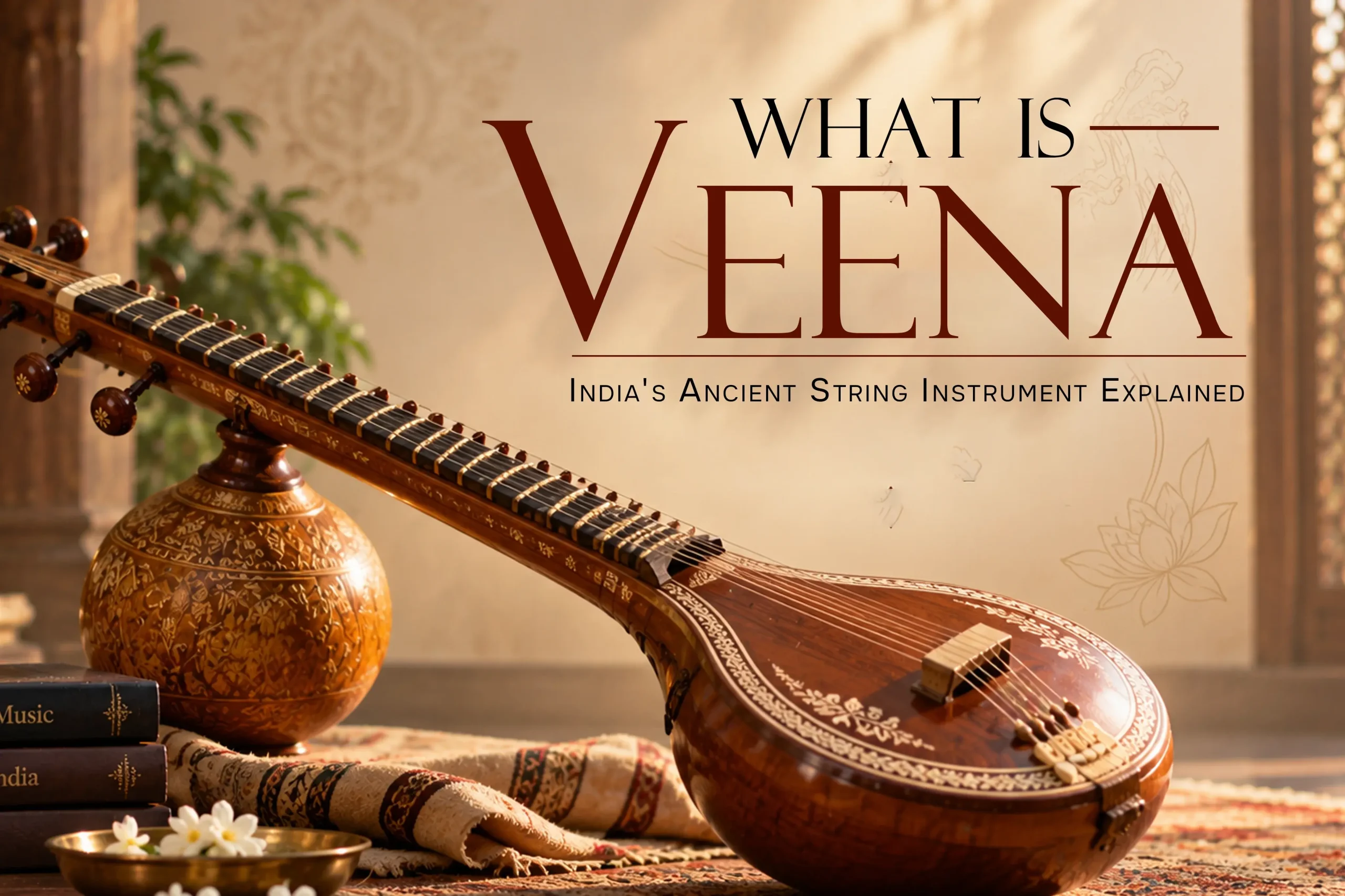
Table of Contents
Quick Summary
| The veena is a plucked string instrument that is central to classical music, especially the Carnatic tradition. It has a body, metal frets and many strings for melody and drone. Major types include Saraswati veena, Rudra veena and Chitravina veena. Revered for its depth the veena remains a symbol of India’s rich heritage. |
What Is Veena? (Meaning and Overview)
The term veena (also spelled vina) historically refers to a family of Indian stringed instruments. Today, it most commonly describes the Saraswati veena of South India. Derived from Sanskrit, the word broadly means “string instrument” or “lute.” With its resonant gourds, detailed fretwork, and spiritual significance, the veena remains an important instrument in both Carnatic and Hindustani classical music. Its intricate techniques also place it among the hardest Indian classical instruments to learn, yet its rich, expressive sound continues to captivate musicians and listeners.
In usage the veena instrument is a big, fretted plucked lute with a long neck. The veena instrument has two resonating gourds or one gourd and a wooden body. The veena instrument typically has 24 fixed metal frets. It has:
- Four main melody strings
- Three side strings for drone and rhythmic support
- A wooden body, traditionally carved from jackfruit or sandalwood
The veena is a most popular instrument in both Carnatic and Hindustani classical music. In Hindu iconography, Goddess Saraswati, the deity of knowledge, music, and arts, is often depicted playing the veena, symbolising the harmony of wisdom and sound.
Who Invented the Veena? A Look at Its History
The question “who invented veena?” does not have an answer in the modern sense. Instead the veena’s origins lie in mythology, scripture and gradual evolution over millennia.
Mythological Origins
- In Hindu tradition, the invention of the veena is often credited to Sage Narada, a celestial musician and storyteller.
- Ancient texts like the Rigveda and Samaveda (dating back to the first millennium BCE) mention veena-like instruments, showing its deep historical roots.
- Some legends say a hunter discovered musical tones by plucking a bowstring, inspiring early veena-like instruments.
Historical Evolution
- The earliest forms were likely simple harp-like or bow-shaped string instruments.
- Over centuries, these evolved into more complex designs with frets, bridges, and resonators, as described in treatises like Bharata’s Natya Shastra and Sangita Ratnakara.
- By the 10th–11th centuries CE, the seven-string, 24-fret version became standard.
- In the 17th century, during the reign of Raghunath Nayak of Thanjavur, the veena took a form closer to today’s Saraswati veena.
So while no single person “invented” the veena in the sense of an invention, its development is tied to ancient sages, royal patronage and centuries of refinement by master craftsmen and musicians.
Types of Veena in Indian Classical Music
The veena family includes types, each associated with different regional styles and musical traditions. Below is a comparison of the types:
| Type of Veena | Region & Tradition | Key Features | Playing Style |
| Saraswati Veena | South India – Carnatic | Fretted lute; large wooden body + gourd resonator; 24 frets; 7 strings | Plucked with fingers; rested on lap/floor |
| Rudra Veena | North India – Hindustani | Stick zither; two large equal gourds; deep, resonant sound; used in Dhrupad | Plucked; heavy and majestic tone |
| Chitravina | South India – Carnatic | Fretless; slide-playing with a smooth block (gottu); 20–21 strings | Slide technique; fluid melodic phrases |
| Vichitra Veena | North India – Hindustani | Fretless; played with a glass/metal slide; similar to Chitravina | Slide technique; Hindustani ragas |
| Rudra Veena (Been) | North India – Dhrupad | Very large; ancient form; associated with Dagar gharana | Deep, meditative Dhrupad style |
Among these the veena of Saraswati is the widely recognised veena and is often the veena that people mean when they talk about the veena instrument. The Rudra veena and the Vichitra veena are specialised veenas mainly associated with Hindustani classical music while the Chitravina is a prominent veena in Carnatic music. Together these variations highlight the veena’s place in both Indian classical traditions.
Structure of the Veena Instrument
Understanding the veena’s structure helps explain its sound and playing technique.
Main Components
1. Dandi (Neck)
- A long, hollow wooden neck, often carved from a single piece of jackfruit or sandalwood.
- Supports the frets and strings.
2. Kudam (Main Resonator)
- A large, rounded wooden or gourd resonator at one end, amplifying the sound.
- Rests on the player’s lap or the floor.
3. Tumba (Secondary Resonator)
A smaller gourd at the far end of the neck, balancing the instrument and enhancing resonance.
4. Frets (Meru)
- Typically 24 fixed metal frets, set in wax so they can be adjusted for tuning.
- Allow precise pitch control for Carnatic gamakas (ornaments).
5. Strings
- Four main melody strings (steel or brass)
- Three side strings (drone and rhythmic support)
- Total of seven strings in the standard Saraswati veena.
6. Bridge (Jaavadi)
A curved wooden bridge that transmits string vibrations to the resonator.
The craftsmanship involved in making a veena is highly specialized. Makers in places like Thanjavur and Bobbili are known for producing some of the veena instruments.
How to Play Veena: A Beginner’s Guide
Starting your veena journey? Focus on posture, hand positions and simple exercises.
1. Posture & Holding
- Sit cross-legged or on a low stool.
- Rest the kudam (large resonator) on your right thigh.
- Place the tumba (small gourd) on the floor or a cushion.
- Keep the neck slightly raised for easy left-hand movement.
2. Hand Positions
- Left hand: Press strings on frets; thumb supports the neck; used for gamakas.
- Right hand: Pluck with index/middle fingers; optional metallic plectrum for brighter tone.
3. Beginner Exercises
- Sarali Varisai: Basic scales for strength and coordination.
- Alankaras: Rhythmic patterns for fluency.
- Gamaka practice: Learn oscillations and slides for Carnatic expression.
How to Play Veena Instrument Techniques
After mastering basics focus on these techniques:
- Gamakas: Oscillations, slides, and bends (e.g., jaru, kampita, sphurita) that give veena its vocal-like Carnatic expression.
- Meend & Slides: On fretless veenas (Chitravina, Vichitra), use a smooth block (gottu/batta) for continuous pitch bends.
- Tala (Rhythm): Pluck side strings in patterned cycles to add rhythmic support to melody.
- Advanced Pieces: Learn Kritis (compositional songs) and Ragam-Tanam-Pallavi (improvisational format) for concert-level mastery.
Veena’s Role in Carnatic and Hindustani Music
The veena plays a role in both Indian classical traditions though its prominence and form differ.
Carnatic Music (South India)
- The Saraswati veena is a leading string instrument, often called the “king” of Carnatic music.
- Used for solos, vocal accompaniment, and ensembles.
- Its design supports intricate gamakas and microtonal nuances vital to Carnatic ragas.
- Many renowned composers and performers have been veena virtuosos.
Hindustani Music (North India)
- Rudra veena and Vichitra veena are the main veena forms.
- Rudra veena is closely linked to Dhrupad, known for slow, meditative alap and spiritual depth.
- Though less common than sitar or sarod today, it remains respected for its ancient lineage and rich tone.
Learning the veena can be a rewarding musical journey. Now, let’s explore some famous veena players and memorable performances.
Famous Veena Players and Performances
The veena has been preserved and elevated by generations of extraordinary artists. Here are some of the most celebrated veena players:
Carnatic Veena Maestros
- Dr. Jayanthi Kumaresh: Known for her innovative jugalbandis and global collaborations.
- Suma Sudhindra: A legendary figure who brought the veena to international stages.
- Karaikudi Mani: A 20th-century icon who modernized veena technique and teaching.
- Nirmala Rajasekar: Renowned for her renditions and teaching.
- Raghunath Manet: Blends Carnatic music with dance and theatre.
Hindustani Veena Legends
- Asad Ali Khan: A Dhrupad maestro who revived the Rudra veena on the world stage.
- Baha’ud’din Mohiuddin Dagar: Continued the Dagar gharana’s Dhrupad tradition on Rudra veena.
- Suvir Misra: Known for his Vichitra veena performances.
- Gopal Krishan: Popularized the Vichitra veena in Hindustani music.
Final Thoughts
The veena stands as a symbol of India’s spiritual heritage. From its origins with Sage Narada to its modern forms, the veena continues to inspire musicians and listeners with its deep resonance and expressive range. Whether you are drawn to the richness of music or the meditative depths of Hindustani Dhrupad, the veena offers a profound journey into Indian classical tradition. Although Artium Academy currently does not offer veena courses, learners can begin by mastering Hindustani classical or Carnatic music, which provide a strong foundation in melody, rhythm, and musical expression. With regular practice and guidance from experienced teachers, beginners can prepare themselves for their veena journey and contribute to preserving this ancient art form for future generations.
FAQs
A veena is a plucked string instrument primarily associated with Carnatic and Hindustani classical music. It originated in the subcontinent with references dating back to the period around 1500 BCE.
Mythologically the veena is credited to Sage Narada. Historically it evolved over centuries from instruments to the complex fretted veenas we know today with major developments during the Thanjavur Nayak period.
Beginners start with posture, hand positioning and basic scale exercises like Sarali Varisai. Learning to play veena involves mastering plucking techniques, gamakas and rhythmic patterns under a guru or, through structured courses.
Major types include Saraswati veena (Carnatic) Rudra veena (Hindustani Dhrupad) Chitravina (fretless Carnatic) and Vichitra veena (fretless Hindustani). Each has a structure and playing style.
The veena is often seen as one of the Indian classical instruments to learn because it is large, has many complicated gamakas and requires very precise finger control. However with practice and good guidance learning to play the veena becomes very rewarding.
Traditional veenas are made from jackfruit wood or sandalwood. They have metal frets set in wax and use steel or brass strings. The resonator is often made from a gourd or wood. Making a veena is a specialised craft, especially in regions such as Thanjavur.
The Saraswati veena is the prominent type used in classical music. The Rudra veena and Vichitra veena are used in Hindustani music. Overall the veena is more central to concerts today.
Basic proficiency may be achieved after one to two years of practice. To reach mastery for concert‑level performance it usually requires five to ten years or more depending on how much time and effort you invest and the quality of your guidance.
Notable veena players include Dr. Jayanthi Kumaresh, Suma Sudhindra, Asad Ali Khan, Karaikudi Mani, Nirmala Rajasekar and Raghunath Manet among others.
Yes, beginners can learn the veena online through teachers and music platforms that offer dedicated veena lessons. These classes commonly cover posture, basic exercises, gamakas, repertoire, and personalised feedback.