
All Topics
- Alchemizing Music Concepts for Students
- Anuv Jain Songs
- Artist Spotlight
- artium gift card
- Artium Maestros
- Artium News
- Artium Tech Blog
- Best Coke Studio Songs
- Best Female Singers
- Birthday songs
- Bollywood Love Songs
- buying guide
- Carnatic Music
- Child Singers
- Devotional Music
- Editorials by Ananth Vaidyanathan
- English Love Songs
- Festival
- Film Music
- Ghazal Music
- Guitar
- Hindustani Classical Music
- Indian Classical Music
- Indian Folk Music
- Insights
- Instagram Reels Viral Songs
- Instruments
- Karaoke
- Karaoke Singing
- Keyboard
- Kids Music
- maestros
- Music Education
- Music for Kids
- Music Games
- Music Industry
- Music Instruments
- Music Legends
- Music Press Release
- Music Technology
- Music Theory
- Music Therapy
- Music Tools
- Piano
- piano guide
- Songs
- South Devotional Music
- Success Stories
- Tamil Film Music
- Telugu Film Music
- Time Theory
- Tools
- Uncategorized
- Uncategorized
- Uncategorized
- Uncategorized
- Vocal Range
- Vocal Singing
- Vocals
- western classical music
- western music
- Western vocal music
Sitar Instrument: History, Types, Parts and How It Works
Sitar Instrument: History, Types, Parts and How It Works
Table of Contents
Quick Summary
| The sitar is a plucked string instrument used mainly in Hindustani classical music. Its main types include Kharaj Pancham, Gandhar Pancham and electric sitar. Important parts include the tumba, dandi, frets, jawari, main strings and sympathetic strings. It evolved from long-necked string instruments into a refined instrument for expressive melodies, slides and raga performance. |
Introduction to the Sitar Instrument
The sitar instrument is one of the recognisable Indian classical instruments. It has a neck curved metal frets, a large rounded resonator and several strings. The instrument is played by plucking the strings with a metal pick called a mizrab usually worn on the index finger.
Unlike a guitar a sitar does not simply produce one note at a time through fixed frets. Its movable frets and flexible strings allow a player to create slides, bends and ornamentations. These details are essential to the style of Hindustani music.
If you are exploring what is hindustani music, the sitar is an important instrument to understand. It is commonly used to present a raga, develop melodic ideas and accompany rhythmic sections played with tabla.
History of Sitar Musical Instrument
Origins and Early Development
The history of sitar instrument traditions includes several theories. A popular story connects its invention with Amir Khusrau. Historians and music scholars continue to debate this claim. One discussed explanation traces the modern sitar to earlier Indian long-necked lutes, including instruments related to the tritantri veena.
The Persian word seh-tar means “three strings” and some scholars believe that the name “sitar” developed from this term. Over time Indian makers and musicians adapted the instrument changing its shape, string arrangement and playing technique.
Early versions were likely simpler than the sitar. As musicians explored ways of presenting raga music the instrument gradually developed more strings, movable frets and sympathetic strings.
Evolution in Hindustani Classical Music
The sitar became increasingly important in Hindustani music particularly during the nineteenth and twentieth centuries. Instrument makers refined its design while leading performers developed techniques and playing styles.
The instrument became known for:
- Long melodic slides called meend.
- Fast plucked passages known as taan.
- Repeated rhythmic strokes.
- Resonance from sympathetic strings.
- Flexible frets that can be adjusted for different ragas.
Artists such as Ravi Shankar and Vilayat Khan helped introduce the sitar to audiences beyond India. Their performances and collaborations brought international attention to the instrument.
Today the sitar remains central to classical concerts and is also heard in fusion, devotional, advertising and film music.
Sitar Instrument Information: Types and Variants
Main Types of Sitar
The main types of sitar are often identified by their string arrangement, tuning and musical approach.
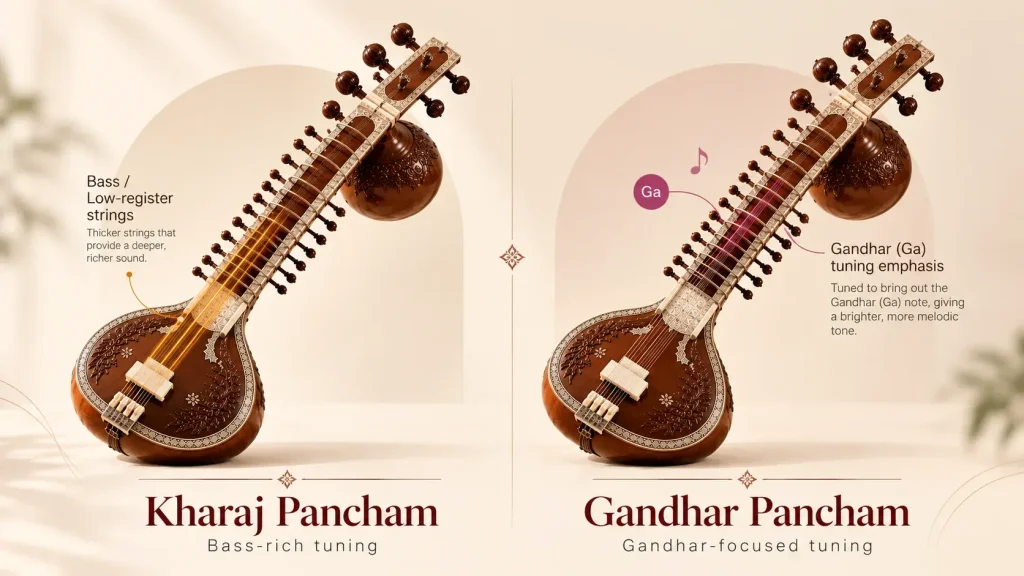
Kharaj Pancham Sitar
A Kharaj Pancham sitar generally includes bass strings that extend the instrument’s range. The term kharaj refers to a register while pancham refers to the fifth note of the scale.
This type is often chosen by players who want a bass response and a broader range for developing the alap or the slow unmetered introduction to a raga. It may have a body or an additional resonator depending on the maker and design.
Gandhar Pancham Sitar
A Gandhar Pancham sitar is associated with a string arrangement and tuning approach. It typically focuses more on the upper registers and is often preferred for a lighter, more agile style of playing.
The exact design can vary between gharanas, teachers and instrument makers. Therefore the names should not be treated as standardised categories in every school of sitar playing.
Modern and Special Variants
Modern sitars may differ in:
- Number of main strings.
- Number of sympathetic strings.
- Presence of a second resonator.
- Neck length and body size.
- Type of wood and finish.
- Bridge design.
- Tuning peg arrangement.
Some instruments are made for beginners. Are slightly easier to handle. Concert instruments may use selected wood, a more refined bridge and detailed hand finishing.
An electric sitar uses a pickup or electronic amplification system to send the sound to an amplifier. It may resemble a sitar in appearance. Its body, strings, bridge and playing response can differ from those of an acoustic sitar. Electric versions are useful for stage performance, fusion music and recording. They do not always reproduce the exact resonance of a traditional instrument.
To place the sitar within the wider family of instruments used in hindustani classical music, it helps to compare it with the sarod, tanpura, bansuri and tabla. Each instrument has a different role, sound and technique.
Parts of the Sitar Instrument
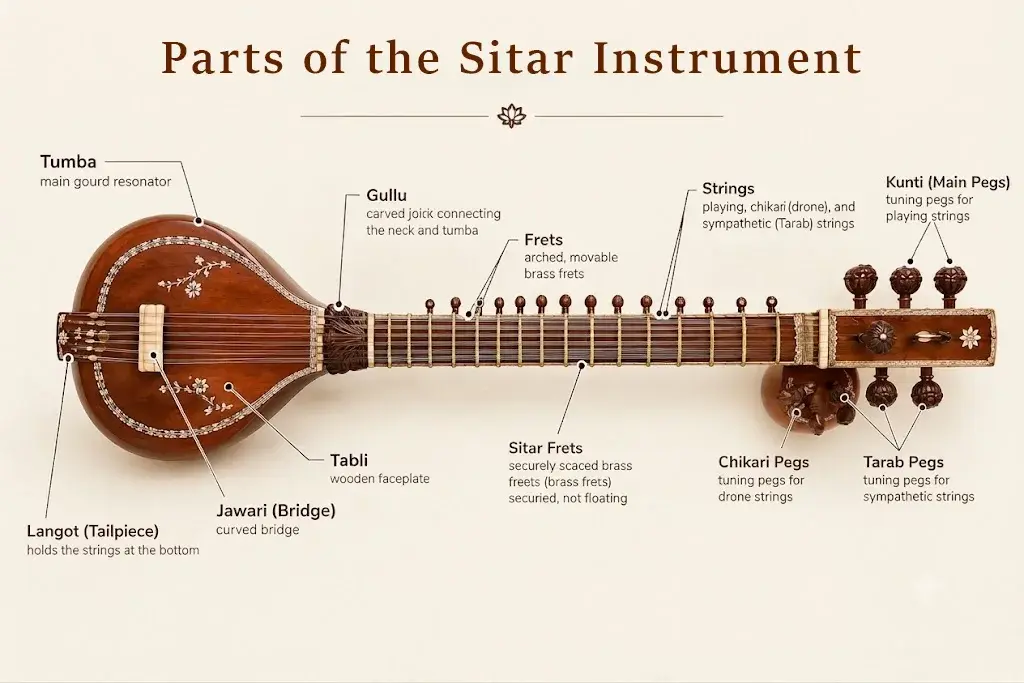
Understanding the parts of a sitar instrument makes it easier to follow a lesson or choose an instrument.
1. Tumba
The tumba is the resonator, traditionally made from a dried and hollowed gourd. It helps amplify the vibration of the strings and contributes to the sitar’s resonant tone.
Some sitars have a tumba attached to the upper part of the neck. This additional resonator can add balance and resonance although not every sitar has one.
2. Dandi
The dandi is the neck or fingerboard. It is commonly made from wood, such as tun wood or another suitable hardwood. The dandi supports the frets, strings and tuning arrangement.
Because the neck is long, sitar technique involves coordinating the left hand across a large playing area.
3. Frets
Sitar frets are. Usually tied to the neck rather than permanently fixed. This allows a musician or instrument technician to move them slightly to suit a raga’s notes.
The curved shape also helps the player pull a string sideways to create a pitch bend.
4. Main Strings
A sitar commonly has main playing strings. Depending on the design these may include melody strings, rhythm strings and a bass string.
The player plucks these strings with the mizrab. The main strings carry the phrase and are responsible for the melody.
5. Sympathetic Strings
Sympathetic strings, known as taraf strings usually pass underneath or beside the frets. They are not plucked directly during playing. Instead they vibrate when matching notes are played on the strings. This creates the sitar’s shimmering resonance.
6. Jawari
The jawari is the bridge surface over which the strings pass. Its shaped gently sloping surface affects the sustain, brightness and buzzing quality of the sound.
Jawari work requires skill. If the surface is too flat, too rounded or uneven the sitar may sound dull, harsh or unstable. Regular maintenance is therefore important.
7. Langot and Pegs
The langot is a fitting near the end of the instrument where strings are attached. Wooden tuning pegs hold the strings at the end and allow the player to adjust their pitch.
8. Gulu and Tabli
The gulu is the joint where the neck meets the resonator. The tabli is the wooden plate covering the resonating chamber. With the tumba these parts help transmit and reinforce vibrations.
How Sitar Is Made: Step-by-Step Overview
Materials Used
Traditional sitar making uses:
- A dried gourd for the tumba.
- Seasoned hardwood for the dandi.
- Wood for the tabli and bridges.
- Metal for the frets and strings.
- Wood or metal for tuning pegs and fittings.
- Decorative materials for inlay and finishing.
The quality and seasoning of the wood are important. Wood that has not dried properly may bend, crack or affect tuning stability.
Basic Construction Process
- Preparing the gourd: A suitable gourd is dried, hollowed and carefully shaped to create the sitar’s main resonating chamber.
- Making the neck: A strong, seasoned wooden neck is carved and smoothed to support the strings and frets.
- Fitting the resonator: The gourd is attached to the wooden top plate, creating a stable body through which sound vibrations can travel.
- Adding the frets: Curved metal frets are tied to the neck and positioned according to the sitar’s tuning. They can usually be adjusted when needed.
- Installing the bridges: The main bridge and the smaller bridge for the sympathetic strings are fitted. Their shape and height greatly influence the sitar’s tone.
- Adding strings and tuning pegs: The main and sympathetic strings are attached, passed over the bridges and connected to their respective tuning pegs.
- Finishing and jawari work: The sitar is polished and decorated, while the jawari is carefully filed to create the required sustain and tonal quality.
Even after construction, a handmade sitar may need occasional adjustments because changes in humidity, temperature and string tension can affect its sound.
How the Sitar Instrument Works
The sitar produces sound when its strings are plucked with a mizrab. Their vibrations travel through the bridge and resonate inside the hollow gourd, creating the instrument’s rich tone.
The frets shorten the strings to produce different notes, while their curved shape allows players to pull the strings sideways and create smooth pitch bends. Sympathetic strings vibrate along with the main strings, adding resonance and sustain.
A sitar performance may include:
- Alap: Slow raga exploration without a fixed beat.
- Jor: Rhythmic development without tabla.
- Jhala: Fast and energetic playing.
- Gat: A composed section performed with a rhythmic cycle, often alongside tabla.
Beginners should first focus on correct posture, clean plucking and steady tuning before developing speed.
Why Learn or Explore the Sitar Instrument?
Learning about the sitar can deepen your understanding of melody, rhythm and improvisation. It also develops patience because the instrument requires tuning, controlled plucking and gradual coordination, between both hands.
You may enjoy exploring the sitar if you:
- Like Indian classical or instrumental music.
- Want to understand how ragas are developed.
- Enjoy expressive slides and sustained notes.
- Are interested in Indian cultural traditions.
- Want to listen to music more actively.
- Plan to connect instrumental practice with vocal training.
Even if you do not plan to play the sitar, studying its sound can improve your appreciation of Hindustani performances. Vocal learners can also understand pitch, ornamentation, phrasing and vocal range by observing how sitarists develop melodies across different notes.
If you are learning the sitar and want to learn hindustani music alongside it, Artium Academy offers 1:1 online Hindustani music classes with certified teachers. You can practise from home with personalised guidance, even though sitar instrument classes are not currently offered.
Final Thoughts
The sitar is more than a stringed instrument with a shape. Its gourd resonator, frets, jawari and sympathetic strings work together to create the expressive sound associated with Hindustani music.
If the sitar has sparked your interest in Indian music, you can explore Hindustani music through structured vocal lessons. Artium Academy’s GRMP curriculum and 1:1 live classes provide personalised guidance for beginners, returning learners and young students.
Ready to begin your musical journey? Book a free 1:1 trial class with Artium Academy and learn from certified teachers at your own pace.
FAQs
A sitar is a plucked string instrument used mainly in Hindustani classical music. It has a fretted neck, a gourd resonator, main strings and sympathetic strings.
The sitar developed in the subcontinent from earlier long-necked string instruments. Its precise origin is debated, although some theories connect it with the veena and the Persian term seh-tar.
The discussed types include Kharaj Pancham and Gandhar Pancham sitars. They differ mainly in string arrangement tuning emphasis and playing approach. Modern acoustic and electric variants are also available.
Kharaj Pancham sitars generally emphasise a bass range through additional low strings. Gandhar Pancham sitars usually focus more on the upper registers. Exact features can vary by maker and musical tradition.
An electric sitar uses a pickup or electronic amplification system. It is often designed for stage, studio or fusion use while a traditional sitar depends on its gourd and wooden resonating body.
The tumba is the resonator at the lower end of the sitar. It is traditionally made from a dried hollowed gourd. Helps amplify the strings’ vibrations.
The dandi is the neck that supports the frets, strings and tuning system. It gives the player space to move between notes and perform bends.
The jawari is the shaped bridge surface over which the strings pass. Its design affects the sitar’s tone sustain and characteristic buzzing quality. It must be maintained by a technician.
The sitar is often used in Hindi film music to create classical, romantic, spiritual, nostalgic or reflective moods. Composers may use a traditional acoustic sitar, an electric version or sampled sitar sounds, depending on the style and arrangement of the song.
The sitar is primarily an instrument. It presents ragas through development, rhythmic passages, composed sections and improvisation often with tabla accompaniment.