
All Topics
- Alchemizing Music Concepts for Students
- Anuv Jain Songs
- Artist Spotlight
- artium gift card
- Artium Maestros
- Artium News
- Artium Tech Blog
- Best Coke Studio Songs
- Best Female Singers
- Birthday songs
- Bollywood Love Songs
- buying guide
- Carnatic Music
- Child Singers
- Devotional Music
- Editorials by Ananth Vaidyanathan
- English Love Songs
- Festival
- Film Music
- Ghazal Music
- Guitar
- Hindustani Classical Music
- Indian Classical Music
- Indian Folk Music
- Insights
- Instagram Reels Viral Songs
- Instruments
- Karaoke
- Karaoke Singing
- Keyboard
- Kids Music
- maestros
- Music Education
- Music for Kids
- Music Games
- Music Industry
- Music Instruments
- Music Legends
- Music Press Release
- Music Technology
- Music Theory
- Music Therapy
- Music Tools
- Piano
- piano guide
- Songs
- South Devotional Music
- Success Stories
- Tamil Film Music
- Telugu Film Music
- Time Theory
- Tools
- Uncategorized
- Uncategorized
- Uncategorized
- Uncategorized
- Vocal Range
- Vocal Singing
- Vocals
- western classical music
- western music
- Western vocal music
Shehnai Instrument Explained: History, Sound, and Famous Players
Shehnai Instrument Explained: History, Sound, and Famous Players
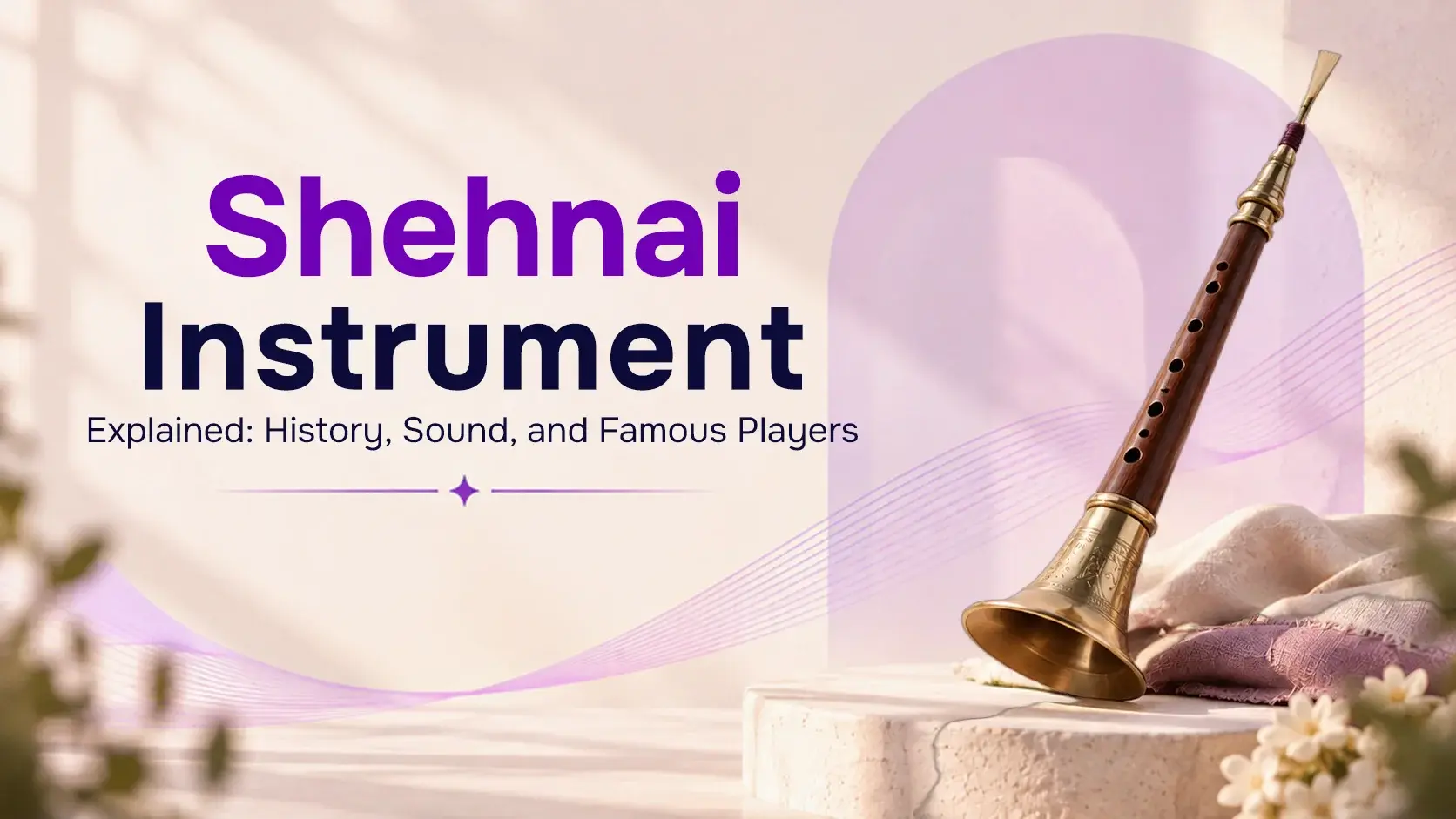
Table of Contents
Quick Summary
| The shehnai instrument is a traditional double reed Indian wind instrument with a wooden body, finger holes, and a flared bell. The shehnai’s lively, emotive voice is typically associated with wedding celebrations and auspicious moments, as well as folk music and the concert stage of Hindustani classical music. Believed to have emerged from the pungi, the shehnai’s history has been defined by it being a popular choice for both festive occasions and concert performances. Ustad Bismillah Khan is recognized as the shehnai’s greatest traditional performer. |
Introduction
The shehnai instrument is one of the most well-known sounds of Indian musical life. With its bright, ringing tone, it can sound a wedding, lead a procession, or build gradually in a classical raga. But while people will be familiar with it at joyful occasions, the shehnai is far more than a ceremonial instrument: a masterful player will use it to sculpt long phrases, add notes and craft a profoundly expressive musical form.
If you are exploring what is hindustani music, the shehnai instrument provides a vibrant illustration of how a tune can evolve over time via a raga. It’ll even help you to approach the concept of breath, pitch and musical expression- even if you play a different instrument or genre.
What Is Shehnai? (Definition and Overview)
The shehnai is a woodwind instrument from the Indian subcontinent. The musician blows into the small double reed at one end; this vibrates and makes the air inside move. The musician presses on finger holes along the shehnai to change pitch.
The outcome is a deep and bright tone that has the capacity of being cheerfully, solemnly or meditatively musical, based on the style of playing. Shehnai, while similar to the oboe in certain general sets of instrument family terms, is an individual instrument form with its own construction, performance traditions and musical character. It is considered one of the traditional indian musical instrument forms deeply associated with North Indian music and ceremonial life.
The term music instrument shehnai just describes this wind instrument, but this instrument’s function also varies in the context of the music. A short ceremonial tune can be lively; a concert piece may evolve a slow raga with a number of variations.
Shehnai in English
In English the shehnai is commonly defined as a double-reed wind instrument, or an oboe-like instrument. While these analogies are helpful, the shehnai is a distinct instrument with its own particular construction, sounds and musical history. Shehnai is not just an Indian adaptation of the Western oboe.
Shehnai Instrument Information: Structure and Sound
Some of the most popular shehnai models have the following features: a wooden tube, a flared bell at the lower end, a mouthpiece made of a reed, several finger holes (six or seven). As you might expect, the holes vary from instrument to instrument and maker to maker.
The reed is composed of two slivers of cane held tightly together. As the player blows, the two pieces vibrate one against the other. As the reed is influenced by the pressure of the player’s breath, then getting the note steady, and the pitch can be quite a challenge.
Here is a simple way to picture the sound-making process:
● You blow air into the double reed.
● The reed is stimulated to vibrate and causes the air inside the tube to move.
● It has finger holes the player covers or uncovers to produce different notes.
● Breath, lip pressure and finger action are involved in shaping tone and phrasing.
The sound of a shehnai is often “bright, resounding, and bold”. It can deliver its sound without amplification in a large hall, but be intimate and expressive in close quarters. Shehnai music instrument can produce long notes as well as intricate and quick decorated sections, but the performer must have excellent breath control and precise control of their muscles.
Shehnai Is a Refined Version of Which Instrument?
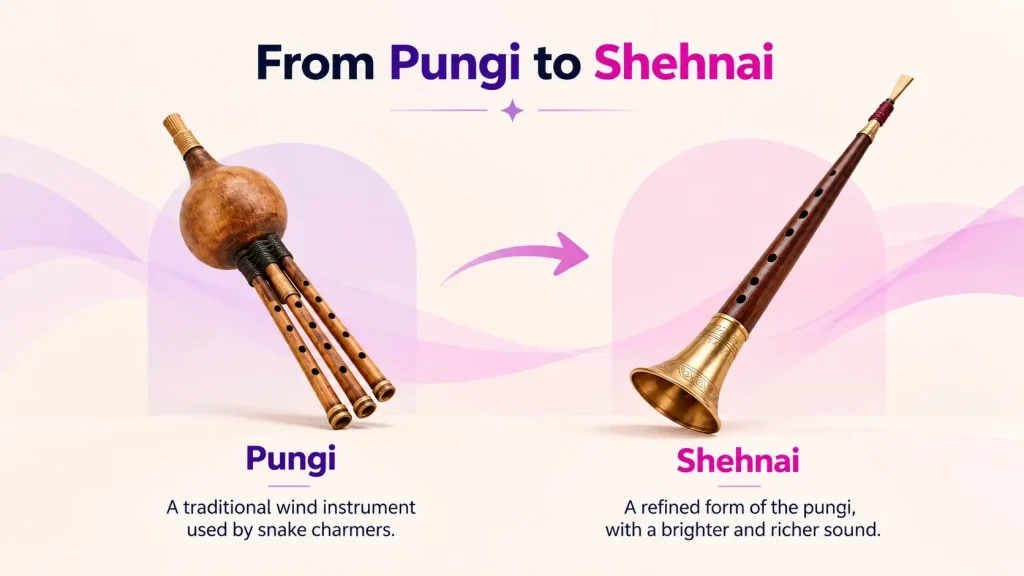
In popular stories, the Shehnai music instrument is regarded as an advanced version of the pungi, a reed instrument.
According to the popular narrative, the piercing sound of the pungi was softened by redesigning its pipe and accommodating finger holes to produce a more musical instrument. Unfortunately, the historical record is not completely settled: the instrument is also linked to the Persian surna in some references.
It would be better to simply refer to the pungi connection as a popular story.
Hence, in reply to the question “shehnai is a refined version of which instrument”, the to the point reply would be: It is generally believed that the shehnai is a refined form of the pungi, however, its history might have more than one origin.
History and Cultural Significance of the Shehnai
For generations, the shehnai has been used on celebratory and spiritual occasions, such as weddings and temple festivals. IIts clear, bright sound works well outdoors and for processions, but it’s also been played in concerts.
The shehnai instrument became a part of classical music through the efforts of Ustad Bismillah Khan. His debut performance at the All-India Music Conference held in Kolkata in 1937, was the beginning of concert performances of shehnai in the country. He performed at the Red Fort on August 15, 1947, the day India achieved independence.
The instrument is also a vital part of life outside the concert hall. In many parts of the country, the shehnai instrument is played as part of community celebrations and in folk music. You can use it to mark the beginning of a celebration, give a melody to a parade, or set a serious mood.
How the Shehnai Is Played
It’s not as simple as just blowing into the shehnai instrument. You need to blow steadily into the reed and keep your fingers pressed down on the holes so the notes come out clear. Phrases come together based on how the singer breathes and how their lips touch the reed.
Here are some basics a beginner’s practice could include:
- Set up comfortably: Sit or stand with the instrument held in a steady position, and your shoulders relaxed.
- Practise a steady breath: Practise taking quick, soft, and even airstreams. Don’t blow too hard through the reed.
- Learn one note at a time: Practice moving from one note to the next to see how they connect.
- Build a small phrase: Once individual notes feel more consistent, join them into a slow, simple melody.
- Practise in short sessions: Being attentive regularly during a short period of time can be more effective than one long session where your embouchure or breath runs out.
New players might find the shehnai instrument hard to play at first because of its delicate double reed and the airflow required. A teacher can point out comfortable assumptions — holes that aren’t fully covered or leaks between lips and mouthpiece–difficult to spot by yourself.
If you want to know the rest of the family of instruments used in hindustani classical music, for instance, the shehnai music instrument is just one of several wind instruments in a raga-based setting that can play the melody.
Famous Shehnai Players in India
Ustad Bismillah Khan is perhaps the most famous shehnai player. His playing was so beautiful that listeners could appreciate the instrument not just as an instrument of ceremony but as one that could communicate classical feelings too. He used his own style of playing ragas and proved the shehnai’s strength as an instrument of long, smooth, melodic phrases.
Other celebrated shehnai players include:
- Ali Ahmed Hussain Khan, known for his concert performances and contribution to the instrument’s classical repertoire.
- Anant Lal, a respected shehnai exponent associated with Hindustani classical music.
- Daya Shankar, who popularized the shehnai tradition with hundreds of performances across India and overseas.
- Ali Bux, Bismillah Khan’s uncle and an important early influence on his musical training.
These artists represent different generations and performance styles. When people ask about famous shehnai players in India, Bismillah Khan is usually the name most closely associated with the instrument’s rise on the concert stage.
These two artists are from different generations and represent different styles of performance. When asked if shehnai is a common instrument in India, the most mentioned name related with shehnai and music on the concert stage is Bismillah Khan.
Shehnai vs Clarinet vs Oboe: Key Differences
All are wind instruments: music instrument shehnai, clarinet and oboe, but they are quite different in their sound production, design and the cultures they’re associated with. This handy little chart puts them next to each other for an easy comparison.
| Feature | Shehnai | Clarinet | Oboe |
| Reed | Double reed | Single reed | Double reed |
| Body and bore | Usually a wooden, conical body with a flared bell | Usually a cylindrical body with a bell | Usually a conical body with a flared bell |
| Finger holes or keys | Often has six to eight keyless finger holes | Uses a system of keys | Uses a system of keys |
| Typical sound | Bright, strong and carrying | Flexible, smooth and broad in range | Clear, focused and penetrating |
| Common musical settings | Indian ceremonies, folk traditions, temples and Hindustani classical concerts | Classical, folk, jazz and contemporary music | Orchestral, chamber and solo classical music |
| Musical tradition | Rooted in Indian musical traditions | Used in many global music traditions | Mainly associated with Western classical traditions |
What sets the shehnai apart from the clarinet is the shehnai’s otherworldliness in Indian music and its generally keyless nature. The clarinet has a single reed, with the shehnai and the oboe using double reeds-yet as the clarinet is to the shehnai, the oboe is to the shehnai.
When and Where Is the Shehnai Traditionally Played?
Weddings and Auspicious Occasions
The sound of the music instrument shehnai is deeply linked to weddings and other celebratory occasions. Its bright, direct sound makes it suitable for a procession or street gathering, and being an instrument with a ceremonial tradition makes it common at celebrations in many societies.
Classical Concerts and Film Music
In a classical concert, a shehnai player might elaborate a raga with a slow introduction, and then a more rhythmically and compositionally complex portion. Shehnai music instruments have also featured in film music, where their timbre can convey celebration or sentimentality, or can evoke a particular location. Bismillah Khan’s popularity was partly responsible for making the instrument more popular to concert audiences.
Is the Shehnai Still Relevant in Modern Indian Music?
Yes. Shehnai is still relevant to religious and wedding rituals, classical music concerts and recordings, as tastes change and technological advances continue. It still appeals to new audiences who are opening their ears to Indian music for the first time. Its tone bridges old-world practice with modern performance, and can balance well with other instruments.
In case you’d like to get into Indian music as you’re playing an instrument or working on your voice, you can learn hindustani music via Artium Academy’s online music courses.
Book Your Free 1:1 Trial Class with teachers and a curriculum that is recognized by the GRMP.
While shehnai lessons aren’t currently available at Artium Academy, you can explore other music courses, instruments and music tools offered by the academy.
Conclusion
Ever wondered how a few breaths can fill a wedding, temple or concert hall with music?
The shehnai instrument has a piercing bright sound, and a long history and tradition of being used for Indian wedding and ceremonial music. It has a story involving a commonly associated instrument called the pungi, a supposed historical link to a Persian instrument called the surna, and a transition from the ceremonial to the classical concert stage with Ustad Bismillah Khan. Starting to understand the sound is to understand Indian music.
If you’re interested in taking music classes online, Artium Academy provides you with organized 1:1 live classes in some of the vocal and instrumental music classes done by certified teachers. You can try a free trial class and find the appropriate option for your music interests.
Frequently Asked Questions
It is a wooden instrument with a double reed. Playing the shehnai requires inhaling into the reed and fingering (covering holes with fingers) to produce notes. Shehnai: Wind instrument and how it is played.
It has a wooden body, a double reed at the mouthpiece end, finger holes along the tube and a flared bell. Materials and hole numbers may vary from instrument to instrument.
It is also called a classier pungi by a few. Other accounts also tie the history of the instrument back to that of the Persian surna, so the origins of the instrument should be left as broad as possible!
Ustad Bismillah Khan is the best-known shehnai player. Other notable names include Ali Ahmed Hussain Khan, Anant Lal and Daya Shankar.
Initial growth can be difficult due to the delicate nature of the double reed, but by holding long, even tones and playing sustained fingerings consistently, you will begin to improve.
This music is traditionally heard at weddings, temples, festivities, processions and other happy occasions. It is also heard during classical concerts.
The instrument is usually made of wood, with a cane reed and a flared bell, often made of metal. Different types and shapes of shehnai are available.
The shehnai and oboe both use double reeds, whereas the clarinet uses a single reed. They have different shaped bodies, fingerings and traditional sounds and music.
Yes. It is still played in ceremonial music, classical records and concerts, and that sound can also be used to make new arrangements.
Yes, a beginner can learn shehnai online with a teacher or programme that regularly offers shehnai classes and proper guidance.