
All Topics
- Alchemizing Music Concepts for Students
- Anuv Jain Songs
- Artist Spotlight
- artium gift card
- Artium Maestros
- Artium News
- Artium Practice Studio
- Artium Tech Blog
- Best Coke Studio Songs
- Best Female Singers
- Birthday songs
- Bollywood Love Songs
- buying guide
- Carnatic Music
- Child Singers
- Devotional Music
- Editorials by Ananth Vaidyanathan
- English Love Songs
- Festival
- Film Music
- Ghazal Music
- Guitar
- Hindustani Classical Music
- Indian Classical Music
- Indian Folk Music
- Insights
- Instagram Reels Viral Songs
- Instruments
- Karaoke
- Karaoke Singing
- Keyboard
- Kids Music
- maestros
- Music Education
- Music for Kids
- Music Games
- Music Industry
- Music Instruments
- Music Legends
- Music Press Release
- Music Technology
- Music Theory
- Music Therapy
- Music Tools
- Piano
- piano guide
- Songs
- South Devotional Music
- Success Stories
- Tamil Film Music
- Telugu Film Music
- Time Theory
- Tools
- Uncategorized
- Uncategorized
- Uncategorized
- Uncategorized
- Vocal Range
- Vocal Singing
- Vocals
- western classical music
- western music
- Western vocal music
Alankar in Music: Meaning, Types, and How to Practice
Alankar in Music: Meaning, Types, and How to Practice
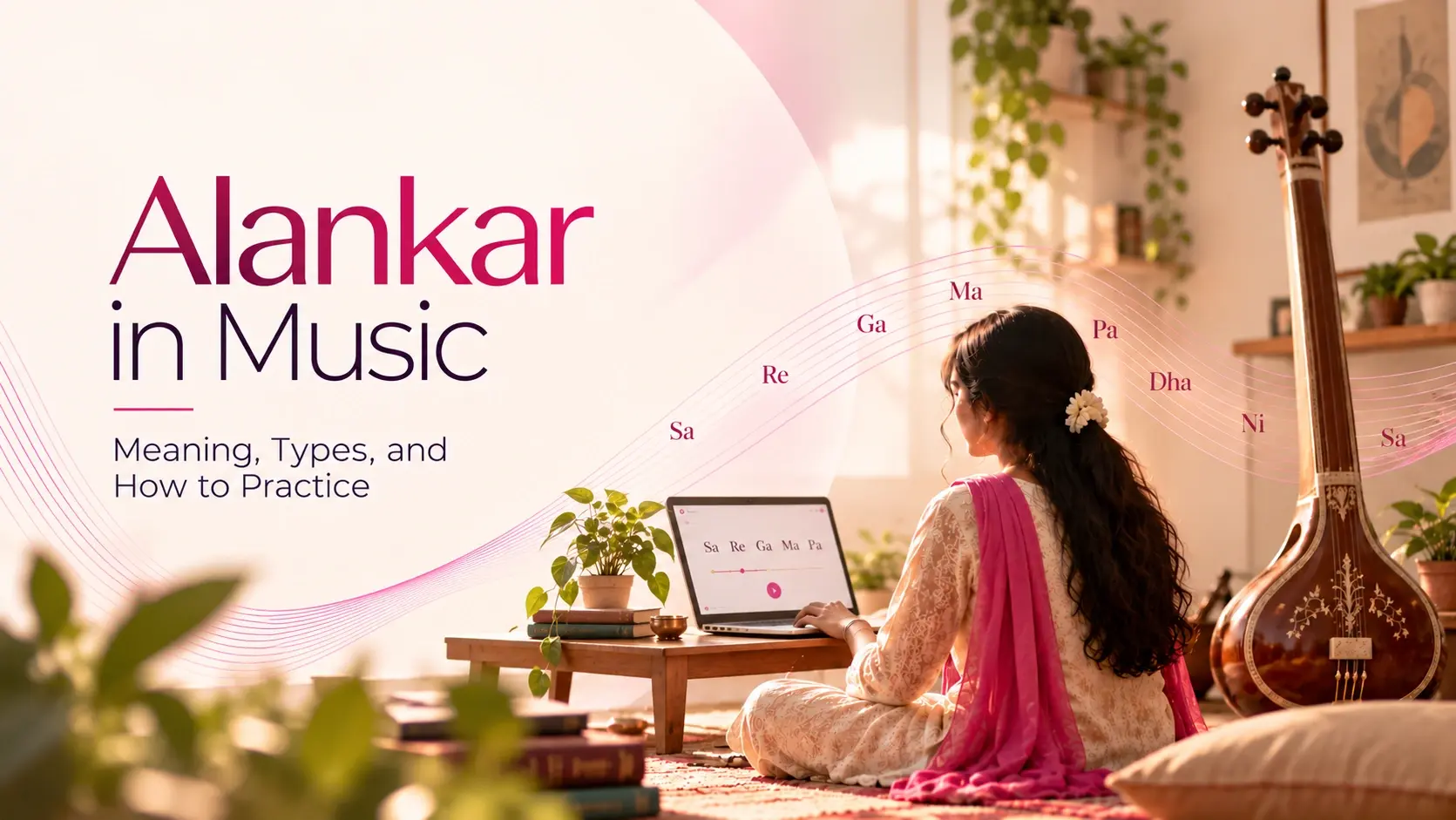
Table of Contents
Quick Summary
| Alankar in music consists of repeating patterns of swaras that are sung or played in a sequence for the purpose of learning to develop pitch accuracy, voice control and rhythm. The term alankar means “decorative”. In Carnatic music, the seven basic alakarams are taught subsequent to sarali, janta and dhatu varisai. They correspond with the seven basic talas. In Hindustani classical music similar exercises are called paltas. They should be practised on a daily basis at a slow speed, with a steady shruti and any increase in speed only when all notes are heard clearly. |
Introduction
Have you ever noticed why your singing teacher always makes you sing ‘Sa Re Ga Ma Pa’ for hours before you even get to sing a song?
It’s not to try your patience. It’s all the alankar in music, which is the secret to every voice that is confident. So if you are wondering what is alankar in music and why each of the instrumentmasters starts here, you’ve come to the right place.
In Carnatic music such patterns are known as alankaram. When one is looking out for alankaram in carnatic music or alankaram Carnatic, one has probably arrived at the point where regular basic exercises now convert into training in the tala. In the Hindustani tradition, alankar in Hindustani classical music will work in quite the same manner.
In this article, you will discover the meaning of alankarams and their talas, common errors, and a simple daily practice. You will also understand how Artium Academy’s new Practice Studio will enable you to practise in a more mindful and steady manner.
What Is Alankar in Music?
If you have always wondered what is alankar in music then think of it as a workout for your vocal cords (or your instrument). Rather than singing a song, you get to do short repetitions of note patterns which help to develop your ear, throat and rhythm.
The term “alankar” has its roots in the Sanskrit language and translates as “ornament” or “decoration”. Similar to how jewellery adorns and decorates a person, these patterns adorn and shape your music. These patterns are something no great singer, whether a first-year music student or a concert artist can do without.
Alankar in music will assist you with:
- Swara accuracy: delivering the right note every time
- Voice flexibility: this is when your voice moves freely from pitch to pitch.
- Laya and tala: staying in rhythm while you sing
- Breath control: holding Patterns but not breathless
Here’s an easy way to understand. Repeat “Sa Re Ga Ma Pa” in sequence. Now repeat it again but as a jabber: “Sa Re Ga, Re Ga Ma, Ga Ma Pa” That is the basic theory behind an alankar. You use the notes of a raga and structure the pattern of that raga in an oscillating pattern, climbing higher and then descending again.
They can be used not only in singing. Violinists, Veena players, flutists and keyboard players employ alankars, because they prepare your fingers as well as the ears.
Alankar in Hindustani Classical Music
In Hindustani they are called paltas (pratimas). Most of the searches for alankar in Hindustani classical music are by beginners who are searching for where to start so here is the short version.
Generally the students starts with paltas in Bilawal raag which all the notes are shuddh (natural) All basic upward paltas would be:
Sa Re Ga, Re Ga Ma, Ga Ma Pa, Ma Pa Dha, Pa Dha Ni, Dha Ni Sa
All you need to do is just reverse the direction. When you are comfortable, then take the same patterns in other ragas like Yaman so that you can grow accustomed to the nuances of various combinations of notes.
Hindustani alankars are generally played steadily with a tanpura accompaniment and a simple taal such as Teentaal. Just like Carnatic music, the objective is: mastery, precision and assurance.
Alankaram in Carnatic Music
Let’s come to the answer, the alankaram in Carnatic music This is where the pattern work becomes more structured, because each alankaram is tied to a specific tala.
In most learners’ Carnatic learning path, they go through these phases:
- Sarali varisai: simple ascending and descending note exercises
- Janta varisai: notes sung in pairs (like “Sa Sa, Ri Ri, Ga Ga”)
- Dhatu varisai: zig-zag patterns that build agility
- Alankarams: patterns set to the seven talas
- Geethams, varnams and kritis: your first full compositions
Most search when looking for alankaram Carnatic is this step. An alankaram is like a go-between for an exercise and a song. It teaches you to keep a tala while you sing a pattern, just what you need for geethams and varnams.
Why Mayamalavagowla?
What Carnatic teachers generally do is to start these classes with raga Mayamalavagowla (MMG). The note structure of this raga is symmetrical and not uncomfortable to the ear, thus aiding the new student in establishing his shruti, making him focus on accurate note placement. It is said that this order was established by Carnatic music composer Purandara Dasa, known as Carnatic music teacher’s father.
The 7 Alankarams and Their Talas
All the alankaram will be named based on the tala that it will follow. Here is a quick reference:
| Alankaram | Tala | Total beats (aksharas) |
| Dhruva | Dhruva tala | 14 |
| Matya | Matya tala | 10 |
| Rupaka | Rupaka tala | 6 |
| Jhampa | Jhampa tala | 10 |
| Triputa | Triputa tala | 7 |
| Ata | Ata tala | 14 |
| Eka | Eka tala | 4 |
For beginners, Eka, Rupaka and Triputa are the most welcoming since their cycles are relatively short and manageable with your hand. Once you’ve developed your steady beat, more challenging longer talas such as Dhruva and Ata can be a good fit.
Alankaram is also rehearsed at various tempos. Begin with the first ( slow) then proceed to the second and third as your accuracy improves. Never begin at the fast tempo as it establishes the basis for anything that follows.
Benefits of Practicing Alankar
Why do teachers make alankar practice compulsory, even for singers only interested in singing songs? The difference in your music can be seen in every facet:
- A steadier voice: Practice makes the muscle (a.k.a. Your voice) stronger, and helps eliminate any shakiness you experience on sustained notes.
- Sharper ear training: you will know how to hear when you are just a little flat or sharp and fix that yourself.
- Better tala sense: singing into the rhythm is not stressful but feels natural.
- Smoother transitions: smoother transitions between notes, which is advantageous in fast movements.
- A strong base for ragas: the patterns you are practising now will become phrases in ragas and compositions later.
- Confidence on stage and in class: when fundamentals are in place, you don’t have to worry about failing.
You may see results within just a couple of weeks for this amount of time daily.
How to Practice Alankar: A Step-by-Step Routine
Here’s a basic routine you can do at home. You may have to vary the timing if required.
- Warm up your voice (3-5 minutes). Make some easy lip rolls and tongue rolls, and follow them with humming and simple scales like, “Sa – Pa – Sa”, to get you going.
- Set your shruti. Use a tanpura or shruti reference to sing against a consistent baseline pitch. You can use Artium’s free online music tools to find your shruti.
- Start slow. Sing the alankar at first speed and give every note its respect. Speed is not the point here, clarity is.
- Keep the tala.Count the beats with your hand (clap, wave, finger count). It trains you to maintain your ability to beat time.
- Go up and come down. Sing the ascending pattern, then the descending pattern, without breaking the flow.
- Repeat in other talas. When you are comfortable with one alankaram, go on to the next, for example from Eka to Rupaka to Triputa.
- Increase the speed gradually. Only go to the second speed once the first is free. Sometimes you want to hurry but you will regret this when you form habits that are difficult to undo later on.
- Record and listen. Record a brief clip every week and listen to your improvements and mistakes more rapidly.
A simple weekly plan:
- Monday-Wednesday: warm-ups + one Alankaram in first speed
- Thursday to Friday: add the next alankaram
- Saturday: revise everything and record yourself
- Sunday: rest, or listen to your teacher.
Common Mistakes to Avoid
Almost all new builders make some of these. A little knowledge early on can save you hours.
- Rushing the speed. Fast and fuzzy is worse than slow and clean.
- Skipping the warm-up. Cold cords quickly deplete, which can lead to strain.
- Ignoring the shruti. If your drone note changes, all the subsequent notes go out of tune.
- Losing the tala. The pattern is meaningless unless you keep track of the number of beats.
- Practising for too long at once. Short concentrated sessions are more effective than one tiring one.
- Never recording yourself. The best teacher is your own ear, but only if you listen.
- Practising alone without feedback. Your teacher hears your mistake but you can’t.
Practice Alankara in Artium’s Practice Studio
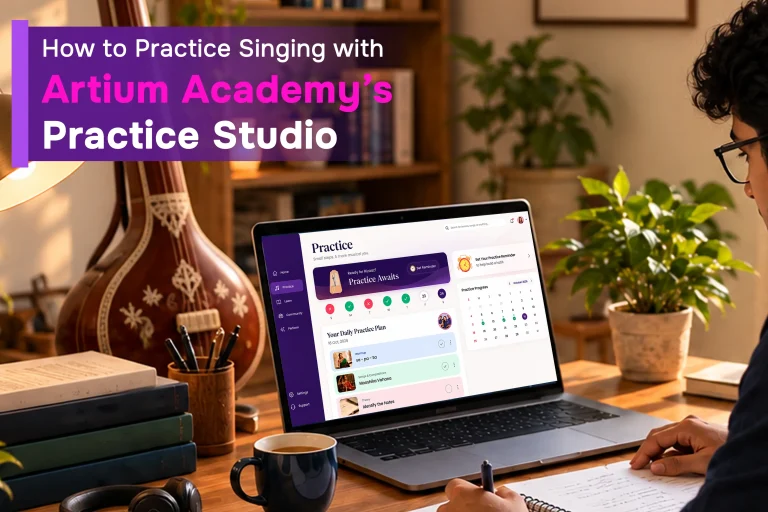
If you are finding it difficult to stay committed at home, then you are not the only one. While most learners can tell you what to practise, they struggle with how to go about it. The Artium Academy app now has a dedicated space called Practice Studio where you can come and practise with a simple tagline, “Practice Makes Perfect”.
Practice Studio plots out your riyaz into digestible practice schedules so that you never need to figure out what to practice next:
- Warm-ups: easy exercises, such as Sa – Pa – Sa, lip rolls and tongue rolls to warm up your voice
- Songs & Compositions: practice plans for devotional songs & nottu swara
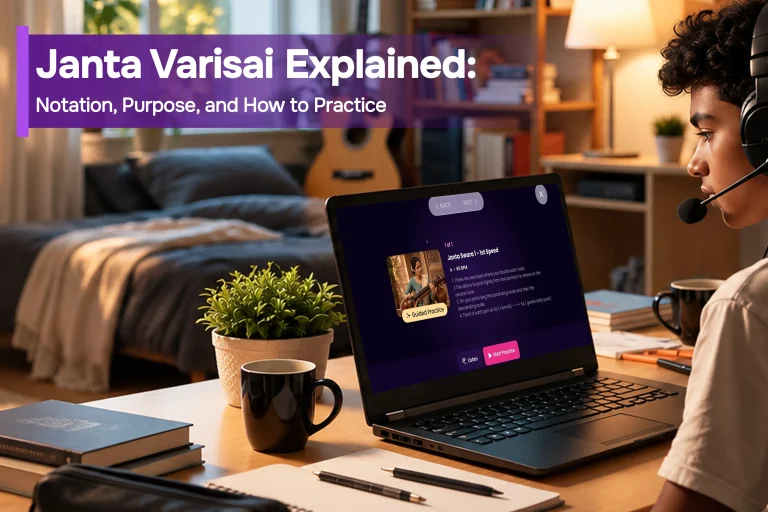
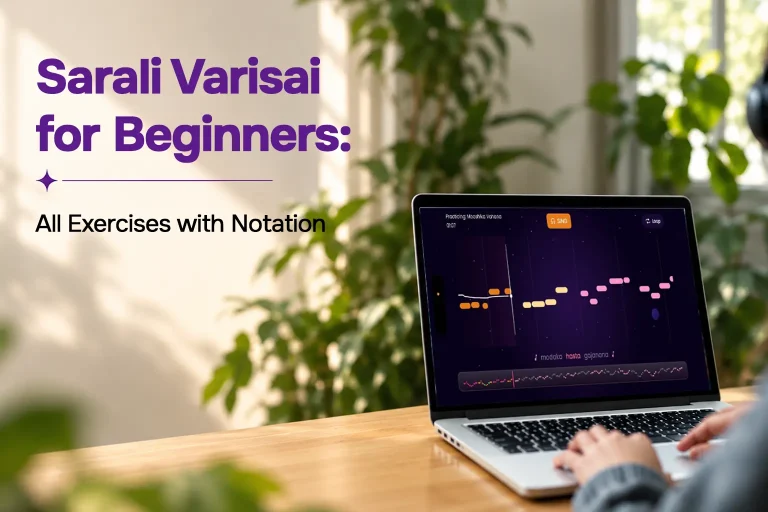
- Swara & Raga: Foundation plans with Alankara and Dhatu varisai and Janta varisai
This Alankara lesson includes the following lessons in Eka Tala, Rupaka Tala and Triputa Tala, first speed and Mayamalavagowla. This is the recommended learning sequence used by your teacher, begin slowly, sustain the tala and work up to speed.
You might even set the Set Reminder feature to help you develop a daily practice habit, which can be the most challenging aspect of learning music.
Practice Studio complements Artium Academy’s live, 1:1 classes with fully certified teaching, a GRMP-recognized curriculum and masterclasses by renowned artists. The teacher interacts with you in the classroom, while Practice Studio supports you in quality practice.
Conclusion
Alankar in music may look simple, but it is the foundation of everything that comes after: ragas, varnams, kritis and improvisation. Whether you follow the Carnatic path of seven alankarams or the Hindustani approach of paltas, the idea is the same: practice singing slowly, steadily and clearly, every single day.
Go a small step at a time. Do one alankaram, stay on your tala, maintain your shruti and let your voice evolve naturally. The more disciplined you are, the faster you will see the results in your singing.
Curious how your voice could sound in a few weeks? Book your free 1:1 trial class with Artium Academy and learn from certified teachers at your own pace.
Frequently Asked Questions
Alankaar in music is a group of swara sequences (note patterns) sung/played in ascending and descending order. Alankaar means “ornament”. Alankaar’s help with the consistency of the pitch, voice control, and rhythm, which is why it is the basis of Indian Classical Music practice.
Alankarams are a set of seven exercises based on the seven basic talas in Carnatic music. They follow sarali, janta and dhatu varisai in the beginner’s lessons and serve as a ramp to geethams, varnams and kritis.
There are seven: Dhruva, Matya, Rupaka, Jhampa, Triputa, Ata and Eka. Each had its name derived from the tala which was used.
Mayamalavagowla is the classical beginner raga of the convention named after Purandara Dasa. Its scale is simple and very conducive to voice training. It is suitable for helping beginners to settle into shruti and also to develop clean swarasthana.
The intention remains the same to focus on voice control and note accuracy. In the world of Hindustani classical music, alankars are also known as paltas, which are generally practiced in the ragas Bilawal or Yaman. In Carnatic music, alankarams are set sequences associated with particular talas.
These three stages, which include simple ascending and descending notes, are the beginning stages of sarali varisai. Alankarams are later stages and are more difficult because the patterns follow a tala pattern.
For the first time, beginners should begin with 20–30 minutes of practice for the start. You should do Warm-up first. Start slowly, gradually practice faster only if you have a steady beat and have a fairly good hold on the notes and the thala.
Yes. A shruti reference (tanpura) , a quiet space, and a mechanism for keeping time with your hand. Having a structured practice routine with a guided sound program helps keep you on pace.
It is also very desirable to have a qualified teacher, as the teacher will be able to rectify mistakes in pronunciation, shruti and tala that are not always possible to perceive by yourself. Practice boxes can be used to revise classes.
Practice Studio offers Swara & Raga guided practice plans. An Alankara plan is available with Eka, Rupaka and Triputa Tala lessons at first speed. There are warm-ups such as tongue rolls and lip rolls. There is also a Set Reminder option to remind you to practise every day.