
All Topics
- Alchemizing Music Concepts for Students
- Anuv Jain Songs
- Artist Spotlight
- artium gift card
- Artium Maestros
- Artium News
- Artium Practice Studio
- Artium Tech Blog
- Best Coke Studio Songs
- Best Female Singers
- Birthday songs
- Bollywood Love Songs
- buying guide
- Carnatic Music
- Child Singers
- Devotional Music
- Editorials by Ananth Vaidyanathan
- English Love Songs
- Festival
- Film Music
- Ghazal Music
- Guitar
- Hindustani Classical Music
- Indian Classical Music
- Indian Folk Music
- Insights
- Instagram Reels Viral Songs
- Instruments
- Karaoke
- Karaoke Singing
- Keyboard
- Kids Music
- maestros
- Music Education
- Music for Kids
- Music Games
- Music Industry
- Music Instruments
- Music Legends
- Music Press Release
- Music Technology
- Music Theory
- Music Therapy
- Music Tools
- Piano
- piano guide
- Songs
- South Devotional Music
- Success Stories
- Tamil Film Music
- Telugu Film Music
- Time Theory
- Tools
- Uncategorized
- Uncategorized
- Uncategorized
- Uncategorized
- Vocal Range
- Vocal Singing
- Vocals
- western classical music
- western music
- Western vocal music
Janta Varisai Explained: Notation, Purpose, and How to Practice
Janta Varisai Explained: Notation, Purpose, and How to Practice
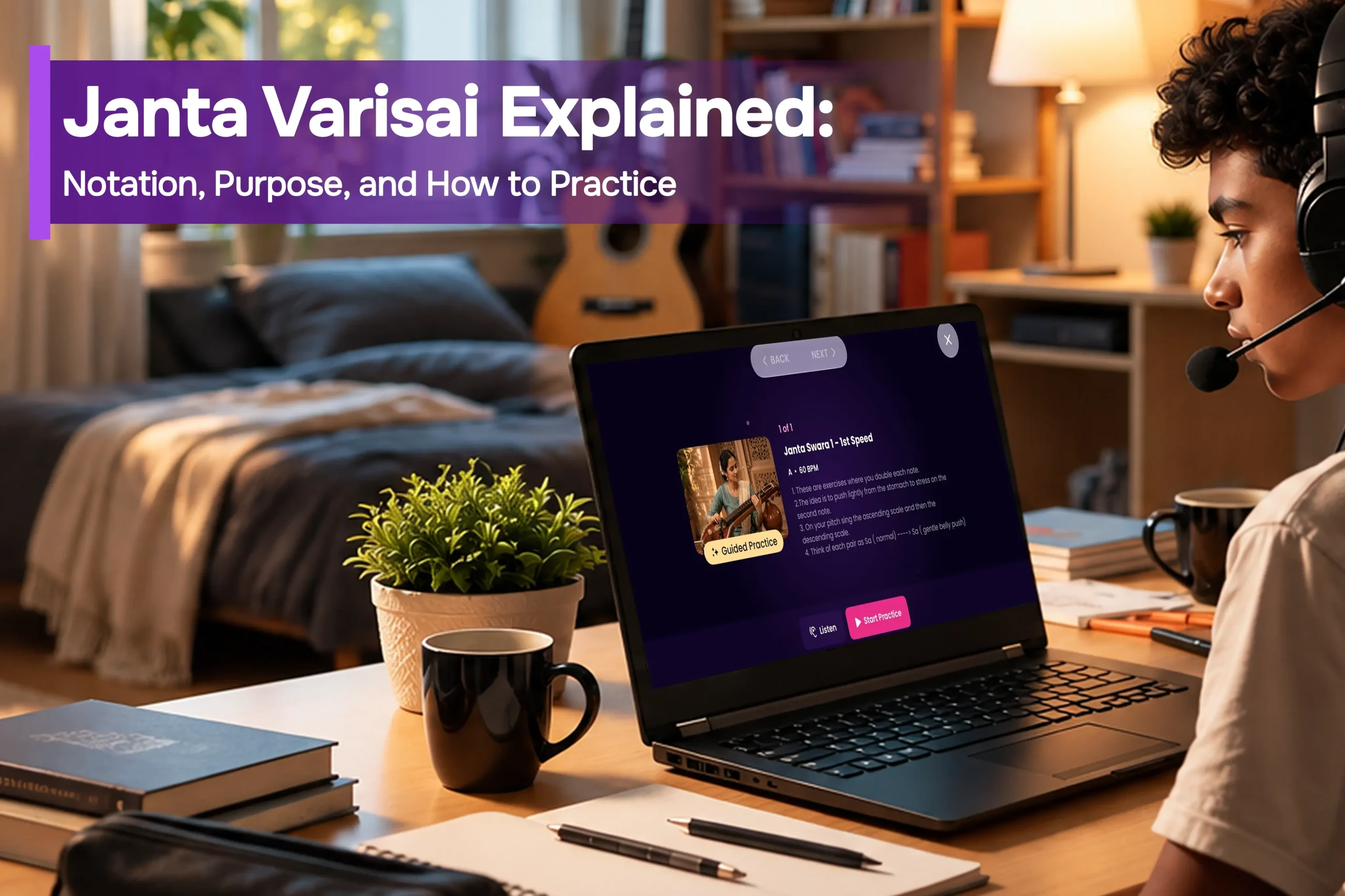
Table of Contents
Quick Summary
| Janta varisai is the second Carnatic exercise you learn, after Sarali Varisai. All swaras are sung twice in a row, Sa Sa, Ri Ri, with a soft attack on the second note. In raga Mayamalavagowla and Adi tala. Janta Varisai improves pitch precision, voice strength and rhythm (time sense) for singers, and clean finger and bow control for veena and violin students. Once Janta Varisai is complete, students proceed to upper and lower octave varisais, dhatu varisai, alankaras and geethams. Practice it free on the Artium Academy app. |
What Is Janta Varisai?
Janta Varisai is the second round of practice exercises in Carnatic music. You get to Janta Varisai immediately after sarali varisai. This is the first exercise where you will begin singing the same swara twice in succession.
“Janta” means a duo. Instead of singing Sa Ri Ga Ma, you sing Sa Sa, Ri Ri, Ga Ga, Ma Ma. The second note of every duo gets a special emphasis (if you listen you can hear it). That emphasis is what differentiates Janta Varisai from merely repeating a note
Similar to sarali varisai, it is practised in the raga Mayamalavagowla (15th melakarta raga) and is performed in the Adi tala. These fundamental exercises are believed to be composed by Purandara Dasa, the reputed father of Carnatic music.
Sarali varisai helps you ascend the notes while Janta Varisai helps you sit tight on each of those notes. This is where janta varisai in Carnatic music starts to feel like real practice, because you control pitch and stress together instead of just moving up and down. It is also the stage where many students who learn Carnatic music online first notice how much a steady second note changes their sound.
Janta Varisai Notation
Carnatic notation is written with the first letter of each swara: S, R, G, M, P, D, N. In Mayamalavagowla these are Sa, Shuddha Ri, Antara Ga, Shuddha Ma, Pa, Shuddha Dha and Kakali Ni. A dot above a letter marks the upper octave (Ṡ), and a dot below marks the lower octave. Once you get used to these small symbols, reading Carnatic music notation becomes much easier, and Janta Varisai is a gentle place to begin.
InJanta Varisai, every letter is doubled. Here’s the basic Ascending and Descending:
| Ascending: S S R R G G M M | P P D D N N Ṡ ṠDescending: Ṡ Ṡ N N D D P P | M M G G R R S S |
Read each pair as a single unit. Sing the first note normally, then push the second note along with your stomach muscles. These two notes should stay at the same pitch; only the emphasis should change.
The precise manner in which the pairs fit into Adi tala varies according to speed and school so always follow your teacher’s version.
The Purpose of Janta Varisai
Janta Varisai shows you how to play the same note twice at the same pitch. That one practice alone will underpin nearly everything you are taught subsequently.
- Pitch accuracy: When a swara is sung twice, you can tell instantly if the second one strays.
- Voice strength: the light compression on the second note requires the voice to produce a consistent, confident sound.
- Rhythm: the exercises are done in Adi tala, so you learn to keep time when you sing.
- Agility: doubled notes assist your voice or fingers in moving smoothly. It’ll get you ready for quicker playing.
- Instrument control: on veena or violin, the same exercise encourages precise plucking, steady bowing, and accurate finger action.
Our most advanced students often revert to Janta Varisai as their daily warm-up, because working on basic, clean techniques makes all ragas more accessible.
Janta Varisai 4 and the Lesson Progression
Janta Varisai is a series so simply Janta Varisai 4′ refers to the 4th Janta Varisai, in the series. Some schools count the number of exercises differently: NIOS (syllabus), 10 exercises in 4 speeds. Artium’s Practice Studio plan, 12 exercises in 1st speed then the 2nd speed lessons.
The first exercises prepare the double-note practice for a straightforward soar and dive. Subsequent exercises are gradually more complex, adding nuances like emphasizing various swaras, combining single and double notes, and so on. Janta Varisai 4 is the right place for a transition as well, a checkpoint: if your notes remain steady here, go on! Different teachers have different pattern practices, so stick to your lesson notation.
Here’s an easy method to go from step to step:
- Achieve mastery of the first three exercises in 1st speed before trying Janta Varisai 4.
- Sing each exercise to the top and then back down. Do not pause between exercises.
- Proceed only when the second note of each pair is not moving around and is in tune.
- Try 2nd speed last. Double the speed and same swaras go into the same beat. If you can do crystal clear 1st speed, you can do second without any problem.
Vakra Janta Varisai
Vakra Janta Varisai applies the double-note idea to zig-zag patterns. “Vakra” is Sanskrit for curved or bent, and in music it describes phrases that wind back and forth instead of climbing or falling in a straight line.
The term overlaps with dhatu varisai, the exercises where swaras are arranged in a zig-zag, which the NIOS Carnatic syllabus also calls vakra varisa. Some teachers use “vakra janta” for a janta exercise built on such a zig-zag. Here is an illustrative shape (not a lesson from the app):
| S S R R G G R R | S S R R G G M M |
Names vary from school to school, so use whichever term your teacher prefers. The skill is the same: staying accurate while the direction of the phrase keeps changing. It also prepares you for vakra ragas, whose scales zig-zag, in later compositions.
Janta Varisai in Veena
The notation for Janta Varisai in veena is the same as for the voice. What changes is how you produce the second note of each pair. These are general tips, so please confirm them with your teacher:
- Pluck each swara twice with clear, separate right-hand strokes, the second slightly stronger.
- Place the left-hand finger once and let both plucks sound from the same fret position, so the pitch stays identical.
- Keep the drone strings steady and check every swara against them.
- Start slowly with a metronome or tala count, and increase the speed only when both notes of every pair sound even.
Janta Varisai in Violin
On the violin, Janta Varisai trains clean bowing and intonation together. Again, treat these as general tips and confirm them with your teacher:
- Play each swara twice, using a separate bow stroke for each note, with a little more bow weight on the second.
- Keep your finger on the string for both notes, so the pitch does not change within the pair.
- Check every swara against the shruti, because doubled notes make small pitch errors easy to hear.
- Keep your posture and bow hold relaxed, and practise at the same time every day, starting slowly.
Practice Janta Varisai in the Artium Practice Studio
Reading about janta varisai only takes you halfway. You also need to hear it, sing it and see how close your pitch is. That is what the new Practice Studio in the Artium Academy app is built for. It is free and available on both Android and iOS.
How the Janta Varisai practice plan works
Open the Janta Varisai plan and you will find the exercises lined up in order, from 1st speed to 2nd speed. Each lesson opens on its own practice screen with a Guided Practice tag, the pitch and tempo (the first lesson uses A at 60 BPM) and four short instructions:
- Double each note.
- Push lightly from your stomach to stress the second note.
- Sing the ascending scale and then the descending scale on your pitch.
- Think of each pair as Sa (normal) followed by Sa (gentle belly push).
Listen vs Start Practice
| Mode | What happens | Best for |
| Listen | You listen to the exercise and sing along with it | Your first pass, to learn the pattern and the pitch |
| Start Practice | You listen first, then sing it back yourself | Testing what you have learnt without the audio leading you |
Reading the practice screen
The screen is colour-coded, so you always know where you are in the exercise:
- Pink “Listen” cue: the listen-first phase, before it is your turn to sing.
- Orange notes: the notes you have already passed.
- Cream notes: the notes coming up next.
- White line: traces your live pitch, so you can see whether you are on the note.
The practice covers the full exercise, ascent and descent, so you finish the whole pattern in one go.
A simple routine
- Read the instructions and note the pitch and tempo.
- Use Listen once or twice and sing along until the pairs feel natural.
- Switch to Start Practice and sing after the audio, watching the white pitch line.
- Repeat the ascent and descent, keeping the second note of each pair steady.
- Move to the next lesson only when the current one feels clean at 60 BPM.
Want extra support away from the app? Our free music tools, including a tanpura and a metronome, are handy companions for your daily riyaz.
What Comes After Janta Varisai?
After Janta Varisai, most students move on to the upper and lower octaves, then zig-zag patterns, and then their first compositions. A common order, which varies a little by school:
- Tara sthayi (hecchu sthayi) varisai: exercises in the upper octave.
- Mandra sthayi (taggu sthayi) varisai: exercises in the lower octave.
- Dhatu varisai: zig-zag exercises, also called vakra varisa.
- Alankaras: swara patterns set to different talas.
- Geethams, then swarajathis: your first simple compositions.
- Varnams: the first major compositions, usually in Adi tala.
Sarali varisai and Janta Varisai stay in the middle octave, which is why the octave exercises come next. Some schools teach alankaras before the sthayi varisais, so follow your teacher’s sequence.
Conclusion
Janta varisai looks simple, but singing or playing every swara twice with a steady second note is what makes your pitch, rhythm and tone dependable for everything that follows. Go slowly, keep each pair even, and move on only when an exercise feels clean.
The Practice Studio gives you a free, guided way to do this every day. And when you want personal feedback, Artium Academy offers 1:1 live classes with certified teachers, a GRMP-recognised curriculum and masterclasses by renowned artists.
Ready to start? Book your free 1:1 trial class with Artium Academy and learn from certified teachers at your own pace.
Janta Varisai FAQs
Janta varisai is the second set of Carnatic exercises, taught after sarali varisai. Each swara is sung twice in a row, with a gentle stress on the second note.
“Janta” means a pair or twin, because every swara is doubled: Sa Sa, Ri Ri, Ga Ga.
Sarali varisai uses single notes in a straight ascent and descent. Janta varisai doubles each note and stresses the second one.
It is taught in raga Mayamalavagowla and Adi tala, the same as sarali varisai.
It depends on the school. The NIOS syllabus lists 10 in four speeds, and Artium’s practice plan has 12 in 1st speed, followed by 2nd speed lessons.
It is the fourth exercise in the series. By this point the patterns start to vary, so it is a good checkpoint for even, in-tune pairs.
It is a janta exercise built on a zig-zag pattern. “Vakra” means curved or bent, and the term overlaps with dhatu varisai.
Pluck each swara twice with clear strokes, keep the finger on the same fret for both, and start slowly with a metronome.
Use a separate bow stroke for each note of the pair, keep your finger down for both, and check the pitch against the shruti.
Upper and lower octave varisais, dhatu (vakra) varisai, alankaras, geethams, swarajathis and varnams, though the order varies by school.
A focused 15 to 20 minutes is a good start for beginners. Your teacher may suggest more as you progress.
Yes. The Practice Studio is free in the Artium Academy app on Android and iOS.
The app gives you guided practice, but a teacher can correct your pitch and technique in real time. Artium Academy offers a free 1:1 trial class to try it out.