
All Topics
- Alchemizing Music Concepts for Students
- Anuv Jain Songs
- Artist Spotlight
- artium gift card
- Artium Maestros
- Artium News
- Artium Practice Studio
- Artium Tech Blog
- Best Coke Studio Songs
- Best Female Singers
- Birthday songs
- Bollywood Love Songs
- buying guide
- Carnatic Music
- Child Singers
- Devotional Music
- Editorials by Ananth Vaidyanathan
- English Love Songs
- Festival
- Film Music
- Ghazal Music
- Guitar
- Hindustani Classical Music
- Indian Classical Music
- Indian Folk Music
- Insights
- Instagram Reels Viral Songs
- Instruments
- Karaoke
- Karaoke Singing
- Keyboard
- Kids Music
- maestros
- Music Education
- Music for Kids
- Music Games
- Music Industry
- Music Instruments
- Music Legends
- Music Press Release
- Music Technology
- Music Theory
- Music Therapy
- Music Tools
- Piano
- piano guide
- Songs
- South Devotional Music
- Success Stories
- Tamil Film Music
- Telugu Film Music
- Time Theory
- Tools
- Uncategorized
- Uncategorized
- Uncategorized
- Uncategorized
- Vocal Range
- Vocal Singing
- Vocals
- western classical music
- western music
- Western vocal music
How to Practice Singing with Artium Academy’s Practice Studio
How to Practice Singing with Artium Academy’s Practice Studio
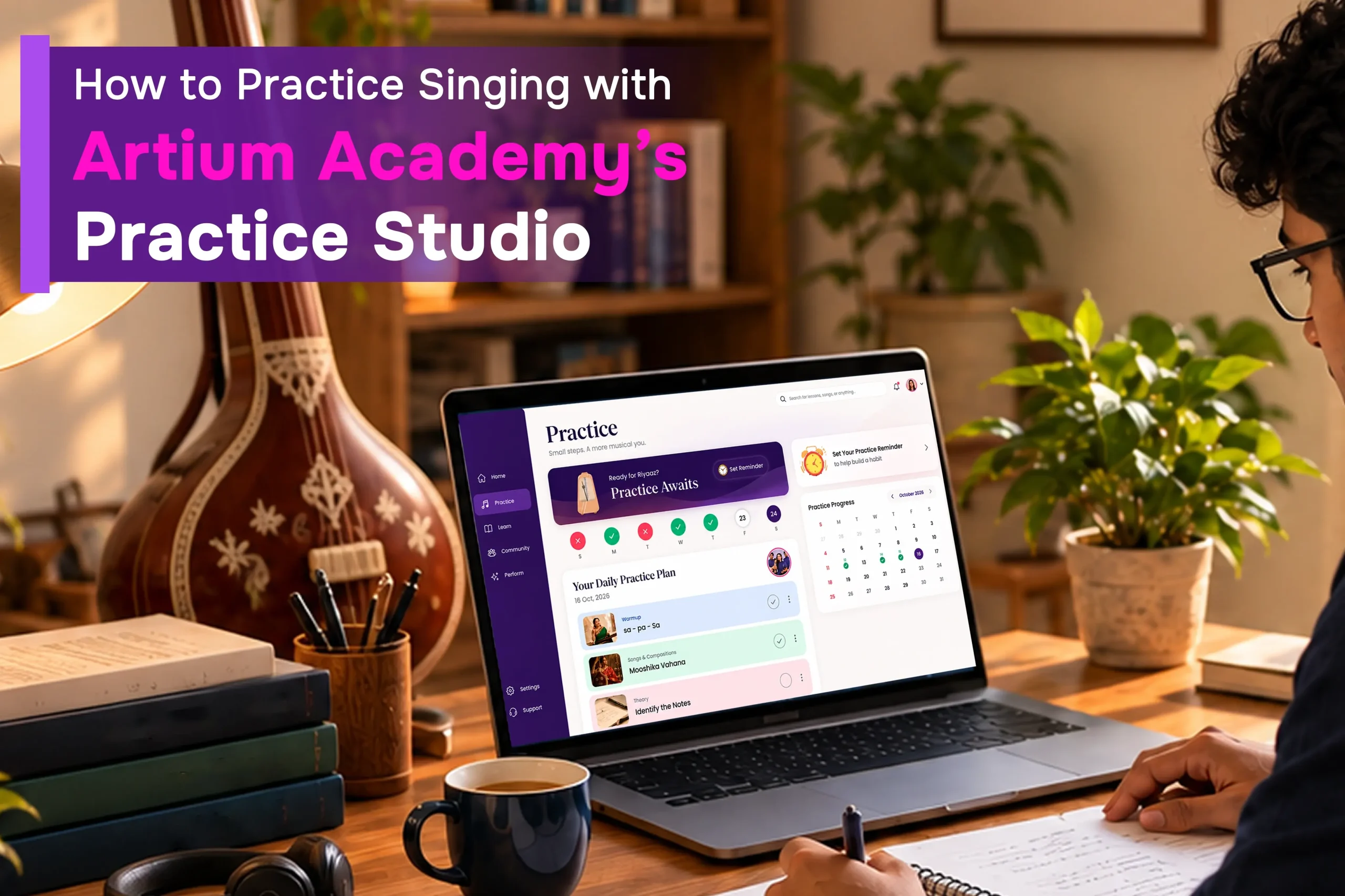
Table of Contents
Quick Summary
| To practice singing, warm up five minutes, then dedicate 20-30 minutes per day on breath control, pitch exercises, and one song. Sing with a second recording device, analyze your recordings, and fix one issue per day. Sing in a quiet room at home, use a metronome or tanpura to hold the beat, and maintain a steady routine. Beginners will see significant results after three to six months of consistent singing practice. Artium Academy’s Practice Studio combines schedules, reminders, recording, progress, and practice tools in one app. |
Introduction
Ever caught yourself singing perfectly in the shower, then going quiet the moment someone walks in?
You’re not alone. Many people think, “I don’t know how to sing,” when the real gap is simply not knowing how to practice singing. Talent helps, but a smart routine matters far more. With regular vocal practice, a little breath control and the right guidance, almost anyone can sing better.
In this blog, you’ll learn how to practice singing at home, how many minutes to practice each day, and which singing techniques are worth your time. You’ll also see how singing practice online has become easier with Artium Academy’s new Practice Studio.
Vocal Practice: Why a Daily Routine Matters
Ask any singer what had the most profound impact on their voice, and it is unlikely to be some underutilized vocal hack. Nine times out of ten, it is about one behaviour; turning up.
Vocal practice is the equivalent of taking up exercise at the gym. Your voice uses muscles, breath and hearing. Short but regular bursts exercise all three much more effectively than one long one every Sunday.
Here is what a steady routine does for you:
- Creates muscle memory. Your voice retains pitch, tone and breath patterns even after the repetitions have stopped.
- Protect your voice. A structured warm-up and warm-down decreases the chance of strain.
- Makes progress visible. Small wins matter when you keep track.
Common mistakes to avoid
- Jumping right into hard songs without warming up
- Practising only the songs that you already sing well
- Pushing through a tired or sore throat
- Never make a recording of yourself, so you can’t identify what needs to be corrected.
If you’ve committed any of these errors, take it easy. You’ve been there, we all have, and they’re all simple to correct.
How to Sing Better: The Basics Every Singer Needs
Learn these four basics of singing before you get into the fancy techniques, and they will be the foundation of everything else.
1. Posture
Good posture stands straight, shoulders down, feet hips apart, neck free. Your breath has space to breathe.
2. Pitch
Pitch means singing the right note. Find a note from a piano or tanpura, sing it. Play and adjust. Repeat a number of times.
3. Rhythm
Rhythm (or taal, in Indian music) keeps you in time. A metronome is your best friend here. Begin slowly and speed up only when you feel steady.
4. Listening
Great singers are great listeners. Pay attention to your voice and the singers in the song you are practicing. Find out where the singer takes a breath and how long each note is held.
Focus on one basic thing at a time. Don’t attempt to do all of these things simultaneously, it will just frustrate you.
How to Practice Singing at Home
You don’t need a studio to practice well. A quiet little corner and a little prep work is more than enough. Here’s a simple method for how to practice singing at home.
- Select a fixed time. Morning or early evening tend to be good options. Make it the same each time.
- Set up your space. Use a glass of water beside you and maintain an erect posture whether you’re standing or sitting
- Warm up gently. 3-5 mins of humming and lip trills (softly).
- Practice one skill. Dedicate 10 minutes to pitch or scale or breath control.
- Sing one song. Practice a short part, not the entire song.
- Record and listen. A phone recording will suffice. Listen once and make one point for improvement.
- Cool down. End with gentle humming to take care of your voice.
Helpful tools for home practice: a shruti (tanpura) drone for your pitch, a metronome for your rhythm, and a recorder for your feedback. The Practice Studio inside the Artium Academy app has all of these, so you won’t have to switch from app to app.
Vocal Practice for Singing: A Sample Daily Plan
A defined music practice schedule removes the uncertainty. Use the table below as a guideline and change it to your everyday.
| Time available | Warm-up | Main practice | Song work | Cool-down |
| 15 minutes | 3 min | 7 min (breath + pitch) | 4 min | 1 min |
| 30 minutes | 5 min | 12 min (scales or swaras) | 11 min | 2 min |
| 60 minutes | 8 min | 20 min (technique) | 28 min | 4 min |
Tips to make this plan work:
- Practice more weekdays than weekends.
- Switch up the emphasis of your main practice several days in between so you don’t get bored.
- Take a day off to give your voice time to rest.
- Write your plan or set it as a reminder.
After some vocal practice for singing, a plan like this moves from “I should practice” to “I know exactly what to do today.”
Singing Practice Online: Why It Works
It wasn’t too long ago that singing practice involved attending a class and waiting for the next class to get feedback. Today, singing practice online lets you practice whenever you are ready.
Why it works:
- Flexible. Practice before school, after school or late at night.
- Guided. Well-structured plans specify what to do, so you are never left wondering.
- Trackable. Witness your daily advancement.
- Comfortable. You sing at home freely and don’t feel observed.
Singing practice online is most effective when it’s integrated with teaching. You need a place to put into practice what you’ve learned between lessons, and that’s what a practice space is for.

Inside Artium Academy’s Practice Studio: How It Works
Now to the part you may be waiting for. Artium Academy has introduced the Practice Studio inside the Artium Academy app, built to help you practice with structure and stay consistent. Here is what you will find.
● Practice plans
Instead of wondering what to sing today, you can follow ready-made practice plans. Each plan breaks your practice into clear, manageable steps.
● Daily progress tracking
See your progress every day. Watching your practice streak grow is a gentle push to keep going, even on busy days.
● Practice reminders
Set a reminder at a time that suits you, and the app nudges you to practice. It is a simple way to build a habit.
● Record your practice
Record yourself right inside the app, listen back and notice what to improve. This is one of the quickest ways to train your ear.
● Practice tools
The Practice Studio comes with musical tools like a metronome, tanpura and tabla, so you can practice with rhythm and a steady pitch reference. Artium has also described the studio as a space where you can get feedback on pitch, sur and taal.
More resources to explore
There is plenty more to discover once you start exploring:
- Warm-ups to get your voice ready
- Songs and compositions to practice at your level
- Swara and raga practice for Indian classical learners
- Special collections such as Navratri song practice, including the popular Aigiri Nandini, during the festive season
The Practice Studio is designed to work alongside Artium’s live 1:1 classes with certified teachers and a GRMP-recognised curriculum. You learn in class and practise in the studio, so each part supports the other.
Learn How to Sing for Beginners: Start Here
If you’re wondering how to sing for beginners, one of the most basic things you should do is keep things simple and consistent. This is a four-week beginner program.
- Week 1: Warm up and Listen Practice with humming, lip trills and matching one note at a time. 10 to 15 minutes a day.
- Week 2: Add breath control. Hold down notes for a few seconds, and breathe slowly and evenly.
- Week 3: Learn a simple scale. Sing the scale slowly against a drone or piano to see if your pitch matches.
- Week 4: Sing a short song. Select a song you really enjoy and learn a single verse.
Don’t speed ahead. Beginners often try to learn too much in the first weekA small victory every day is more valuable than occasional great effort.
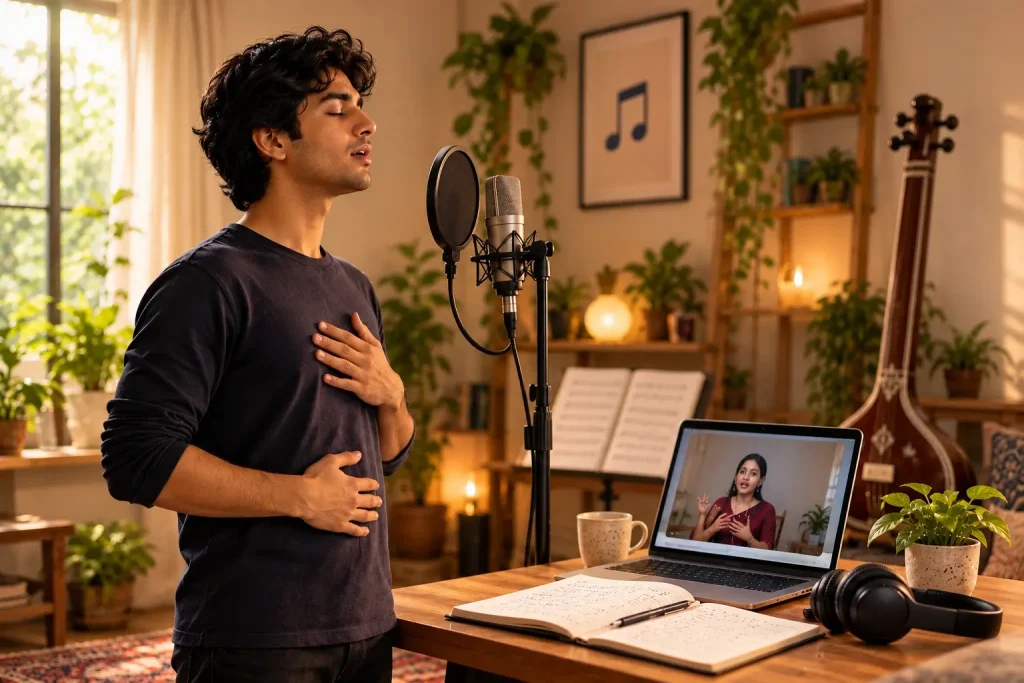
How to Practice Breath Control for Singing
Breath is the power behind your voice. Proper breath control allows you to hold a note, keep a consistent pitch and to not run out of air before the end of the line. How to Practice Breath Control for Singing.
Exercise 1: Breathing slowly in the stomach
Put one hand on your tummy. Breathe in through your nose for four beats so your tummy expands and then breathe out through your mouth slowly for six beats. Repeat five times.
Exercise 2: The continuous hiss
Inhale and exhale as an even “sss” sound. Try to maintain a steady noise. Gradually extend the time over several weeks.
Exercise 3: Sustained note
Sing a nice, comfortable “aa” note for as long as you can, keeping relaxed. Don’t push it. Hold the note with a metronome or a tanpura.
Exercise 4: Lip trills
Think of a “brrr” sound: blow air out through your loose lips and move up and down in your pitch gradually. It helps you build breath support without having to push your voice.
Practice these for 5 minutes a day, and you will be noticing more consistent notes within a few weeks.
Singing Practice Online Free: What You Can Try Today
You can begin singing practice online free without spending anything. Here are some easy ways to start:
- Use free online music tools like a metronome or tanpura app to practice pitch and rhythm.
- Follow simple warm-up videos that guide you through humming and breathing exercises.
- Record yourself with your phone and compare it with the original song.
- Book your free 1:1 trial class with Artium Academy to meet a certified teacher, share your goals and get guidance on the right course and level.
- Explore the Practice Studio in the Artium Academy app to get a feel for the practice features before you begin.
There are plenty of free tools to get started. When you’re ready to grow and need advice and clarity, a guided platform accelerates your progress.
How to Improve Your Voice Quality for Singing
Voice quality is about how your voice sounds: clear, warm and steady. If you are wondering how to improve your voice quality for singing, these habits help.
- Stay hydrated. Drink water during the whole day. Warm water is good for sore throat.
- Sleep well. Your voice, like the rest of you, requires sleep to repair.
- Avoid straining. Yelling, whispering excessively and clearing your throat repeatedly can wear out your voice.
- Warm up every time. Two minutes of pre moment.
- Sing at a comfortable pitch. Don’t try to go higher or lower than you should initially.
- Listen to recordings. Compare the recordings week to week and listen to the improvement.
Voice quality does not improve overnight. Have patience and allow your voice to develop gradually.
How Many Hours to Practice Singing a Day
This is one of the most common questions, and the honest answer is: less than you think, but more regularly.
| Level | Suggested daily practice |
| Beginner | 15–30 minutes |
| Intermediate | 30–60 minutes |
| Advanced | 1–2 hours, in short blocks |
So if you’re asking yourself “how many hours to practice singing a day?” approach it in minutes for starters. You can always divide extended practice sessions into two with a rest in the middle. Cease if your voice is beginning to turn tiresome or scratchy.
Twenty minutes of focused effort will yield more quality results than an hour of semi-conscious singing. Bring practice into your daily routine with visual cues and daily tracking so you can be consistent.
Feeling Like “I Don’t Know How to Sing”? Here’s Where to Start
Do You Feel Like “I Don’t Know How to Sing”? Get Started Here. If you think to yourself sometimes I don’t know how to sing, you’re in good company. It is probably not a talent issue; singing is a skill, and skills can be learned.
Here is how to begin:
- Start with listening. Hum on the tune of a song you love and observe the notes.
- Match one note. Use a piano or tanpura and try to sing the same note.
- Try short sessions. Five to ten minutes is enough on day one.
- Be kind to yourself. Your first recordings may not sound perfect, and that is okay.
- Get a little guidance. A teacher can quickly spot small things you might miss.
All these good singers you see today began just where you are now. The first step and a little patience are all you need.
Best Singing Techniques to Practice Every Week
Once your basics are manageable, you can start adding some techniques to actually grow your voice. These are the best singing techniques to alternate between each week:
- Pitch control: Sing slow scales or swaras with a drone and make sure every note holds its pitch.
- Breath support: Practice sustained notes and gentle phrasing to sing longer lines.
- Dynamics: Practice singing softly and then a little louder to add feeling.
- Articulation: Say your lyrics clearly so listeners understand every word.
- Range building: Slowly explore slightly higher and lower notes without straining.
- Swara, raga and taal practice: For Indian classical learners, regular swara and raga work builds ear, voice and rhythm together.
A simple weekly rotation:
- Mon & Thu: Pitch control and scales
- Tue & Fri: Breath support and sustained notes
- Wed & Sat: Song practice with dynamics and articulation
- Sun: Rest or light listening
Preparing for a singing audition? Here are a few tips to prepare for your singing auditions: choose a song that suits your voice, practice it in short sections, record yourself often, and rehearse in front of a friend or family member. Slow, steady practice builds confidence far better than last-minute cramming.
Conclusion
Singing techniques don’t have to be overwhelming. Warm up, do a little bit of practicing everyday, concentrate on breathing and pitch, use your phone to listen to yourself, and be patient.
This is what the Practice Studio inside the Artium Academy app is designed to do. Practice plans, Daily progress, Reminders, Recording, Tools and Warm-ups, Songs, Swara and raga practice library. Alongside live 1:1 classes with experienced teachers, it will take you from your very first notes to a confident singer.
Ready to begin? Book your free 1:1 trial class with Artium Academy and learn from certified teachers at your own pace.