
All Topics
- Alchemizing Music Concepts for Students
- Anuv Jain Songs
- Artist Spotlight
- artium gift card
- Artium Maestros
- Artium News
- Artium Practice Studio
- Artium Tech Blog
- Best Coke Studio Songs
- Best Female Singers
- Birthday songs
- Bollywood Love Songs
- buying guide
- Carnatic Music
- Child Singers
- Devotional Music
- Editorials by Ananth Vaidyanathan
- English Love Songs
- Festival
- Film Music
- Ghazal Music
- Guitar
- Hindustani Classical Music
- Indian Classical Music
- Indian Folk Music
- Insights
- Instagram Reels Viral Songs
- Instruments
- Karaoke
- Karaoke Singing
- Keyboard
- Kids Music
- maestros
- Music Education
- Music for Kids
- Music Games
- Music Industry
- Music Instruments
- Music Legends
- Music Press Release
- Music Technology
- Music Theory
- Music Therapy
- Music Tools
- Piano
- piano guide
- Songs
- South Devotional Music
- Success Stories
- Tamil Film Music
- Telugu Film Music
- Time Theory
- Tools
- Uncategorized
- Uncategorized
- Uncategorized
- Uncategorized
- Vocal Range
- Vocal Singing
- Vocals
- western classical music
- western music
- Western vocal music
How to Learn Indian Music in Singapore
How to Learn Indian Music in Singapore
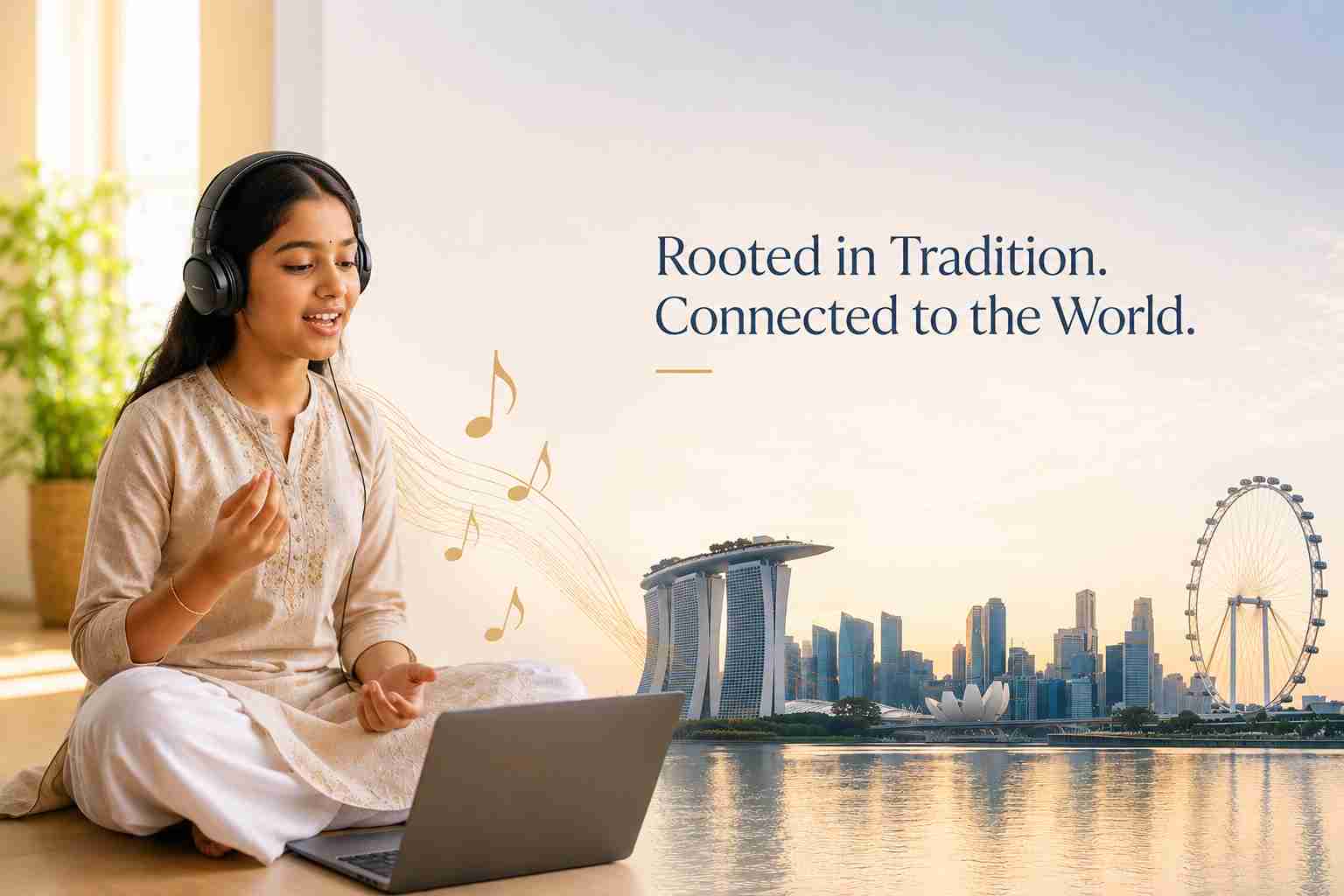
Table of Contents
Ever found yourself humming to your favourite Carnatic raaga while watching the beautiful sunset over Marina Bay?
Or just tapping your fingers to the beats of a Hindustani thumri while sipping tea at Little India?
Don’t worry, you are not alone in doing this. The vibrant Indian community of Singapore has kept the spirit of Indian music alive and thriving for decades. Hence, today, more children, adults and music aspirants than ever are choosing to actively learn Indian music in Singapore. Whether you are a parent wanting your child to stay connected to their roots, an adult or hobbyist dreaming of singing your favourite Hindi film music song or someone in love with the beauty of ragas and talas, this blog is for you. Indian music is more than just an art form; it is our heritage, telling the story of who we are. And you know what the best part is? You don’t have to travel to India to learn it. Online music classes have made world-class Indian music education accessible right from your home in Singapore.
So, for all those of you wondering how to learn Indian music in Singapore, you are at the right place. Let’s dive in.
The growing popularity of Indian music in Singapore
Singapore has had a rich Indian cultural presence for decades. With lakhs of people of Indian origin calling it home, the demand for quality Indian music education in Singapore has never been stronger. From temple festivals at Sri Srinivasa Perimal to cultural fiesta events that have set Singapore Book of Records for the largest mass performance of Indian traditional arts, Indian music is woven into the social fabric of this country.
The last few years has seen a visible rise in the number of aspiring musicians, both young and old, who are signing up for Carnatic music classes in Singapore and Hindustani music lessons in Singapore. Many Indian fine arts institutions in Singapore have been nurturing classical talents for years, while the rise of online platforms has opened the doors even wider.
Why are more children and adults learning Indian classical music?
We get asked this question a lot and we love answering it because the reasons are so compelling!
Let us start with children; learning Indian classical music is much more than just a cultural activity for them. The children who learn Indian classical music display improved memory, better concentration, enhanced language skills and stronger emotional intelligence. The structured nature of Indian classical music with its emphasis on shruti (pitch), laya (rhythm) and raga, essentially gives young minds a stronger cognitive workout wrapped in something beautiful.
For adults and hobbyists, it’s about reconnecting with their roots, expressing emotions and finding a meditative outlet in today’s busy world. As it is proven, music has the power to reduce stress, boost mood and bring a sense of belonging, especially for the Indian diaspora living away from home. And in general, it is simply the joy of music. From singing along to a favourite Bollywood melody, mastering classical varnam or learning to play the guitar to a Tamil film song, music adds color to life.
Understanding the different types of Indian music
Hold on, before you jump into looking for Indian singing classes in Singapore, let us understand what “Indian music” actually means. It is a beautifully diverse world. Indian classical music forms the foundation of the tradition and is broadly divided into two systems:
Carnatic music is native to South India (Tamil Nadu, Keralam, Karnataka and Andhra Pradesh) and is known for its intricate composition, gamaka-laden ragas and structured rhythm (tala) systems. It is devotional at heart with compositions by saint-composers like Tyagaraja, Muthuswami Dikshitar and Syama Sastri.
Hindustani music is native to North India and is deeply influenced by Persian and Mughal culture. It features expansive raga exploration through forms like Khayal, Thumri and Dhrupad with artists like Pandit Ravi Shankar and Ustad Bismillah Khan being the legendary figures of this tradition.
Film music is perhaps the most universally loved genre in Indian music. Hindi, Tamil, Telugu, Kannada and Malayalam film music have produced some of the most iconic songs of all time, from the golden melodies of Lata Mangeshkar to the peppy chartbusters of A.R. Rahman.
Devotional music including bhajans, kirtans and Carnatic keerthanas is deeply spiritual and widely sung in homes and temples across Singapore. Western vocals, guitars and piano round off the spectrum with many Indian music lovers also keen to learn these instruments alongside classical training.
Who can learn Indian music?
Well, the obvious answer to this question is that anyone can learn Indian music.
- Children (6+ years)
This is the right age to start. They can absorb music naturally and starting young helps build a lifelong love for the art. Music lessons for kids are especially designed to be fun, age-appropriate, and engaging. - Teenagers
The teenage years are a great phase to build technique, deepen cultural pride and develop a personal musical identity. - Adults
It’s never too late. Many adults start learning Indian classical vocals in their 30s, 40s or beyond and find it to be one of the most fulfilling experiences of their lives. - Hobbyists and music lovers
If you want to sing your favourite songs better or understand the theory behind the music you love, there’s a course for you too.
Where to learn Indian music in Singapore?
For those of you searching “Indian music classes near me in Singapore”, the options are various:
Offline/In-person schools: Singapore has many reputable institutions offering classical music education. Some of these include Singapore India Fine Arts Society (SIFAS), Sakhti Fine Arts, Parampara Society, Rhythms Aesthetic Society and Sri Senpaga Vinayagar Music and Dance Academy. Most of these offer classes in Carnatic vocal, Hindustani vocal, Tabla, Veena, Mridangam, and Violin, conducted by qualified teachers.
Online Music Platforms: Platforms like Artium Academy bring the best of Indian music education to your doorstep or rather, your screen, anywhere in the world, including Singapore.
Choosing between Online and Offline Indian Music Classes
It is important to understand that online and offline music class options both have their own advantages and the right selection depends on the learner’s lifestyle and preferences. Here’s a quick look:
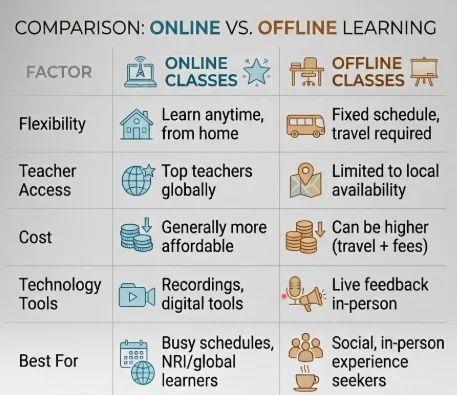
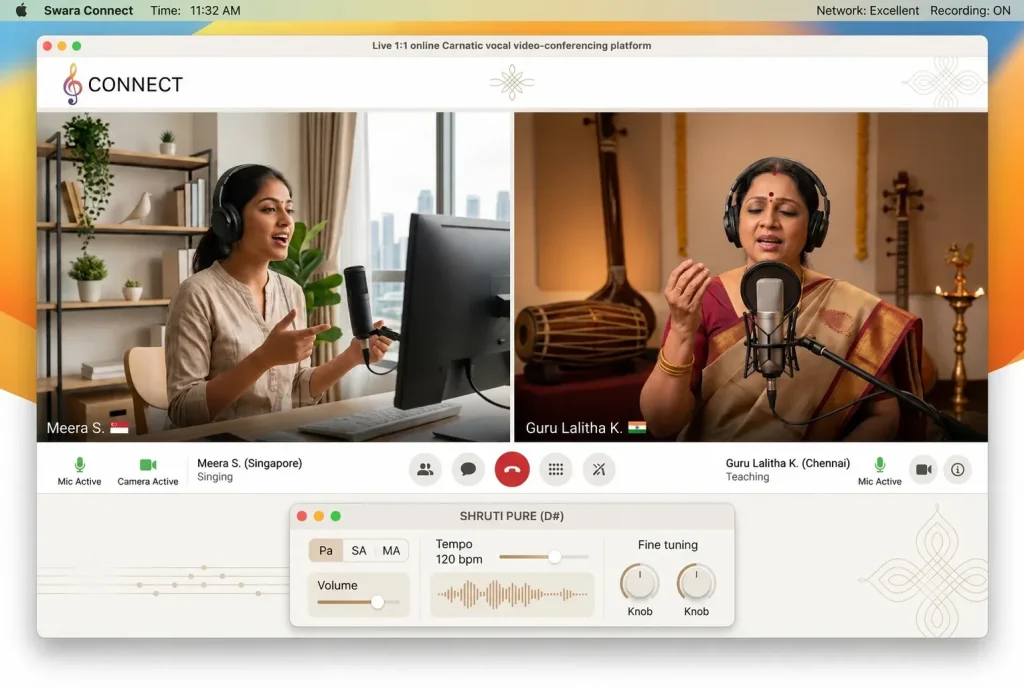
In the last decade or so, online music classes have proven to be game-changers, especially for the Indian diaspora in Singapore. With live 1:1 sessions, recorded lessons for review, flexible timings across time zones and access to legendary teachers, online learning has made quality music education more accessible, convenient and effective than ever before.
Choosing the Best Indian Music School in Singapore
With so many options available, here’s what to look for when choosing a music school or platform:
Qualified and Experienced Teachers: Check for teachers trained at reputable institutions or with a strong track record of performance.
Structured Curriculum: A well-designed curriculum ensures systematic progression from beginner to advanced levels.
Certification: Having a globally recognized certification adds credibility to your learning.
Flexibility: Flexible scheduling is important, especially for working adults and school-going children.
Free Trial Option: A good school or platform will always let you try before you commit.
Guidance: For online platforms, check whether the music courses are certified or endorsed by renowned musicians to ensure an authentic learning experience.
And this is where Artium Academy stands out. As India’s No. 1 online music learning platform with over 45,000 students worldwide, we offer live 1:1 classes across a range of Indian and Western music courses. Not just that, we are proud to have music courses certified by India’s greatest music legends like Sonu Nigam, KS Chithra, Aruna Sairam, Shubha Mudgal, Louiz Banks and Raju Singh. So, when you learn with Artium Academy, you are not just learning music; you are learning from the best in the industry.
What You’ll Learn in Indian Music Class
Whether online or offline, when you enroll in a structured Indian music class, your music journey will be somewhat like this:
Carnatic Music Classes:
- Sarali varisais, Janta varisais and alankarams (foundational exercises)
- Geethams and Swarajatis (early compositions)
- Varnams and Kritis by great composers like Tyagaraja
- Raga Lakshana (characteristics of ragas) and tala system
- Gamakas (the ornamental microtonal phrases unique to Carnatic style)
- Manodharma Sangita – the beautiful art of improvisation
Hindustani Music
- Basic swaras (Sa Re Ga Ma Pa Dha Ni) and alankaras
- Introduction to ragas and their time/season associations
- Simple compositions in Vilambit and Madhya laya
- Khayal gayaki and Thumri styles
- Layakari and Tala training
Film music, devotional and other courses
- Hindi and South Indian film music(Tamil, Telugu, Kannada, Malayalam)
- North & South Indian devotional music, bhajans, kirtans, keerthanas
- Western vocals, guitar lessons and piano courses
How long does it take to learn Indian music?
Now, let us address the main question you’ve all been waiting for. The honest answer: it depends on your goals, but the journey is deeply rewarding at every stage.
Here’s a realistic roadmap:
| Learning goal | Approximate timeline |
| Sing confidently at family gatherings | 3-6 months |
| Perform at cultural/community events | 12-18 months |
| Reach an advanced amateur level | 2-3 years |
| Teaching capability | 3-5 years |
| Concert level mastery | 5+ years |
The key to progress here is consistent daily practice, the quality of instruction, learners’ ages, and family support. Children aged 8-12 tend to learn the fastest, while adults bring dedication and cultural context that can accelerate understanding. Remember, Indian classical music, like any other art form, is not about reaching a finish line. It is a lifelong journey of discovery. As the saying goes among seasoned musicians: The more you learn, the more you realise how much there is still to learn.
Your musical journey begins here
We all agree to the fact that Singapore is one of the most exciting places in the world to explore Indian music. Whether you are looking for Carnatic music classes in Singapore, looking for Hindustani music lessons, or exploring guitar lessons or online vocal courses, the resources available today are better than ever.
If you’re looking for best in online Indian music education with the flexibility to learn from home, the guidance of certified online music teachers and the inspiration of legendary maestros, Artium Academy is your place to be. With 45,000+ global learners and courses spanning Indian classical music, film music, devotional, Western vocals and instruments, Artium brings the richness of Indian music to wherever you are in the world.
Your song is waiting to be sung. Why not start today?
FAQs
You can study music in Singapore at established arts schools like SIFAS, Rhythms Aesthetic Society, Sri Senpaga Vinayagar Temple Music and Dance Academy and more. If you prefer flexibility, online music classes are a strong option, especially for students who want live, tailored learning from home.
Start with a clear plan: learn basic swaras, rhythm, and simple exercises, then move into ragas compositions and gradual practice with a qualified teacher. The most effective route is structured training through an in-person school or guided online music classes with feedback and practice support.
Look for a platform that offers live 1:1 classes, a structured curriculum and teachers experienced in Carnatic vocal training. For example, at Artium Academy, we offer online Carnatic music classes with tailored lessons and maestro-certified learning.
Beginners should start with foundational exercises such as sarali varisais, simple rhythmic patterns, and basic song forms before moving on to varnams and kritis. A beginner-friendly teacher or course will pace the lessons carefully and adapt them to the learner’s age, comfort and goals.
That completely depends on your goal. Basic singing confidence may take a few months, while strong amateur or performance-level progress usually takes several years of consistent practice and guided training. Indian classical music is a long-term journey, so steady progress matters more than speed.
No. You do not need to know an Indian language to start learning. Teachers usually guide pronunciation, lyrics and meaning as part of the learning process and beginners can focus first on swaras, rhythm and correct vocal technique. Knowing the language can help later, but it is not a barrier to beginning your music journey.
Very informative and useful.
Thank you so much!