
All Topics
- Alchemizing Music Concepts for Students
- Anuv Jain Songs
- Artist Spotlight
- artium gift card
- Artium Maestros
- Artium News
- Artium Practice Studio
- Artium Tech Blog
- Best Coke Studio Songs
- Best Female Singers
- Birthday songs
- Bollywood Love Songs
- buying guide
- Carnatic Music
- Child Singers
- Devotional Music
- Editorials by Ananth Vaidyanathan
- English Love Songs
- Festival
- Film Music
- Ghazal Music
- Guitar
- Hindustani Classical Music
- Indian Classical Music
- Indian Folk Music
- Insights
- Instagram Reels Viral Songs
- Instruments
- Karaoke
- Karaoke Singing
- Keyboard
- Kids Music
- maestros
- Music Education
- Music for Kids
- Music Games
- Music Industry
- Music Instruments
- Music Legends
- Music Press Release
- Music Technology
- Music Theory
- Music Therapy
- Music Tools
- Piano
- piano guide
- Songs
- South Devotional Music
- Success Stories
- Tamil Film Music
- Telugu Film Music
- Time Theory
- Tools
- Uncategorized
- Uncategorized
- Uncategorized
- Uncategorized
- Vocal Range
- Vocal Singing
- Vocals
- western classical music
- western music
- Western vocal music
The Best Age to Start Piano Lessons for Children
The Best Age to Start Piano Lessons for Children
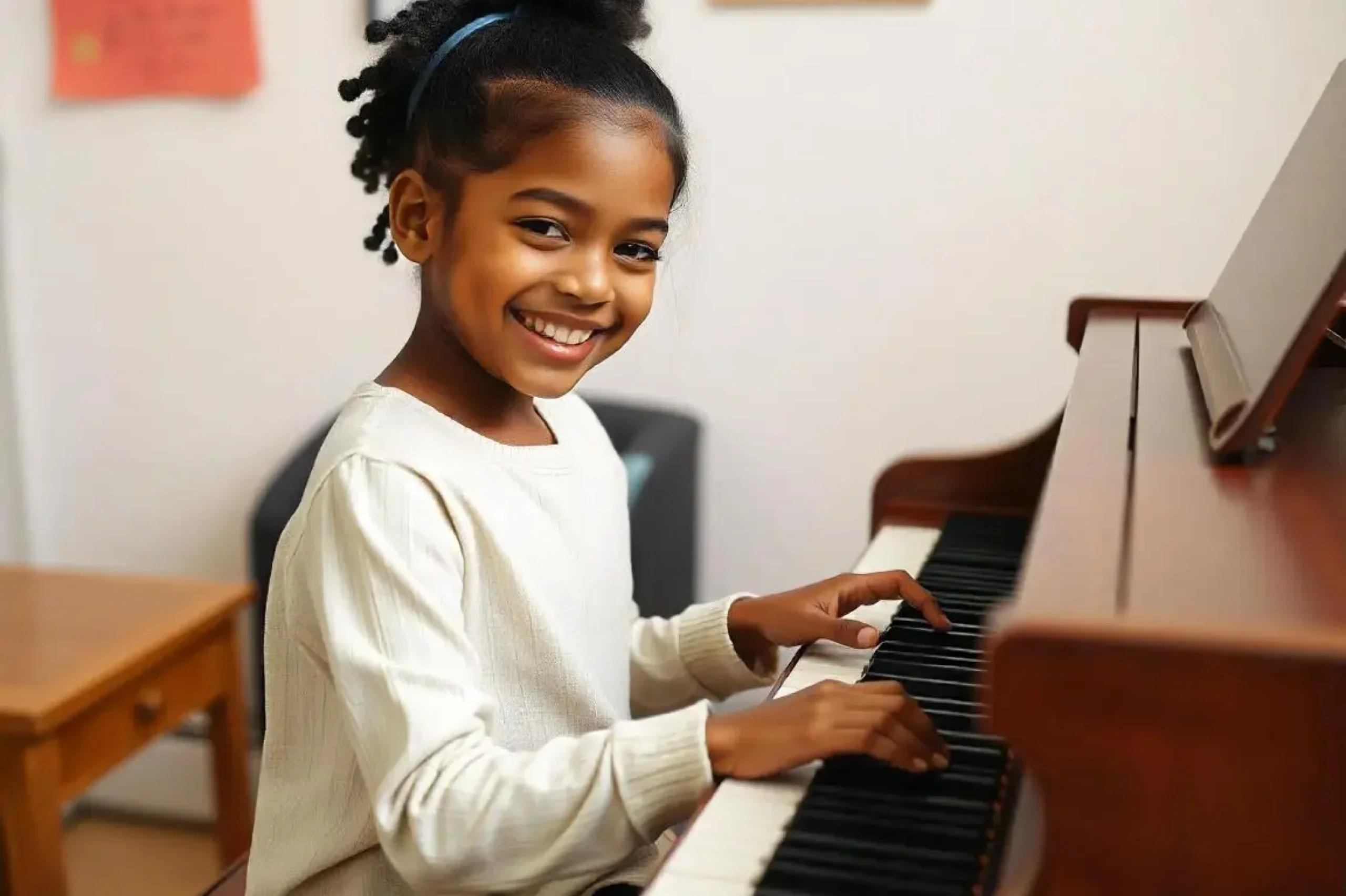
Table of Contents
Quick Summary
| The best age to start piano lessons for most children is around 5 years, when they can stretch five white keys, move fingers independently, follow simple instructions, and show genuine interest. Starting earlier is possible with playful, parent-led music exposure, but formal lessons usually work best once readiness signs align. |
As a parent, amidst everything that you aspire to and hope for your child, you continuously find yourself trying to provide them with the best facilities and provisions across academics, sports and other extracurricular activities.
Lately, parents have also been focusing on children undertaking music lessons now more than ever, as it makes for a holistic development of a child’s cognition, creativity and emotional expression while inculcating discipline and improving social skills. The best way to understand the fundamentals of music is by learning how to play the piano before other instruments; the layout of a piano or a keyboard is easier to understand scales and chords, which can later on be applied to other musical instruments.
Research says that 5 years is the best age to put children into piano lessons. Let’s study a few other criteria that made us arrive at the decision.
When to Start Piano Lessons for Kids?
- Hand Size:
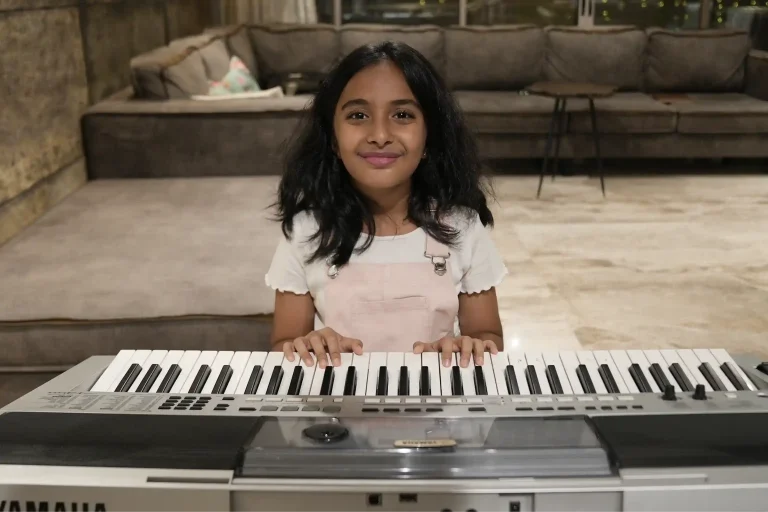
Physical growth of a child’s fingers are the utmost mark of when a child is ready to play the piano. If their fingers can stretch across five white keys on the piano, they should be good to go!
- Dexterity:
Muscle control plays a huge factor in being able to play the piano easily. So if your child can comfortably move individual fingers with ease, that’s a sign that they are ready to give the instrument a go.
- Reading/Counting Ability:
The piano is usually taught with sheet music or some reading material. This would require your child to be able to understand basic symbols and words along with good hand-eye coordination.
- Desire To Learn:
Never force your child to learn anything, even if it’s music. Encouragement and motivation is always welcome but their desire should also reflect the same; otherwise, it will end up feeling like a chore. This could ruin their interest right from the get-go and build frustration and contempt with themselves. An interest could also take a while to develop, so patience is the key here.
Exceptions:
As parents, it’s important to realise that every child has a different pace of learning and grasping new things. If a child isn’t eager to learn piano, pushing them might stifle their interest. It’s often better to wait until they’re truly ready, as many successful musicians start later and excel due to greater maturity and skills.

Benefits of Learning Piano at a Young Age
- Cognitive Development:
Playing the piano helps in improving memory, concentration and other problem-solving skills. This helps your child stay more focused and add discipline in all aspects of life.
- Emotional Development:
Piano playing fosters self-expression, helps reduce stress, teaches patience and also helps in developing empathy through learning, which in turn enhances a child’s self esteem.
- Motor Skills:
Through developed hand-eye coordination, once your child starts learning the piano, this skill can be further applied to everyday, as well as sports!!
- Academic Skills:
Subjects like math and reading can be heavily influenced by the after-effects of piano playing through improved attention spans and abilities to comprehend complex statements and theories.
How to Structure Piano Lessons for Kids
- Short and Fun Sessions
Don’t expect your child to sit at the piano for hours at first. Keep lessons brief and playful using the Best Children’s Piano Songs to spark their interest and build a lasting love for the instrument.
- Incorporating Games and Activities
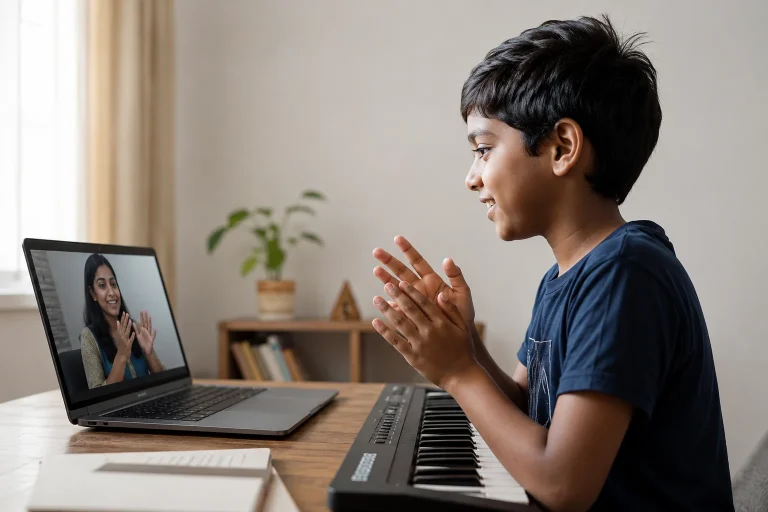
Add some quizzes or trivia around the piano as part of their learning experience. Ask them to try and play a note without looking at the piano or to be able to identify the note just by ear. This will build curiosity and make them want to get better through healthy competition with themselves.
- Setting Realistic Goals
It’s important to give your child a sense of accomplishment with every step of learning the piano. Often, appreciate and encourage them on completing every lesson to keep their motivation up and maintain steady progress and improvement.
- Parental Involvement
Your involvement in your child’s piano playing journey is more important than you think. Keep a check on their practice schedule. Sit with them for lessons every once in a while, ask them how they feel about playing the piano and reflect on if there’s anything else you could do to create a better learning environment at home.
For a more comprehensive guide on how to structure piano lessons for kids, check out our article, Piano Lessons for Kids: Ultimate Guide for Beginners. In this guide, you’ll find detailed explanations on how to make piano lessons effective, fun, and engaging for young learners. From creative lesson ideas and practice techniques to setting realistic goals and involving parents in the learning journey, this article covers everything you need to know to help your child succeed with the piano.
Can a 3 Year Old Learn Piano?
Many parents wonder what age to start piano lessons and some even ask whether a 3-year-old can begin. The short answer: yes a 3-year-old can be introduced to the piano but formal lessons are usually not ideal at this age.
At three most children are still developing:
● Fine motor control needed to press keys with independence
● Attention span for structured 20–30 minute lessons
● Basic pre-reading and pattern-recognition skills that support early music learning
However age 3 can be a wonderful time for music exposure rather than strict instruction. Think in terms of:
● Exploring the keyboard through play
● Singing songs while pressing black and white keys
● Clapping rhythms and playing call-and-response games
● Short, fun “mini-sessions” of 5–10 minutes instead of formal lessons
If you’re considering what age to begin piano lessons for your child age 3 is best viewed as a “pre-piano” stage. It builds familiarity and love for music setting a foundation, for more structured learning a bit later.
Do Children Who Start At Ages 3, 4, or 5 Have an Advantage?
Many parents wonder if starting at 3 4 or 5 gives a long-term advantage when deciding the age to begin piano lessons.
● Ages 3 to 4: This is good for exposure to music and the keyboard but it can be limited by developing motor skills and short attention spans.
● Age 5: Some children can manage fun lessons but many are still not ready for regular note-reading or longer practice sessions.
● Ages 6 to 8: This is often the age for piano lessons, with better coordination reading ability and focus for steady progress.
Starting early can help build comfort ear training and confidence but children who begin at the best age to begin piano lessons (usually 6 to 8) often progress faster in technique and reading with less frustration.
Tips For Starting Your Child At The Piano
When you have decided what age to start piano lessons these quick tips will help you make the age for piano lessons count.
● Check readiness signs: Look for focus lasting 10 to 15 minutes a love for music the ability to follow instructions and finger control. These signs matter more than the age for the best age for piano lessons.
● Keep lessons fun: Use 5 to 10 minutes for ages 3 to 5 or 10 to 15 minutes for ages 6 to 8. Add games, clapping and simple songs.
● Build a routine: Set a practice time and keep the piano inviting. This helps build habits at any stage of what age to start piano lessons.
● Teach posture and basics early: Focus on posture, curved hands and keyboard landmarks. This prevents habits no matter the best age for piano lessons.
● Pick a child-friendly teacher: Choose a teacher who is experienced with kids, who uses play and who talks with parents to find the true best age for piano lessons, for your child.
● Make music everyday: Listen, sing and clap together to support whatever what age to start piano lessons you choose and keep motivation high.
Conclusion
In the hustle of today’s day and age, many parents are resorting to online means of learning music, where one can learn in the comfort of their home at their own convenience. We, at Artium Academy are India’s leading music education platform that cater to 20,000+ learners, globally! With piano courses designed and certified by industry experts such as Louiz Banks, we aim to transform you into performers and artists in the piano space, using our elite pioneering learning technology! Book a FREE trial with us and let’s explore your child’s music potential together!
Also, check our new practice tools to help our learners practice with intent, clarity and purpose.
FAQs
Most teachers recommend starting formal piano lessons around age 5, when hand size, finger independence, and basic reading/counting skills are developed enough for structured learning.
If a 3–4-year-old is highly motivated, begin with short, playful “pre-piano” activities (rhythm games, note names, simple melodies) and transition to formal lessons around age 5.
Ages 5–7 are often ideal for steady long-term progress because children can focus longer, practice more independently, and understand teacher feedback clearly.
For traditional weekly lessons, 4 can be early unless the child shows strong readiness (hand span, attention, desire). At this age, short, fun sessions with heavy parental involvement work better.
Wait until the child can sit for 10–15 minutes, follow simple directions, and show curiosity about music. Readiness matters more than exact age.
Yes. Older beginners often progress faster due to better discipline, reading skills, and practice habits, and they can reach advanced levels with consistent training.
Look for: ability to stretch five white keys, independent finger movement, basic symbol/number recognition, and a clear desire to learn without being forced.
For ages 5–7, 20–30 minute lessons work best, paired with short daily practice (10–15 minutes) to maintain attention and build routine.
A full-size or 61-key keyboard with weighted/semi-weighted keys can be a good starter if space/budget is limited, but ensure proper posture and key response for technique.
Pause formal lessons and return to musical play, songs they love, or group classes. Reintroduce structured lessons when motivation returns; many successful musicians start later.