
All Topics
- Alchemizing Music Concepts for Students
- Anuv Jain Songs
- Artist Spotlight
- artium gift card
- Artium Maestros
- Artium News
- Artium Tech Blog
- Best Coke Studio Songs
- Best Female Singers
- Birthday songs
- Bollywood Love Songs
- buying guide
- Carnatic Music
- Child Singers
- Devotional Music
- Editorials by Ananth Vaidyanathan
- English Love Songs
- Festival
- Film Music
- Ghazal Music
- Guitar
- Hindustani Classical Music
- Indian Classical Music
- Indian Folk Music
- Insights
- Instagram Reels Viral Songs
- Instruments
- Karaoke
- Karaoke Singing
- Keyboard
- Kids Music
- maestros
- Music Education
- Music for Kids
- Music Games
- Music Industry
- Music Instruments
- Music Legends
- Music Press Release
- Music Technology
- Music Theory
- Music Therapy
- Music Tools
- Piano
- piano guide
- Songs
- South Devotional Music
- Success Stories
- Tamil Film Music
- Telugu Film Music
- Time Theory
- Tools
- Uncategorized
- Uncategorized
- Uncategorized
- Uncategorized
- Vocal Range
- Vocal Singing
- Vocals
- western classical music
- western music
- Western vocal music
What Is Allegro in Music? Meaning and Famous Allegro Pieces
What Is Allegro in Music? Meaning and Famous Allegro Pieces

Table of Contents
Quick Summary
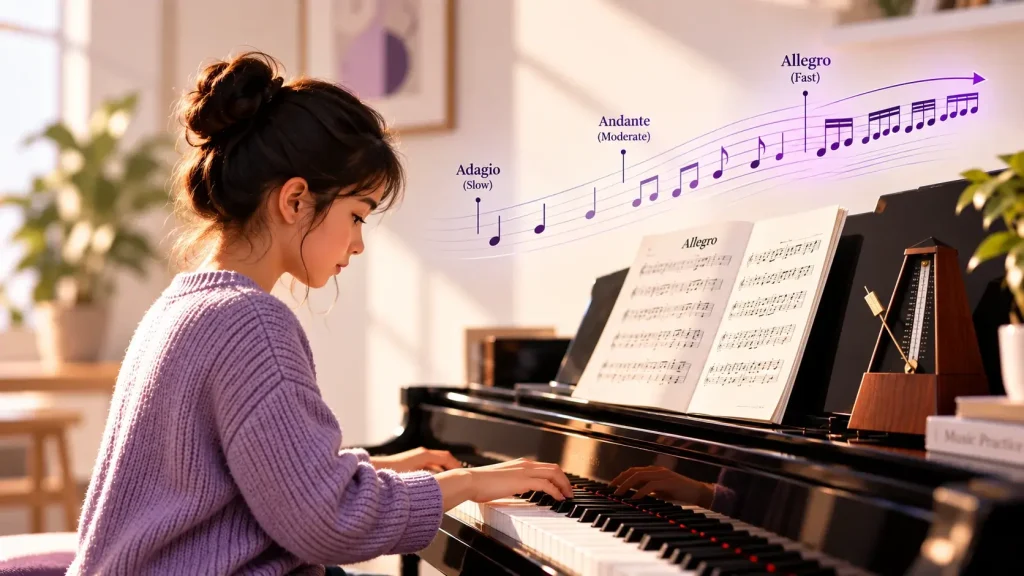
| Allegro in music is a tempo marking that indicates a lively and happy pace. Allegro tempo is usually found at the beginning of a composition or section. It is a directive for singers and players to perform at a cheerful pace of approximately 120 to 156 beats per minute and is characteristic of classical works, film music and many contemporary songs. |
Introduction
Did you notice the term allegro in a piece of music at the top of the page, and wonder what it meant? Allegro in music is a direction to play a passage in a quick, lively manner.
It is especially used in Western music, particularly in orchestral compositions, sonatas, concertos, piano pieces, and the pieces which comprise the examination syllabus. But it does not necessarily mean that the concept of allegro is always confined to classical music. Allegro is well maintained by film songs, pop songs, jazz compositions, dance numbers, and so on.
Learn this tempo marking so you can more easily read music terms, follow sheet music, and work on your timing and rhythm.
Allegro Meaning in Music (Definition)
Allegro is an Italian word describing a lively, fast, or cheerful tempo in music. It originates from a European language, with Italian being a language of choice for a lot of musical directions.
If a composer indicates allegro at the start of a piece/movement, it typically has the following meaning:
● Play or sing at a brisk pace.
● Keep the rhythm steady.
● Create an energetic, bright, or forward-moving feeling.
● Maintain clarity rather than rushing.
Allegro does not always convey the same character. It is not simply a direction to play fast. For instance, two compositions may share an identical measurement and briskness; yet one may produce an exuberant sound and the other may seem intense or immediate.
The marking may also be modified:
● Allegro moderato: A slightly slower variant of Allegro.
● Allegro con brio: quick and spirited or bright.
● Allegro ma non troppo: fast, but not too fast.
● Molto allegro: very lively and faster than allegro.
A Brief History of Allegro
Allegro is an Italian word that initially meant “cheerful”, “lively”, or “joyful”. The language Italian evolved as the primary terminology for musical directions during the Renaissance and Baroque musical eras, with composers adopting Italian words for tempo, character, and articulation.
By the 17th and 18th centuries, allegro was widely used in European classical music. Composers such as Antonio Vivaldi, Johann Sebastian Bach, Joseph Haydn, Wolfgang Amadeus Mozart, and Ludwig van Beethoven frequently used it to mark energetic movements in concertos, sonatas, symphonies, and chamber works.
Earlier music did not use precise tempo indications. The composer might indicate allegro to indicate a certain energetic nature of the music rather than a specific beat per minute. It was not until after the metronome was invented in the early 19th century that metronome markings became standard.
Today Allegro remains a common word in music today. While pop, film and electronic music is now more likely to use BPM instead of an Italian marking, many current songs and pieces are still written with the quick and lively feel that allegro provides.
Allegro Music: Tempo Range and Characteristics
Allegro is a relative term and there is no single fixed Allegro speed. The most popular guide is between c. 120 – 168 BPM (~ 138), others cite from c. 120 – 156 (~ 138), and still others less strictly. As with all tempo terms, the actual Speed will depend on composer, time period, instrument, time signature, and circumstance.
When a metronome marking is included it provides clearer instruction. If the score states a quarter note = 132bpm. Then it is suggested that the beat be arranged to be conducted to that speed.
Common characteristics of allegro include:
● A clear and active pulse.
● Energetic melodies and rhythmic patterns.
● Frequent use in opening movements and finales.
● Crisp articulation, particularly in instrumental pieces.
● A feeling of movement, excitement, or brightness.
If you are a beginner, keep in mind that fast does not necessarily mean reckless. Allegro should be played in a manner that is steady, musical, and emotional.
Allegro vs Other Common Tempo Markings
A tempo marking is more for guidance for a performer, as to how fast the piece should be played. The exact beats per minute are indefinite, but the following is an estimate to get you started.
Allegro vs Andante
Andante is a more relaxed rate of walking, and allegro is quicker and livelier.
| Feature | Andante | Allegro |
| General meaning | Walking pace | Rapid and energetic |
| Typical feel | Cool, relaxing, thoughtful | Warm, stimulating, lively |
| Approximate BPM | About 56–108 BPM | About 120–168 BPM |
| Common use | Lyrical episodes and soft tunes | Opening movements, finales, and lively sections |
| Practice focus | Fluent phrasing and control of flow | Precision, rhythmic stability and clearness |
If a learner is moving from andante to allegro, it is useful to increase the speed gradually rather than immediately doubling the tempo.
Allegro vs Presto
Presto outstrips allegro. If allegro is a good jog, presto is an outright dash.
| Feature | Allegro | Presto |
| General meaning | Fast and lively | Very fast |
| Typical feel | Energetic and controlled | Urgent, exciting, and rapid |
| Approximate BPM | About 120–168 BPM | Often about 168–200 BPM |
| Technical demand | Requires clean rhythm and articulation | Requires advanced control and quick reactions |
| Common challenge | Avoiding rushing | Maintaining clarity at very high speed |
It’s not just the metronome marking that is different. Presto tends to add more frantic energy and allegro provides a more expansive opportunity to breathe and to focus on articulation and expression.
Allegro vs Moderato
Moderato means moderate or medium speed. It usually sits between slower walking tempos and faster allegro music.
| Feature | Moderato | Allegro |
| General meaning | At a moderate speed | Fast and lively |
| Typical feel | Balanced, steady, comfortable | Energetic and forward-moving |
| Approximate BPM | About 108–120 BPM | About 120–168 BPM |
| Suitable for | Beginners developing steady timing | Learners building speed and agility |
| Main focus | Consistency and balance | Speed, precision, and expression |
A piece marked allegro moderato combines both ideas. It asks for an active pace but with moderation and control.
Famous Allegro Songs and Classical Compositions
Many famous classical pieces contain allegro movements. Some of the most popular are:
● Mozart – Eine kleine Nachtmusik, first movement: Usually labeled Romanze, its opening lyricism and folk-dance feel make this movement immediately identifiable.
● Mozart – Symphony No. 40, first movement: The work is marked Molto allegro and has a restless quality.
● Beethoven – Symphony No. 5, 1st movement: Allegro con brio – fast and furious.
● Vivaldi – ‘Spring’ from The Four Seasons: The first movement Allegro, from The Four Seasons, conveys the energy of spring through upbeat, high-spirited rhythms.
● Bach – Brandenburg Concerto No. 3: The first and fourth movement shows the allegro through its rhythmic energy and cross rhythms.
● Symphonies and String Quartets: Countless of them have lively finales as well as all-program first movements from Haydn.
Allegro songs are characterized as fast, happy and bright. The term allegro often indicates a specific speed at which the music should be played and is used with a metronome marking or descriptive tempo mark. When people find Allegro songs they may also be looking for Songs with a similar upbeat energetic style, which often means a different tempo or genre. Most contemporary Songs are not described as allegro with an Italian marking, but rather by Bpm or style.
Allegro in Sheet Music: What to Look For
Allegro on your sheet music is often marked on the top-left of the first stave, it might also have some markings such as:
- Allegro moderato – slightly slower Allegro
- Allegro con brio – Allegro with vivacity and brilliance
- Allegro ma non troppo – Fast, but not too fast
These add further dimension to how the piece needs to be performed.
How Allegro Is Used in Classical, Film, and Modern Music
In classical music, Allegro is often used in the first movement of a sonata, symphony, concerto or chamber piece. An Allegro can also help to establish a good momentum at the start of a piece of music. It is often used in a finale to bring a piece to a close.
Film composers implement similar concepts when writing chases, parties, fights, or discovery. A quick rhythmic throb can give a scene a sense of excitement even if the score does not explicitly describe allegro.
In contemporary music, producers tend to mark music by Bpm rather than common Italian markings. Modern chart, dance and film music (particularly within pop/rock, jazz, Indian and dance music genres) between 120–168bpm may be of allegro quality. For example a Bollywood dance number might not be classed as Allegro but may be of Allegro tempo.
Artium Academy’s music education resources introduce learners to western, carnatic and hindustani styles. You can also learn using the free online music tools, such as practice tools that can help with rhythm and tempo.
How to Identify Allegro When Listening to a Piece
You are not required to read notation to identify allegro. Give this basic listening sequence a go:
● Feel the pulse. Rhythmically tap your hand or foot with the music.
● Feeling the tempo: Does the momentum seem lively and energetic, or more slow and relaxed?
● Listen to the rhythm. Music marked Allegro is often upbeat, has frequent repetitions, and propels forward.
● Check the mood: Is the music lively, cheerful, exciting, dramatic, or spirited?
● Compare it to a slower one. It becomes quite easy to distinguish this if you listen to the variations of the andante and allegro ones one after the other.
● Use the BPM. If provided, use the BPM.1.1 Enter your song! Check the BPM if provided by the song. A metronome or music app can help you estimate the speed.
Also note that instrumentation changes the sensation of the speed. A light piano section may sound much faster than a heavy orchestral piece, at the same BPM.
How Musicians Practise Playing at an Allegro Tempo
If you sing or if you play a guitar, a keyboard etc. practise allegro in steps.
- Learn the rhythm first. Clap or speak the rhythm before you play the notes.
- Take it easy. Build up to a speed where you can play each note, word, or chord correctly.
- Use a Metronome. Set slow at first and creep upward in modest increments.
- Learn in small chunks. Practice at the level of two or four bars rather than always doing the whole piece.
- Maintain a relaxed physical state. Any tension in the shoulders, hands, jaw or throat can affect your ability to play rapidly.
- Be clear above all. When errors seem too ‘ fast ‘, slow them down and then get back to play.
- Put in the feeling. When the rhythm is established, you may want to add dynamics, phrase marks, expression, and appropriate inhalations.
- Transition Practice. Most mistakes are made during the transition from one phrase or chord to another.
- Play at a comfortable final tempo. The most appropriate tempo is one that you still have plenty of energy and musical control.
Allegro music may mean precise enunciation, breathing efficiently, and moving the voice freely. For instrumentalists, a relaxed technique and free finger work are just as crucial.
We offer learners 1:1 live classes with experienced teachers and a structured GRMP-accredited curriculum. Their masterclasses are also led by notable artists and are designed to enable students to relate technical work to musical expression.
Conclusion
Allegro in music is a lively tempo mark. Usually something goes around 120-168BPM (although some wrongly specify Allegro as even quicker), but a true speed may depend on the get, era, and performer.
Most important of all, take care not to carry the active approach so far that you play allegro as though it is rushing (over fast). Play with a beat, a metronome, slow practice, and added expression and you will be able to deliver allegro appropriately.
Let’s get started. Book a free 1:1 trial class with Artium Academy and take the lessons at your own speed with our certified teachers.
Frequently Asked Questions
Allegro is a tempo marking meaning ‘fast’, ‘lively’ or ‘cheerful’ in Italian. Allegro is a speed, or tempo, used in music asking the performer to sing or play fast and lively.
The proper BPM of Allegro music can be between around 120 to 168. However, this varies with the music and the musical genre the piece belongs to.
Famous examples include Mozart’s Eine kleine Nachtmusik, Mozart’s Symphony No. 40, Beethoven’s Symphony No. 5, Vivaldi’s “Spring” from The Four Seasons, and Bach’s Brandenburg Concertos.
It is faster than andante (walking pace) but not as fast as presto (very fast). The three designations also differ in character and volume.
Allegro is a tempo mark. It is quick, lively, and bright but it is not as quick as presto.
Bach, Mozart, Beethoven, Haydn, Vivaldi, Schubert, and many other composers used allegro movements in symphonies, concertos, sonatas, string quartets, and suites.
Musicians take into account the composer’s metronome marking, the musical period, the character of the music, the markings around it, and how it would traditionally have been performed. An instructor or conductor may inform the decision.
Allegro is known for classical music. Its liveliness and fast tempo are prominent elements in pop, rock, jazz, film music, dance music, and Indian film music. Nowadays modern music employs BPM.
Allegro is from Italian, meaning cheerful, merry, lively. In music, it not only describes a tempo (speed of movement), but also, very often, a brisk and lively character.
Yes. A composition can slow dramatically from allegro to andante, can be slowed slightly with a ritardando, the speed up with an accelerando, and even returned to an earlier speed with a tempo (or tempo primo).