
All Topics
- Alchemizing Music Concepts for Students
- Anuv Jain Songs
- Artist Spotlight
- artium gift card
- Artium Maestros
- Artium News
- Artium Practice Studio
- Artium Tech Blog
- Best Coke Studio Songs
- Best Female Singers
- Birthday songs
- Bollywood Love Songs
- buying guide
- Carnatic Music
- Child Singers
- Devotional Music
- Editorials by Ananth Vaidyanathan
- English Love Songs
- Festival
- Film Music
- Ghazal Music
- Guitar
- Hindustani Classical Music
- Indian Classical Music
- Indian Folk Music
- Insights
- Instagram Reels Viral Songs
- Instruments
- Karaoke
- Karaoke Singing
- Keyboard
- Kids Music
- maestros
- Music Education
- Music for Kids
- Music Games
- Music Industry
- Music Instruments
- Music Legends
- Music Press Release
- Music Technology
- Music Theory
- Music Therapy
- Music Tools
- Piano
- piano guide
- Songs
- South Devotional Music
- Success Stories
- Tamil Film Music
- Telugu Film Music
- Time Theory
- Tools
- Uncategorized
- Uncategorized
- Uncategorized
- Uncategorized
- Vocal Range
- Vocal Singing
- Vocals
- western classical music
- western music
- Western vocal music
What Is Tempo in Music? Meaning, Types, and How It Works
What Is Tempo in Music? Meaning, Types, and How It Works
Table of Contents
Quick Summary
| Tempo in music is the speed (fast or slow) at which the beats move. It is measured in beats per minute (BPM), often labeled with Italian words like Largo, Andante and Allegro and it shapes the mood of every song you listen to. Read this blog to understand the simple ways to maintain tempo while you play or sing. |
Why Speed Is the Heartbeat of Every Song
To understand tempo in music, let’s try a little experiment. Hum “Happy Birthday” at a slow, dreamy pace, then hum it again at double speed. The notes and words haven’t changed, but one version feels like a lullaby and the other feels like a party. That shift in speed is what musicians call tempo and it quietly shapes how every song makes us feel.
If you have ever asked what tempo in music is, then you are at the right place. Whether you sing in the shower, strum a guitar on weekends or are about to pick up your first instrument, understanding speed helps you play in time, follow sheet music and perform with confidence.
In this guide, we will cover the meaning of tempo, the common markings you will see on a score, how BPM works and how pace changes emotion. We will also share practical ways to practise keeping a steady beat. So, let us dive in.
How to Define Tempo in Music Simply
If a friend asked you to define tempo in music in a single sentence, here’s an easy answer: it is how fast the beat goes. That’s really all there is to it. A few everyday comparisons make the idea stick:
- A relaxed stroll is a moderate pace, while a sprint is fast.
- A resting heartbeat is a handy reference point at roughly 60 to 100 beats per minute.
- A lullaby for a sleepy baby moves slowly, while a festival dhol pattern races ahead.
Keep in mind that this speed applies to the whole piece or a section of it, not to individual notes. A song can have fast notes inside a slow tempo and the reverse is just as common.
Different Types of Tempo in Music
For centuries, composers have used Italian words to describe speed and you will still spot them on scores today. These words are not rigid rules. Each one covers a range and the BPM figures below are approximate since sources and performers vary a little.
If you are new to reading scores, our detailed guide on how to read sheet music shows where these markings sit on the page. For now, here are different types of tempo in music from slowest to fastest.
Slow Tempo Markings (Largo, Adagio)
Slow markings give music room to breathe. They suit solemn, tender or deeply emotional moments.
Largo: very slow and broad, at roughly 40-60 BPM
Adagio: slow and relaxed, at roughly 66-76 BPM. The word literally means “at ease”.
There’s an even slower marking called Grave, for music that feels weighty and serious. Beethoven’s famous “Moonlight Sonata” opens with a slow, brooding Adagio-style movement, which is a great example of how slow speeds create deep atmosphere.
Moderate Tempo Markings (Andante Moderato)
Moderate markings sit in comfortable positions. Many popular songs live in this zone because it feels natural to move and sing along to.
Andante: “at a walking pace,” at roughly 76-108 BPM.
Moderato: a steady, moderate speed, at roughly 108-120 BPM.
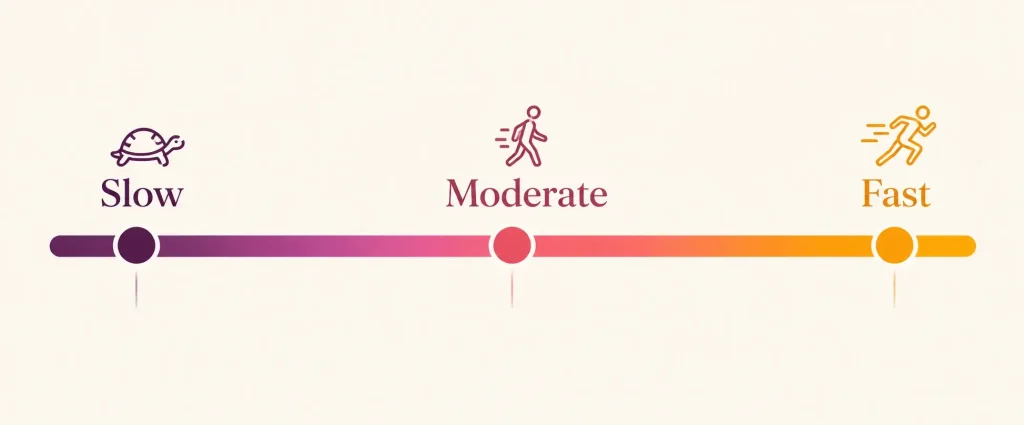
Fast Tempo Markings (Allegro, Presto, Vivace)
Fast markings bring energy, excitement and sometimes a little nervous thrill.
Allegro: fast and cheerful, at roughly 120-156 BPM
Vivace: lively and bright, at roughly 156-176 BPM
Presto: very fast, at roughly 168-200 BPM
Beyond Presto, the term Prestissimo covers anything faster than about 200 BPM. Notice that some ranges overlap, which is why performers often rely on feel as well as numbers.
Indian music has a similar idea. Hindustani classical music describes speed as vilambit (slow), madhya (medium) and drut (fast) laya and a performance often moves between them as it builds.
Scores also use words that signal a change in speed. Accelerando means gradually getting faster, ritardando means gradually slowing down and “a tempo” means returning to the original pace.
How Tempo Is Measured (BPM Explained)
Italian terms give you a feel for speed but BPM gives you an exact number to work with when measuring tempo in music. It stands for beats per minute which is simply how many beats fall within 60 seconds.
At 60 BPM, you get one beat every second, just like a ticking wall clock. At 120 BPM, you get two beats every second which feels like a brisk march. On a score, you may see a note symbol followed by a number, such as a quarter note equals 90. That tells you to play 90 quarter-note beats every minute.
Here’s a quick way to see how BPM maps to feel:
| Speed Zone | Approximate BPM | Typical Feel |
| Slow | Below 76 | Calm, tender, serious |
| Moderate | 76-120 | Relaxed, walking, steady |
| Fast | 120-168 | Lively, energetic |
| Very Fast | 168 & above | Excited, intense |
Want to find the BPM of a favourite song? Tap along to the beat for 15 seconds. Tap along to the beat for 15 seconds, count your taps and multiply by four. It is a surprisingly accurate trick.
How Tempo Affects the Mood and Emotion of a Song
This is where speed gets truly fascinating. The same melody can feel completely different depending on how quickly it moves.
Slow speeds often feel calm, sad, romantic or reflective. Moderate speeds tend to feel warm, comfortable and steady. Lastly, fast speeds usually feel joyful, energetic or tense.
Think of a cheerful pop song covered slowly on acoustic guitar. The words stay the same, but the whole emotional color changes. Many people also find that quicker music lifts their energy during workouts while slower music helps them wind down at night.
That said, speed is only one part of the picture. Instruments, key, rhythm and lyrics all shape how a song feels too. Learning to hear how tempo works alongside these ingredients makes you a more thoughtful listener and performer.

Tempo Vs Rhythm Vs Beat: Understanding the Differences
These three words get mixed up all the time, but each describes something different.
| Term | What It Means | Simple Example |
| Beat | The steady pulse you can tap along to | Your foot tapping in time |
| Tempo | How fast that pulse moves | Slow, medium or fast tapping |
| Rhythm | The pattern of long & short sounds over the beat | The clapping pattern of a well-known chorus |
Here is an easy way to remember it. The beat is the heartbeat, the speed is how fast that heart is racing and the rhythm is the pattern of words and notes dancing on top. You can change one without changing the others, so a song can keep the same rhythm while moving faster.
You may also hear about the time signature which tells you how beats are grouped into bars. It describes structure, not speed.
How to Practice Keeping Tempo While Playing or Singing
Holding a steady tempo in music is one of the most valuable skills any musician can build. The good news is that it improves with simple, regular habits rather than endless hours. Here’s how to start.
Using a Metronome
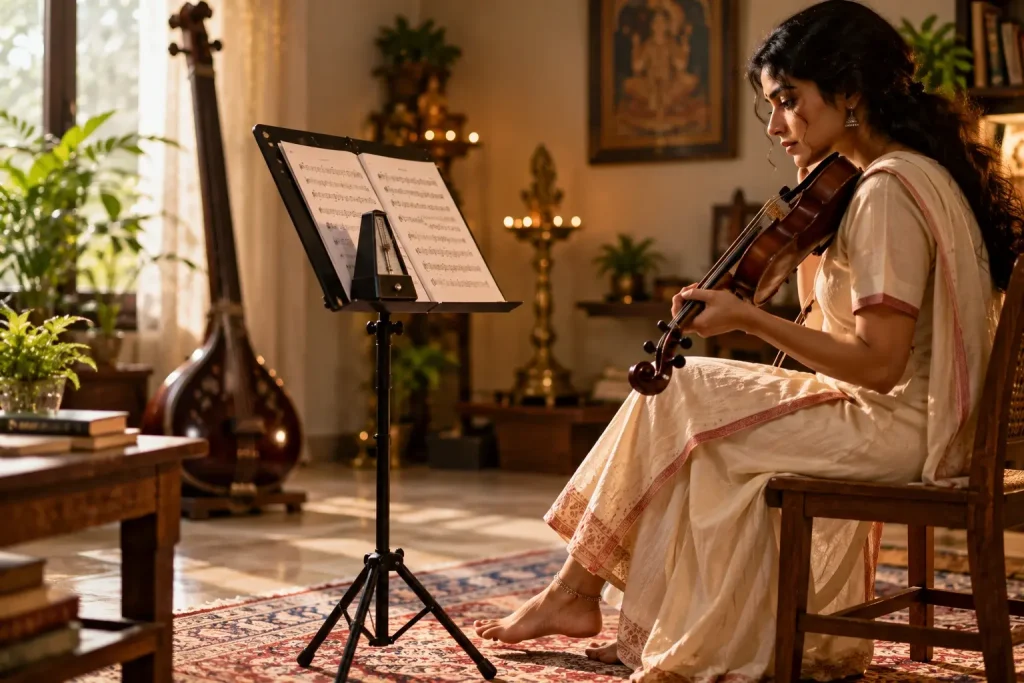
A metronome is a device or app that clicks at a set beats-per-minute rate, giving you an honest, unchanging reference. If you are curious about how it works, we have explained what a metronome is and how it works in detail.
You can also try our free online metronome for practice with adjustable BPM and different click sounds. Here’s a simple routine to follow:
- Start well below your goal speed, so you can play every note cleanly.
- Raise the BPM in small steps, only after several clean runs in a row.
- Tap your foot or nod your head so the beat lives in your body.
- Record yourself and listen back, since rushing and dragging are easier to hear afterward.
- Alternate between practising with and without the click to build your own inner pulse.
Common Tempo Mistakes Beginners Make
Almost every learner runs into the same few hurdles. Spot them early and they are easy to fix:
- Rushing through easy sections and slowing down at tricky ones
- Practicing a new piece at full speed before the notes are secure
- Ignoring rests, which are silent beats that still count
- Never practicing with a click, so timing stays vague
- Chasing speed instead of accuracy.
Remember, playing a piece slowly and cleanly beats playing it fast and messy every single time.
Keep the Beat, Keep the Music Alive
Tempo in music may seem like a small detail, but it is one of the most powerful tools a musician has. It sets the mood, shapes the energy and holds a performance together. Once you understand the markings, BPM and the difference between tempo, rhythm and beat, you will hear every song a little more clearly.
If you would like expert help building a rock-solid sense of timing, Artium Academy is here for you. With over 45,000 learners learning worldwide, we offer live, 1:1 online classes in vocals and instruments, where expert teachers help you practise timing the right way from your very first lesson.
Our music courses are curated by legendary musicians including Sonu Nigam, KS Chithra, Raju Singh, Louiz Banks, Aruna Sairam, Ananth Vaidyanathan and Shubha Mudgal, and come with a globally recognised certification.
Ready to begin your music journey? Book a free trial class and take the first confident step towards playing and singing in perfect time.
Frequently Asked Questions
Tempo is the speed of a piece of music, or how fast its beat moves. It matters because it sets the mood, helps musicians play together, and keeps a performance steady from start to finish.
Tempo is how fast or slow the beat goes. If you can tap your foot to a song, the pace of that tapping is its tempo.
Tempo is commonly grouped into slow (Largo, Adagio), moderate (Andante, Moderato), and fast (Allegro, Vivace, Presto) markings. Each Italian term covers a range of speeds and a typical mood.
BPM counts how many beats occur in one minute. For example, 60 BPM means one beat per second, while 120 BPM means two beats per second.
Roughly speaking, anything below about 76 BPM feels slow, 76 to 120 BPM feels moderate, and above 120 BPM feels fast. These are guidelines, and genres and performers interpret them differently.
Slow speeds often create calm, tender, or sad feelings, while fast speeds usually create excitement and energy. Other elements like key, instruments, and lyrics also shape the final mood.
Metronomes, tap-tempo apps, online metronome tools, backing tracks, and click tracks in recording software all help. Even simple foot tapping builds a reliable sense of pulse.
Yes. Composers use terms like accelerando (gradually faster), ritardando (gradually slower), and “a tempo” (back to the original speed). Many modern songs also change speed between sections.
Beginners often focus so hard on the right notes that their sense of pulse slips. Nerves, rushing through easy parts, and not practising with a click are common causes.
A metronome gives you a steady, unchanging beat to measure yourself against. It shows you exactly when you rush or drag, and lets you raise the speed gradually and safely.